


1 Chronicles 21:13
Bible text: King James Version (1769 Blayney text) · Public domain
Bible text: King James Version with Strong's numbers · Public domain
Bible text: Berean Standard Bible · Public domain
Bible text: American Standard Version (1901) · Public domain
Bible text: World English Bible, Messianic edition · Public domain
Bible text: Geneva Bible (1599) · Public domain
Bible text: Young's Literal Translation · Public domain
- וַיֹּאמֶרvai·Yo·merand he saidH559Conj-w ¦ V-Qal-ConsecImperf-3msVerb Qal Consecutive Imperfect 3rd Singular Masculineוַandיֹּאמֶרhe said
- דָּוִידda·VidDavidH1732N-proper-mNoun Proper Masculine
- אֶל'eltoH413PrepPreposition
- גָּדgadGadH1410N-proper-mNoun Proper Masculine
- צַרtzarit is distressH6862N-csNoun Singular common gender Absolute
- לִיlito mePrep-l ¦ 1csSuffix Personal 1st Singular common genderלִtoיme
- מְאֹדme·'OdexceedinglyH3966Adj-msAdjective Numerical Singular Masculine Absolute
- אֶפְּלָה'e·pe·lahlet me fallH5307V-Qal-Imperf-1csVerb Qal Imperfect 1st Singular common gender
- נָּאna'pleaseH4994PrtParticle Interjection
- בְיַדve·yadin [the] hand ofH3027Prep-b ¦ N-cscNoun Singular common gender Constructבְinיַד[the] hand of
- יְהוָהYah·wehYahwehH3068N-properNoun Proper Title
- כִּיkiforH3588PrtParticle Conditional
- רַבִּיםra·Bim[are] greatH7227Adj-mpAdjective Plural Masculine Absolute
- רַחֲמָיוra·cha·Mavhis compassion<s>H7356N-mpc ¦ 3msNoun Plural Masculine Constructרַחֲמָיcompassion<s>וhis
- מְאֹדme·'OdexceedinglyH3966Adj-msAdjective Numerical Singular Masculine Absolute
- וּבְיַדu·ve·yadand in [the] hand ofH3027Conj-w ¦ Prep-b ¦ N-cscNoun Singular common gender Constructוּandבְinיַד[the] hand of
- אָדָם'a·Dama humanH120N-msNoun Singular Masculine Absolute
- אַל'almay notH408NegParticle Negative
- אֶפֹּל'e·PolI fallH5307V-Qal-Imperf-1csVerb Qal Imperfect 1st Singular common gender
English is a literal word-by-word gloss of the Hebrew, not the KJV's wording. Why?
This is the original text the KJV's translators worked from — each Hebrew word with its own literal English meaning in this verse, prepared by scholars at Tyndale House, Cambridge. The KJV translates whole sentences, not word by word, so its wording differs: one Hebrew word can become several English words, and the KJV may choose “the LORD” where the gloss reads “Yahweh”. Both are faithful — they answer different questions. For the KJV's own rendering, switch to the KJV text.
Details
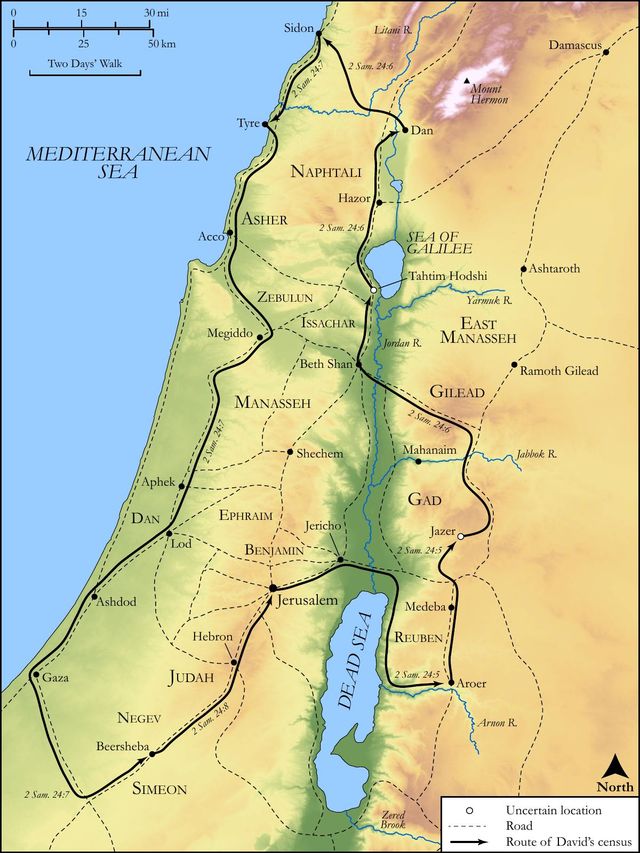
See on the biblical-era map
Study this verse
Public-domain commentary
Matthew Henry
From his Commentary on the Whole Bible. Henry comments on passages, not single verses — this entry covers 1 Chronicles 21:7–17. His two-level outline is real structure in the source text, so it is rendered as structure.
David is here under the rod for numbering the people, that rod of correction which drives out the foolishness that is bound up in the heart, the foolishness of pride. Let us briefly observe,
I.How he was corrected. If God's dearest children do amiss, they must expect to smart for it.
1.He is given to understand that God is displeased; and that it is no small uneasiness to so good a man as David, Ch1 21:7. God takes notice of, and is displeased with, the sins of his people; and no sin is more displeasing to him than pride of heart: nor is anything more humbling, and grieving, and mortifying to a gracious soul, than to see itself under God's displeasure.
2.He is put to his choice whether he will be punished by war, famine, or pestilence; for punished he must be, and by one of these. Thus, for his further humiliation, he is put into a strait, a great strait, and has the terror of all the three judgments impressed upon his mind, no doubt to his great amazement, while he is considering which he shall choose.
3.He hears of 70,000 of his subjects who in a few hours were struck dead by the pestilence, Ch1 21:14. He was proud of the multitude of his people, but divine Justice took a course to make them fewer. Justly is that taken from us, weakened, or embittered to us, which we are proud of. David must have the people numbered: Bring me the number of them, says he, that I may know it. But now God numbers them after another manner, numbers to the sword, Isa 65:12. And David had another number of them brought, more to his confusion than was to his satisfaction, namely, the number of the slain - a black bill of mortality, which is a drawback to his muster-roll.
4.He sees the destroying angel, with his sword drawn against Jerusalem, Ch1 21:16. This could not but be very terrible to him, as it was a visible indication of the anger of Heaven, and threatened the utter destruction of that beloved city. Pestilences make the greatest devastations in the most populous places. The sight of an angel, though coming peaceably and on a friendly errand, has made even mighty men to tremble; how dreadful then must this sight be of an angel with a drawn sword in his hand, a flaming sword, like that of the cherubim, which turned every way to keep the way of the tree of life! While we lie under the wrath of God the holy angels are armed against us, though we see them not as David did.
II.How he bore the correction.
1.He made a very penitent confession of his sin, and prayed earnestly for the pardon of it, Ch1 21:8. Now he owned that he had sinned, had sinned greatly, had done foolishly, very foolishly; and he entreated that, however he might be corrected for it, the iniquity of it might be done away.
2.He accepted the punishment of his iniquity: "Let thy hand be on me, and on my father's house, Ch1 21:17. I submit to the rod, only let me be the sufferer, for I am the sinner; mine is the guilty head at which the sword should be pointed." 3. He cast himself upon the mercy of God (though he knew he was angry with him) and did not entertain any hard thoughts of him. However it be, Let us fall into the hands of the Lord, for his mercies are great, Ch1 21:13. Good men, even when God frowns upon them, think well of him. Though he slay me, yet will I trust in him. 4. He expressed a very tender concern for the people, and it went to his heart to see them plagued for his transgression: These sheep, what have they done?
Continue studying 1 Chronicles 21:13 across the web’s major study libraries — every link below opens this exact verse, chapter, or book on the destination site.
Read & Compare
 BibleGatewayThis verse in more than 200 translations and 70 languages.
 Bible.comThe YouVersion reader — hundreds of translations, reading plans, and highlights.
 ESV.orgCrossway's official English Standard Version reader.
 NET BibleThe NET translation with 60,000+ translators' notes on every rendering decision.
 STEP BibleTyndale House's free study tool — original text, vocabulary, and scholarly resources.
 BibliaLogos Bible Software's free web reader.
 USCCBThe New American Bible (Revised Edition) with the U.S. bishops' study notes.
Commentaries
 BibleHub CommentariesDozens of classic commentaries on this verse, gathered on one page.
 StudyLightMore than 100 commentary sets — the largest collection on the web.
 BibleRefPlain-English commentary on what this verse means, verse by verse.
 Enduring WordDavid Guzik's free commentary on this chapter, widely used by Bible teachers.
 Bible Study ToolsVerse commentary alongside Greek and Hebrew study aids.
Original Language & Research
- BibleHub InterlinearThe verse word by word — original language, transliteration, and English.
- BibleHub LexiconEvery word's original-language definition and Strong's entry.
 Blue Letter BibleDeep-study tools — Strong's numbers, concordance, and word studies.
 SefariaThe Hebrew text with Rashi and centuries of Jewish commentary.
Sermons, Hymns & Audio


TrulyRandomVerse is not affiliated with these sites and doesn’t control their content. They’re linked because they’re genuinely useful.
Summary
In 1 Chronicles 21:13, King David, confronted by the prophet Gad with three options for divine judgment following his unauthorized census of Israel, articulates a profound preference: to submit to the hand of the Lord rather than the hand of man. This pivotal declaration reveals David's deep theological insight into God's character, recognizing His abundant mercy even in the midst of severe discipline. David's choice underscores his immediate and humble repentance, his unwavering trust in the "very great" mercies of God, and his understanding that divine judgment, unlike human retribution, is ultimately rooted in perfect justice, wisdom, and a redemptive purpose.
Context
ShowHideLiterary Context
This verse serves as the climactic response from King David to the divine ultimatum delivered by the prophet Gad, following David's sin of numbering Israel. The narrative in 1 Chronicles 21 commences with Satan inciting David to conduct a census, an act that incurs God's wrath, despite the warning from Joab in 1 Chronicles 21:3. As a consequence, God offers David a choice of three forms of judgment: three years of famine, three months of flight from enemies, or three days of devastating pestilence. David's profound declaration in 1 Chronicles 21:13 is his immediate and decisive reply, setting the stage for the subsequent divine plague and David's intercession at the threshing floor of Ornan, which providentially becomes the chosen site for the future temple, as detailed in 1 Chronicles 22:1. The parallel account found in 2 Samuel 24 corroborates these core events and David's crucial decision.
Historical & Cultural Context
The act of numbering the people in ancient Israel, while sometimes permissible (e.g., for military organization or allocation of resources), became sinful when undertaken out of pride, a reliance on human strength rather than divine provision, or without the prescribed atonement offering, as outlined in Exodus 30:12. David's census, not divinely commanded, appears to have stemmed from a desire to assess his own military might, reflecting a lapse in his trust in God's protection and a display of self-reliance. Among the nations round about, censuses were common for taxation or conscription, but for Israel, a unique theocracy, such actions carried profound spiritual implications. The concept of divine judgment, often manifested through famine, war, or pestilence, was a well-understood consequence of violating the covenant relationship between God and His people. David's deep understanding of God's "mercies" (Hebrew: rachamim) was firmly rooted in the covenantal theology of Israel, where God, though perfectly just, was also renowned for His enduring lovingkindness and profound compassion, a truth repeatedly declared throughout the Law and the Prophets.
Key Themes
ShowHideThis verse powerfully encapsulates several foundational themes central to the book of Chronicles and the broader biblical narrative. Firstly, it vividly illustrates the sovereignty of God over all human affairs, including the consequences of sin, even for a king chosen by divine decree. Secondly, it highlights the authentic nature of true repentance, as David immediately acknowledges his transgression and humbly submits to God's will, rather than attempting to evade the inevitable consequences. Thirdly, and perhaps most profoundly, it unveils the enduring biblical theme of divine mercy in judgment. David's explicit preference for God's hand over man's underscores his conviction that God's justice, even in its most severe forms, is always tempered by compassion and ultimately serves a redemptive purpose. This stands in stark contrast to human judgment, which is often arbitrary, cruel, or lacking in the ultimate transformative goal of divine discipline. This vital theme resonates throughout the Old Testament, from the initial covenant promises to the impassioned prophetic calls for repentance, as eloquently expressed in passages like Psalm 103:8 and Lamentations 3:32.
Exposition and Analysis
ShowHideKey Word Analysis
ShowHideThis word conveys a profound sense of narrowness, distress, anguish, or extreme difficulty. David uses it to describe his agonizing predicament, caught between the severe consequences of his sin and the daunting options for divine judgment. It signifies a situation with no easy escape, a desperate and constricted position where all choices are painful.
This primitive word, used here metaphorically, represents power, authority, agency, and control. David's choice is between falling into the power or dominion of the Lord versus the power or dominion of man. It signifies the source of judgment and the nature of the authority administering it.
This plural noun, derived from the root racham, signifies a deep, visceral compassion, often likened to a mother's tender love for her child. David's declaration that God's mercies are "very great" (KJV: "very great [are] his mercies") expresses his profound conviction that even in God's judgment, His underlying character of tender compassion and pity will prevail, making His sovereign hand infinitely preferable to any human hand.
Verse Breakdown
ShowHide"And David said unto Gad, I am in a great strait:"
David immediately acknowledges the gravity of his situation and the profound distress he feels. His use of "great strait" indicates that he recognizes the severity of his sin and the inescapable nature of divine judgment. There is no attempt to deny culpability, negotiate terms, or evade the impending consequences.
"let me fall now into the hand of the LORD;"
This is David's decisive and pivotal choice. He expresses a clear preference to be disciplined directly by God. This choice is not an act of defiance but rather an expression of profound trust, humility, and theological discernment. He understands that God's judgment, though severe, is always righteous, purposeful, and ultimately redemptive, unlike human judgment which can be arbitrary, vindictive, or purely destructive.
"for very great [are] his mercies:"
This crucial clause provides the theological foundation and rationale for David's choice. His confidence is rooted in his intimate knowledge of God's unchanging character. David knows that God's nature is fundamentally merciful and compassionate. Even in the exercise of His wrath, God remembers mercy (Habakkuk 3:2). This deep conviction enables him to submit to God's hand, believing that divine justice is always tempered by an overwhelming abundance of grace and compassion.
"but let me not fall into the hand of man."
This clause establishes the stark contrast David draws. He implicitly recognizes the inherent limitations, potential cruelty, and lack of ultimate redemptive purpose in human judgment. To fall into the hand of man would mean suffering at the hands of enemies or human authorities whose actions might lack the divine wisdom, perfect justice, and profound compassion that uniquely characterize God's dealings with His people.
Literary Devices
ShowHideThe verse powerfully employs Contrast as its central literary device, setting "the hand of the LORD" against "the hand of man." This stark juxtaposition highlights David's profound theological insight: God's character, even in judgment, is infinitely superior to human character. The phrase "great strait" functions as a potent Metaphor for David's impossible and agonizing predicament, conveying a sense of being trapped with no easy or desirable escape. Furthermore, the repeated use of "hand" serves as Metonymy, where "hand" represents the power, authority, and agency of either God or man. David's choice is a testament to his understanding of God's Mercy, which is presented as "very great," an Emphatic Adjective underscoring the boundless and overwhelming nature of divine compassion even when justice demands punishment.
Theological and Thematic Connections
ShowHideThis verse profoundly articulates a core biblical truth: God's character is fundamentally defined by mercy, even in the exercise of His perfect justice. David's choice reflects a deep theological understanding that God's discipline is never punitive for its own sake but is always redemptive, aimed at correction, purification, and ultimately, restoration. It draws a sharp contrast between the perfect, compassionate, and wise judgment of God and the fallibility, potential cruelty, and limited perspective of human judgment. This truth encourages believers across all generations to always turn to God in genuine repentance, trusting that His ultimate desire is for their good, even when facing the painful consequences of sin. It powerfully reaffirms that God's steadfast love undergirds all His actions, including His discipline, and that His mercies truly are "very great" and unfailing.
Reflection and Application
ShowHideDavid's profound declaration in 1 Chronicles 21:13 serves as a timeless and powerful guide for believers navigating the consequences of their own failings or facing daunting, seemingly impossible circumstances. It calls us to cultivate a radical and unwavering trust in God's character, particularly His boundless mercy, even when His hand brings discipline or severe trials. In moments of "great strait," when we are confronted with the painful repercussions of our choices or the overwhelming challenges of life, David's example urges us to turn directly and humbly to the Lord, rather than seeking fleeting human solutions, attempting to evade responsibility, or succumbing to despair. His preference for God's hand reminds us that divine discipline, though often painful and refining, is always administered with perfect wisdom, absolute justice, and an underlying love that seeks our ultimate good and spiritual restoration. It is a compelling call to humble submission, genuine repentance, and unwavering faith in the "very great" mercies of our Heavenly Father, knowing with certainty that His compassion will never fail.
Questions for Reflection
ShowHideFAQ
ShowHideWhy was David's census a sin, and why did it incur such severe judgment?
ShowHideWhile a census itself was not inherently sinful (as seen in Numbers 1:1-3), David's census in 1 Chronicles 21 was deeply problematic because it was done out of pride and a fundamental lack of trust in God. The text explicitly states that Satan incited David (1 Chronicles 21:1), indicating it was not a divine command but a human initiative driven by a desire to rely on military strength and human numbers rather than on God's protection and provision. It likely reflected a kingly ambition to boast in his own power and resources rather than in the Lord, which was a direct affront to God's covenant with Israel. Furthermore, it may have lacked the proper atonement offering required for a census in Exodus 30:12, which served to acknowledge God's ownership of His people. The severe judgment underscores God's absolute holiness, His intolerance for pride and self-reliance, and the serious consequences of sin, even for His chosen king.
Christ-Centered Fulfillment
ShowHide1 Chronicles 21:13, with David's profound choice to "fall into the hand of the LORD," finds its ultimate and glorious Christ-centered fulfillment in the person and redemptive work of Jesus Christ. David's understanding of God's "very great mercies" serves as a powerful foreshadowing of the supreme demonstration of divine mercy manifested at the cross. While David faced judgment for his own personal sin, humanity's "great strait" is infinitely more profound: the universal stain of sin and its eternal, damning consequences (Romans 3:23 and Romans 6:23). Yet, God, in His immeasurable and unfathomable mercy, chose to allow His own Son to fall into the "hand" of humanity's judgment on the cross. Jesus, the perfect and sinless Lamb of God, willingly submitted to this ultimate suffering, not as a helpless victim of human cruelty, but as the divine sacrifice who takes away the sin of the world (John 1:29). He, the perfect Son, endured the full weight of divine wrath against sin, so that all who believe in Him might not fall into the hand of eternal judgment but instead be welcomed into the hand of God's saving grace and eternal reconciliation (2 Corinthians 5:21). David's trust in God's mercy is fully vindicated and infinitely surpassed in Christ, who is the very embodiment of God's "very great mercies," offering not merely a reprieve from temporal judgment, but eternal life, complete forgiveness, and perfect reconciliation with a holy God (Ephesians 2:4-5).