


1 Chronicles 21:12
- אִם'imwhetherH518PrtParticle Conditional
- שָׁלוֹשׁsha·Lo·oshthreeH7969N-csNoun Singular common gender Absolute
- שָׁנִיםsha·NimyearsH8141N-mpNoun Plural Masculine Absolute
- רָעָבra·'AvfamineH7458N-msNoun Singular Masculine Absolute
- וְאִםve·'imand orH518Conj-w ¦ PrtParticle Conditionalוְandאִםor
- שְׁלֹשָׁהshe·lo·ShahthreeH7969N-csNoun Singular common gender Absolute
- חֳדָשִׁיםcho·da·ShimmonthsH2320N-mpNoun Plural Masculine Absolute
- נִסְפֶּהnis·Pehbeing swept awayH5595V-Niphal-Prtcpl-msVerb Niphal Participle Singular Masculine Absolute
- מִפְּנֵיmi·pe·neifrom beforeH6440Prep-m ¦ N-mpcNoun Plural Masculine Constructמִfromפְּנֵיbefore
- צָרֶיךָtza·rei·Khayour opponentsH6862N-mpc ¦ 2msNoun Plural Masculine Constructצָרֶיopponentsךָyour
- וְחֶרֶבve·Che·revand [the] sword ofH2719Conj-w ¦ N-fscNoun Singular Feminine Constructוְandחֶרֶב[the] sword of
- אוֹיְבֶךָ'oy·Ve·khayour enemiesH341V-Qal-Prtcpl-mp ¦ 2msVerb Qal Participle Plural Masculine Constructאוֹיְבֶenemiesךָyour
- לְמַשֶּׂגֶתle·ma·se·Getto overtaking [you]H5381Prep-l ¦ V-Hiphil-Prtcpl-fsVerb Hiphil Participle Singular Feminine Absoluteלְtoמַשֶּׂגֶתovertaking [you]
- וְאִםve·'imand orH518Conj-w ¦ PrtParticle Conditionalוְandאִםor
- שְׁלֹשֶׁתshe·Lo·shetthreeH7969N-cscNoun Singular common gender Construct
- יָמִיםYa·mimdaysH3117N-mpNoun Plural Masculine Absolute
- חֶרֶבChe·rev[the] sword ofH2719N-fscNoun Singular Feminine Construct
- יְהוָהYah·wehYahwehH3068N-properNoun Proper Title
- וְדֶבֶרve·De·verand pestilenceH1698Conj-w ¦ N-msNoun Singular Masculine Absoluteוְandדֶבֶרpestilence
- בָּאָרֶץba·'A·retzin the landH776Prep-b ¦ N-fsNoun Singular Feminine Absoluteבָּin theאָרֶץland
- וּמַלְאַךְu·mal·'Akhand [the] angel ofH4397Conj-w ¦ N-mscNoun Singular Masculine Constructוּandמַלְאַךְ[the] angel of
- יְהוָהYah·wehYahwehH3068N-properNoun Proper Title
- מַשְׁחִיתmash·ChitdestroyingH7843V-Hiphil-Prtcpl-msVerb Hiphil Participle Singular Masculine Absolute
- בְּכָלbe·kholin allH3605Prep-b ¦ N-mscNoun Singular Masculine Constructבְּinכָלall
- גְּבוּלge·Vul[the] territory ofH1366N-mscNoun Singular Masculine Construct
- יִשְׂרָאֵלYis·ra·'ElIsraelH3478N-properNoun Proper Location
- וְעַתָּהve·'a·Tahand thereforeH6258Conj-w ¦ AdvAdverbוְandעַתָּהtherefore
- רְאֵהre·'EhconsiderH7200V-Qal-Imp-2msVerb Qal Imperative 2nd Singular Masculine
- מָהmahwhat?H4100InterrogPronoun Interrogative
- אָשִׁיב'a·Shivwill I bring backH7725V-Hiphil-Imperf-1csVerb Hiphil Imperfect 1st Singular common gender
- אֶת'et<obj.>H853DirObjMParticle Object Indicator
- שֹׁלְחִיsho·le·Chi[the] [one who] sent meH7971V-Qal-Prtcpl-ms ¦ 1csVerb Qal Participle Singular Masculine Constructשֹׁלְחִ[the] [one who] sentיme
- דָּבָרda·VarwordH1697N-msNoun Singular Masculine Absolute
English is a literal word-by-word gloss of the Hebrew, not the KJV's wording. Why?
This is the original text the KJV's translators worked from — each Hebrew word with its own literal English meaning in this verse, prepared by scholars at Tyndale House, Cambridge. The KJV translates whole sentences, not word by word, so its wording differs: one Hebrew word can become several English words, and the KJV may choose “the LORD” where the gloss reads “Yahweh”. Both are faithful — they answer different questions. For the KJV's own rendering, switch to the KJV text.
Details
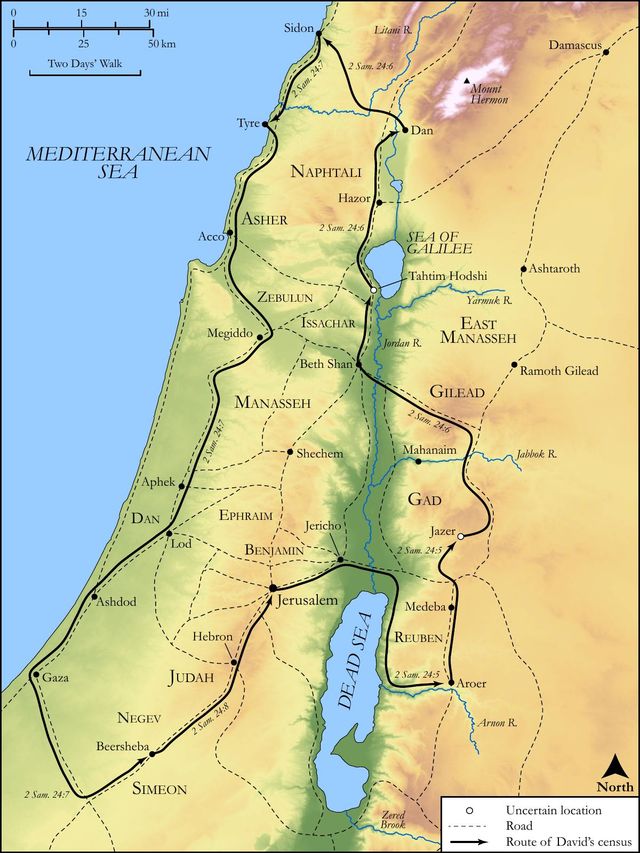
See on the biblical-era map
Study this verse
Public-domain commentary
Matthew Henry
From his Commentary on the Whole Bible. Henry comments on passages, not single verses — this entry covers 1 Chronicles 21:7–17. His two-level outline is real structure in the source text, so it is rendered as structure.
David is here under the rod for numbering the people, that rod of correction which drives out the foolishness that is bound up in the heart, the foolishness of pride. Let us briefly observe,
I.How he was corrected. If God's dearest children do amiss, they must expect to smart for it.
1.He is given to understand that God is displeased; and that it is no small uneasiness to so good a man as David, Ch1 21:7. God takes notice of, and is displeased with, the sins of his people; and no sin is more displeasing to him than pride of heart: nor is anything more humbling, and grieving, and mortifying to a gracious soul, than to see itself under God's displeasure.
2.He is put to his choice whether he will be punished by war, famine, or pestilence; for punished he must be, and by one of these. Thus, for his further humiliation, he is put into a strait, a great strait, and has the terror of all the three judgments impressed upon his mind, no doubt to his great amazement, while he is considering which he shall choose.
3.He hears of 70,000 of his subjects who in a few hours were struck dead by the pestilence, Ch1 21:14. He was proud of the multitude of his people, but divine Justice took a course to make them fewer. Justly is that taken from us, weakened, or embittered to us, which we are proud of. David must have the people numbered: Bring me the number of them, says he, that I may know it. But now God numbers them after another manner, numbers to the sword, Isa 65:12. And David had another number of them brought, more to his confusion than was to his satisfaction, namely, the number of the slain - a black bill of mortality, which is a drawback to his muster-roll.
4.He sees the destroying angel, with his sword drawn against Jerusalem, Ch1 21:16. This could not but be very terrible to him, as it was a visible indication of the anger of Heaven, and threatened the utter destruction of that beloved city. Pestilences make the greatest devastations in the most populous places. The sight of an angel, though coming peaceably and on a friendly errand, has made even mighty men to tremble; how dreadful then must this sight be of an angel with a drawn sword in his hand, a flaming sword, like that of the cherubim, which turned every way to keep the way of the tree of life! While we lie under the wrath of God the holy angels are armed against us, though we see them not as David did.
II.How he bore the correction.
1.He made a very penitent confession of his sin, and prayed earnestly for the pardon of it, Ch1 21:8. Now he owned that he had sinned, had sinned greatly, had done foolishly, very foolishly; and he entreated that, however he might be corrected for it, the iniquity of it might be done away.
2.He accepted the punishment of his iniquity: "Let thy hand be on me, and on my father's house, Ch1 21:17. I submit to the rod, only let me be the sufferer, for I am the sinner; mine is the guilty head at which the sword should be pointed." 3. He cast himself upon the mercy of God (though he knew he was angry with him) and did not entertain any hard thoughts of him. However it be, Let us fall into the hands of the Lord, for his mercies are great, Ch1 21:13. Good men, even when God frowns upon them, think well of him. Though he slay me, yet will I trust in him. 4. He expressed a very tender concern for the people, and it went to his heart to see them plagued for his transgression: These sheep, what have they done?
Historical interpretation
Historical reception
1 surviving comment on this verse from the historical church.
Three years famine: 2 Samuel 24:13 reads "seven years". The apparent discrepency lies in the error in the Hebrew manuscripts. The Greek Septuagint, which is a translation of a much more ancient version, reads "three years famine". (John Litteral) Or it can be explained as that which joined with the three foregoing years of famine mentioned, 2 Samuel 21. and the seventh year of the land's resting, would make up the seven years proposed by the prophet, 2 Samuel 24:13.
Continue studying 1 Chronicles 21:12 across the web’s major study libraries — every link below opens this exact verse, chapter, or book on the destination site.
Read & Compare
 BibleGatewayThis verse in more than 200 translations and 70 languages.
 Bible.comThe YouVersion reader — hundreds of translations, reading plans, and highlights.
 ESV.orgCrossway's official English Standard Version reader.
 NET BibleThe NET translation with 60,000+ translators' notes on every rendering decision.
 STEP BibleTyndale House's free study tool — original text, vocabulary, and scholarly resources.
 BibliaLogos Bible Software's free web reader.
 USCCBThe New American Bible (Revised Edition) with the U.S. bishops' study notes.
Commentaries
 BibleHub CommentariesDozens of classic commentaries on this verse, gathered on one page.
 StudyLightMore than 100 commentary sets — the largest collection on the web.
 BibleRefPlain-English commentary on what this verse means, verse by verse.
 Enduring WordDavid Guzik's free commentary on this chapter, widely used by Bible teachers.
 Bible Study ToolsVerse commentary alongside Greek and Hebrew study aids.
Original Language & Research
- BibleHub InterlinearThe verse word by word — original language, transliteration, and English.
- BibleHub LexiconEvery word's original-language definition and Strong's entry.
 Blue Letter BibleDeep-study tools — Strong's numbers, concordance, and word studies.
 SefariaThe Hebrew text with Rashi and centuries of Jewish commentary.
Sermons, Hymns & Audio


TrulyRandomVerse is not affiliated with these sites and doesn’t control their content. They’re linked because they’re genuinely useful.
Summary
1 Chronicles 21:12 presents King David with a stark and agonizing choice of divine judgment, conveyed through the prophet Gad, as a direct consequence of his unauthorized census of Israel. God offers three distinct and severe punishments: a three-year famine, three months of defeat and destruction by his enemies, or three days of devastating pestilence unleashed by the angel of the Lord across the land. This pivotal verse profoundly underscores the gravity of David's sin, God's absolute sovereignty in executing justice, and the immense responsibility of leadership, compelling David to choose which terrifying message Gad should relay back to the Lord.
Context
ShowHideLiterary Context
This verse serves as the climactic moment of the Lord's judgment pronouncement to King David, delivered by the prophet Gad, following David's egregious sin of numbering Israel (1 Chronicles 21:1-8). The narrative begins with "Satan standing against Israel" and inciting David to conduct a census, an act explicitly condemned by God, likely indicating a reliance on human military strength rather than divine provision or a display of kingly pride. Despite the wise counsel and warnings of Joab, David's commander (1 Chronicles 21:3-6), the king proceeded with the census, leading directly to God's displeasure and the subsequent divine judgment. This immediate context sets the stage for David's agonizing choice, highlighting the direct and severe link between disobedience and its consequences. This account finds a significant parallel in 2 Samuel 24, offering another perspective on the same event. The verses immediately following detail David's ultimate choice and the swift, devastating execution of the pestilence, culminating in David's intercession and the establishment of an altar at the threshing floor of Ornan.
Historical & Cultural Context
The act of numbering the people, while sometimes legitimate, could be viewed as a profound sin in ancient Israel when undertaken without divine command or proper ritual atonement. In this instance, it likely signified a lack of trust in God's ability to provide victory and security, shifting reliance from divine power to human military might. Such an act could also be interpreted as an expression of royal pride, a king boasting in his own strength rather than acknowledging God as the true source of Israel's might. Ancient Israelite law stipulated specific atonement for a census (as seen in Exodus 30:12), which David evidently neglected. The concept of divine judgment through a triad of famine, war, or pestilence was a familiar motif in the ancient Near East and is frequently presented in the Old Testament as the consequences for covenant unfaithfulness, powerfully articulated in the covenant warnings of Leviticus 26 and Deuteronomy 28. As the anointed king, David served as the representative head of the nation, and his sin had corporate ramifications, bringing judgment upon all Israel.
Key Themes
ShowHideThe passage powerfully illustrates the profound consequences of disobedience, demonstrating unequivocally that sin, even by a divinely appointed king, incurs severe divine judgment, impacting not only the individual but the entire community. It underscores God's unwavering justice and sovereignty, revealing His absolute authority over natural phenomena (famine), human conflicts (enemies), and disease (pestilence), and His unwavering commitment to upholding His covenant and moral order. The severity of judgment is starkly presented through the catastrophic options, emphasizing the gravity of David's offense and the holiness of God. Furthermore, the narrative highlights the immense weight of leadership, as David's personal transgression brought potential devastation upon the entire nation, revealing the profound responsibility placed upon those entrusted with authority over God's people. This episode also subtly introduces the theme of divine mercy within judgment, as David is given a choice, and ultimately, God relents from full destruction, demonstrating His compassion even in wrath, as seen in 1 Chronicles 21:15.
Exposition and Analysis
ShowHideKey Word Analysis
ShowHideThis term (H1698) refers to a widespread, deadly epidemic or plague. Derived from a root meaning "to destroy," deber in biblical literature is frequently depicted as a direct instrument of God's wrath or judgment, often appearing alongside famine and sword as a triad of divine punishment (e.g., Jeremiah 21:7). Its inclusion here signifies a supernatural, rapid, and indiscriminate form of death, emphasizing the direct hand of God in the judgment.
This word (H2719) denotes a cutting instrument, specifically a sword, and is associated with destructive effect. In this verse, "sword" appears twice: first, as the instrument of human enemies ("the sword of thine enemies"), and second, as a metaphor for God's direct judgment ("the sword of the LORD"). The latter signifies God's irresistible power to execute judgment, making it a divine weapon of destruction, distinct from human warfare.
This term (H4397) signifies a messenger or deputy, specifically, of God. In the Old Testament, the "angel of the LORD" is a significant theological figure, often understood as a manifestation of God Himself (a theophany or Christophany) or a divine messenger acting with God's full authority. Here, the "angel of the LORD destroying" indicates a direct, personal, and irresistible execution of divine judgment, not merely a natural disaster but a targeted act of supernatural intervention, underscoring the immediate and powerful presence of God's judgment.
Verse Breakdown
ShowHide"Either three years' famine"
This clause presents the first of three options for divine judgment: a prolonged period of widespread scarcity and starvation. Famine was a common and devastating consequence of drought or agricultural failure in the ancient world, often interpreted as a direct sign of divine displeasure due to its direct impact on sustenance and life. The "three years" signifies a significant, enduring period of national suffering.
"or three months to be destroyed before thy foes, while that the sword of thine enemies overtaketh [thee]"
The second option involves military defeat and subjugation by Israel's adversaries. This implies a period of sustained vulnerability, flight, and loss, where the nation would be at the mercy of its enemies. The phrase "the sword of thine enemies overtaketh [thee]" vividly portrays the relentless pursuit and destructive power of human adversaries.
"or else three days the sword of the LORD, even the pestilence, in the land, and the angel of the LORD destroying throughout all the coasts of Israel"
This third, and ultimately chosen, option represents the most intense and direct form of divine judgment. The "three days" indicates a swift, concentrated period of devastation. The "sword of the LORD" is a powerful metaphor for God's direct, irresistible power to execute judgment, specifically through "the pestilence." The explicit mention of "the angel of the LORD destroying throughout all the coasts of Israel" underscores the supernatural, comprehensive, and undeniable nature of this judgment, leaving no doubt about its divine origin and reach across the entire nation.
"Now therefore advise thyself what word I shall bring again to him that sent me"
This concluding phrase emphasizes David's agency and the immense weight of his decision. Gad, as God's faithful messenger, places the burden of choice directly on David, forcing him to confront the immediate and severe consequences of his sin and to determine the specific form of the impending national catastrophe. This highlights the personal responsibility and accountability of leaders before God.
Literary Devices
ShowHideThe verse employs several powerful literary devices to convey the gravity of David's situation and the severity of God's judgment. The most prominent is Triadic Structure, presenting three distinct, equally severe options of judgment (famine, sword of enemies, pestilence). This tripartite arrangement creates a sense of overwhelming choice and inescapable consequence, emphasizing the comprehensive nature of God's punitive power. Metaphor is powerfully evident in "the sword of the LORD," which personifies divine judgment as an irresistible, divinely wielded force, distinct from the literal "sword of thine enemies." The phrase "angel of the LORD destroying" functions as a form of Personification, giving a visible, active agent to the invisible hand of divine wrath and destruction. The stark contrast between the duration of the punishments (three years, three months, three days) creates a sense of Climax or escalation, with the shortest duration (three days) paradoxically representing the most intense, direct, and immediate divine intervention, building tension and emphasizing the swiftness and severity of God's judgment.
Theological and Thematic Connections
ShowHide1 Chronicles 21:12 vividly illustrates the profound truth that sin, particularly by those in leadership, carries severe and far-reaching consequences, extending beyond the individual to impact the entire community. It underscores God's unwavering justice and holiness, demonstrating that He holds even His chosen servants accountable for their actions. The options presented—famine, war, and pestilence—are not arbitrary but represent classic biblical forms of divine judgment, often linked to covenant disobedience, emphasizing God's absolute sovereignty over all aspects of creation and human affairs. David's predicament forces him to confront the direct results of his actions and to acknowledge God's ultimate authority, even in the execution of judgment.
Reflection and Application
ShowHideThis passage serves as a potent reminder of the gravity of sin and the undeniable reality of divine accountability, even for those whom God has highly favored and called to leadership. David's agonizing choice, though born of his transgression, highlights the profound principle that while judgment for sin is certain, God often provides a path for repentance and a demonstration of His mercy even within the context of His justice. For believers today, this narrative calls us to a deeper understanding of the ripple effects of our choices, especially for those in positions of influence within families, churches, or communities. It compels us to examine our hearts for subtle forms of pride, self-reliance, or any act that would diminish our complete trust in God's sovereign provision and power. Furthermore, David's eventual choice to "fall into the hand of the LORD" (1 Chronicles 21:13) teaches us a vital lesson: to trust implicitly in God's character—His great mercies—even when facing the painful consequences of our failures, knowing that His compassion is infinitely greater than any earthly alternative or human solution.
Questions for Reflection
ShowHideFAQ
ShowHideWhy was David's census considered a sin, and why did it bring such severe judgment upon Israel?
ShowHideWhile the biblical text in 1 Chronicles 21 (and its parallel in 2 Samuel 24) does not explicitly state God's precise reason for condemning David's census, biblical scholars generally propose a few compelling reasons. It was likely not the mere act of numbering people itself, but rather the motive behind it or the circumstances under which it was done. Possibilities include:
The severity of the judgment (famine, war, or pestilence) underscores the seriousness with which God views disobedience, especially from His anointed leaders. David's sin, as the head of the nation, had corporate ramifications, bringing judgment upon all Israel, highlighting the principle of corporate responsibility in ancient Israel where the actions of the leader could affect the entire community.
Christ-Centered Fulfillment
ShowHideThe stark choice presented to David in 1 Chronicles 21:12, a direct consequence of his sin, profoundly foreshadows the ultimate choice and sacrifice made by Christ for humanity. David's transgression brought judgment upon the people, requiring a severe reckoning and a choice between three temporal calamities. In profound contrast, Jesus, the perfect Son of David and the promised Messiah, willingly bore the full weight of God's eternal judgment for humanity's sin, enduring the "sword of the LORD" not upon a nation, but upon Himself on the cross (Isaiah 53:5-6). While David faced a terrifying choice of three temporal judgments, Christ became the singular, eternal solution to the problem of sin, taking upon Himself the "pestilence" of sin's curse and the "destruction" of death, thereby delivering us from its power. David's anguish in choosing a judgment for his people highlights the immense burden of leadership and the devastating cost of sin. Yet, Jesus, who knew no sin, chose to become sin for us, so that in Him we might become the righteousness of God (2 Corinthians 5:21). The terrifying "angel of the LORD destroying" who brought death in David's time is ultimately fulfilled and overcome in Christ, who, through His death and resurrection, disarmed the powers of destruction and offers life eternal to all who believe (Colossians 2:15). Thus, what began as a moment of severe judgment for David and Israel points forward to the merciful and complete redemption offered through the Lamb of God, who bore the ultimate judgment on the cross, taking away the sin of the world (John 1:29).