


1 Chronicles 21:16
Bible text: King James Version (1769 Blayney text) · Public domain
Bible text: King James Version with Strong's numbers · Public domain
Bible text: Berean Standard Bible · Public domain
Bible text: American Standard Version (1901) · Public domain
Bible text: World English Bible, Messianic edition · Public domain
Bible text: Geneva Bible (1599) · Public domain
Bible text: Young's Literal Translation · Public domain
- וַיִּשָּׂאvai·yi·Sa'and he lifted upH5375Conj-w ¦ V-Qal-ConsecImperf-3msVerb Qal Consecutive Imperfect 3rd Singular Masculineוַandיִּשָּׂאhe lifted up
- דָוִידda·VidDavidH1732N-proper-mNoun Proper Masculine
- אֶת'et<obj.>H853DirObjMParticle Object Indicator
- עֵינָיו'ei·Navhis eyesH5869N-fdc ¦ 3msNoun Dual Feminine Constructעֵינָיeyesוhis
- וַיַּרְאvai·Yar'and he sawH7200Conj-w ¦ V-Qal-ConsecImperf-3msVerb Qal Consecutive Imperfect 3rd Singular Masculineוַandיַּרְאhe saw
- אֶת'et<obj.>H853DirObjMParticle Object Indicator
- מַלְאַךְmal·'Akh[the] angel ofH4397N-mscNoun Singular Masculine Construct
- יְהוָהYah·wehYahwehH3068N-properNoun Proper Title
- עֹמֵד'o·MedstandingH5975V-Qal-Prtcpl-msVerb Qal Participle Singular Masculine Absolute
- בֵּיןbeinbetweenH996Adj-mscAdjective Numerical Singular Masculine Construct
- הָאָרֶץha·'A·retzthe earthH776Art ¦ N-fsNoun Singular Feminine Absoluteהָtheאָרֶץearth
- וּבֵיןu·Veinand betweenH996Conj-w ¦ Adj-mscAdjective Numerical Singular Masculine Constructוּandבֵיןbetween
- הַשָּׁמַיִםha·sha·Ma·yimthe heavensH8064Art ¦ N-mpNoun Plural Masculine Absoluteהַtheשָּׁמַיִםheavens
- וְחַרְבּוֹve·char·Boand his swordH2719Conj-w ¦ N-fsc ¦ 3msNoun Singular Feminine Constructוְandחַרְבּswordוֹhis
- שְׁלוּפָהshe·lu·FahdrawnH8025V-Qal-PassPrtcpl-fsVerb Qal Participle Passive Singular Feminine Absolute
- בְּיָדוֹbe·ya·Doin his handH3027Prep-b ¦ N-csc ¦ 3msNoun Singular common gender Constructבְּinיָדhandוֹhis
- נְטוּיָהne·tu·Yah[was] stretched outH5186V-Qal-PassPrtcpl-fsVerb Qal Participle Passive Singular Feminine Absolute
- עַל'aloverH5921PrepPreposition
- יְרוּשָׁלִָםye·ru·sha·LimJerusalemH3389N-properNoun Proper Location
- וַיִּפֹּלvai·yi·Poland he fellH5307Conj-w ¦ V-Qal-ConsecImperf-3msVerb Qal Consecutive Imperfect 3rd Singular Masculineוַandיִּפֹּלhe fell
- דָּוִידda·VidDavidH1732N-proper-mNoun Proper Masculine
- וְהַזְּקֵנִיםve·ha·ze·ke·Nimand the eldersH2205Conj-w ¦ Art ¦ Adj-mpAdjective Plural Masculine Absoluteוְandהַtheזְּקֵנִיםelders
- מְכֻסִּיםme·khu·SimcoveredH3680V-Pual-PassPrtcpl-mpVerb Pual Participle Passive Plural Masculine Absolute
- בַּשַּׂקִּיםba·sa·Kimin <the> sackcloth<s>H8242Prep-b ¦ N-mpNoun Plural Masculine Absoluteבַּin <the>שַּׂקִּיםsackcloth<s>
- עַל'alonH5921PrepPreposition
- פְּנֵיהֶםpe·nei·Hemtheir facesH6440N-mpc ¦ 3mpNoun Plural Masculine Constructפְּנֵיfacesהֶםtheir
English is a literal word-by-word gloss of the Hebrew, not the KJV's wording. Why?
This is the original text the KJV's translators worked from — each Hebrew word with its own literal English meaning in this verse, prepared by scholars at Tyndale House, Cambridge. The KJV translates whole sentences, not word by word, so its wording differs: one Hebrew word can become several English words, and the KJV may choose “the LORD” where the gloss reads “Yahweh”. Both are faithful — they answer different questions. For the KJV's own rendering, switch to the KJV text.
Details
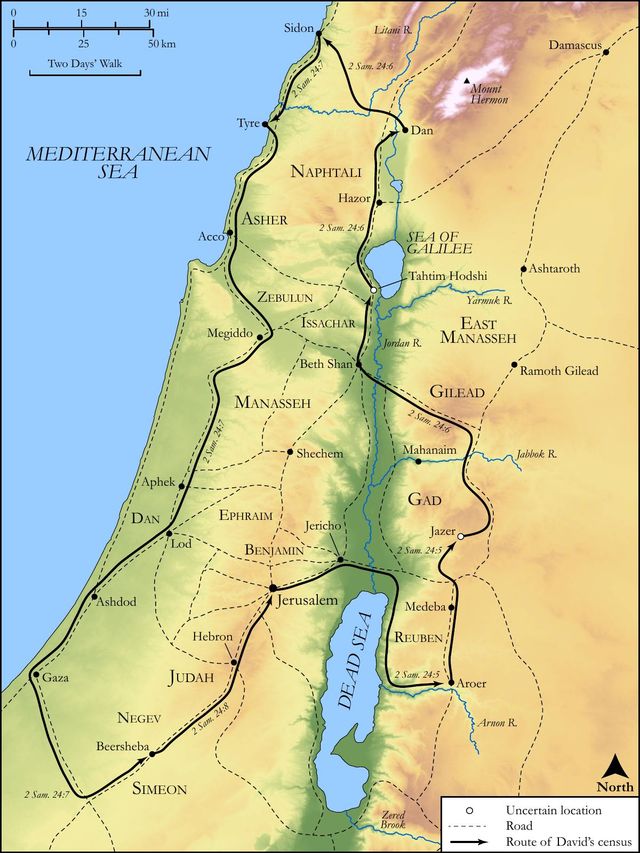
See on the biblical-era map
Study this verse
Public-domain commentary
Matthew Henry
From his Commentary on the Whole Bible. Henry comments on passages, not single verses — this entry covers 1 Chronicles 21:7–17. His two-level outline is real structure in the source text, so it is rendered as structure.
David is here under the rod for numbering the people, that rod of correction which drives out the foolishness that is bound up in the heart, the foolishness of pride. Let us briefly observe,
I.How he was corrected. If God's dearest children do amiss, they must expect to smart for it.
1.He is given to understand that God is displeased; and that it is no small uneasiness to so good a man as David, Ch1 21:7. God takes notice of, and is displeased with, the sins of his people; and no sin is more displeasing to him than pride of heart: nor is anything more humbling, and grieving, and mortifying to a gracious soul, than to see itself under God's displeasure.
2.He is put to his choice whether he will be punished by war, famine, or pestilence; for punished he must be, and by one of these. Thus, for his further humiliation, he is put into a strait, a great strait, and has the terror of all the three judgments impressed upon his mind, no doubt to his great amazement, while he is considering which he shall choose.
3.He hears of 70,000 of his subjects who in a few hours were struck dead by the pestilence, Ch1 21:14. He was proud of the multitude of his people, but divine Justice took a course to make them fewer. Justly is that taken from us, weakened, or embittered to us, which we are proud of. David must have the people numbered: Bring me the number of them, says he, that I may know it. But now God numbers them after another manner, numbers to the sword, Isa 65:12. And David had another number of them brought, more to his confusion than was to his satisfaction, namely, the number of the slain - a black bill of mortality, which is a drawback to his muster-roll.
4.He sees the destroying angel, with his sword drawn against Jerusalem, Ch1 21:16. This could not but be very terrible to him, as it was a visible indication of the anger of Heaven, and threatened the utter destruction of that beloved city. Pestilences make the greatest devastations in the most populous places. The sight of an angel, though coming peaceably and on a friendly errand, has made even mighty men to tremble; how dreadful then must this sight be of an angel with a drawn sword in his hand, a flaming sword, like that of the cherubim, which turned every way to keep the way of the tree of life! While we lie under the wrath of God the holy angels are armed against us, though we see them not as David did.
II.How he bore the correction.
1.He made a very penitent confession of his sin, and prayed earnestly for the pardon of it, Ch1 21:8. Now he owned that he had sinned, had sinned greatly, had done foolishly, very foolishly; and he entreated that, however he might be corrected for it, the iniquity of it might be done away.
2.He accepted the punishment of his iniquity: "Let thy hand be on me, and on my father's house, Ch1 21:17. I submit to the rod, only let me be the sufferer, for I am the sinner; mine is the guilty head at which the sword should be pointed." 3. He cast himself upon the mercy of God (though he knew he was angry with him) and did not entertain any hard thoughts of him. However it be, Let us fall into the hands of the Lord, for his mercies are great, Ch1 21:13. Good men, even when God frowns upon them, think well of him. Though he slay me, yet will I trust in him. 4. He expressed a very tender concern for the people, and it went to his heart to see them plagued for his transgression: These sheep, what have they done?
Continue studying 1 Chronicles 21:16 across the web’s major study libraries — every link below opens this exact verse, chapter, or book on the destination site.
Read & Compare
 BibleGatewayThis verse in more than 200 translations and 70 languages.
 Bible.comThe YouVersion reader — hundreds of translations, reading plans, and highlights.
 ESV.orgCrossway's official English Standard Version reader.
 NET BibleThe NET translation with 60,000+ translators' notes on every rendering decision.
 STEP BibleTyndale House's free study tool — original text, vocabulary, and scholarly resources.
 BibliaLogos Bible Software's free web reader.
 USCCBThe New American Bible (Revised Edition) with the U.S. bishops' study notes.
Commentaries
 BibleHub CommentariesDozens of classic commentaries on this verse, gathered on one page.
 StudyLightMore than 100 commentary sets — the largest collection on the web.
 BibleRefPlain-English commentary on what this verse means, verse by verse.
 Enduring WordDavid Guzik's free commentary on this chapter, widely used by Bible teachers.
 Bible Study ToolsVerse commentary alongside Greek and Hebrew study aids.
Original Language & Research
- BibleHub InterlinearThe verse word by word — original language, transliteration, and English.
- BibleHub LexiconEvery word's original-language definition and Strong's entry.
 Blue Letter BibleDeep-study tools — Strong's numbers, concordance, and word studies.
 SefariaThe Hebrew text with Rashi and centuries of Jewish commentary.
Sermons, Hymns & Audio


TrulyRandomVerse is not affiliated with these sites and doesn’t control their content. They’re linked because they’re genuinely useful.
Summary
1 Chronicles 21:16 vividly portrays a terrifying moment in David's reign, as he and the elders of Israel witness the Angel of the LORD standing poised with a drawn sword over Jerusalem. This chilling manifestation of divine judgment, a direct consequence of David's unauthorized census, underscores the severe repercussions of sin, prompting an immediate and profound act of communal repentance and humility from the king and the nation's leaders, which ultimately sets the stage for God's merciful intervention and the establishment of the future temple site.
Context
ShowHideLiterary Context
This verse marks the terrifying culmination of the narrative in 1 Chronicles 21. The chapter opens with Satan inciting David to conduct a census, an act rooted in pride and a lack of trust in God's covenant faithfulness. Despite the wise counsel of Joab, David proceeds with the numbering, incurring God's severe displeasure, which manifests as a devastating plague upon Israel. Verses 14-15 describe the plague's widespread death and God's command to the Angel of the LORD to cease the destruction. Verse 16 then presents the horrifying visual that elicits David's desperate plea for mercy in 1 Chronicles 21:17, leading to the construction of an altar and the immediate cessation of the plague. The immediate literary flow thus traces a clear progression from sin to divine judgment, followed by sincere repentance, ultimately culminating in God's mercy and the consecration of a sacred space for atonement.
Historical & Cultural Context
David's census, while seemingly a logistical undertaking, was likely perceived as an act of self-reliance, a king's trust in his own military might rather than in the Lord's covenantal protection and provision. In ancient Israel, numbering the people was typically done for military conscription or taxation, and without explicit divine command, it could be interpreted as a king's desire to boast in his own strength, usurping God's prerogative. The concept of divine judgment through widespread plague was a familiar understanding in Israel, as in the plague that followed Korah's rebellion. The cultural practice of wearing "sackcloth" and "falling upon their faces" was a deeply ingrained and universally understood sign of profound mourning, humiliation, and earnest supplication before God. This public display of contrition was intended to avert divine wrath, demonstrating a communal acknowledgment of guilt and a desperate appeal for mercy. Jerusalem, as the newly established capital and spiritual heart of the nation, held immense significance, making the direct threat over it particularly potent and terrifying.
Key Themes
ShowHideThe broader themes woven throughout 1 Chronicles include the centrality of the Davidic covenant, the importance of proper worship, and the preparation for the temple's construction. Within 1 Chronicles 21, this verse powerfully illustrates the gravity of sin and its far-reaching consequences, extending beyond the individual to impact the entire nation. It also illuminates the nature of divine judgment, which is swift and severe when provoked, yet consistently tempered by divine mercy when met with genuine repentance and humility. The appearance of the Angel of the LORD underscores God's direct involvement in human affairs, acting as both an instrument of wrath and a precursor to reconciliation. Finally, the scene sets the stage for the redemptive act of intercession and the establishment of the temple site on the threshing floor of Ornan, linking the experience of judgment to the provision of atonement.
Exposition and Analysis
ShowHideKey Word Analysis
ShowHideFrom an unused root meaning "to despatch as a deputy," this term refers to a messenger, specifically, of God. In the context of the "Angel of the LORD," this figure often embodies a special divine messenger, frequently understood as a theophany or Christophany (a pre-incarnate appearance of Jesus Christ). Here, the Angel is the direct executor of God's judgment, symbolizing God's active and personal involvement in the punishment of David's sin.
Derived from a root meaning "to be dry" or "to lay waste," this word denotes a cutting instrument, specifically a sword. It is a universal and potent symbol of war, judgment, and divine wrath. The sword being "drawn" signifies readiness for action, and its being "stretched out over Jerusalem" emphasizes the immediate, imminent, and grave danger facing the holy city. It represents the instrument of God's destructive power, poised to strike, making the threat palpable and terrifying.
Properly, a mesh, this term refers to coarse, loose cloth or sacking, typically made of goat hair. It was traditionally worn as a sign of mourning, repentance, humiliation, and deep distress. The act of David and the elders clothing themselves in sackcloth immediately conveys the gravity of the situation and their profound contrition, signaling a public and communal act of humility and an earnest appeal for divine intervention.
Verse Breakdown
ShowHide"And David lifted up his eyes, and saw the angel of the LORD stand between the earth and the heaven,"
This opening clause powerfully depicts David's direct and terrifying confrontation with divine judgment. His "lifting up his eyes" suggests an intentional gaze, perhaps in response to an inner conviction or a sudden, overwhelming revelation. The Angel of the LORD's position "between the earth and the heaven" emphasizes his celestial origin and divine authority, bridging the gap between the divine and human realms, making the threat universal and inescapable. This is not a mere vision but a terrifying, tangible reality.
"having a drawn sword in his hand stretched out over Jerusalem."
This phrase concretizes the imminent threat. The "drawn sword" is an unmistakable and ancient symbol of impending judgment and wrath, signifying that the destructive power is ready to be unleashed. Its being "stretched out over Jerusalem" signifies that the holy city itself, the heart of the nation and the dwelling place of God's presence, is the direct target of God's anger. This detail intensifies the horror, as it implies the destruction is poised to strike at the very core of Israel's identity and hope.
"Then David and the elders [of Israel, who were] clothed in sackcloth, fell upon their faces."
This final clause describes the immediate and profound response to the terrifying sight. The collective action of David and the elders, representing the entire nation, signifies corporate repentance and solidarity in their distress. "Clothed in sackcloth" denotes deep mourning, humility, and a public acknowledgment of guilt, while "fell upon their faces" is the ultimate posture of submission, desperation, and worship before a holy God. This act demonstrates their recognition of God's sovereignty, their profound contrition, and their desperate plea for mercy in the face of overwhelming divine wrath.
Literary Devices
ShowHideThe verse employs several powerful Literary Devices to convey its message with striking impact. Imagery is central, with the vivid depiction of the Angel of the LORD suspended between heaven and earth, holding a gleaming, Symbolic "drawn sword" stretched menacingly over Jerusalem. This visual creates an immediate sense of dread and impending doom, making the abstract concept of divine judgment tangible and terrifying. The "drawn sword" itself is a potent Symbol of divine wrath and execution, while the "sackcloth" is a powerful Symbol of repentance, humility, and desperate supplication. The scene is imbued with Dramatic Irony as David, whose prideful act initiated the sin, is now confronted with its terrifying, widespread consequences. The collective response of David and the elders falling on their faces is a powerful act of Pathos, evoking both sympathy and a profound understanding of the overwhelming nature of God's power and the appropriate human response to divine holiness and wrath.
Theological and Thematic Connections
ShowHide1 Chronicles 21:16 serves as a profound theological statement on the nature of God, the devastating consequences of sin, and the divinely ordained path to reconciliation. It reveals God as both perfectly just, requiring accountability for human transgression, and immensely merciful, willing to relent from judgment when met with genuine repentance. The terrifying vision of the Angel of the LORD with a drawn sword underscores the severity of divine wrath, demonstrating that God's holiness demands a response to human sin. Yet, David and the elders' immediate, humble response of falling on their faces in sackcloth highlights the efficacy of sincere repentance and intercession in averting judgment. This pivotal moment marks a crucial turning point, moving from the manifestation of God's anger to the opportunity for atonement and the establishment of a sacred space. It ultimately points to God's ultimate desire for restoration and reconciliation rather than utter destruction.
Reflection and Application
ShowHideThe scene in 1 Chronicles 21:16 is a stark and sobering reminder of the profound seriousness of sin and its far-reaching, often devastating, consequences. David's act of pride and self-reliance, though seemingly a minor administrative decision, brought a widespread plague upon his people, powerfully illustrating that our actions, especially those of leaders, can have ripple effects that extend far beyond ourselves, impacting communities and even nations. This passage compels us to deeply consider our own tendencies toward pride and self-reliance, prompting us to ask whether we truly trust in God's sovereign provision and power, or if we subtly rely on our own strength, wisdom, or resources. The immediate and humble response of David and the elders—donning sackcloth and falling on their faces—provides a powerful and timeless model for genuine repentance. It teaches us that when confronted with the undeniable reality of our sin and the overwhelming holiness of God, the appropriate response is not defiance, despair, or rationalization, but profound humility, sorrow, and an earnest, desperate turning to God for mercy. This act of corporate repentance further underscores the importance of communal confession and the transformative power of intercession, reminding us that God is always ready to show compassion and extend grace to those who humble themselves before Him in sincere contrition.
Questions for Reflection
ShowHideFAQ
ShowHideWhat is the significance of the "Angel of the LORD" in this passage?
ShowHideThe "Angel of the LORD" (Hebrew: mal'akh Yahweh) is a crucial and distinct figure in the Old Testament, often understood by scholars not merely as an ordinary angelic being, but as a special divine messenger who embodies God's presence. In many instances, this figure is interpreted as a theophany—a visible manifestation of God Himself—or even a Christophany, a pre-incarnate appearance of Jesus Christ. Here in 1 Chronicles 21:16, the Angel is not simply delivering a message but is actively executing God's judgment, serving as the direct instrument of the plague. His formidable presence underscores the direct, personal, and terrifying nature of God's wrath against David's sin and the nation. The Angel's role as the executor of judgment highlights God's sovereign control over life and death, and His immediate, active involvement in human affairs, demonstrating that the plague was a direct divine consequence, not a random or natural disaster.
Christ-Centered Fulfillment
ShowHideThe terrifying vision of the Angel of the LORD with a drawn sword poised over Jerusalem, a stark symbol of divine judgment for sin, finds its ultimate Christ-centered fulfillment in the person and redemptive work of Jesus Christ. The "Angel of the LORD" himself, often considered a pre-incarnate manifestation of Christ, powerfully foreshadows the one who would ultimately stand between God's righteous wrath and a sinful humanity. While the sword of judgment was stretched over Jerusalem in 1 Chronicles 21, Christ, as the true Lamb of God, willingly stepped into the path of that very sword. On the cross, Jesus bore the full weight of God's righteous judgment against sin, becoming the ultimate, once-for-all sacrifice that effectively turned away the divine wrath that humanity deserved (Romans 3:25). He is the one who, through His atoning death, disarmed the spiritual forces of evil and made peace through the blood of His cross (Colossians 2:14-15). Thus, the judgment averted by David's repentance and sacrifice on the threshing floor of Ornan, which providentially became the site of the future temple, ultimately points to Christ's perfect, substitutionary sacrifice. This sacrifice permanently removes the sword of God's wrath from those who believe, offering eternal reconciliation and unfettered access to God's presence (Romans 5:8-10). He is the true and eternal intercessor, whose perfect plea and sacrifice far surpass David's, securing not just temporary reprieve but everlasting salvation for all who trust in Him (Hebrews 7:25).