


Exodus 3:2
Bible text: King James Version (1769 Blayney text) · Public domain
Bible text: King James Version with Strong's numbers · Public domain
Bible text: Berean Standard Bible · Public domain
Bible text: American Standard Version (1901) · Public domain
Bible text: World English Bible, Messianic edition · Public domain
Bible text: Geneva Bible (1599) · Public domain
Bible text: Young's Literal Translation · Public domain
- וַיֵּרָאVai·ye·ra'and he appearedH7200Conj-w ¦ V-Niphal-ConsecImperf-3msVerb Niphal Consecutive Imperfect 3rd Singular Masculineוַandיֵּרָאhe appeared
- מַלְאַךְmal·'Akh[the] angel ofH4397N-mscNoun Singular Masculine Construct
- יְהֹוָהYah·wehYahwehH3068N-properNoun Proper Title
- אֵלָיו'e·Lavto himH413Prep ¦ 3msPreposition Definiteאֵלָיtoוhim
- בְּלַבַּתbe·la·batin a flame ofH3827Prep-b ¦ N-fscNoun Singular Feminine Constructבְּinלַבַּתa flame of
- אֵשׁ'eshfireH784N-csNoun Singular common gender Absolute
- מִתּוֹךְmi·Tokhfrom [the] middle ofH8432Prep-m ¦ N-mscNoun Singular Masculine Constructמִfromתּוֹךְ[the] middle of
- הַסְּנֶהha·se·Nehthe bushH5572Art ¦ N-msNoun Singular Masculine Absoluteהַtheסְּנֶהbush
- וַיַּרְאvai·Yar'and he sawH7200Conj-w ¦ V-Qal-ConsecImperf-3msVerb Qal Consecutive Imperfect 3rd Singular Masculineוַandיַּרְאhe saw
- וְהִנֵּהve·hi·Nehand there!H2009Conj-w ¦ PrtParticle Interjectionוְandהִנֵּהthere!
- הַסְּנֶהha·se·Nehthe bushH5572Art ¦ N-msNoun Singular Masculine Absoluteהַtheסְּנֶהbush
- בֹּעֵרbo·'Er[was] burningH1197V-Qal-Prtcpl-msVerb Qal Participle Singular Masculine Absolute
- בָּאֵשׁba·'Eshwith <the> fireH784Prep-b ¦ N-csNoun Singular common gender Absoluteבָּwith <the>אֵשׁfire
- וְהַסְּנֶהve·ha·se·Nehand the bushH5572Conj-w ¦ Art ¦ N-msNoun Singular Masculine Absoluteוְandהַtheסְּנֶהbush
- אֵינֶנּוּ'ei·Ne·nunot itH369N-msc ¦ 3msNoun Singular Masculine Constructאֵינֶnotנּוּit
- אֻכָּל'u·Kal[was] consumedH398V-Pual-PassPrtcpl-msVerb Pual Participle Passive Singular Masculine Absolute
English is a literal word-by-word gloss of the Hebrew, not the KJV's wording. Why?
This is the original text the KJV's translators worked from — each Hebrew word with its own literal English meaning in this verse, prepared by scholars at Tyndale House, Cambridge. The KJV translates whole sentences, not word by word, so its wording differs: one Hebrew word can become several English words, and the KJV may choose “the LORD” where the gloss reads “Yahweh”. Both are faithful — they answer different questions. For the KJV's own rendering, switch to the KJV text.
Details
See on the biblical-era maps

Study this verse
Public-domain commentary
Matthew Henry
From his Commentary on the Whole Bible. Henry comments on passages, not single verses — this entry covers Exodus 3:1–6. His four-level outline is real structure in the source text, so it is rendered as structure.
The years of the life of Moses are remarkably divided into three forties: the first forty he spent as a prince in Pharaoh's court, the second a shepherd in Midian, the third a king in Jeshurun; so changeable is the life of men, especially the life of good men. He had now finished his second forty, when he received his commission to bring Israel out of Egypt. Note, Sometimes it is long before God calls his servants out of that work which of old he designed them for, and has been graciously preparing them for. Moses was born to be Israel's deliverer, and yet not a word is said of it to him till he is eighty years of age. Now obverve,
I.How this appearance of God to him found him employed.
He was keeping the flock (tending sheep) near mount Horeb, Exo 3:1. This was a poor employment for a man of his parts and education, yet he rests satisfied with it, and thus learns meekness and contentment to a high degree, for which he is more celebrated in sacred writ than for all his other learning. Note,
1.In the calling to which we are called we should abide, and not be given to change.
2.Even those that are qualified for great employments and services must not think it strange if they be confined to obscurity; it was the lot of Moses before them, who foresaw nothing to the contrary but that he should die, as he had lived a great while, a poor despicable shepherd. Let those that think themselves buried alive be content to shine like lamps in their sepulchres, and wait till God's time come for setting them on a candlestick. Thus employed Moses was, when he was honoured with this vision. Note,
(1.)God will encourage industry. The shepherds were keeping their flocks when they received the tidings of our Saviour's birth, Luk 2:8. Satan loves to find us idle; God is well pleased when he find us employed.
(2.)Retirement is a good friend to our communion with God. When we are alone, the Father is with us. Moses saw more of God in a desert than ever he had seen in Pharaoh's court.
II.What the appearance was.
To his great surprise he saw a bush burning, when he perceived no fire either from earth or heaven to kindle it, and, which was more strange, it did not consume, Exo 3:2. It was an angel of the Lord that appeared to him; some think, a created angel, who speaks in the language of him that sent him; others, the second person, the angel of the covenant, who is himself Jehovah. It was an extraordinary manifestation of the divine presence and glory; what was visible was produced by the ministry of an angel, but he heard God in it speaking to him.
1.He saw a flame of fire; for our God is a consuming fire. When Israel's deliverance out of Egypt was promised to Abraham, he saw a burning lamp, which signified the light of joy which that deliverance should cause (Gen 15:17); but now it shines brighter, as a flame of fire, for God in that deliverance brought terror and destruction to his enemies, light and heat to his people, and displayed his glory before all. See Isa 10:17.
2.This fire was not in a tall and stately cedar, but in a bush, a thorny bush, so the word signifies; for God chooses the weak and despised things of the world (such as Moses, now a poor shepherd), with them to confound the wise; he delights to beautify and crown the humble.
3.The bush burned, and yet was not consumed, an emblem of the church now in bondage in Egypt, burning in the brick-kilns, yet not consumed; perplexed, but not in despair; cast down, but not destroyed.
III.The curiosity Moses had to enquire into this extraordinary sight:
I will turn aside and see, Exo 3:3. He speaks as one inquisitive and bold in his enquiry; whatever it was, he would, if possible, know the meaning of it. Note, Things revealed belong to us, and we ought diligently to enquire into them.
IV.The invitation he had to draw near, yet with a caution not to come too near, nor rashly.
1.God gave him a gracious call, to which he returned a ready answer, Exo 3:4. When God saw that he took notice of the burning bush, and turned aside to see it, and left his business to attend it, then God called to him. If he had carelessly neglected it as an ignis fatuus - a deceiving meteor, a thing not worth taking notice of, it is probable that God would have departed, and said nothing to him; but, when he turned aside, God called to him. Note, Those that would have communion with God must attend upon him, and approach to him, in those ordinances wherein he is pleased to manifest himself, and his power and glory, though it be in a bush; they must come to the treasure, though in an earthen vessel. Those that seek God diligently shall find him, and find him their bountiful rewarder. Draw nigh to God, and he will draw nigh to you. God called him by name, Moses, Moses. This which he heard could not but surprise him much more than what he saw. The word of the Lord always went along with the glory of the Lord, for every divine vision was designed for divine revelation, Job 4:16, etc.; Job 32:14-15. Divine calls are then effectual,
(1.)When the Spirit of God makes them particular, and calls us by name. The word calls, Ho, every one! The Spirit, by the application of that, calls, Ho, such a one! I know thee by name, Exo 33:12.
(2.)When we return an obedient answer to them, as Moses here, "Here am I, what saith my Lord unto his servant? Here am I, not only to hear what is said, but to do what I am bidden."
2.God gave him a needful caution against rashness and irreverence in his approach,
(1.)He must keep his distance; draw near, but not too near; so near as to hear, but not so near as to pry. His conscience must be satisfied, but not his curiosity; and care must be taken that familiarity do not breed contempt. Note, In all our approaches to God, we ought to be deeply affected with the infinite distance there is between us and God, Ecc 5:2. Or this may be taken as proper to the Old Testament dispensation, which was a dispensation of darkness, bondage, and terror, from which the gospel happily frees us, giving us boldness to enter into the holiest, and inviting us to draw near.
(2.)He must express his reverence, and his readiness to obey: Put off thy shoes from off thy feet, as a servant. Putting off the shoe was then what putting off the hat is now, a token of respect and submission. "The ground, for the present, is holy ground, made so by this special manifestation of the divine presence, during the continuance of which it must retain this character; therefore tread not on that ground with soiled shoes." Keep thy foot, Ecc 5:1. Note, We ought to approach to God with a solemn pause and preparation; and, though bodily exercise alone profits little, yet we ought to glorify God with our bodies, and to express our inward reverence by a grave and reverent behaviour in the worship of God, carefully avoiding everything that looks light, and rude, and unbecoming the awfulness of the service.
V.The solemn declaration God made of his name, by which he would be known to Moses: I am the God of thy father, Exo 3:6.
1.He lets him know that it is God who speaks to him, to engage his reverence and attention, his faith and obedience; for this is enough to command all these: I am the Lord. Let us always hear the word as the word of God, Th1 2:13.
2.He will be known as the God of his father, his pious father Amram, and the God of Abraham, Isaac, and Jacob, his ancestors, and the ancestors of all Israel, for whom God was now about to appear. By this God designed,
(1.)To instruct Moses in the knowledge of another world, and to strengthen his belief of a future state. Thus it is interpreted by our Lord Jesus, the best expositor of scripture, who from this proves that the dead are raised, against the Sadducees. Moses, says he, showed it at the bush (Luk 20:37), that is, God there showed it to him, and in him to us, Mat 22:31, etc. Abraham was dead, and yet God is the God of Abraham; therefore Abraham's soul lives, to which God stands in relation; and, to make his soul completely happy, his body must live again in due time. This promise made unto the fathers, that God would be their God, must include a future happiness; for he never did anything for them in this world sufficient to answer to the vast extent and compass of that great word, but, having prepared for them a city, he is not ashamed to be called their God, Heb 11:16; and see Act 26:6, Act 26:7; Act 24:15.
(2.)To assure Moses of the fulfillment of all those particular promises made to the fathers. He may confidently expect this, for by these words it appears that God remembered his covenant, Exo 2:24. Note,
[1.]God's covenant-relation to us as our God is the best support in the worst of times, and a great encouragement to our faith in particular promises.
[2.]When we are conscious to ourselves of our own great unworthiness we may take comfort from God's relation to our fathers, Ch2 20:6.
VI.The solemn impression this made upon Moses:
He hid his face, as one both ashamed and afraid to look upon God. Now that he knew it was a divine light his eyes were dazzled with it; he was not afraid of a burning bush till he perceived that God was in it. Yea, though God called himself the God of his father, and a God in covenant with him, yet he was afraid. Note,
1.The more we see of God the more cause we shall see to worship him with reverence and godly fear.
2.Even the manifestations of God's grace and covenant-love should increase our humble reverence of him.
Historical interpretation
Sixteen Centuries of Reception
10 surviving comments on this verse. Each one is dated, so this reads as a timeline rather than a list.
Select a marker to jump to its quote. Markers stagger vertically where authors wrote within a few decades of each other.
When the almighty Lord of the universe began to legislate through the Word and decided to make his power visible to Moses, he sent Moses a divine vision with the appearance of light, in the burning bush. Now a bramble bush is full of thorns. So too when the Word was concluding his legislation and his stay among men as their Lord, again he permitted himself to be crowned with thorns as a mystic symbol. Returning to the place from which he had descended, the Word renewed that by which he had first come, appearing first in the bush of thorns and later being surrounded with thorns that he might show that all was the work of the same one power. He is one, and his Father is one, the eternal beginning and end.
And when an angel appears to Moses, Holy Scripture also makes it plain, saying, “The angel of the Lord appeared to him in a flame of fire in a bush.” But when it refers to the actual being who replies, it calls him God and Lord and no longer an angel. It is equally clear in its distinction between the angel and the Lord in the account of what happened at the Red Sea.
The vision and the voice are in the one place, nor is anyone else heard except the one who is seen. He who is an angel of God when he is seen is the same one who is the Lord when he is heard, but he himself who is the Lord when he is heard is recognized as the God of Abraham, Isaac and Jacob. When he is called the angel of God, it is revealed that this is not his true nature and that he is not alone, for he is the angel of God. When he is called the Lord and God, he is proclaimed as possessing the glory and name of his own nature. Accordingly you have in an angel who appeared in the bush him who is also the Lord and God.
The bush which was unsuitable even as an image of dead gods was able to depict within itself the mystery of the living God. Moses, this is a sign to you: as you saw God dwelling in the midst of fire, by fire must you serve the God who dwells in the fire.
What does this mean? The vision that is said to have appeared to Moses in the desert is sometimes called an angel, sometimes the Lord. It means this: he is called angel when he served by speaking externally, and Lord, because he ruled within and produced the conditions needed for speaking. For when the speaker is ruled from within, he is called both angel because of his service and Lord because of his inspiration. Exposition of the Old and New Testament, Exodus
It was the Word, breathed from the Father’s mouth,
Who of the Virgin took a mortal frame.
The human form that not yet in the flesh
Appeared to Moses wore a brow like ours,
Since God, who would by power of the Word
Assume a body, made the face the same.
Flames rose and seemed to burn the thorny bush.
God moved amid the branches set with spines,
And tresses of the flames swayed harmlessly,
That he might shadow forth his Son’s descent
Into our thorny members sin infests
With teeming briers and fills with bitter woes.
For tainted at its root that noxious shrub
Had sprouted from its baneful sap a crop
Of evil shoots beset with many thorns.
The sterile branches suddenly grew bright
As God enkindled with his mighty power
The leafy boughs, nor harmed the tangled briers.
He touched the scarlet berries, blood-red fruits,
And grazed the twigs that grew from deadly wood,
Shed by the tortured bush with cruel pangs.
And here he is first called the angel of the Lord and then God. Is the angel then the God of Abraham, the God of Isaac and the God of Jacob? Therefore he may be rightly understood to be the Savior himself of whom the apostle says, “Whose are the fathers, and from whom is Christ according to the flesh, who is over all things, God blessed forever.” Hence even here he, who is the God blessed over all things forever, is not unreasonably understood to be himself the God of Abraham, the God of Isaac and the God of Jacob. But why was he previously called the angel of the Lord when he appeared in the flame of fire from the bush? Was it because he was one of many angels but by a dispensation represented the person of his Lord? Or was something belonging to a creature assumed which might appear visibly for the task at hand and from which words might be uttered in an audible way, whereby the presence of the Lord would also become known to the bodily senses of man, as circumstances required, by means of a creature made subject to him? For if he was one of the angels, who can readily affirm whether the person given him to announce was that of the Son, or of the Holy Spirit, or of God the Father or of the Trinity itself altogether, who is the one and only God, in order that he might say, “I am the God of Abraham, the God of Isaac and the God of Jacob”?For we cannot say that the God of Abraham, the God of Isaac and the God of Jacob is the Son of God and not the Father. Nor will anyone dare to deny that either the Holy Spirit or the Trinity itself, which we believe and understand to be the one God, is the God of Abraham, the God of Isaac and the God of Jacob. For he who is not God is not the God of those fathers. Moreover … not only the Father is God, as all, even the heretics, admit, but the Son also, which willingly or not they are forced to confess, for the apostle says, “who is, over all things, God blessed forever,” and the Holy Spirit as well. The same apostle declares, “Therefore glorify God in your body,” when he had previously stated, “Do you not know that your bodies are the temple of the Holy Spirit in you, whom you have from God?” And these three are one God, as the sound Catholic faith believes. It is not sufficiently clear which person in the Trinity that angel represented, assuming that he was one of the rest of the angels, and whether it was any person and not that of the Trinity itself.
It was not without reason, beloved brethren, nor without the signification of some mystery that there was a flame in the bush: “And the bush was not consumed.” Indeed, the bush was a genus of thorns. What the earth has produced for sinful man cannot be put in any kind of praise, for it was first said to man when he sinned: “Thorns and thistles shall the earth bring forth to you.” The fact that the bush was not burned, that is, was not seized by the flames, is understood to signify no good. In the flame is recognized the Holy Ghost; in the bush and thorns is represented the hard, haughty Jewish people.
What does this mean? The vision that is said to have appeared to Moses in the desert is sometimes called an angel, sometimes the Lord. It means this: he is called angel when he served by speaking externally, and Lord, because he ruled within and produced the conditions needed for speaking. For when the speaker is ruled from within, he is called both angel because of his service and Lord because of his inspiration.
The Lord appeared: That is, an angel representing God, and speaking in his name.
Continue studying Exodus 3:2 across the web’s major study libraries — every link below opens this exact verse, chapter, or book on the destination site.
Read & Compare
 BibleGatewayThis verse in more than 200 translations and 70 languages.
 Bible.comThe YouVersion reader — hundreds of translations, reading plans, and highlights.
 ESV.orgCrossway's official English Standard Version reader.
 NET BibleThe NET translation with 60,000+ translators' notes on every rendering decision.
 STEP BibleTyndale House's free study tool — original text, vocabulary, and scholarly resources.
 BibliaLogos Bible Software's free web reader.
 USCCBThe New American Bible (Revised Edition) with the U.S. bishops' study notes.
Commentaries
 BibleHub CommentariesDozens of classic commentaries on this verse, gathered on one page.
 StudyLightMore than 100 commentary sets — the largest collection on the web.
 BibleRefPlain-English commentary on what this verse means, verse by verse.
 Enduring WordDavid Guzik's free commentary on this chapter, widely used by Bible teachers.
 Bible Study ToolsVerse commentary alongside Greek and Hebrew study aids.
Original Language & Research
- BibleHub InterlinearThe verse word by word — original language, transliteration, and English.
- BibleHub LexiconEvery word's original-language definition and Strong's entry.
 Blue Letter BibleDeep-study tools — Strong's numbers, concordance, and word studies.
 SefariaThe Hebrew text with Rashi and centuries of Jewish commentary.
Sermons, Hymns & Audio


TrulyRandomVerse is not affiliated with these sites and doesn’t control their content. They’re linked because they’re genuinely useful.
Summary
Exodus 3:2 presents the dramatic and pivotal moment of God's self-revelation to Moses in the wilderness, where "the angel of the LORD appeared unto him in a flame of fire out of the midst of a bush: and he looked, and, behold, the bush burned with fire, and the bush [was] not consumed." This supernatural event, defying the laws of nature, served as the divine summons for Moses to embark on his prophetic mission to lead the Israelites out of Egyptian bondage, initiating a transformative chapter in the history of salvation and the unfolding of God's covenantal promises.
Context
ShowHideLiterary Context
This verse serves as the narrative climax of the preceding chapters, transitioning from Moses' early life and flight from Egypt in Exodus 2 to his divine commission. Having spent forty years as a shepherd in Midian, far removed from the grandeur of Pharaoh's court, Moses is tending his father-in-law Jethro's flock. The narrative carefully sets the scene, placing Moses in a seemingly mundane pastoral setting near Mount Horeb (also known as Mount Sinai), which will later become the sacred site for the giving of the Law. The sudden, miraculous appearance of the burning bush interrupts this ordinary routine, signaling an extraordinary divine intervention that will fundamentally reorient Moses' life and the destiny of the Israelite people. The verses immediately following Exodus 3:2 detail God's direct address to Moses, His identification as the God of Abraham, Isaac, and Jacob, and His declaration of intent to deliver Israel from oppression, setting the stage for the entire Exodus narrative.
Historical & Cultural Context
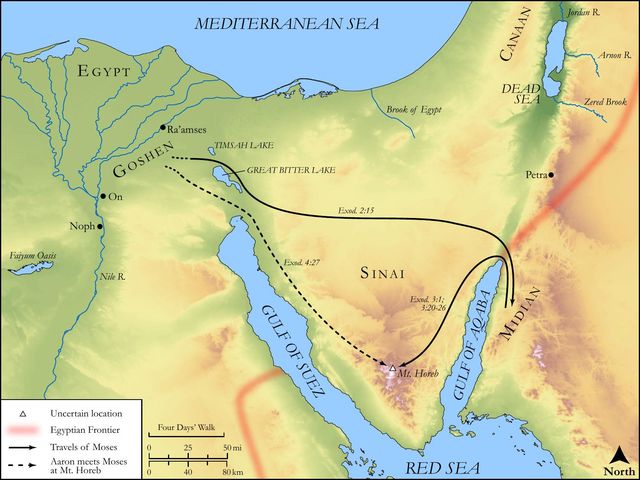
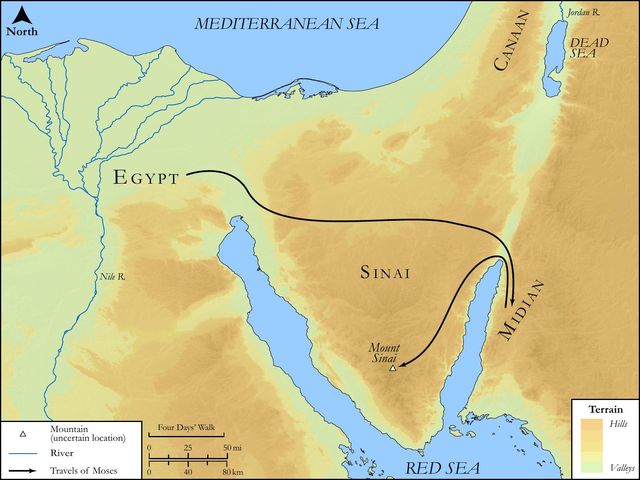
Moses' flight from Egypt (Exodus 2:15) placed him in Midian, a region east of the Gulf of Aqaba, inhabited by nomadic tribes. His occupation as a shepherd was humble, a stark contrast to his upbringing in Pharaoh's palace. The location, "the backside of the desert" near "the mountain of God, even to Horeb" (Exodus 3:1), is significant. Mount Horeb (Sinai) was already considered sacred, a place where God had previously manifested or would do so. The cultural understanding of divine encounters often involved fire, storms, or other natural phenomena, but the unconsumed bush would have been uniquely perplexing and attention-grabbing, demanding a response from Moses. For the enslaved Israelites in Egypt, this encounter marks God's remembrance of His covenant with their forefathers (Exodus 2:24-25), signaling the imminent fulfillment of ancient promises.
Key Themes
ShowHideExodus 3:2 introduces several foundational themes that resonate throughout the book of Exodus and the entire biblical narrative. Foremost is the theme of Divine Initiative and Revelation, as God sovereignly chooses the time and manner of His self-disclosure, initiating contact with humanity. This is a profound theophany, a visible manifestation of God's presence, underscoring His active involvement in human history. The Holiness of God is immediately apparent through the miraculous fire and the subsequent command for Moses to remove his sandals (Exodus 3:5). The paradox of the unconsumed bush highlights God's Sustaining Power and His ability to dwell among His creation without destroying it, a theme that will be crucial as Israel journeys through the wilderness. Furthermore, this verse marks the beginning of God's Call to Leadership, demonstrating that God often chooses unlikely individuals in humble circumstances to accomplish His grand purposes, as seen in Moses' transformation from a shepherd to a deliverer.
Exposition and Analysis
ShowHideKey Word Analysis
ShowHideThis term (H4397) derives from an unused root meaning "to despatch as a deputy." It refers to a messenger, specifically, of God. While it can denote a created angelic being, in numerous Old Testament contexts, particularly when associated with "of the LORD" (YHWH), it signifies a direct, visible manifestation of God Himself, a pre-incarnate appearance of the Son of God. The subsequent dialogue in Exodus 3 confirms this divine identity as the speaker reveals Himself as YHWH.
This is the sacred personal name of God (H3068), often transliterated as Yahweh, meaning "the self-Existent or Eternal." It is derived from the verb "to be" (H1961, hayah). Its use here signifies God's covenantal faithfulness and His active presence. The "angel of the LORD" is therefore not merely an emissary but the very presence of the covenant God.
This primitive root (H1197) means "to kindle" or "to consume (by fire)." It describes the active process of combustion. The paradox in Exodus 3:2 is that while the bush was actively "burning" (H1197), it was not "consumed" (H398), highlighting the supernatural nature of the fire.
This primitive root (H398) means "to eat (literally or figuratively)," and by extension, "to burn up" or "devour." The fact that the bush was "not consumed" despite burning is the central miracle of the verse, indicating that this fire was not a destructive force but a manifestation of divine presence and power that sustained rather than destroyed.
Verse Breakdown
ShowHide"And the angel of the LORD appeared unto him"
This phrase immediately establishes the divine initiative. It is God, through His manifest presence ("the angel of the LORD"), who takes the first step to reveal Himself to Moses. The verb "appeared" (H7200, râʼâh) suggests a visible, direct encounter, not merely a dream or vision.
"in a flame of fire out of the midst of a bush"
This describes the specific form of the theophany. Fire (H784, ʼêsh) is a recurring biblical symbol for God's presence, holiness, and power. The location—"out of the midst of a bush" (H5572, çᵉneh, a common bramble)—underscores God's ability to manifest Himself in the ordinary and humble, transforming it into sacred space.
"and he looked, and, behold, the bush burned with fire"
Moses' natural human response to such an unusual sight is to "look" (H7200, râʼâh), indicating his initial curiosity and observation. The repetition of "bush burned with fire" emphasizes the active state of combustion. The interjection "behold" (H2009, hinnēh) draws attention to the marvel Moses witnessed.
"and the bush [was] not consumed"
This is the miraculous core of the verse. The conjunction "and" (H2009, hinnēh) introduces the astonishing paradox. Despite the active burning, the bush was not being "consumed" (H398, ʼâkal), meaning it was not being eaten up or destroyed by the flames. This defies natural law and points directly to a supernatural, divine agency at work.
Literary Devices
ShowHideThe passage in Exodus 3:2 is rich with literary devices that amplify its theological significance. The most prominent is Theophany, the visible manifestation of God, which is central to the narrative, presenting God's direct interaction with humanity in a tangible form. This theophany is characterized by Symbolism, where fire represents God's holiness, presence, and power, yet in this instance, it is a non-consuming fire, symbolizing His sustaining and life-giving nature rather than destructive judgment. The core of the verse presents a powerful Paradox: a bush that is actively "burning with fire" yet "was not consumed." This inherent contradiction defies natural expectation, immediately signaling a supernatural event and drawing Moses' attention to the divine. This paradox is not merely a spectacle but carries profound theological meaning, illustrating God's ability to indwell creation without destroying it, and to empower His chosen instruments without diminishing them. The narrative also employs Emphasis through repetition, particularly of "the bush" and "fire," to underscore the miraculous nature of the event and fix the reader's attention on the central image.
Theological and Thematic Connections
ShowHideThe encounter at the burning bush in Exodus 3:2 is a foundational moment of divine revelation, underscoring God's active involvement in human history and His unwavering commitment to His covenant people. It highlights God's transcendence and immanence: He is utterly holy and distinct, yet He chooses to manifest Himself in the mundane, drawing near to humanity. The unconsumed bush powerfully symbolizes God's sustaining power, His ability to dwell among His creation and empower His servants without destroying them. This divine encounter initiates Moses' call, demonstrating that God's choice is sovereign and His empowerment sufficient for the task, even when it seems overwhelming. It sets the stage for the entire Exodus narrative, revealing a God who sees the affliction of His people and comes down to deliver them (Exodus 3:7-8).
Reflection and Application
ShowHideExodus 3:2 offers profound insights for contemporary believers. It reminds us that God is not confined to sacred spaces or grand spectacles; He can reveal Himself and call us in the most ordinary and unexpected circumstances of our daily lives, even amidst our mundane routines. The unconsumed bush serves as a powerful metaphor for God's enduring presence and His ability to empower and sustain His servants without diminishing or consuming them. This means that when God calls us to a task, His presence is not meant to overwhelm or exhaust us, but to equip and preserve us, enabling us to bear the "fire" of His presence and purpose without being burned out. It encourages us to cultivate a posture of attentiveness, recognizing that every moment holds the potential for a divine encounter, and to approach God's presence with reverence and humility, understanding that we stand on holy ground whenever He manifests Himself. Just as God sustained the bush, He promises to sustain us through trials and service, proving His faithfulness and power.
Questions for Reflection
ShowHideFAQ
ShowHideWho was the "angel of the LORD" in Exodus 3:2?
ShowHideThe "angel of the LORD" (Hebrew: Mal'akh Yahweh, H4397, H3068) in Exodus 3:2 is consistently understood in the Old Testament as more than a mere created angel. The subsequent dialogue in Exodus 3 reveals the speaker identifies as God Himself, using the divine name YHWH ("I AM THAT I AM" in Exodus 3:14). Many theologians interpret this as a pre-incarnate appearance of Jesus Christ, the Son of God, acting as the visible manifestation of the invisible God, foreshadowing His full incarnation.
Why was the bush burning but not consumed?
ShowHideThe bush burning without being consumed (Exodus 3:2) is a profound miracle, a supernatural event designed to capture Moses' attention and signify the unique divine nature of the encounter. Theologically, it symbolizes God's holiness and power, which can indwell creation without destroying it. It also represents God's sustaining presence, indicating that He empowers His servants without diminishing or consuming them, and that His presence is life-giving and transformative, not destructive. It serves as a visual parable of God's enduring nature and His ability to preserve His people.
What is a "theophany" and how does Exodus 3:2 relate to it?
ShowHideA "theophany" is a visible manifestation or appearance of God to humanity. Exodus 3:2 is a classic and highly significant example of a theophany, where God reveals Himself to Moses in the form of a flame within a bush. This direct, sensory encounter underscores God's active involvement in human history and His desire to communicate with His creation, setting the stage for His divine commission to Moses and the subsequent deliverance of Israel. Other examples include God's appearance to Abraham in Genesis 18 or to Isaiah in Isaiah 6.
Christ-Centered Fulfillment
ShowHideThe appearance of "the angel of the LORD" in Exodus 3:2 is widely understood by Christian theologians as a pre-incarnate manifestation of Jesus Christ, the second person of the Trinity. As the one through whom God reveals Himself (as stated in John 1:18), Christ is the ultimate mediator between the holy God and sinful humanity. This burning bush encounter, where God's fiery presence dwells without consuming, powerfully foreshadows Christ's future incarnation, where the fullness of God would "dwell among us" (John 1:14) in human flesh without destroying it. Just as the bush was not consumed by the divine fire, Christ's divine power sustains and empowers believers without destroying them, enabling them to bear the "fire" of the Holy Spirit's presence and carry out God's purposes. Ultimately, this event points to Christ as the one who brings God's presence near, not to condemn, but to redeem and empower His people, fulfilling the promise of God's abiding and sustaining presence (e.g., Matthew 28:20).