


Exodus 2:24
Bible text: King James Version (1769 Blayney text) · Public domain
Bible text: Berean Standard Bible · Public domain
Bible text: American Standard Version (1901) · Public domain
Bible text: World English Bible, Messianic edition · Public domain
Bible text: Geneva Bible (1599) · Public domain
Bible text: Young's Literal Translation · Public domain
- וַיִּשְׁמַעvai·yish·Ma'and he heardH8085Conj-w ¦ V-Qal-ConsecImperf-3msVerb Qal Consecutive Imperfect 3rd Singular Masculineוַandיִּשְׁמַעhe heard
- אֱלֹהִים'E·lo·HimGodH430N-mpNoun Plural Masculine Absolute
- אֶת'et<obj.>H853DirObjMParticle Object Indicator
- נַאֲקָתָםna·'a·ka·Tamtheir groaningH5009N-fsc ¦ 3mpNoun Singular Feminine Constructנַאֲקָתָgroaningםtheir
- וַיִּזְכֹּרvai·yiz·Korand he rememberedH2142Conj-w ¦ V-Qal-ConsecImperf-3msVerb Qal Consecutive Imperfect 3rd Singular Masculineוַandיִּזְכֹּרhe remembered
- אֱלֹהִים'E·lo·HimGodH430N-mpNoun Plural Masculine Absolute
- אֶת'et<obj.>H853DirObjMParticle Object Indicator
- בְּרִיתוֹbe·ri·Tohis covenantH1285N-fsc ¦ 3msNoun Singular Feminine Constructבְּרִיתcovenantוֹhis
- אֶת'etwithH854PrepPreposition
- אַבְרָהָם'av·ra·HamAbrahamH85N-proper-mNoun Proper Masculine
- אֶת'etwithH854PrepPreposition
- יִצְחָקyitz·ChakIsaacH3327N-proper-mNoun Proper Masculine
- וְאֶתve·'Etand withH854Conj-w ¦ PrepPrepositionוְandאֶתwith
- יַעֲקֹבya·'a·KoJacobH3290N-proper-mNoun Proper Masculine
English is a literal word-by-word gloss of the Hebrew, not the KJV's wording. Why?
This is the original text the KJV's translators worked from — each Hebrew word with its own literal English meaning in this verse, prepared by scholars at Tyndale House, Cambridge. The KJV translates whole sentences, not word by word, so its wording differs: one Hebrew word can become several English words, and the KJV may choose “the LORD” where the gloss reads “Yahweh”. Both are faithful — they answer different questions. For the KJV's own rendering, switch to the KJV text.
Details
See on the biblical-era maps

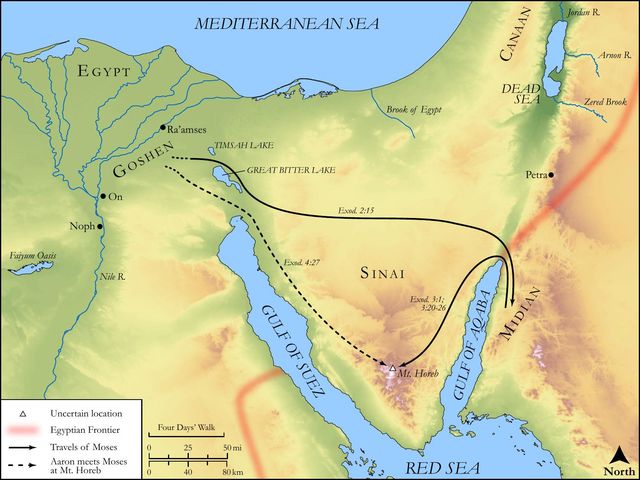
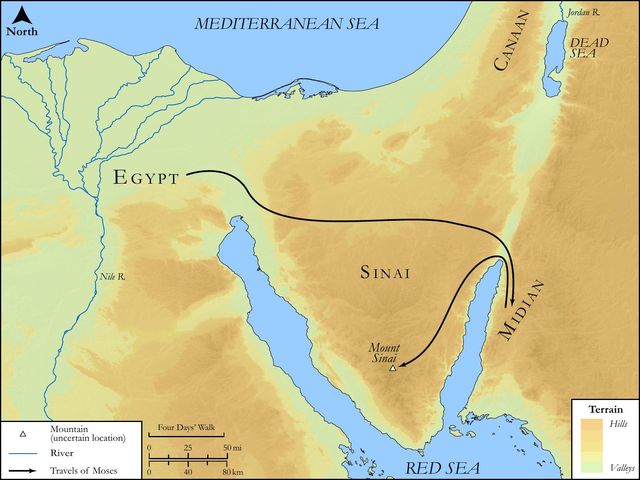
Study this verse
Public-domain commentary
Matthew Henry
From his Commentary on the Whole Bible. Henry comments on passages, not single verses — this entry covers Exodus 2:23–25.
Here is, 1. The continuance of the Israelites' bondage in Egypt, Exo 2:23. Probably the murdering of their infants did not continue; this part of their affliction attended only the period immediately connected with the birth of Moses, and served to signalize it. The Egyptians now were content with their increase, finding that Egypt was enriched by their labour; so that they might have them for slaves, they cared not how many they were. On this therefore they were intent, to keep them all at work, and make the best hand they could of their labour. When one Pharaoh died, another rose up in his place that was governed by the same maxims, and was as cruel to Israel as his predecessors. If there was sometimes a little relaxation, yet it presently revived again with as much rigour as ever; and probably, as the more Israel were oppressed the more they multiplied, so the more they multiplied the more they were oppressed. Note, Sometimes God suffers the rod of the wicked to lie very long and very heavily on the lot of the righteous. If Moses, in Midian, at any time began to think how much better his condition might have been had he staid among the courtiers, he must of himself think this also, how much worse it would have been if he had had his lot with brethren: it was a great degradation to him to be keeping sheep in Midian, but better so than making brick in Egypt. The consideration of our brethren's afflictions would help to reconcile us to our own. 2. The preface to their deliverance at last. (1.) They cried, Exo 2:23. Now, at last, they began to think of God under their troubles, and to return to him from the idols they had served, Eze 20:8. Hitherto they had fretted at the instruments of their trouble, but God was not in all their thoughts. Thus hypocrites in heart heap up wrath; they cry not when he binds them, Job 36:13. But before God unbound them he put it into their hearts to cry unto him, as it is explained, Num 20:16. Note, It is a good sign that God is coming towards us with deliverance when he inclines and enables us to cry to him for it. (2.) God heard, Exo 2:24, Exo 2:25. The name of God is here emphatically prefixed to four different expressions of a kind intention towards them. [1.] God heard their groaning; that is, he made it to appear that he took notice of their complaints. The groans of the oppressed cry aloud in the ears of the righteous God, to whom vengeance belongs, especially the groans of God's spiritual Israel; he knows the burdens they groan under and the blessings they groan after, and that the blessed Spirit, by these groanings, makes intercession in them. [2.] God remembered his covenant, which he seemed to have forgotten, but of which he is ever mindful. This God had an eye to, and not to any merit of theirs, in what he did for them. See Lev 26:42. (3.) God looked upon the children of Israel. Moses looked upon them and pitied them (Exo 2:11); but now God looked upon them and helped them. (4.) God had a respect unto them, a favourable respect to them as his own. The frequent repetition of the name of God here intimates that now we are to expect something great, Opus Deo dignum - A work worthy of God. His eyes, which run to and fro through the earth, are now fixed upon Israel, to show himself strong, to show himself a God in their behalf.
Continue studying Exodus 2:24 across the web’s major study libraries — every link below opens this exact verse, chapter, or book on the destination site.
Read & Compare
 BibleGatewayThis verse in more than 200 translations and 70 languages.
 Bible.comThe YouVersion reader — hundreds of translations, reading plans, and highlights.
 ESV.orgCrossway's official English Standard Version reader.
 NET BibleThe NET translation with 60,000+ translators' notes on every rendering decision.
 STEP BibleTyndale House's free study tool — original text, vocabulary, and scholarly resources.
 BibliaLogos Bible Software's free web reader.
 USCCBThe New American Bible (Revised Edition) with the U.S. bishops' study notes.
Commentaries
 BibleHub CommentariesDozens of classic commentaries on this verse, gathered on one page.
 StudyLightMore than 100 commentary sets — the largest collection on the web.
 BibleRefPlain-English commentary on what this verse means, verse by verse.
 Enduring WordDavid Guzik's free commentary on this chapter, widely used by Bible teachers.
 Bible Study ToolsVerse commentary alongside Greek and Hebrew study aids.
Original Language & Research
- BibleHub InterlinearThe verse word by word — original language, transliteration, and English.
- BibleHub LexiconEvery word's original-language definition and Strong's entry.
 Blue Letter BibleDeep-study tools — Strong's numbers, concordance, and word studies.
 SefariaThe Hebrew text with Rashi and centuries of Jewish commentary.
Sermons, Hymns & Audio


TrulyRandomVerse is not affiliated with these sites and doesn’t control their content. They’re linked because they’re genuinely useful.
Summary
Exodus 2:24 marks a pivotal moment in the unfolding narrative of Israel's deliverance, revealing God's profound attentiveness and unwavering faithfulness to His covenant promises. After generations of escalating oppression and brutal enslavement in Egypt, this verse declares that the Almighty God heard the deep groaning of His people and, in an act of active remembrance, called to mind His sacred covenant established with Abraham, Isaac, and Jacob, thereby initiating the long-awaited divine intervention for their redemption.
Context
ShowHideLiterary Context
Exodus 2:24 serves as a crucial turning point, bridging the narrative gap between Israel's severe oppression and God's active intervention. The preceding verses in Exodus 1 detail the rapid multiplication of the Israelites in Egypt, which prompted a new Pharaoh to enslave them and later decree the infanticide of all male Hebrew infants (Exodus 1:15-22). Exodus 2:1-22 then focuses on the miraculous preservation and early life of Moses, the one destined to be Israel's deliverer, culminating in his flight to Midian. This verse, therefore, shifts the focus from human suffering and the emergence of a human leader to the divine initiative, signaling that God Himself is about to act decisively in response to His people's plight and in fulfillment of His ancient promises. It sets the stage for the dramatic call of Moses in Exodus 3.
Historical & Cultural Context
The Israelites had been in Egypt for approximately 430 years (Exodus 12:40), initially welcomed by Joseph but later subjected to brutal slavery by a new dynasty that "knew not Joseph" (Exodus 1:8). Their "groaning" was not merely a sigh but a deep, guttural expression of profound suffering, forced labor, and existential despair under the harsh conditions imposed by the Egyptian taskmasters. In Scripture, covenants were solemn, binding agreements often sealed with rituals, as when God passed between the pieces with Abraham, and God "remembering" a covenant implied an active commitment to uphold its terms, not a passive recollection. The Pharaoh's absolute power and the Israelites' complete subjugation made divine intervention their only hope, underscoring the significance of God's action as a challenge to the reigning human authority.
Key Themes
ShowHideThis verse powerfully contributes to several overarching themes in Exodus and the broader Pentateuch. It highlights the theme of God's Covenant Faithfulness, demonstrating that His promises, even those made centuries earlier to the patriarchs Abraham, Isaac, and Jacob, are immutable and will be fulfilled (Genesis 12:1-3). It also underscores Divine Compassion and Justice, revealing a God who is not distant but intimately aware of and moved by the suffering of His people, particularly the oppressed. The "groaning" of Israel and God's subsequent "hearing" and "remembering" initiate the theme of Divine Deliverance and Redemption, setting the stage for the Exodus as the paradigmatic act of salvation in Israelite history. Furthermore, it reinforces the theme of God's Sovereignty, asserting His ultimate control over human history and His readiness to intervene on behalf of His chosen people, regardless of the might of earthly empires.
Exposition and Analysis
ShowHideExodus 2:24 serves as the divine pivot point, transitioning from Israel's suffering to God's active intervention. The repetition of "God" emphasizes His singular, sovereign agency in this pivotal moment.
Key Word Analysis
ShowHideThis word (H8085) is a primitive root meaning "to hear intelligently (often with implication of attention, obedience, etc.; causatively, to tell, etc.)." When applied to God, as here, it signifies far more than mere auditory perception. It implies a deep, empathetic understanding, an attentive acknowledgment of the suffering, and, critically, a readiness to respond with decisive action. God's hearing is active and purposeful, leading to intervention.
This word (H2142) is a primitive root meaning "to mark (so as to be recognized), i.e. to remember; by implication, to mention." In the context of God, "remembering" is not a passive mental recall as if He had forgotten and suddenly recollected. Instead, it denotes an active, purposeful engagement with a past commitment, leading to decisive action in the present. It signifies God's unwavering commitment to fulfill His solemn promises, bringing His covenant into active operation.
This word (H1285) is derived from a root meaning "to cut" (referencing the ancient practice of cutting animals in half to seal a covenant, as in Genesis 15:9-18). It refers to "a compact (because made by passing between pieces of flesh); confederacy, (con-) feder(-ate), covenant, league." This term highlights the binding, solemn, and often unconditional nature of God's promises to Abraham, Isaac, and Jacob, which now serve as the foundation for His intervention.
Verse Breakdown
ShowHide"And God heard their groaning,"
This clause emphasizes God's empathetic awareness and active attentiveness to the deep distress of the Israelites. Their "groaning" (H5009, nᵉʼâqâh), a sign of profound anguish and helplessness under oppression, reached the very throne of the Almighty, signifying that their suffering was not unnoticed or unheeded by their sovereign Lord. This hearing is a precursor to His declaration in Exodus 3:7 that He has indeed "seen the affliction of my people which are in Egypt, and have heard their cry."
"and God remembered his covenant with Abraham, with Isaac, and with Jacob."
This second clause reveals the theological basis and motivation for God's impending action. God's "remembering" (H2142, zâkar) is not a sudden recollection but a dynamic, covenant-keeping act. It signifies His unwavering commitment to fulfill the solemn promises made generations earlier to the patriarchs (H85, ʼAbrâhâm; H3327, Yitschâq; H3290, Yaʻăqôb). This covenant (H1285, bᵉrîyth), detailed in passages like Genesis 12:1-3 and Genesis 15:13-14, included promises of land, numerous descendants, and a special relationship with God. God's remembrance is the catalyst for the miraculous events that will follow, demonstrating His faithfulness regardless of the passage of time or the severity of the circumstances.
Literary Devices
ShowHideExodus 2:24 employs several significant literary devices to convey its profound theological message. The Repetition of "God" at the beginning of both clauses ("And God heard... and God remembered...") serves to emphasize divine agency and sovereignty, highlighting that this turning point is entirely God's initiative, not a result of human merit or strategy. This repetition also creates a sense of Parallelism, linking God's compassionate hearing of suffering directly to His active remembrance of His covenant, suggesting a cause-and-effect relationship where suffering triggers covenant faithfulness. The "groaning" itself functions as Metonymy, representing the entire experience of Israel's oppression, suffering, and desperate plight. Furthermore, the entire verse acts as a Pivot Point or Turning Point in the narrative, shifting the focus from the detailed accounts of Israel's suffering and Moses' early life to the imminent divine intervention that will lead to the Exodus.
Theological and Thematic Connections
ShowHideExodus 2:24 is a foundational verse for understanding God's character and His relationship with humanity. It unequivocally declares God's active engagement with the suffering of His people, demonstrating that His compassion is not passive but leads to decisive action. More profoundly, it underscores the immutability of God's covenant promises. His "remembering" is an assurance that His word is reliable and His commitments are eternal, transcending generations and even the most dire circumstances. This verse establishes that Israel's deliverance is not earned but is a gracious fulfillment of God's prior, unconditional pledges, setting the stage for the entire redemptive history of the Old Testament.
Reflection and Application
ShowHideExodus 2:24 offers profound and enduring encouragement for believers today, assuring us of God's unchanging character and unwavering commitment to His people. In moments of deep distress, when our circumstances seem overwhelming and our prayers feel like mere groans, this verse reminds us that God hears. He is not distant or indifferent to our suffering, but intimately aware and deeply compassionate. Just as He actively remembered His covenant with Abraham, Isaac, and Jacob, He remains faithful to His new covenant promises in Christ, demonstrating unwavering loyalty and perfect timing. This truth should build a foundational trust in God's active involvement in our lives, His perfect timing, and His ultimate commitment to deliver His people according to His will and for His glory, reminding us that even in our deepest valleys, His covenant faithfulness is our sure hope.
Questions for Reflection
ShowHideFAQ
ShowHideDid God literally forget His covenant before this point?
ShowHideNo, the Hebrew word zakhar (זָכַר), translated as "remembered," does not imply that God had a lapse of memory. For God, "remembering" is an active, purposeful act of bringing a past commitment or promise into the present for decisive action. It signifies His unwavering faithfulness and the activation of His plan based on His prior pledges, rather than a sudden recollection of something previously forgotten. This is consistent with God's omniscient nature, as seen in passages like Psalm 139:1-4.
What is the significance of God remembering His covenant with Abraham, Isaac, and Jacob?
ShowHideThis remembrance is the theological basis for Israel's deliverance. The covenant was a series of unconditional promises made by God to the patriarchs, including the promise of land, numerous descendants, and a special relationship with God (Genesis 12:1-3). By remembering this covenant, God was reaffirming His commitment to these ancient promises, demonstrating His faithfulness, and initiating the process by which He would fulfill them, starting with the liberation of His people from Egyptian bondage. It highlights that their salvation was rooted in God's character and His prior commitments, not in their own merit or actions.
How does God "hear" groaning, and what does it imply?
ShowHideThe Hebrew word shama (שָׁמַע), translated as "heard," implies more than just auditory perception. When used in relation to God, it signifies deep understanding, empathetic awareness, and a readiness to respond with action. It means God was not merely aware of their suffering, but He was deeply moved by it and prepared to intervene on their behalf, demonstrating His compassionate nature and His active engagement with the plight of His people. This active hearing is further elaborated in Exodus 3:7, where God states, "I have surely seen the affliction of my people who are in Egypt and have heard their cry because of their taskmasters, for I know their sufferings."
Christ-Centered Fulfillment
ShowHideExodus 2:24, with its depiction of God hearing the groans of His people and actively remembering His covenant to initiate their deliverance, finds its ultimate and most profound fulfillment in the person and work of Jesus Christ. While God delivered Israel from physical bondage in Egypt, Christ came to deliver humanity from a far greater and more pervasive bondage: the dominion of sin and death. Jesus is the ultimate "seed" of Abraham, through whom all the nations of the earth are blessed, fulfilling the very covenant God remembered in Exodus 2:24 (Galatians 3:16 and Galatians 3:29). His atoning sacrifice on the cross is God's supreme act of "remembering" His covenant of grace, providing a perfect and eternal redemption for all who believe (Hebrews 9:12). Just as God heard Israel's cries and sent Moses as their deliverer, He heard the universal groaning of a world enslaved by sin and sent His Son, the greater Deliverer, to secure an eternal salvation that transcends any earthly liberation, establishing a new and better covenant sealed by His own blood (Hebrews 8:6).