


Exodus 12:40
Bible text: King James Version (1769 Blayney text) · Public domain
Bible text: Berean Standard Bible · Public domain
Bible text: American Standard Version (1901) · Public domain
Bible text: World English Bible, Messianic edition · Public domain
Bible text: Geneva Bible (1599) · Public domain
Bible text: Young's Literal Translation · Public domain
- וּמוֹשַׁבu·mo·Shavand [the] dwelling ofH4186Conj-w ¦ N-mscNoun Singular Masculine Constructוּandמוֹשַׁב[the] dwelling of
- בְּנֵיbe·Nei[the] people ofH1121N-mpcNoun Plural Masculine Construct
- יִשְׂרָאֵלYis·ra·'ElIsraelH3478N-properNoun Proper Location
- אֲשֶׁר'a·SherwhichH834RelParticle Relative
- יָשְׁבוּya·she·Vuthey dweltH3427V-Qal-Perf-3cpVerb Qal Perfect 3rd Plural common gender
- בְּמִצְרָיִםbe·mitz·Ra·yimin EgyptH4714Prep-b ¦ N-properNoun Proper LocationבְּinמִצְרָיִםEgypt
- שְׁלֹשִׁיםshe·lo·Shim[was] thirtyH7970Adj-mpAdjective Numerical Plural Masculine Absolute
- שָׁנָהsha·Nahyear[s]H8141N-fsNoun Singular Feminine Absolute
- וְאַרְבַּעve·'ar·Ba'and fourH702Conj-w ¦ Adj-cscAdjective Numerical Singular common gender Constructוְandאַרְבַּעfour
- מֵאוֹתme·'othundred<s>H3967Adj-fpAdjective Numerical Plural Feminine Absolute
- שָׁנָהsha·Nahyear[s]H8141N-fsNoun Singular Feminine Absolute
English is a literal word-by-word gloss of the Hebrew, not the KJV's wording. Why?
This is the original text the KJV's translators worked from — each Hebrew word with its own literal English meaning in this verse, prepared by scholars at Tyndale House, Cambridge. The KJV translates whole sentences, not word by word, so its wording differs: one Hebrew word can become several English words, and the KJV may choose “the LORD” where the gloss reads “Yahweh”. Both are faithful — they answer different questions. For the KJV's own rendering, switch to the KJV text.
Details
See on the biblical-era maps

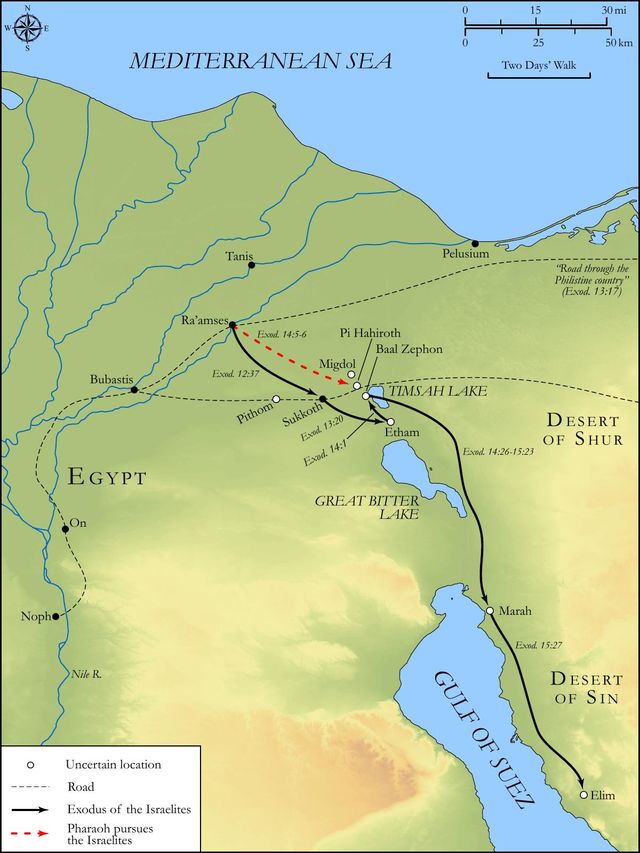
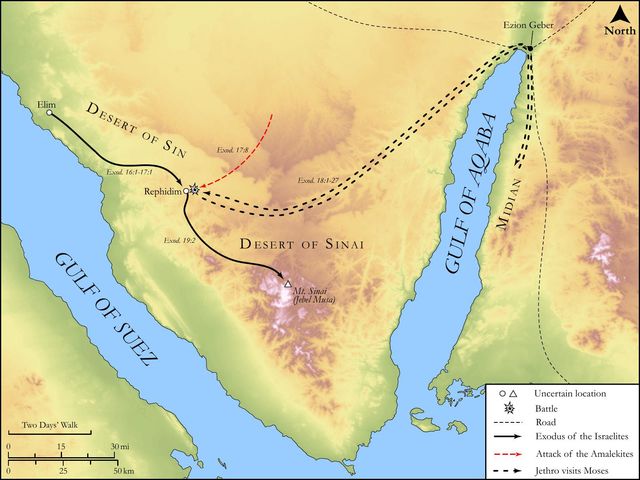
Study this verse
Public-domain commentary
Matthew Henry
From his Commentary on the Whole Bible. Henry comments on passages, not single verses — this entry covers Exodus 12:37–42.
Here is the departure of the children of Israel out of Egypt; having obtained their dismission, they set forward without delay, and did not defer to a more convenient season. Pharaoh was now in a good mind; but they had reason to think he would not long continue so, and therefore it was no time to linger. We have here an account, 1. Of their number, about 600,000 men (Exo 12:37), besides women and children, which I think, we cannot suppose to make less than 1,200,000 more. What a vast increase was this, to arise from seventy souls in little more than 200 years' time! See the power and efficacy of that blessing, when God commands it, Be fruitful and multiply. This was typical of the multitudes that were brought into the gospel church when it was first founded; so mightily grew the word of God, and prevailed. 2. Of their retinue (Exo 12:38): A mixed multitude went up with them, hangers on to that great family, some perhaps willing to leave their country, because it was laid waste by the plagues, and to seek their fortune, as we say, with the Israelites; others went out of curiosity, to see the solemnities of Israel's sacrifice to their God, which had been so much talked of, and expecting to see some glorious appearances of their God to them in the wilderness, having seen such glorious appearances of their God for them in the field of Zoan, Psa 78:12. Probably the greatest part of this mixed multitude were but a rude unthinking mob, that followed the crowd they knew not why; we afterwards find that they proved a snare to them (Num 11:4), and it is probable that when, soon afterwards, they understood that the children of Israel were to continue forty years in the wilderness, they quitted them, and returned to Egypt. Note, There were always those among the Israelites that were not Israelites, and there are still hypocrites in the church, who make a deal of mischief, but will be shaken off at last. 3. Of their effects. They had with them flocks and herds, even very much cattle. This is taken notice of because it was long before Pharaoh would give them leave to remove their effects, which were chiefly cattle, Gen 46:32. 4. Of the provision made for the camp, which was very poor and slender. They brought some dough with them out of Egypt in their knapsacks, Exo 12:34. They had prepared to bake, the next day, in order to their removal, understanding it was very near; but, being hastened away sooner than they thought of, by some hours, they took the dough as it was, unleavened; when they came to Succoth, their first stage, they baked unleavened cakes, and, though these were of course insipid, yet the liberty they were brought into made this the most joyful meal they had ever eaten in their lives. Note, The servants of God must not be slaves to their appetites, nor solicitous to wind up all the delights of sense to their highest pitch. We should be willing to take up with dry bread, nay, with unleavened bread, rather than neglect or delay any service we have to do for God, as those whose meat and drink it is to do his will. 5. Of the date of this great event: it was just 430 years from the promise made to Abraham (as the apostle explains it, Gal 3:17) at his first coming into Canaan, during all which time the children of Israel, that is, the Hebrews, the distinguished chosen seed, were sojourners in a land that was not theirs, either Canaan or Egypt. So long the promise God made to Abraham of a settlement lay dormant and unfulfilled, but now, at length, it revived, and things began to work towards the accomplishment of it. The first day of the march of Abraham's seed towards Canaan was just 430 years (it should seem to a day) from the promise made to Abraham, Gen 12:2, I will make of thee a great nation. See how punctual God is to his time; though his promises be not performed quickly, they will be accomplished in their season. 6. Of the memorableness of it: It is a night to be much observed, Exo 12:42. (1.) The providences of that first night were very observable; memorable was the destruction of the Egyptians, and the deliverance of the Israelites by it; God herein made himself taken notice of. (2.) The ordinances of that night, in the annual return of it, were to be carefully observed: This is that night of the Lord, that remarkable night, to be celebrated in all generations. Note, The great things God does for his people are not to be a nine days' wonder, as we say, but the remembrance of them is to be perpetuated throughout all ages, especially the work of our redemption by Christ. This first passover-night was a night of the Lord much to be observed; but the last passover-night, in which Christ was betrayed (and in which the passover, with the rest of the ceremonial institutions, was superseded and abolished), was a night of the Lord much more to be observed, when a yoke heavier than that of Egypt was broken from off our necks, and a land better than that of Canaan set before us. That was a temporal deliverance to be celebrated in their generation; this is an eternal redemption to be celebrated in the praises of glorious saints, world without end.
Continue studying Exodus 12:40 across the web’s major study libraries — every link below opens this exact verse, chapter, or book on the destination site.
Read & Compare
 BibleGatewayThis verse in more than 200 translations and 70 languages.
 Bible.comThe YouVersion reader — hundreds of translations, reading plans, and highlights.
 ESV.orgCrossway's official English Standard Version reader.
 NET BibleThe NET translation with 60,000+ translators' notes on every rendering decision.
 STEP BibleTyndale House's free study tool — original text, vocabulary, and scholarly resources.
 BibliaLogos Bible Software's free web reader.
 USCCBThe New American Bible (Revised Edition) with the U.S. bishops' study notes.
Commentaries
 BibleHub CommentariesDozens of classic commentaries on this verse, gathered on one page.
 StudyLightMore than 100 commentary sets — the largest collection on the web.
 BibleRefPlain-English commentary on what this verse means, verse by verse.
 Enduring WordDavid Guzik's free commentary on this chapter, widely used by Bible teachers.
 Bible Study ToolsVerse commentary alongside Greek and Hebrew study aids.
Original Language & Research
- BibleHub InterlinearThe verse word by word — original language, transliteration, and English.
- BibleHub LexiconEvery word's original-language definition and Strong's entry.
 Blue Letter BibleDeep-study tools — Strong's numbers, concordance, and word studies.
 SefariaThe Hebrew text with Rashi and centuries of Jewish commentary.
Sermons, Hymns & Audio


TrulyRandomVerse is not affiliated with these sites and doesn’t control their content. They’re linked because they’re genuinely useful.
Summary
Exodus 12:40 precisely states that the Israelites' time of dwelling in Egypt was four hundred and thirty years, serving as a powerful testament to God's meticulous faithfulness in fulfilling His ancient promises to Abraham, bringing His people out of bondage at the exact divinely appointed moment, thereby highlighting His sovereign control over history and His unwavering commitment to His covenant people.
Context
ShowHideLiterary Context
This verse is strategically placed within the narrative of the Exodus, immediately following the detailed instructions for the first Passover observance and preceding the actual departure of the Israelites from Egypt, which is described as occurring "on that very day" in Exodus 12:41. It acts as a definitive historical marker, confirming the exact duration of Israel's presence in Egypt and underscoring the precise timing of their liberation. Its placement highlights that the Exodus was not a random event but the culmination of a long-foretold divine plan, emphasizing God's meticulous adherence to His promises.
Historical & Cultural Context
The mention of 430 years is crucial as it directly relates to God's covenantal promises to Abraham. Centuries earlier, God had prophesied to Abraham that his descendants would be "sojourners in a land that is not theirs and will be enslaved and oppressed for four hundred years" (Genesis 15:13). This verse in Exodus confirms the fulfillment of that prophecy, demonstrating God's sovereign control over history and His unwavering commitment to His covenant people, even through generations of hardship and slavery. The concept of "sojourning" (living as temporary residents) was a common experience in the lands of the patriarchs, often implying a lack of permanent land rights or full societal integration, which accurately describes Israel's status in Egypt, particularly during their period of increasing oppression and forced labor.
Key Themes
ShowHideExodus 12:40 powerfully reinforces several core theological themes woven throughout the Pentateuch and indeed, the entire biblical narrative. Foremost among these is God's unwavering faithfulness and meticulous promise-keeping. The precise mention of 430 years underscores that God's covenant with Abraham (Genesis 12:1-3) was not forgotten, even across generations of hardship and slavery. God remembered His people and His word, bringing it to pass exactly when He purposed, down to "the very day" as Exodus 12:41 confirms, demonstrating His perfect divine timing in the outworking of His redemptive plan. The verse also highlights the nature of Israel as a sojourning people, emphasizing that their dwelling in Egypt was temporary, a prelude to their inheritance of the Promised Land, a theme that resonates with the broader biblical concept of God's people as pilgrims awaiting their true, eternal home.
Exposition and Analysis
ShowHideKey Word Analysis
ShowHideThis Hebrew term, derived from the root yâshab (to sit, dwell), refers to a dwelling, habitation, or abode. In this context, it carries the nuance of a temporary residence or a place where one settles for a period, rather than a permanent homeland. This emphasizes that Israel's time in Egypt, though long, was always intended to be a transitional phase, a prelude to their inheritance of the Promised Land. They were not meant to be permanent residents but a people on a journey toward their true, God-given home. It implies a sense of unsettledness or temporary lodging, even while physically present.
This is a primitive root meaning "to sit down," and by implication, "to dwell" or "to remain." Its use here reinforces the reality of their physical presence and establishment in Egypt. While "sojourning" (môwshâb) speaks to the temporary nature of their stay, "dwelt" (yâshab) confirms that they were truly settled and established there for a significant period, even as their status remained that of temporary residents in a foreign land. This combination of terms highlights the paradox of their long-term, yet ultimately temporary, presence.
This name, meaning "he will rule as God," is a symbolic name given to Jacob and subsequently to his posterity, the nation. Its inclusion here underscores that the 430-year period pertains not merely to a group of individuals, but to the covenant people of God, the descendants of Abraham, Isaac, and Jacob, whose identity and destiny are intrinsically linked to God's promises and His redemptive plan. It emphasizes the collective experience and the national scope of God's faithfulness.
Verse Breakdown
ShowHide"Now the sojourning of the children of Israel,"
This opening phrase immediately frames the duration as pertaining to the entire period of Israel's temporary dwelling, emphasizing their identity as a distinct people ("children of Israel") and their transient status.
"who dwelt in Egypt,"
This clarifies the specific geographical location of this significant sojourning, identifying Egypt as the land where this extended period of residence occurred. It grounds the historical reality of their presence in a foreign land.
"[was] four hundred and thirty years."
This provides the precise duration of the sojourn. This figure is understood by many scholars, and explicitly by the Apostle Paul in Galatians 3:17, to encompass the entire period from God's covenant with Abraham (when he was called to sojourn in Canaan) to the Exodus. This broader interpretation includes the time Abraham, Isaac, and Jacob sojourned in Canaan before Jacob's family descended into Egypt, as well as the approximately 215 years they spent in Egypt itself. This reconciles the 430 years with the 400 years mentioned in Genesis 15:13, where the 400 years refer specifically to the period of affliction and oppression within the larger sojourn.
Literary Devices
ShowHideThe primary literary device employed in Exodus 12:40 is Numerical Precision. The exact figure of "four hundred and thirty years" serves to emphasize the meticulousness of God's timing and the absolute reliability of His word. This precision underscores the literal fulfillment of prophecy, demonstrating that the Exodus was not a random or opportunistic escape, but the culmination of a divinely orchestrated plan set in motion centuries earlier. This exactitude lends an air of historical veracity and divine authority to the narrative, reinforcing the theme of God's sovereign control over the unfolding of history.
Theological and Thematic Connections
ShowHideExodus 12:40 powerfully articulates several core theological truths. Firstly, it highlights God's unwavering faithfulness and meticulous promise-keeping. The precise mention of 430 years underscores that God's covenant with Abraham was not forgotten, even across generations of hardship and slavery. God remembered His people and His word, bringing it to pass exactly when He purposed, down to "the very day" as Exodus 12:41 confirms. This demonstrates God's perfect divine timing in the outworking of His redemptive plan, assuring us that His purposes will always come to fruition.
Secondly, the verse reinforces the nature of Israel as a sojourning people. Their dwelling in Egypt was temporary, a prelude to their inheritance of the Promised Land. This theme of sojourning is central to biblical theology, portraying God's people as pilgrims on a journey, not yet in their eternal home. This concept resonates throughout Scripture, from Abraham's nomadic life to the New Testament's portrayal of believers as "strangers and exiles" awaiting a heavenly city.
Reflection and Application
ShowHideExodus 12:40 offers profound encouragement for believers today, reminding us of God's unchanging character and His faithful interaction with humanity throughout history. It teaches us that God's promises are true, and His timing is perfect, even if fulfillment takes generations or seems delayed from our limited human perspective. We can trust Him with our own long-term hopes, prayers, and struggles, knowing He works on His own divine timetable, which is always for our ultimate good and His glory. This verse also reinforces the biblical idea that, as followers of Christ, we are often "sojourners" or "strangers" in this world, awaiting a greater, eternal home. Our present circumstances, no matter how challenging or long-lasting, are ultimately temporary in light of God's overarching plan for redemption and a new creation. This perspective calls us to live with an eternal mindset, prioritizing heavenly realities over fleeting earthly comforts, and to endure patiently, knowing our true inheritance awaits.
Questions for Reflection
ShowHideFAQ
ShowHideWhy does the Bible sometimes mention 400 years and sometimes 430 years for Israel's time in Egypt?
ShowHideThe apparent discrepancy between the 400 years mentioned in Genesis 15:13 and the 430 years in Exodus 12:40 and Galatians 3:17 is resolved by understanding the starting point of the count. The 430 years refers to the entire period from God's covenant with Abraham (when he began his sojourn in Canaan) to the Exodus. This includes the time Abraham, Isaac, and Jacob lived in Canaan before Jacob's family descended into Egypt, as well as the time they spent in Egypt itself. The 400 years, on the other hand, refers specifically to the period of affliction and enslavement that God prophesied for Abraham's descendants, which constituted a significant portion of their time in Egypt. Paul's statement in Galatians confirms that the 430 years is the total duration from the covenant's establishment to the giving of the Law at Sinai, which occurred shortly after the Exodus.
Does this verse imply that the Israelites were in Egypt for the entire 430 years?
ShowHideNo, not exclusively. As explained above, the 430 years encompasses the entire period from the establishment of God's covenant with Abraham until the Exodus. This includes the time Abraham, Isaac, and Jacob sojourned in Canaan before the descent into Egypt. The actual time spent in Egypt was a significant portion of this period, particularly the 400 years of affliction and enslavement, but the initial portion of the 430 years was spent by the patriarchs sojourning in Canaan. Therefore, the verse refers to the total duration of their "sojourning" as a distinct people, not solely their time within the geographical borders of Egypt.
Christ-Centered Fulfillment
ShowHideExodus 12:40, with its precise historical marker of God's faithfulness and perfect timing, finds profound fulfillment and amplification in the person and work of Jesus Christ. The Exodus itself is a foundational redemptive event in the Old Testament, serving as a powerful type or foreshadowing of the ultimate deliverance wrought by Christ. Just as God meticulously orchestrated Israel's liberation after 430 years of sojourning, so too did He orchestrate the coming of His Son, Jesus, at the "fullness of time" (Galatians 4:4). This divine timing ensured that Christ's advent perfectly aligned with God's eternal plan for salvation. The temporary "sojourning" of Israel in Egypt points to the temporary nature of our earthly existence and the ultimate "Promised Land" that Christ secures for us. Believers in Christ are called "strangers and exiles" (1 Peter 2:11) in this world, just as Israel was a sojourning people. Our true home, our ultimate inheritance, is not an earthly land but a heavenly kingdom, secured by Jesus's death and resurrection. The deliverance from Egyptian bondage foreshadows the greater spiritual liberation from the bondage of sin and death that Jesus accomplished through His atoning sacrifice on the cross (Romans 6:22). God's faithfulness to His ancient promise to Abraham, culminating in the Exodus, points to His ultimate faithfulness in sending Christ to fulfill all His covenant promises, bringing about a new and eternal redemption for all who believe, ushering them into an inheritance that is imperishable, undefiled, and unfading, kept in heaven (1 Peter 1:4).