


Genesis 12:1
Bible text: King James Version (1769 Blayney text) · Public domain
Bible text: Berean Standard Bible · Public domain
Bible text: American Standard Version (1901) · Public domain
Bible text: World English Bible, Messianic edition · Public domain
Bible text: Geneva Bible (1599) · Public domain
Bible text: Young's Literal Translation · Public domain
- וַיֹּאמֶרvai·Yo·merand he saidH559Conj-w ¦ V-Qal-ConsecImperf-3msVerb Qal Consecutive Imperfect 3rd Singular Masculineוַandיֹּאמֶרhe said
- יְהוָהYah·wehYahwehH3068N-properNoun Proper Title
- אֶל'eltoH413PrepPreposition
- אַבְרָם'av·RamAbramH87N-proper-mNoun Proper Masculine
- לֶךְlekhgoH1980V-Qal-Imp-2msVerb Qal Imperative 2nd Singular Masculine
- לְךָle·Khafor <the> yourselfPrep-l ¦ 2msSuffix Personal 2nd Singular Masculineלְfor <the>ךָyourself
- מֵאַרְצְךָme·'ar·tze·Khafrom your landH776Prep-m ¦ N-fsc ¦ 2msNoun Singular Feminine Constructמֵfromאַרְצְlandךָyour
- וּמִמּוֹלַדְתְּךָu·mi·mo·lad·te·Khaand from your kindredH4138Conj-w ¦ Prep-m ¦ N-fsc ¦ 2msNoun Singular Feminine Constructוּandמִfromמּוֹלַדְתְּkindredךָyour
- וּמִבֵּיתu·mi·Beitand from [the] household ofH1004Conj-w ¦ Prep-m ¦ N-mscNoun Singular Masculine Constructוּandמִfromבֵּית[the] household of
- אָבִיךָ'a·Vi·khayour fatherH1N-msc ¦ 2msNoun Singular Masculine Constructאָבִיfatherךָyour
- אֶל'eltoH413PrepPreposition
- הָאָרֶץha·'A·retzthe landH776Art ¦ N-fsNoun Singular Feminine Absoluteהָtheאָרֶץland
- אֲשֶׁר'a·SherwhichH834RelParticle Relative
- אַרְאֶךָּ'ar·'E·kaI will show youH7200V-Hiphil-Imperf-1cs ¦ 2msVerb Hiphil Imperfect 1st Singular common genderאַרְאֶI will showךָּyou
English is a literal word-by-word gloss of the Hebrew, not the KJV's wording. Why?
This is the original text the KJV's translators worked from — each Hebrew word with its own literal English meaning in this verse, prepared by scholars at Tyndale House, Cambridge. The KJV translates whole sentences, not word by word, so its wording differs: one Hebrew word can become several English words, and the KJV may choose “the LORD” where the gloss reads “Yahweh”. Both are faithful — they answer different questions. For the KJV's own rendering, switch to the KJV text.
Details
See on the biblical-era maps


Study this verse
Public-domain commentary
Matthew Henry
From his Commentary on the Whole Bible. Henry comments on passages, not single verses — this entry covers Genesis 12:1–3. His four-level outline is real structure in the source text, so it is rendered as structure.
We have here the call by which Abram was removed out of the land of his nativity into the land of promise, which was designed both to try his faith and obedience and also to separate him and set him apart for God, and for special services and favours which were further designed. The circumstances of this call we may be somewhat helped to the knowledge of from Stephen's speech, Act 7:2, where we are told, 1. That the God of glory appeared to him to give him this call, appeared in such displays of his glory as left Abram no room to doubt the divine authority of this call. God spoke to him afterwards in divers manners; but this first time, when the correspondence was to be settled, he appeared to him as the God of glory, and spoke to him. 2. That this call was given him in Mesopotamia, before he dwelt in Charran; therefore we rightly read it, The Lord. had said unto Abram, namely, in Ur of the Chaldees; and, in obedience to this call, as Stephen further relates the story (Act 7:4), he came out of the land of the Chaldeans, and dwelt in Charran, or Haran, about five years, and thence, when his father was dead, by a fresh command, pursuant to the former, God removed him into the land of Canaan. some think that Haran was in Chaldea, and so was still a part of Abram's country, or that Abram, having staid there five years, began to call it his country, and to take root there, till God let him know this was not the place he was intended for. Note: If God loves us, and has mercy in store for us, he will not suffer us to take up our rest any where short of Canaan, but will graciously repeat his calls, till the good work begun be performed, and our souls repose in God only. In the call itself we have a precept and a promise.
I.A trying precept: Get thee out of thy country, Gen 12:1. Now,
1.By this precept he was tried whether he loved his native soil and dearest friends, and whether he could willingly leave all, to go along with God. His country had become idolatrous, his kindred and his father's house were a constant temptation to him, and he could not continue with them without danger of being infected by them; therefore Get thee out, yalak - Vade tibi, Get thee gone, with all speed, escape for thy life, look not behind thee, Gen 19:17. Note, Those that are in a sinful state are concerned to make all possible haste out of it. Get out for thyself (so some read it), that is, for thy own good. Note, Those who leave their sins, and turn to God, will themselves be unspeakable gainers by the change, Pro 9:12. This command which God gave to Abram is much the same with the gospel call by which all the spiritual seed of faithful Abram are brought into covenant with God. For,
(1.)Natural affection must give way to divine grace. Our country is dear to us, our kindred dearer, and our father's house dearest of all; and yet they must all be hated (Luk 14:26), that is, we must love them less than Christ, hate them in comparison with him, and, whenever any of these come in competition with him, they must be postponed, and the preference given to the will and honour of the Lord Jesus.
(2.)Sin, and all the occasions of it, must be forsaken, and particularly bad company; we must abandon all the idols of iniquity which have been set up in our hearts, and get out of the way of temptation, plucking out even a right eye that leads us to sin (Mat 5:29), willingly parting with that which is dearest to us, when we cannot keep it without hazard of our integrity. Those that resolve to keep the commandments of God must quit the society of evil doers, Psa 119:115; Act 2:40.
(3.)The world, and all our enjoyments in it, must be looked upon with a holy indifference and contempt; we must no longer look upon it as our country, or home, but as our inn, and must accordingly sit loose to it and live above it, get out of it in affection.
2.By this precept he was tried whether he could trust God further than he saw him; for he must leave his own country, to go to a land that God would show him. He does not say, "It is a land that I will give thee," but merely, "a land that I will show thee." Nor does he tell him what land it was, nor what kind of land; but he must follow God with an implicit faith, and take God's word for it, in the general, though he had no particular securities given him that he should be no loser by leaving his country, to follow God. Note, Those that will deal with God must deal upon trust; we must quit the things that are seen for things that are not seen, and submit to the sufferings of this present time in hopes of a glory that is yet to be revealed (Rom 8:18); for it doth not yet appear what we shall be (Jo1 3:2), any more than it did to Abram, when God called him to a land he would show him, so teaching him to live in a continual dependence upon his direction, and with his eye ever towards him.
II.Here is an encouraging promise, nay, it is a complication of promises, many, and exceedingly great and precious.
Note, All God's precepts are attended with promises to the obedient. When he makes himself known also as a rewarder: if we obey the command, God will not fail to perform the promise. Here are six promises: -
1.I will make of thee a great nation. When God took him from his own people, he promised to make him the head of another; he cut him off from being the branch of a wild olive, to make him the root of a good olive. This promise was,
(1.)A great relief to Abram's burden; for he had now no child. Note, God knows how to suit his favours to the wants and necessities of his children. He that has a plaster for every sore will provide one for that first which is most painful.
(2.)A great trial to Abram's faith; for his wife had been long barren, so that, if he believe, it must be against hope, and his faith must build purely upon that power which can out of stones raise up children unto Abraham, and make them a great nation. Note,
[1.]God makes nations: by him they are born at once (Isa 66:8), and he speaks to build and plant them, Jer 18:9. And,
[2.]If a nation be made great in wealth and power, it is God that makes it great.
[3.]God can raise great nations out of dry ground, and can make a little one to be a thousand.
2.I will bless thee, either particularly with the blessing of fruitfulness and increase, as he had blessed Adam and Noah, or, in general, "I will bless thee with all manner of blessings, both of the upper and the nether springs. Leave thy father's house, and I will give thee a father's blessing, better than that of they progenitors." Note, Obedient believers will be sure to inherit the blessing.
3.I will make thy name great. By deserting his country, he lost his name there. "Care not for that," says God, "but trust me, and I will make thee a greater name than ever thou couldst have had there." Having no child, he feared he should have no name; but God will make him a great nation, and so make him a great name. Note,
(1.)God is the fountain of honour, and from him promotion comes, Sa1 2:8.
(2.)The name of obedient believers shall certainly be celebrated and made great. The best report is that which the elders obtained by faith, Heb 11:2.
4.Thou shalt be a blessing; that is, (1.) "Thy happiness shall be a sample of happiness, so that those who would bless their friends shall only pray that God would make them like Abram;" as Rut 4:11. Note, God's dealings with obedient believers are so kind and gracious that we need not desire for ourselves or our friends to be any better dealt with: to have God for our friend is blessedness enough. (2.) "Thy life shall be a blessing to the places where thou shalt sojourn." Note, Good men are the blessings of their country, and it is their unspeakable honour and happiness to be made so.
5.I will bless those that bless thee and curse him that curseth thee. This made it a kind of a league, offensive and defensive, between God and Abram. Abram heartily espoused God's cause, and here God promises to interest himself in his.
(1.)He promises to be a friend to his friends, to take kindnesses shown to him as done to himself, and to recompense them accordingly. God will take care that none be losers, in the long run, by any service done for his people; even a cup of cold water shall be rewarded.
(2.)He promises to appear against his enemies. There were those that hated and cursed even Abram himself; but, while their causeless curses could not hurt Abram, God's righteous curse would certainly overtake and ruin them, Num 24:9. This is a good reason why we should bless those that curse us, because it is enough that God will curse them, Psa 38:13-15.
6.In thee shall all the families of the earth be blessed. This was the promise that crowned all the rest; for it points at the Messiah, in whom all the promises are yea and amen. Note,
(1.)Jesus Christ is the great blessing of the world, the greatest that ever the world was blessed with. He is a family blessing, by him salvation is brought to the house (Luk 19:9); when we reckon up our family blessings, let us put Christ in the imprimis - the first place, as the blessing of blessings. But how are all the families of the earth blessed in Christ, when so many are strangers to him? Answer, [1.] All that are blessed are blessed in him, Act 4:12 [2.] All that believe, of what family soever they shall be, shall be blessed in him. [3.] Some of all the families of the earth are blessed in him. [4.] There are some blessings which all the families of the earth are blessed with in Christ; for the gospel salvation is a common salvation, Jde 1:3.
(2.)It is a great honour to be related to Christ; this made Abram's name great, that the Messiah was to descend from his loins, much more than that he should be the father of many nations. It was Abram's honour to be his father by nature; it will be ours to be his brethren by grace, Mat 12:50.
Historical interpretation
Seven Centuries of Reception
10 surviving comments on this verse. Each one is dated, so this reads as a timeline rather than a list.
Select a marker to jump to its quote. Markers stagger vertically where authors wrote within a few decades of each other.
Then said the high priest, Are these things so? And he said, Men, brethren, and fathers, hearken; The God of glory appeared unto our father Abraham, when he was in Mesopotamia, before he dwelt in Charran, And said unto him, Get thee out of thy country, and from thy kindred, and come into the land which I shall show thee. [Genesis 12:1] Then came he out of the land of the Chaldaeans, and dwelt in Charran: and from thence, when his father was dead, he removed him into this land, wherein ye now dwell. And he gave him none inheritance in it, no, not so much as to set his foot on: yet he promised that he would give it to him for a possession, and to his seed after him, when as yet he had no child. And God spake on this wise, That his seed should sojourn in a strange land; and that they should bring them into bondage, and entreat them evil four hundred years. And the nation to whom they shall be in bondage will I judge, said God: and after that shall they come forth, and serve me in this place.
Abraham, styled "the friend," [Isaiah 41:8] was found faithful, inasmuch as he rendered obedience to the words of God. He, in the exercise of obedience, went out from his own country, and from his kindred, and from his father's house, in order that, by forsaking a small territory, and a weak family, and an insignificant house, he might inherit the promises of God. For God said to him, "Get you out from your country, and from your kindred, and from your father's house, into the land which I shall show you. And I will make you a great nation, and will bless you, and make your name great, and you shall be blessed. And I will bless them that bless you, and curse them that curse you; and in you shall all the families of the earth be blessed." [Genesis 12:1-3] And again, on his departing from Lot, God said to him, "Lift up your eyes, and look from the place where you now are, northward, and southward, and eastward, and westward; for all the land which you see, to you will I give it, and to your seed forever. And I will make your seed as the dust of the earth, [so that] if a man can number the dust of the earth, then shall your seed also be numbered." [Genesis 13:14-16] And again [the Scripture] says, "God brought forth Abram, and spoke unto him, Look up now to heaven, and count the stars if you are able to number them; so shall your seed be. And Abram believed God, and it was counted to him for righteousness." [Genesis 15:5-6] On account of his faith and hospitality, a son was given him in his old age; and in the exercise of obedience, he offered him as a sacrifice to God on one of the mountains which He showed him. [Genesis 22:9]
Some were reached by the Word of God through the law of promise and the discernment of the good inherent in them from their first formation. They did not hesitate but followed it readily as did Abraham, our father. Since he offered himself in love through the law of promise, God appeared to him, saying, “Go from your country and your kindred and from your father’s house to the land that I will show you.” And he went without hesitating at all but being ready for his calling. This is the model for the beginning of this way of life. It still persists in those who follow this pattern. Wherever and whenever souls endure and bow to it they easily attain the virtues, since their hearts are ready to be guided by the Spirit of God.
Abraham represents the mind. In fact Abraham signifies passage. Therefore, in order that the mind, which in Adam had allowed itself to run to pleasure and to bodily attractions, should turn toward the ideal form of virtue, a wise man has been proposed to us as an example to imitate. Actually Abraham in Hebrew signifies “father,” in the sense that the mind, with the authority, the judgment and the solicitude of a father, governs the entire person. This mind then was in Haran, that is, in caverns, subject to the different passions. For this reason it is told, “Go from your country,” that is, from your body. From this land went forth the one whose homeland is in the heavens.
It is not by chance that God orders Abraham to leave his land and his relatives but because he sees in him something that makes him worthy of being the object of divine concern, that is, his faith in God. But it was not fitting that the one who had faith in God should remain among perverse people—the father of Abraham was in fact an idolater—because the company of the wicked often does harm to zealous people, especially to those whose zeal is new. That is why the Savior also proclaims, “If anyone wishes to follow me and does not hate his father, his brothers, his sisters, and even his wife and children, he cannot be my disciple.” The Lord did not say that in order to provoke hatred of one’s relatives, but if one of them becomes an obstacle to virtue, it is necessary to hate him for virtue’s sake. That is what the apostles did, who said, “Look, we have left everything in order to follow you.” Such is the order given now to the patriarch, and God tells him that he will show him a land in which to live, that he will make of him a great nation, that he will bless and magnify his name.
The right thing to do, brothers and sisters, is to believe God before he pays up anything, because just as he cannot possibly lie, so he cannot deceive. For he is God. That’s how our ancestors believed him. That’s how Abraham believed him. There’s a faith for you that really deserves to be admired and made widely known. He had received nothing from him, and he believed his promise. We do not yet believe him, though we have already received so much. Was Abraham ever in a position to say to him, “I will believe you, because you promised me that and paid up”? No, he believed from the very first command given, without having received anything else at all. “Go out from your country,” he was told, “and from your kindred, and go into a country which I will give you.” And he believed straightaway, and [God] didn’t give him that country but kept it for his seed.
When the sacred lesson was read just now, we heard the Lord say to blessed Abraham, “Leave your country, your kinsfolk and your father’s house.” Now everything that was written in the Old Testament, dearly beloved, provided a type and image of the New Testament. As the apostle says, “Now all these things happened to them as a type, and they were written for our correction, upon whom the final age of the world has come.” Therefore, if what happened corporally in Abraham was written for us, we will see it fulfilled spiritually in us if we live piously and justly. “Leave your country,” the Lord said, “your kinsfolk and your father’s house.” We believe and perceive all these things fulfilled in us, brothers, through the sacrament of baptism. Our land is our body; we go forth properly from our land if we abandon our carnal habits to follow the footsteps of Christ. Does not one seem to you happily to leave his land, that is, himself, if from being proud he becomes humble; from irascible, patient; from dissolute, chaste; from avaricious, generous; from envious, kind; from cruel, gentle? Truly, brothers, one who is changed thus out of love for God happily leaves his own land. Finally, even in private conversation, if one who is wicked suddenly begins to perform good works we are inclined to speak thus of him: He has gone out of himself. Indeed, he is properly said to have gone out of himself if he rejects his vices and delights in virtue. “Leave your country,” says the Lord. Our country, that is, our body, was the land of the dying before baptism, but through baptism it has become the land of the living. It is the very land of which the psalmist relates: “I believe that I shall see the bounty of the Lord in the land of the living.” Through baptism, as I said, we have become the land of the living and not of the dying, that is, of the virtues and not of the vices. However, this is true only if after receiving baptism we do not return to the slough of vices, if when we have become the land of the living we do not perform the blameworthy, wicked deeds of death. “And come,” says the Lord, “into the land which I will show you.” It is certain that then we will come with joy to the land that God shows us if with his help we first repel sins and vices from our land, that is, from our body.
“Leave your kinsfolk.” Our kinsfolk is understood as those vices and sins that are in part born with us in some way and are increased and nourished after infancy by our bad acts. Therefore we leave our kinsfolk when through the grace of baptism we are emptied of all sins and vices. However, this is true only if later we strive as much as we can with God’s help to expel vice and to be filled with virtues. If after being freed from all evil through baptism we are willing to be slothful and idle, I fear that what is written in the Gospel may be fulfilled in us: “When the unclean spirit has gone out of a man, he roams through dry places in search of rest and finds none. If after he returns he finds his house unoccupied, he takes with him seven other spirits more evil than himself; and the last state of that man becomes worse than the first.” Therefore let us so go forth from our kinsfolk, that is, from our sins and vices, that we may never again wish to return to them as a dog to its vomit.
“Leave your father’s house.” This we ought to accept in a spiritual manner, dearly beloved. The devil was our father before the grace of Christ; of him the Lord spoke in the Gospel when he rebuked the Jews: “The father from whom you are is the devil, and the desires of your father it is your will to do.” He said the devil was the father of humanity, not because of birth from him but because of imitation of his wickedness. Indeed, they could not have been born of him, but they did want to imitate him. This fact that the devil was our first father the psalmist relates in the person of God speaking to the church: “Hear, O daughter, and see; turn your ear, forget your people and your father’s house.”
And the Lord said to Abram, "Go out from your land, and from your kindred, and from your father's house to the land that I will show you. And I will make you into a great nation, and I will bless you, and I will make your name great, and you will be a blessing." For, speaking distinctly, the Lord mentions land, kindred, and father's house. The land of Abram must be understood as the region of the Chaldeans from which he had already departed: his kindred, the family of his brother Nahor, whom he had already left behind: the father's house, in which he was then dwelling in Haran. How then is it that he is now commanded to go out from his father's house as well as from the land and kindred from which he already seemed to have come forth? Unless perhaps it should be understood that he had left his land and his kindred with his parent with the intention, as we have previously mentioned, to return to it after reconciling with the Chaldeans in the following age: he is now commanded by the Lord to turn his mind away from the purpose of returning to Chaldea, and to take away his mind and body from the habitation of Mesopotamia as well. Leaving behind the land in which the city of pride was made, and confused by the judgment of the Lord, he was to come into the land in which he would receive the grace of the heavenly blessing and would create a new and better progeny by merit of his faith and obedience. For what he says, "And I will make you into a great nation," properly pertains to the people of Israel. For concerning the generation of other nations that were likewise to arise from him—namely the Ishmaelites, Edomites, and the peoples from Keturah, his second wife after Sarah—he says in subsequent words to him, "I will make you grow exceedingly, and I will place you among nations, and in you all the families of the earth will be blessed." This is a promise of blessing greater and far superior to the former. That one indeed is earthly, this one is heavenly: because the former signifies the propagation of carnal Israel, this one of the spiritual. The former pertains to the people who were born from him according to the flesh; this one to those who are saved in Christ from all the families of the earth, among whom are indeed those who are born from him according to the flesh and also wish to imitate his faith's piety. To all these, the Apostle Paul says, "And if you belong to Christ, then you are Abraham's seed" (Gal. 3:19). Therefore, what he says, "And in you all the families of the earth will be blessed" is as if he were saying, "And in your seed all the families of the earth will be blessed." For, to speak in the words of the Apostle, Mary was already in the loins of Abraham at that time, from whom Christ was to be born, when these things were said to him. And the wondrous disposition of heavenly severity and piety: for men gathering for a proud work deserved to be divided from one another through different languages and kinships. But leaving that province alone and willingly going into exile at the command of the Lord, he heard that all the nations divided into various provinces and languages would be gathered in him by a common blessing. Note indeed that although the world's third age is usually computed from the birth of Abraham, yet by this special oracle of the Lord to Abraham, the beginnings of the third age are consecrated according to the sufficiency of the matters themselves. For at that time, the holy seed was separated from the nations, and the Savior of all nations, who was to be born from it, was foretold. Until this time, all the faithful and righteous used to make use of that knowledge of moral life which they either knew naturally by guidance or drew originally from the doctrine of their parents. But now the knowledge also of the coming Savior in the flesh, in whom blessing and salvation were to come to all the holy ones, both those who would precede his incarnation by being born earlier and to us who believe we can be saved later by the name of the same Lord Jesus, as Peter says, in the same way as they.
Continue studying Genesis 12:1 across the web’s major study libraries — every link below opens this exact verse, chapter, or book on the destination site.
Read & Compare
 BibleGatewayThis verse in more than 200 translations and 70 languages.
 Bible.comThe YouVersion reader — hundreds of translations, reading plans, and highlights.
 ESV.orgCrossway's official English Standard Version reader.
 NET BibleThe NET translation with 60,000+ translators' notes on every rendering decision.
 STEP BibleTyndale House's free study tool — original text, vocabulary, and scholarly resources.
 BibliaLogos Bible Software's free web reader.
 USCCBThe New American Bible (Revised Edition) with the U.S. bishops' study notes.
Commentaries
 BibleHub CommentariesDozens of classic commentaries on this verse, gathered on one page.
 StudyLightMore than 100 commentary sets — the largest collection on the web.
 BibleRefPlain-English commentary on what this verse means, verse by verse.
 Enduring WordDavid Guzik's free commentary on this chapter, widely used by Bible teachers.
 Bible Study ToolsVerse commentary alongside Greek and Hebrew study aids.
Original Language & Research
- BibleHub InterlinearThe verse word by word — original language, transliteration, and English.
- BibleHub LexiconEvery word's original-language definition and Strong's entry.
 Blue Letter BibleDeep-study tools — Strong's numbers, concordance, and word studies.
 SefariaThe Hebrew text with Rashi and centuries of Jewish commentary.
Sermons, Hymns & Audio


TrulyRandomVerse is not affiliated with these sites and doesn’t control their content. They’re linked because they’re genuinely useful.
Summary
Genesis 12:1 records the foundational divine command to Abram, initiating God's redemptive plan to establish a chosen people through whom all nations would ultimately be blessed. This pivotal verse marks a radical call to separation and faith, demanding Abram leave his homeland, kindred, and father's house for an unknown destination God would reveal, thereby setting the stage for the Abrahamic Covenant and the formation of the nation of Israel as the vehicle for God's universal redemptive purposes.
Context
ShowHideLiterary Context
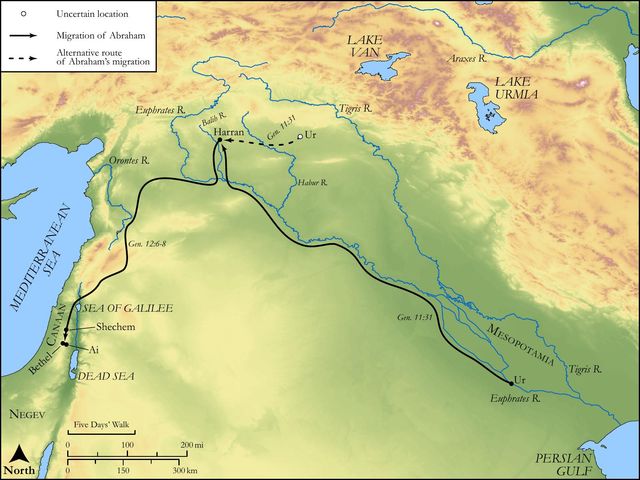
Genesis 12:1 marks a dramatic and pivotal shift in the narrative of Genesis. The preceding chapters (Genesis 1-11) chronicle humanity's universal decline from creation, through the Fall, the Flood, and the Tower of Babel, culminating in widespread idolatry and the dispersion of peoples across the earth. This section highlights humanity's repeated failure and God's judgment. Suddenly, the narrative narrows its focus from all humanity to one specific individual, Abram, introducing God's new redemptive strategy through a chosen family. The immediate literary context in Genesis 11:27-32 details Abram's genealogy and his father Terah's journey from Ur of the Chaldees towards Canaan, settling in Haran. The phrase "Now the LORD had said unto Abram" suggests either a prior call in Ur or a powerful reiteration and command in Haran, compelling Abram to act decisively and sever ties with his past life and family in a pagan environment.
Historical & Cultural Context
Abram lived in the early second millennium BCE (roughly 2000-1800 BCE), a period characterized by vibrant Chaldean city-states like Ur, known for their advanced urban centers, complex legal systems, and pervasive polytheistic worship. Ur, a major Sumerian city, was dedicated to the moon god Nanna (Sin), and idolatry would have been deeply ingrained in Abram's family and societal structure, as indicated by Joshua 24:2. The command to leave "country," "kindred," and "father's house" was a radical demand in a culture where family and clan ties were the primary sources of identity, security, and economic stability. Leaving one's family and homeland meant abandoning all known support systems and venturing into an unknown, potentially hostile, world. This highlights the immense faith and obedience required of Abram.
Key Themes
ShowHideThis verse introduces several foundational themes that permeate the rest of Genesis and the entire biblical narrative. Foremost is the theme of Divine Initiative and Election, where God sovereignly chooses an individual not based on merit but on His own gracious purpose, initiating a new phase of His redemptive plan. It also introduces the theme of Radical Obedience and Faith, as Abram is called to trust God's unseen plan and promises over tangible security. The command to "get thee out" establishes the theme of Separation for Divine Purpose, where God calls His chosen people to be distinct from the surrounding pagan world, setting the stage for the concept of a holy nation. Finally, it lays the groundwork for the Covenant Relationship, as this call immediately precedes the promises of the Abrahamic Covenant in Genesis 12:2-3, which will define God's interaction with Israel and, through them, with all humanity.
Exposition and Analysis
ShowHideKey Word Analysis
ShowHideThis is the tetragrammaton, YHWH (Yahweh), the personal covenant name of God, indicating His self-existent, eternal nature. The use of this specific name here emphasizes that the call to Abram is not from a generic deity but from the one true, sovereign God who enters into a personal, covenantal relationship with humanity. It underscores the authority and faithfulness of the caller.
A primitive root meaning "to say," used with great latitude to include commanding, appointing, declaring, and promising. In this context, it signifies a direct, authoritative divine utterance. The verb's perfect tense ("had said") suggests a completed action, possibly indicating a prior communication (perhaps in Ur, as suggested by Acts 7:2-3) that is now being reiterated or brought to a decisive point. This is a divine imperative, not a suggestion.
The Hebrew phrase is "Lekh Lekha" (לֶךְ־לְךָ), an emphatic imperative meaning literally "Go for yourself" or "Go to yourself." While the Strong's data for H3212 (yâlak) broadly means "to walk" or "to go," the specific construction "Lekh Lekha" carries profound theological weight. It implies a journey that is not merely geographical but deeply personal and transformative, leading Abram to his true self and destiny in God. It highlights the radical, self-redefining nature of the obedience required.
A primitive word for "father," indicating the literal and immediate paternal figure. In the households of the patriarchs, the father was the head of the household and the primary source of authority, identity, and security. Leaving the father's house meant a complete break from this foundational structure.
Refers to a physical dwelling, but also, by extension, the entire family, household, or lineage. The command to leave the "father's house" (bayith) signifies a severing of the most intimate familial and social ties, requiring Abram to abandon his entire known world and rely solely on God for his new identity and security.
Verse Breakdown
ShowHide"Now the LORD had said unto Abram,"
This opening clause immediately establishes the divine initiative. It is God, the sovereign Yahweh, who speaks directly to Abram, not Abram seeking God. The perfect tense "had said" implies a prior or ongoing communication, emphasizing that this call is part of God's deliberate and purposeful plan for Abram's life.
"Get thee out of thy country,"
This is the first and broadest command for separation. "Country" (ʼerets) refers to his homeland, likely Ur of the Chaldees (where the initial call may have occurred) and certainly Haran, where he was currently residing. This demanded a break from his cultural identity, the paganism of his society, and the familiar geographical landscape.
"and from thy kindred,"
The second level of separation, moving closer to Abram's personal sphere. "Kindred" (môwledeth) refers to his extended family, clan, and birthplace. In the days of the patriarchs, one's kindred provided social standing, protection, and economic support. Leaving them meant abandoning his entire social network and support system.
"and from thy father's house,"
This is the most intimate and challenging command for separation. "Father's house" (ʼâb bayith) refers to his immediate family and household, the very core of his identity and security. This demanded a complete break from parental authority and familial ties, signifying total reliance on God alone.
"unto a land that I will shew thee:"
This final clause reveals the destination – an unknown land, to be revealed by God. The ambiguity of the destination highlights the requirement for absolute trust and faith in God's guidance and provision. Abram was called to step into the unknown, solely on the basis of God's promise.
Literary Devices
ShowHideGenesis 12:1 is rich with literary devices that amplify its profound theological significance. The most striking is the Divine Imperative delivered directly by "the LORD," underscoring God's sovereign authority and initiative in human history. The command "Get thee out" (Lekh Lekha) is an Emphatic Repetition in Hebrew, intensifying the urgency and personal nature of the call, suggesting a journey of self-discovery and destiny. The triple command to leave "thy country, and from thy kindred, and from thy father's house" functions as a Climax or Gradation, progressively narrowing the scope of separation from the broad (country) to the intimate (father's house), highlighting the radical and comprehensive nature of the break required. This structure also creates a sense of Parallelism and Rhythmic Emphasis, reinforcing the magnitude of Abram's sacrifice. Furthermore, the deliberate vagueness of "unto a land that I will shew thee" creates Suspense and emphasizes the theme of Faith, as Abram is called to trust in an unseen future and an unknown destination, relying solely on God's guidance. This verse also serves as Foreshadowing, setting the stage for the unfolding narrative of the Abrahamic Covenant and the establishment of a new nation.
Theological and Thematic Connections
ShowHideGenesis 12:1 stands as a monumental turning point in biblical theology, shifting the focus from humanity's universal failure to God's specific, redemptive initiative through a chosen individual. It powerfully asserts God's sovereignty and His active involvement in history, demonstrating that salvation originates not from human striving but from divine election and grace. Abram's radical obedience to leave all familiar securities for an unknown future epitomizes the essence of faith—trusting God's character and promises above all else. This call to separation establishes a pattern for God's people throughout history: to be distinct from the world's systems and idolatry, set apart for His unique purposes and worship. It is the indispensable prelude to the Abrahamic Covenant, laying the groundwork for the promises of land, descendants, and universal blessing that will define God's relationship with Israel and, ultimately, with all humanity through Christ.
Reflection and Application
ShowHideGenesis 12:1 resonates profoundly with believers across all generations, serving as a timeless invitation to radical obedience and profound faith. Just as Abram was called to step out of his comfort zone, to sever ties with the familiar, and to venture into the unknown based solely on God's word, so too are we often summoned by God to leave behind influences that hinder our spiritual growth. This might involve abandoning ungodly habits, toxic relationships, worldly securities, or even deeply ingrained cultural norms that contradict God's truth. The verse challenges us to prioritize God's call above all earthly attachments, reminding us that true security and identity are found not in what we possess or where we belong, but in our unwavering trust in the One who calls us. It encourages us to embrace the spiritual journey of separation from the old self and the world's allure, venturing into God's promised future with complete reliance on His guidance and provision, even when the path ahead is unclear.
Questions for Reflection
ShowHideFAQ
ShowHideWhy did God choose Abram specifically?
ShowHideThe Bible does not explicitly state why God chose Abram over others, emphasizing instead God's sovereign and gracious initiative. His choice appears to be an act of divine election, setting in motion His redemptive plan through one man to bless all nations, rather than based on any inherent merit in Abram himself at that time. This highlights God's unmerited favor and His freedom to choose whom He wills to accomplish His purposes, a theme consistent throughout biblical history, as seen in the choosing of Israel (Deuteronomy 7:7-8).
Does "Get thee out" imply a physical or spiritual journey?
ShowHideWhile the command clearly involves a physical relocation from Abram's homeland, kindred, and father's house, the Hebrew emphatic construction Lekh Lekha ("Go for yourself" or "Go to yourself") suggests a deeper spiritual and personal transformation. It was a call not just to change location, but to change allegiance, identity, and reliance, moving from worldly security and pagan influences to complete dependence on God. This dual nature of the command underscores that true obedience often involves both outward action and inward transformation, leading to a new identity in God (Romans 12:2).
How does this verse relate to the Abrahamic Covenant?
ShowHideGenesis 12:1 is the prerequisite and foundational command that immediately precedes and enables the Abrahamic Covenant. God's command to "Get thee out" is followed directly by the declaration of the covenant promises in Genesis 12:2-3, which include promises of land, numerous descendants, blessing for Abram, and the ultimate promise that through him "all families of the earth shall be blessed." Abram's obedience to the radical call in verse 1 is the initial act of faith that unlocks the subsequent covenant blessings and sets the stage for God's redemptive plan to unfold through his lineage.
Christ-Centered Fulfillment
ShowHideGenesis 12:1, with its radical call to Abram to leave all for an unknown land, profoundly foreshadows the ultimate journey of faith and separation found in Christ. Just as Abram was called out of a pagan world to become the father of a new nation set apart for God, so too are believers in Christ called out of the "old self" and the kingdom of darkness into the kingdom of light, becoming a "new creation" in Him. Jesus Himself echoes Abram's radical obedience by calling His followers to "come out from among them, and be ye separate", urging them to forsake worldly allegiances and embrace a life of singular devotion to God. Moreover, Christ is the ultimate "seed" of Abraham through whom all the families of the earth are truly blessed, fulfilling the covenant promises initiated by this very call to Abram (Galatians 3:16). His journey to the cross and resurrection is the supreme act of obedience and faith, leading humanity to the promised "rest" and "inheritance" that Abram only saw from afar by faith, establishing a spiritual lineage far greater than any physical one.