


Isaiah 66:8
Bible text: King James Version (1769 Blayney text) · Public domain
Bible text: King James Version with Strong's numbers · Public domain
Bible text: Berean Standard Bible · Public domain
Bible text: American Standard Version (1901) · Public domain
Bible text: World English Bible, Messianic edition · Public domain
Bible text: Geneva Bible (1599) · Public domain
Bible text: Young's Literal Translation · Public domain
- מִיmiwho?H4310InterrogPronoun Interrogative
- שָׁמַעsha·Ma'has he heardH8085V-Qal-Perf-3msVerb Qal Perfect 3rd Singular Masculine
- כָּזֹאתka·Zotlike thisH2063Prep-k ¦ PrtParticle Demonstrativeכָּlikeזֹאתthis
- מִיmiwho?H4310InterrogPronoun Interrogative
- רָאָהra·'Ahhas he seenH7200V-Qal-Perf-3msVerb Qal Perfect 3rd Singular Masculine
- כָּאֵלֶּהka·'E·lehlike theseH428Prep-k ¦ PrtParticle Demonstrativeכָּlikeאֵלֶּהthese
- הֲיוּחַלha·Yu·chal¿ will it be brought forthH2342Interrog ¦ V-Hophal-Imperf-3msVerb Hophal Imperfect 3rd Singular Masculineהֲ¿יוּחַלwill it be brought forth
- אֶרֶץ'e·retza landH776N-fsNoun Singular Feminine Absolute
- בְּיוֹםbe·Yomin a dayH3117Prep-b ¦ N-msNoun Singular Masculine Absoluteבְּinיוֹםa day
- אֶחָד'e·ChadoneH259Adj-fsAdjective Numerical Singular Feminine Absolute
- אִם'imor?H518PrtParticle Conditional
- יִוָּלֵדyi·Va·ledwill it be bornH3205V-Niphal-Imperf-3msVerb Niphal Imperfect 3rd Singular Masculine
- גּוֹיGoya nationH1471N-msNoun Singular Masculine Absolute
- פַּעַםPa·'ama timeH6471N-fsNoun Singular Feminine Absolute
- אֶחָת'e·ChatoneH259Adj-fsAdjective Numerical Singular Feminine Absolute
- כִּיkiforH3588PrtParticle Conditional
- חָלָהCha·lahshe was in laborH2342V-Qal-Perf-3fsVerb Qal Perfect 3rd Singular Feminine
- גַּםgamalsoH1571AdvAdverb
- יָלְדָהYal·dahshe gave birth toH3205V-Qal-Perf-3fsVerb Qal Perfect 3rd Singular Feminine
- צִיּוֹןtzi·YonZionH6726N-properNoun Proper Location
- אֶת'et<obj.>H853DirObjMParticle Object Indicator
- בָּנֶיהָba·Nei·haher childrenH1121N-mpc ¦ 3fsNoun Plural Masculine Constructבָּנֶיchildrenהָher
English is a literal word-by-word gloss of the Hebrew, not the KJV's wording. Why?
This is the original text the KJV's translators worked from — each Hebrew word with its own literal English meaning in this verse, prepared by scholars at Tyndale House, Cambridge. The KJV translates whole sentences, not word by word, so its wording differs: one Hebrew word can become several English words, and the KJV may choose “the LORD” where the gloss reads “Yahweh”. Both are faithful — they answer different questions. For the KJV's own rendering, switch to the KJV text.
Details
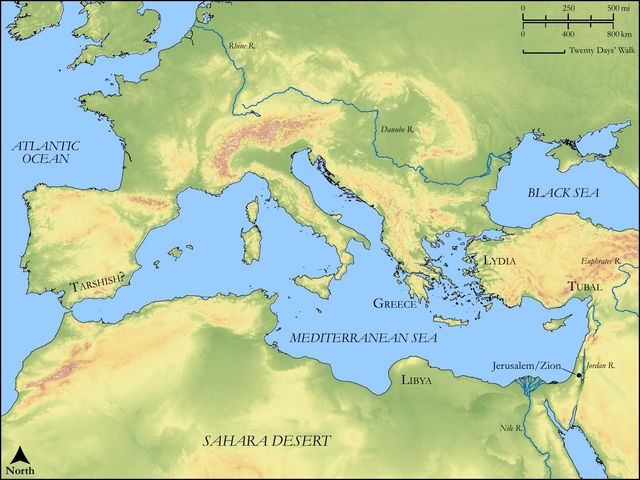
See on the biblical-era map
Study this verse
Public-domain commentary
Matthew Henry
From his Commentary on the Whole Bible. Henry comments on passages, not single verses — this entry covers Isaiah 66:5–14. His three-level outline is real structure in the source text, so it is rendered as structure.
The prophet, having denounced God's judgments against a hypocritical nation, that made a jest of God's word and would not answer him when he called to them, here turns his speech to those that trembled at his word, to comfort and encourage them; they shall not be involved in the judgments that are coming upon their unbelieving nation. Ministers must distinguish thus, that, when they speak terror to the wicked, they may not make the hearts of the righteous sad. Bone Christiane, hoc nihil ad te - Good Christian, this is nothing to thee. The prophet, having assured those that tremble at God's word of a gracious look from him (Isa 66:2), here brings them a gracious message from him. The word of God has comforts in store for those that by true humiliation for sin are prepared to receive them. There were those (Isa 66:4) who, when God spoke, would not hear; but, if some will not, others sill. If the heart tremble at the word, the ear will be open to it. Now what is here said to them?
I.Let them know that God will plead their just but injured cause against their persecutors (Isa 66:5):
Your brethren that hated you said, Let the Lord be glorified. But he shall appear to your joy. This perhaps might have reference to the case of some of the Jews at their return out of captivity; but nothing like it appears in the history, and therefore it is rather to be referred to the first preachers and professors of the gospel among the Jews, to whose case it is very applicable. Observe,
1.How the faithful servants of God were persecuted: Their brethren hated them. The apostles were Jews by birth, and yet even in the cities of the Gentiles the Jews they met with there were their most bitter and implacable enemies and stirred up the Gentiles against them. The spouse complains (Sol 1:6) that her mother's children were angry with her. Pilate upbraided our Lord Jesus with this, Thy own nation have delivered thee unto me, Joh 18:35. Their brethren, who should have loved them and encouraged them for their work's sake hated them, and cast them out of their synagogues, excommunicated them as if they had been the greatest blemishes, when they were really the greatest blessings, of their church and nation. This was a fruit of the old enmity in the seed of the serpent against the seed of the woman. Those that hated Christ hated his disciples, because they supported his kingdom and interest (Joh 15:18), and they cast them out for his name's sake, because they were called by his name, and called upon his name, and laid out themselves to advance his name. Note, It is no new thing for church censures to be misapplied, and for her artillery, which was intended for her defence, to be turned against her best friends, by the treachery of her governors. And those that did this said, Let the Lord be glorified; they pretended conscience and a zeal for the honour of God and the church in it, and did it with all the formalities of devotion. Our Saviour explains this, and seems to have reference to it, Joh 16:2. They shall put you out of their synagogues, and whosoever kills you will think that he does God service. In nomine Domini incipit omne malum - In the name of the Lord commences evil of every kind. Or we may understand it as spoken in defiance of God: "You say God will be glorified in your deliverance; let him be glorified then; let him make speed and hasten his work (Isa 5:19); let him deliver him, seeing he delighted in him." Some take it to be the language of the profane Jews in captivity, bantering their brethren that hoped for deliverance, and ridiculing the expectations they often comforted themselves with, that God would shortly be glorified in it. They thus did what they could to shame the counsel of the poor, Psa 14:6.
2.How they were encouraged under these persecutions: "Let your faith and patience hold out yet a little while; your enemies hate you and oppress you, your brethren hate you and cast you out, but your Father in heaven loves you, and will appear for you when no one else will or dare. His providence shall order things so as shall be for comfort to you; he shall appear for your joy and for the confusion of those that abuse you and trample on you; they shall be ashamed of their enmity to you." This was fulfilled when, upon the signals given of Jerusalem's approaching ruin, the Jews' hearts failed them for fear; but the disciples of Christ, whom they had hated and persecuted, lifted up their heads with joy, knowing that their redemption drew nigh, Luk 21:26, Luk 21:28. Though God seem to hide himself, he will in due time show himself.
II.Let them know that God's appearances for them will be such as will make a great noise in the world (Isa 66:6):
There shall be a voice of noise from the city, from the temple. Some make it the joyful and triumphant voice of the church's friends, others the frightful lamenting voice of her enemies, surprised in the city, and fleeing in vain to the temple for shelter. These voices do but echo to the voice of the Lord, who is now rendering a recompence to his enemies; and those that will not hear him speaking this terror shall hear them returning the alarms of it in doleful shrieks. We may well think what a confused noise there was in the city and temple when Jerusalem, after a long siege, was at last taken by the Romans. Some think this prophecy was fulfilled in the prodigies that went before that destruction of Jerusalem, related by Josephus in his History of the Wars of the Jews (4.388 and 6.311), that the temple-doors flew open suddenly of their own accord, and the priests heard a noise of motion or shifting in the most holy place, and presently a voice, saying, Let us depart hence. And, some time after, one Jesus Bar-Annas went up and down the city, at the feast of tabernacles, continually crying, A voice from the east, a voice from the west, a voice from the four winds, a voice against Jerusalem and the temple, a voice against all this people.
III.Let them know that God will set up a church for himself in the world, which shall be abundantly replenished in a little time (Isa 66:7):
Before she travailed she brought forth. This is to be applied in the type to the deliverance of the Jews out of their captivity in Babylon, which was brought about very easily and silently, without any pain or struggle, such as was when they were brought out of Egypt; that was done by might and power (Deu 4:34), but this by the Spirit of the Lord of hosts, Zac 4:6. The man-child of the deliverance is rejoiced in, and yet the mother was never in labour for it; before her pain came she was delivered. This is altogether surprising, uncommon, and without precedent, unless in the story which the Egyptian midwives told of the Hebrew women (Exo 1:19), that they were lively and were delivered ere the midwives came in unto them. But shall the earth be made to bring forth her fruits in one day? No, it is the work of some weeks in the spring to renew the face of the earth and cover it with its products. Some read this to the same purport with the next clause, Shall a land be brought forth in one day, or shall a nation be born at once? Is it to be imagined that a woman at one birth should bring children sufficient to people a country and that they should in an instant grow up to maturity? No; something like this was done in the creation; but God has since rested from all such works, and leaves second causes to produce their effects gradually. Nihil facit per saltum - He does nothing abruptly. Yet, in this case, as soon as Zion travailed she brought forth. Cyrus's proclamation was no sooner issued out than the captives were formed into a body and were ready to make the best of their way to their own land. And the reason is given (Isa 66:9), because it is the Lord's doing; he undertakes it whose work is perfect. If he bring to the birth in preparing his people for deliverance, he will cause to bring forth in the accomplishment of the deliverance. When every thing is ripe and ready for their release, and the number of their months is accomplished, so that the children are brought to the birth, shall not I then give strength to bring forth, but leave mother and babe to perish together in the most miserable case? How will this agree with the divine pity? Shall I begin a work and not go through with it? How will that agree with the divine power and perfection? Am I he that causes to bring forth (so the following clause may be read) and shall I restrain her? Does God cause mankind, and all the species of living creatures, to propagate, and replenish the earth, and will he restrain Zion? Will he not make her fruitful in a blessed offspring to replenish the church? Or, Am I he that begat, and should I restrain from bringing forth? Did God beget the deliverance in his purpose and promise, and will he not bring it forth in the accomplishment and performance of it? But this was a figure of the setting up of the Christian church in the world, and the replenishing of that family with children which was to be named from Jesus Christ. When the Spirit was poured out, and the gospel went forth from Zion, multitudes were converted in a little time and with little pains compared with the vast product. The apostles, even before they travailed, brought forth, and the children born to Christ were so numerous, and so suddenly and easily produced, that they were rather like the dew from the morning's womb than like the son from the mother's womb, Psa 110:3. The success of the gospel was astonishing; that light, like the morning, strangely diffused itself till it took hold even of the ends of the earth. Cities and nations were born at once to Christ. The same day that the Spirit was poured out there were 3000 souls added to the church. And, when this glorious work was once begun, it was carried on wonderfully, beyond what could be imagined, so mightily grew the word of God and prevailed. He that brought to the birth in conviction of sin caused to bring forth in a thorough conversion to God.
IV.Let them know that their present sorrows shall shortly be turned into abundant joys, Isa 66:10, Isa 66:11. Observe,
1.How the church's friends are described; they are such as love her, and mourn with her and for her. Note, All that love God love Jerusalem; they love the church of God, and lay its interest very near their heart. They admire the beauty of the church, take pleasure in communion with it, and heartily espouse its cause. And those that have a sincere affection for the church have a cordial sympathy with her in all the cares and sorrows of her militant state. They mourn for her; all her grievances are their griefs; if Jerusalem be in distress, their harps are hung on the willow-trees.
2.How they are encouraged: Rejoice with her, and again and again I say, Rejoice. This intimates that Jerusalem shall have cause to rejoice; the days of her mourning shall be at an end, and she shall be comforted according to the time that she has been afflicted. It is the will of God that all her friends should join with her in her joys, for they shall share with her in those blessings that will be the matter of her joy. If we suffer with Christ and sorrow with his church, we shall reign with him and rejoice with her. We are here called, (1.) To bear our part in the church's praises: "Come, rejoice with her, rejoice for joy with her, rejoice greatly, rejoice and know why you rejoice, rejoice on the days appointed for public thanksgiving. You that mourned for her in her sorrows cannot but from the same principle rejoice with her in her joys." (2.) To take our part in the church's comforts. We must suck and be satisfied with the breasts of her consolation. The word of God, the covenant of grace (especially the promises of that covenant), the ordinances of God, and all the opportunities of attending on him and conversing with him, are the breasts, which the church calls and counts the breasts of her consolations, where her comforts are laid up, and whence by faith and prayer they are drawn. With her therefore we must suck from these breasts, by an application of the promises of God to ourselves and a diligent attendance on his ordinances; and with the consolations which are drawn hence we must be satisfied, and not be dissatisfied though we have ever so little of earthly comforts. It is the glory of the church that she has the Lord for her God, that to her pertain the adoption and the service of God; and with the abundance of this glory we must be delighted. We must take more pleasure in our relation to God and communion with him than in all the delights of the sons and daughters of men. Whatever is the glory of the church must be our glory and joy, particularly her purity, unity, and increase.
V.Let them know that he who gives them this call to rejoice will give them cause to do so and hearts to do so, Isa 66:12-14.
1.He will give them cause to do so. For,
(1.)They shall enjoy a long uninterrupted course of prosperity: I will extend, or am extending, peace to her (that is, all good to her) like a river that runs in a constant stream, still increasing till it be swallowed up in the ocean. The gospel brings with it, wherever it is received in its power, such peace as this, which shall go on like a river, supplying souls with all good and making them fruitful, as a river does the lands it passes through, such a river of peace as the springs of the world's comforts cannot send forth and the dams of the world's troubles cannot stop nor drive back nor its sand rack up, such a river of peace as will carry us to the ocean of boundless and endless bliss.
(2.)There shall be large and advantageous additions made to them: The glory of the Gentiles shall come to them like a flowing stream. Gentiles converts shall come pouring into the church, and swell the river of her peace and prosperity; for they shall bring their glory with them; their wealth and honour, their power and interest, shall all be devoted to the service of God and employed for the good of the church: "Then shall you suck from the breasts of her consolations. When you see such crowding for a share in those comforts you shall be the more solicitous and the more vigorous to secure your share, not for fear of having the less for others coming in to partake of Christ" (there is no danger of that; he has enough for all and enough for each), "but their zeal shall provoke you to a holy jealousy." It is well when it does so, Rom 11:14; Co2 9:2.
(3.)God shall be glorified in all, and that ought to be more the matter of our joy than any thing else (Isa 66:14): The hand of the Lord shall be known towards his servants, the protecting supporting hand of his almighty power, the supplying enriching hand of his inexhaustible goodness; the benefit which his servants have by both these shall be known to his glory as well as theirs. And, to make this the more illustrious, he will at the same time make known his indignation towards his enemies. God's mercy and justice shall both be manifested and for ever magnified
2.God will not only give them cause to rejoice, but will speak comfort to them, will speak it to their hearts; and it is he only that can do that, and make it fasten there. See what he will do for the comfort of all the sons of Zion.
(1.)Their country shall be their tender nurse: You shall be carried on her sides, under her arms, as little children are, and shall be dangled upon her knees, as darlings are, especially when they are weary and out of humour, and must be got to sleep. Those that are joined to the church must be treated thus affectionately. The great Shepherd gathers the lambs in his arms and carries them in his bosom, and so must the under-shepherds, that they may not be discouraged. Proselytes should be favourites.
(2.)God will himself be their powerful comforter: As one whom his mother comforts, when he is sick or sore, or upon any account in sorrow, so will I comfort you; not only with the rational arguments which a prudent father uses, but with the tender affections and compassions of a loving mother, that bemoans her afflicted child when it has fallen and hurt itself, that she may quiet it and make it easy, or endeavours to pacify it after she has chidden it and fallen out with it (Jer 31:20): Since I spoke against him, my bowels are troubled for him; he is a dear son, he is a pleasant child. Thus the mother comforts. Thus you shall be comforted in Jerusalem, in the favours bestowed on the church, which you shall partake of, and in the thanksgivings offered by the church, which you shall concur with.
(3.)They shall feel the blessed effects of this comfort in their own souls (Isa 66:13): When you see this, what a happy state the church is restored to, not only your tongues and your countenances, but your hearts shall rejoice. This was fulfilled in the wonderful satisfaction which Christ's disciples had in the success of their ministry. Christ, with an eye to that, tells them (Joh 16:22), Your heart shall rejoice and your joy no man taketh from you. Then your bones, that were dried and withered (the marrow of them quite exhausted), shall recover a youthful strength and vigour and shall flourish like a herb. Divine comforts reach the inward man; they are marrow and moistening to the bones, Pro 3:8. The bones are the strength of the body; those shall be made to flourish with these comforts. The joy of the Lord will be your strength, Neh 8:10.
Historical interpretation
Historical reception
2 surviving comments on this verse. Each one is dated, so this reads as a timeline rather than a list.
Select a marker to jump to its quote. Markers stagger vertically where authors wrote within a few decades of each other.
Zion therefore gave birth, that is, the remnant of Israel and the faith of the believing apostles gave birth to the male Lord and Savior, who was generated at once throughout the entire universe. No one has either heard or told his story or taught it to anyone, so that all the nations might come to believe in a very short time and that there might be formed one Christian people from all the various peoples. This is what Paul was talking about when he said, “If any are in Christ, they are new creatures; the old has passed away and behold, they are made new,” as it is also written elsewhere, “All the families of the nations will worship before him.” … And this people was created in one day, whom the “sun of righteousness” illumined, as the Scripture says: “The Lord will be your everlasting light.” We can also correlate what is said here, “a people will arise as one because Zion bore and delivered her sons,” to that time when, on one day, three thousand and another five thousand of the Jewish people believed. Moreover, it is said in the same book of the Acts of the Apostles that there were persons in Jerusalem from all the nations under heaven, who heard one another speaking the glorious deeds of God, each in their own language. … But the meaning of the Septuagint’s text of this verse is that one people from the entire world shall arise in one moment to the preaching of the gospel. Or, in other words: I have repeatedly made this promise through many prophets, but you have not kept my promise in mind, O city full of crying, O temple vacated by the Lord, O people to whom I returned its own rejection. Is it not I who make fertile and make sterile? Did not she who was previously barren not later bear and deliver a child? Of this is it written in the Psalms: “He gives the barren woman a home and makes her a joyful mother of children.”
Again Isaiah teaches that Jerusalem will not be destroyed root, branch and all. For when he foretold the complete captivity of Jerusalem, he mentioned those chosen to survive. For a not insignificant number will be saved, obviously through faith in Christ—and he wants to make this clear. But the Jews were enraged with him and killed the prince of life. But when he rose again, trampling on death, he returned to his God and Father in heaven. In the meantime, the divine apostles proclaimed him to all, and they called even those who had been enraged with him to repentance and to salvation through faith and the forgiveness of sins through baptism.
Continue studying Isaiah 66:8 across the web’s major study libraries — every link below opens this exact verse, chapter, or book on the destination site.
Read & Compare
 BibleGatewayThis verse in more than 200 translations and 70 languages.
 Bible.comThe YouVersion reader — hundreds of translations, reading plans, and highlights.
 ESV.orgCrossway's official English Standard Version reader.
 NET BibleThe NET translation with 60,000+ translators' notes on every rendering decision.
 STEP BibleTyndale House's free study tool — original text, vocabulary, and scholarly resources.
 BibliaLogos Bible Software's free web reader.
 USCCBThe New American Bible (Revised Edition) with the U.S. bishops' study notes.
Commentaries
 BibleHub CommentariesDozens of classic commentaries on this verse, gathered on one page.
 StudyLightMore than 100 commentary sets — the largest collection on the web.
 BibleRefPlain-English commentary on what this verse means, verse by verse.
 Enduring WordDavid Guzik's free commentary on this chapter, widely used by Bible teachers.
 Bible Study ToolsVerse commentary alongside Greek and Hebrew study aids.
Original Language & Research
- BibleHub InterlinearThe verse word by word — original language, transliteration, and English.
- BibleHub LexiconEvery word's original-language definition and Strong's entry.
 Blue Letter BibleDeep-study tools — Strong's numbers, concordance, and word studies.
 SefariaThe Hebrew text with Rashi and centuries of Jewish commentary.
Sermons, Hymns & Audio


TrulyRandomVerse is not affiliated with these sites and doesn’t control their content. They’re linked because they’re genuinely useful.
Summary
Isaiah 66:8 is a powerful prophetic declaration, employing a series of rhetorical questions to underscore the utterly miraculous and unprecedented nature of God's future work in restoring Zion. It vividly portrays a swift, instantaneous national rebirth, defying all natural processes of growth and development, as if an entire nation could be born in a single day. This verse highlights divine intervention, where the typical pains of labor are immediately followed by abundant offspring, signifying God's sovereign power to bring about His purposes with unparalleled speed and efficacy, culminating in the glorious spiritual and physical restoration of His people.
Context
ShowHideLiterary Context
Isaiah 66:8 is strategically placed in the climactic final chapter of the Book of Isaiah, serving as a triumphant culmination of the prophet's sweeping eschatological vision. The preceding chapters, particularly Isaiah 65, detail the promise of a "new heavens and a new earth" and a transformed existence for God's faithful people, contrasting sharply with the judgment pronounced upon the rebellious. Chapter 66 continues this theme, emphasizing the distinction between those who truly worship God in spirit and truth versus those who engage in hypocritical rituals. Verse 8 specifically shifts from the general promise of restoration to a vivid, almost shocking, depiction of how this restoration will occur for Zion, immediately following a call for the nations to gather and witness God's glory and judgment (Isaiah 66:1-6). The verse acts as an immediate, miraculous fulfillment of the promises of renewal, setting the stage for the gathering of all nations to Jerusalem and the establishment of God's universal kingdom, as further described in Isaiah 66:18-24.
Historical & Cultural Context
The Book of Isaiah spans a significant period of Israelite history, from the Assyrian threat in the 8th century BCE to prophecies concerning the Babylonian exile and the subsequent return. While the immediate audience would have been those facing or anticipating exile, the latter chapters, including 66, look far beyond. The imagery of "travail" and "birth" was deeply resonant in ancient Israelite culture, where childbearing was central to family lineage, covenant promises, and national continuity. The concept of a nation being "born at once" would have been utterly foreign to their experience, as nations typically developed over centuries through slow demographic growth, conquest, and cultural evolution. This stark contrast underscores the supernatural nature of the prophecy. "Zion" refers to Jerusalem, the spiritual and political heart of Israel, and by extension, the people of Israel themselves. The historical context anticipates a time when the scattered and diminished people would be miraculously re-established, whether from exile or a later dispersion, in a manner that defies natural explanation, pointing towards a future ingathering and spiritual revival.
Key Themes
ShowHideThis verse powerfully contributes to several overarching themes within Isaiah and the broader prophetic literature. The primary theme is Divine Sovereignty and Miraculous Intervention, highlighting God's absolute power to accomplish His will instantaneously and supernaturally, bypassing conventional human processes. This echoes earlier declarations of God's ability to do "a new thing" (Isaiah 43:19). Closely related is the theme of Restoration and Rebirth, particularly for Zion (Israel), symbolizing a profound national and spiritual renewal that goes beyond mere physical return from exile. The imagery of "travail" and "birth" emphasizes the Redemptive Nature of God's Plan, where even pain (though here, surprisingly brief) leads to new life and abundant blessing. Finally, the rhetorical questions underscore the Uniqueness and Unprecedented Nature of God's eschatological work, signaling an event unlike anything previously witnessed in human history, pointing towards a future glorious age for God's people and the world, ultimately culminating in the establishment of God's eternal kingdom on the new earth (Isaiah 65:17-25).
Exposition and Analysis
ShowHideKey Word Analysis
ShowHideThis term refers to the earth at large or, partitively, a land or country. In the question "Shall the earth be made to bring forth in one day?", "earth" is used metaphorically to represent the ground or source from which a nation might emerge, emphasizing the impossibility of such a rapid, natural generation of a people or a land's produce. It sets up the rhetorical contrast to God's supernatural act, highlighting the absurdity of a natural process yielding such an immediate result.
This word denotes a foreign nation or Gentile people, but it can also refer to a people or nation in general, including Israel in certain contexts. Here, it specifically refers to the people of Israel as a collective entity. The phrase "shall a nation be born at once?" emphasizes the collective, national scope of the miraculous event—not just individuals, but an entire populace brought into existence or renewed in an instant, defying the gradual processes of societal development.
This primitive root means to twist, whirl, writhe in pain, especially of parturition (childbirth). It conveys the intense, often prolonged pain of labor. The striking contrast in the verse is that Zion's travail is immediately followed by birth ("for as soon as Zion travailed, she brought forth"), subverting the expectation of a lengthy, arduous process and highlighting the miraculous speed and ease of God's divine delivery.
Verse Breakdown
ShowHide"Who hath heard such a thing? who hath seen such things?"
These rhetorical questions serve to emphasize the utterly unprecedented and astonishing nature of the events about to be described. They challenge the listener's experience and knowledge, asserting that what God is about to do is beyond human comprehension or historical precedent, setting an expectation of the extraordinary.
"Shall the earth be made to bring forth in one day?"
This question uses the imagery of the earth spontaneously producing life or fruit in an incredibly short timeframe. It highlights the impossibility of natural, rapid generation and sets up the miraculous contrast with God's action, underscoring that the coming event will be a divine anomaly.
"[or] shall a nation be born at once?"
This directly applies the concept of instantaneous generation to a nation. It underscores the extraordinary nature of the prophecy: an entire people group, with its identity, structure, and population, coming into existence or full restoration in a single moment, bypassing the normal, gradual processes of societal and demographic development.
"for as soon as Zion travailed, she brought forth her children."
This clause provides the astounding answer to the preceding rhetorical questions, revealing the miraculous mechanism. "Zion" personifies the people of God (Israel/Jerusalem). The imagery of travail (labor pains) immediately followed by birth ("brought forth her children") signifies an incredibly swift and virtually effortless delivery. The normal, prolonged pain and duration of childbirth are compressed into an instant, emphasizing God's supernatural power to bring about national rebirth and abundant progeny with divine ease and speed, demonstrating His complete sovereignty over time and natural processes.
Literary Devices
ShowHideIsaiah 66:8 employs several potent rhetorical questions to deeply engage the audience and underscore the miraculous nature of the prophecy, challenging their assumptions about what is naturally possible. The verse is rich in personification, particularly with "Zion" being depicted as a woman in labor, giving birth to "her children." This vivid imagery transforms an abstract concept of national rebirth into a relatable, albeit extraordinary, human experience. The central paradox or hyperbole lies in the idea of instantaneous birth ("in one day," "at once") immediately following "travail," which typically implies a prolonged and painful process. This stark contrast serves to magnify God's power, demonstrating that His actions transcend natural limitations and human expectations. The metaphor of childbirth for national renewal is a recurring biblical theme, but here it is intensified to convey divine speed and efficacy, suggesting a supernatural event that defies all natural laws.
Theological and Thematic Connections
ShowHideIsaiah 66:8 stands as a profound testament to God's sovereign power to bring about His redemptive purposes in ways that defy human expectation and natural law. It speaks to a future, divinely orchestrated event of such magnitude and speed that it can only be attributed to the miraculous intervention of the Almighty. This instantaneous birth of a nation, or the rapid flourishing of Zion, underscores God's faithfulness to His covenant promises, demonstrating that He is not bound by conventional timelines or human limitations. It offers immense hope, assuring believers that even in the most seemingly impossible situations, God can bring about radical transformation and abundant life with unparalleled swiftness and ease. This passage points to an eschatological reality where God's ultimate plan for His people will be fulfilled with divine efficiency and glory.
Reflection and Application
ShowHideIsaiah 66:8 offers a powerful wellspring of hope and encouragement for believers navigating a world often characterized by slow progress, deep-seated problems, and seemingly insurmountable obstacles. This verse invites us to expand our vision of God's capabilities, reminding us that His power is not constrained by our human understanding of time or possibility. Just as a nation can be born "at once," so too can God bring about sudden, transformative breakthroughs in our personal lives, our families, our communities, and even global situations. It challenges us to move beyond incremental expectations and embrace the potential for immediate, divinely orchestrated change. This should cultivate a deeper trust in God's sovereign timing, knowing that what seems like a long, arduous process can, in His perfect will, culminate in a swift and glorious fulfillment. It calls us to pray with bold faith, believing that the God who can birth a nation in a day can also bring about spiritual revival, healing, or resolution in an instant, demonstrating His boundless power and faithfulness.
Questions for Reflection
ShowHideFAQ
ShowHideDoes Isaiah 66:8 refer to the modern State of Israel?
ShowHideWhile Isaiah 66:8 has been interpreted by some as a prophecy fulfilled in the modern rebirth of the nation of Israel in 1948, the primary context of the "new heavens and new earth" in Isaiah 65 and Isaiah 66 suggests a more ultimate, eschatological fulfillment. The "nation born at once" points to a miraculous, supernatural event that transcends typical political or historical developments. While the return of the Jewish people to their land is significant, the biblical imagery of instantaneous birth suggests a divine act of restoration that goes beyond a political re-establishment, encompassing spiritual renewal and a glorious, perhaps even instantaneous, transformation of the people of God in the end times. This could be a spiritual rebirth, a physical ingathering, or both, but its miraculous nature points to God's direct, unparalleled intervention, culminating in the full establishment of His kingdom.
What does "Zion travailed" mean if the birth is instantaneous?
ShowHideThe phrase "as soon as Zion travailed, she brought forth her children" creates a deliberate and striking paradox. "Travailed" (Hebrew chûwl) typically implies the pain and duration of labor. However, the immediate sequence "as soon as... she brought forth" subverts this expectation. It means that while there might be a moment of "labor" or preparation, it is so brief, so instantaneous, that the pain is immediately followed by the joy and abundance of birth. This emphasizes the miraculous nature of God's work: His power is so immense that He can compress what would normally be a prolonged, arduous process into an almost imperceptible moment, bringing forth life and blessing with divine ease and speed. It highlights that God's work is not bound by human limitations or conventional timelines, but operates according to His sovereign and supernatural will.
Christ-Centered Fulfillment
ShowHideIsaiah 66:8, while speaking of the national rebirth of Zion, finds its ultimate and most profound fulfillment in the person and work of Jesus Christ, and the spiritual birth of His Church. The "nation born at once" foreshadows the instantaneous spiritual rebirth of individuals who come to faith in Christ, as described by Jesus in John 3:3, where He declares, "Except a man be born again, he cannot see the kingdom of God." This spiritual birth is a miraculous, immediate transformation, where a new creation comes into being "at once" through the power of the Holy Spirit, without the prolonged "travail" of human effort or merit (2 Corinthians 5:17). Furthermore, the "children" brought forth by Zion can be seen as the Church, comprised of both Jew and Gentile, united in Christ (Ephesians 2:14-16). The rapid expansion of the early Church, beginning at Pentecost (Acts 2), where thousands were "born" into the new covenant community in a single day, powerfully echoes the miraculous speed envisioned in Isaiah. Jesus, as the ultimate "seed" of Abraham and the true Israel, is the one through whom this new spiritual nation is brought forth, demonstrating God's sovereign power to create a people for Himself, not through natural generation, but through the supernatural work of redemption and regeneration, culminating in the glorious, unified body of Christ, the true Zion, which will ultimately inherit the new heavens and new earth (Revelation 21:1-4).