


Genesis 11:30
Bible text: King James Version (1769 Blayney text) · Public domain
Bible text: Berean Standard Bible · Public domain
Bible text: American Standard Version (1901) · Public domain
Bible text: World English Bible, Messianic edition · Public domain
Bible text: Geneva Bible (1599) · Public domain
Bible text: Young's Literal Translation · Public domain
- וַתְּהִיva·te·Hiand she wasH1961Conj-w ¦ V-Qal-ConsecImperf-3fsVerb Qal Consecutive Imperfect 3rd Singular Feminineוַandתְּהִיshe was
- שָׂרַיsa·RaiSaraiH8297N-proper-fNoun Proper Feminine
- עֲקָרָה'a·ka·RahbarrenH6135Adj-fsAdjective Singular Feminine Absolute
- אֵין'einnotH369N-mscNoun Singular Masculine Construct
- לָהּlah[belonged] to <the> herPrep-l ¦ 3fsSuffix Personal 3rd Singular Feminineלָ[belonged] to <the>הּher
- וָלָדva·Lada childH2056N-msNoun Singular Masculine Absolute
English is a literal word-by-word gloss of the Hebrew, not the KJV's wording. Why?
This is the original text the KJV's translators worked from — each Hebrew word with its own literal English meaning in this verse, prepared by scholars at Tyndale House, Cambridge. The KJV translates whole sentences, not word by word, so its wording differs: one Hebrew word can become several English words, and the KJV may choose “the LORD” where the gloss reads “Yahweh”. Both are faithful — they answer different questions. For the KJV's own rendering, switch to the KJV text.
Details
See on the biblical-era maps


Study this verse
Public-domain commentary
Matthew Henry
From his Commentary on the Whole Bible. Henry comments on passages, not single verses — this entry covers Genesis 11:27–32. His three-level outline is real structure in the source text, so it is rendered as structure.
Here begins the story of Abram, whose name is famous, henceforward, in both Testaments. We have here,
I.His country:
Ur of the Chaldees. This was the land of his nativity, an idolatrous country, where even the children of Eber themselves had degenerated. Note, Those who are, through grace, heirs of the land of promise, ought to remember what was the land of their nativity, what was their corrupt and sinful state by nature, the rock out of which they were hewn.
II.His relations, mentioned for his sake, and because of their interest in the following story.
1.His father was Terah, of whom it is said (Jos 24:2) that he served other gods, on the other side of the flood, so early did idolatry gain footing in the world, and so hard is it even for those that have some good principles to swim against the stream. Though it is said (Gen 11:26) that when Terah was seventy years old he begat Abram, Nahor, and Haran (which seems to tell us that Abram was the eldest son of Terah, and was born in his seventieth year), yet, by comparing Gen 11:32, which makes Terah to die in his 205th year, with Act 7:4 (where it is said that he was but seventy-five years old when he removed from Haran), it appears that he was born in the 130th year of Terah, and probably was his youngest son; for, in God's choices, the last are often first and the first last. We have,
2.Some account of his brethren.
(1.)Nahor, out of whose family both Isaac and Jacob had their wives.
(2.)Haran, the father of Lot, of whom it is here said (Gen 11:28) that he died before his father Terah. Note, Children cannot be sure that they shall survive their parents; for death does not go by seniority, taking the eldest first. The shadow of death is without any order, Job 10:22. It is likewise said that he died in Ur of the Chaldees, before the happy removal of the family out of that idolatrous country. Note, It concerns us to hasten out of our natural state, lest death surprise us in it.
3.His wife was Sarai, who some think, was the same with Iscah, the daughter of Haran. Abram himself says of her that she was the daughter of his father, but not the daughter of his mother, Gen 20:12. She was ten years younger than Abram.
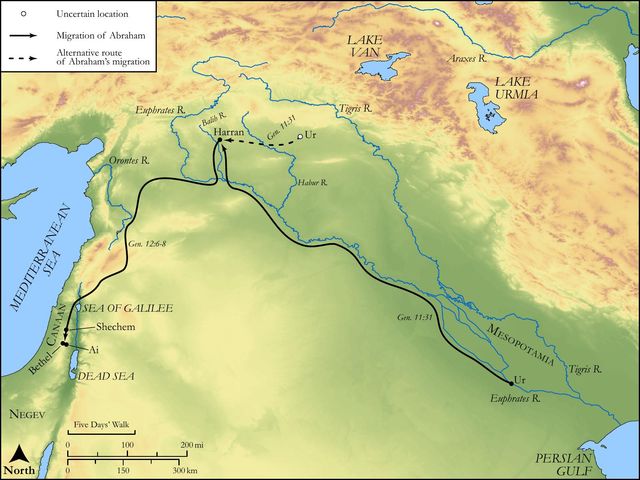
III.His departure out of Ur of the Chaldees, with his father Terah, his nephew Lot, and the rest of his family, in obedience to the call of God, of which we shall read more, Gen 12:1, etc. This chapter leaves them in Haran, or Charran, a place about mid-way between Ur and Canaan, where they dwelt till Terah's head was laid, probably because the old man was unable, through the infirmities of age, to proceed in his journey. Many reach to Charran, and yet fall short of Canaan; they are not far from the kingdom of God, and yet never come thither.
Historical interpretation
Historical reception
1 surviving comment on this verse from the historical church.
But Sarai was barren and had no children. By the counsel of Divine Providence, it happened that she was barren in her youth, so that in her old age, by bearing the son of promise, she might symbolize the holy Church, to whom it is said, "Rejoice, O barren woman who does not bear" (Galatians IV, 27), and so on. For it was fitting that she, who in the figure of unique faith and our hope was to bear one son of promise, should give birth to him not in Chaldea, nor in Mesopotamia, but in the land of promise.
Continue studying Genesis 11:30 across the web’s major study libraries — every link below opens this exact verse, chapter, or book on the destination site.
Read & Compare
 BibleGatewayThis verse in more than 200 translations and 70 languages.
 Bible.comThe YouVersion reader — hundreds of translations, reading plans, and highlights.
 ESV.orgCrossway's official English Standard Version reader.
 NET BibleThe NET translation with 60,000+ translators' notes on every rendering decision.
 STEP BibleTyndale House's free study tool — original text, vocabulary, and scholarly resources.
 BibliaLogos Bible Software's free web reader.
 USCCBThe New American Bible (Revised Edition) with the U.S. bishops' study notes.
Commentaries
 BibleHub CommentariesDozens of classic commentaries on this verse, gathered on one page.
 StudyLightMore than 100 commentary sets — the largest collection on the web.
 BibleRefPlain-English commentary on what this verse means, verse by verse.
 Enduring WordDavid Guzik's free commentary on this chapter, widely used by Bible teachers.
 Bible Study ToolsVerse commentary alongside Greek and Hebrew study aids.
Original Language & Research
- BibleHub InterlinearThe verse word by word — original language, transliteration, and English.
- BibleHub LexiconEvery word's original-language definition and Strong's entry.
 Blue Letter BibleDeep-study tools — Strong's numbers, concordance, and word studies.
 SefariaThe Hebrew text with Rashi and centuries of Jewish commentary.
Sermons, Hymns & Audio


TrulyRandomVerse is not affiliated with these sites and doesn’t control their content. They’re linked because they’re genuinely useful.
Summary
Genesis 11:30, declaring "But Sarai was barren; she [had] no child," serves as a pivotal narrative and theological statement at the culmination of Terah's genealogy. This stark pronouncement of Sarai's natural inability to conceive immediately precedes God's extraordinary call to Abram and His seemingly impossible promise of countless descendants, thereby establishing a profound tension that underscores divine power triumphing over human limitation and the essential role of faith in the unfolding of God's covenant purposes.
Context
ShowHideLiterary Context
Genesis 11:30 concludes the genealogical record of Terah, Abram's father, which traces the lineage from Shem to Abram. The chapter begins with the account of the Tower of Babel, highlighting humanity's rebellion and dispersion, and then shifts to a more focused genealogy leading to Abram. The abrupt declaration of Sarai's barrenness at the end of this genealogy is not merely a biographical detail but a deliberate literary device. It creates an immediate and formidable obstacle to the divine promise of a "great nation" and "numerous offspring" that God is about to make to Abram in Genesis 12:2. This strategic placement sets up a dramatic tension, emphasizing the human impossibility of the covenant's fulfillment and thus magnifying the miraculous nature of God's subsequent intervention.
Historical & Cultural Context
In the households of the patriarchs, fertility was considered a paramount blessing, a sign of divine favor, and essential for family continuity, inheritance, and social standing. Childlessness, particularly for women, was often viewed as a deep misfortune, a source of shame, or even a divine curse. The very identity and purpose of a woman were intrinsically linked to her ability to bear children. Therefore, the statement of Sarai's barrenness would have been understood by the original audience as a profound and seemingly insurmountable barrier to the establishment of a lineage, making God's impending promise to Abram all the more astonishing and counter-cultural. The cultural emphasis on lineage and heirs made Sarai's condition a significant theological and practical problem.
Key Themes
ShowHideGenesis 11:30 introduces and reinforces several key themes that permeate the book of Genesis and the broader biblical narrative. It immediately highlights the theme of human limitation versus divine omnipotence, demonstrating that God's plans are not constrained by natural human capabilities. This verse also sets the stage for the recurring theme of God's sovereignty over life and fertility, a motif seen in the stories of other barren women like Rebekah, Rachel, and Hannah. Furthermore, it underscores the necessity of faith as the sole means by which God's promises, especially those that defy natural explanation, are realized, a concept later expounded upon in the New Testament regarding Abraham's faith (e.g., Romans 4:18-21). The declaration of barrenness also serves as an initial point for the theme of divine election and covenant, showing that God chooses to work through seemingly impossible circumstances to demonstrate His unique power and faithfulness.
Exposition and Analysis
ShowHideGenesis 11:30 succinctly states Sarai's condition: "But Sarai was barren; she [had] no child." This seemingly simple declaration carries profound theological weight, setting the stage for the miraculous intervention of God in the life of Abram and Sarai.
Key Word Analysis
ShowHideAs per H8297, "Sarai" is derived from a root meaning "dominative" or "princely." This name, meaning "my princess" or "my lady," stands in stark contrast to her barren state. It highlights the irony of a woman designated for leadership or nobility who lacks the most fundamental aspect of a woman's fulfillment in that day—offspring to continue a lineage. Her later name change to Sarah, "princess of many," further emphasizes the divine transformation of her status from barrenness to fruitfulness.
This term describes someone "sterile (as if extirpated in the generative organs)." It denotes a physical, permanent inability to conceive children, whether male or female. The use of this specific word leaves no room for ambiguity; Sarai's condition was not temporary or a matter of waiting, but a fundamental biological reality that, from a human perspective, rendered the promise of descendants utterly impossible. This emphasizes the magnitude of the miracle that would eventually occur.
This word simply means "a boy; child." The phrase "she had no child" (literally "there was not to her a child") explicitly reinforces the previous statement of barrenness. It clarifies that her barrenness had resulted in a complete absence of offspring, not just a delay. This repetition underscores the finality and severity of her condition from a human standpoint, making the subsequent divine promise and its fulfillment unequivocally a work of God.
Verse Breakdown
ShowHide"But Sarai was barren"
This initial clause introduces the primary obstacle. The conjunction "But" signals a contrast or a significant turn in the narrative, immediately drawing attention to Sarai's condition as a problem. Her barrenness is stated as a definitive, established fact, not a temporary state. This biological reality, in the cultural context of the time, was a profound personal and familial tragedy, and a direct challenge to any promise of numerous descendants.
"she [had] no child"
This second clause functions as an emphatic reiteration and explanation of the first. It clarifies the practical consequence of her barrenness—a complete absence of offspring. The Hebrew construction literally means "there was not to her a child." This phrase removes any ambiguity, confirming that Sarai had never conceived and thus had no heir, reinforcing the human impossibility of the divine promise of a great nation through her lineage. It highlights the utter void that only God could fill.
Literary Devices
ShowHideGenesis 11:30 masterfully employs several literary devices to amplify its theological significance. Foreshadowing is prominent, as Sarai's barrenness immediately sets the stage for the miraculous birth of Isaac, an event that will demonstrate God's power to bring life from what is naturally impossible. This declaration also creates profound Irony: a woman whose name, Sarai, means "my princess" or "my lady," is unable to fulfill the most basic expectation of a woman in her culture—to bear children. This ironic contrast highlights the human predicament against the backdrop of divine promise. Furthermore, the verse functions as a stark Contrast, juxtaposing human inability with divine omnipotence. The barrenness represents the limit of human capacity, against which God's limitless power to create and sustain life will be dramatically displayed, underscoring that His covenant promises are not contingent on human strength but on His sovereign will.
Theological and Thematic Connections
ShowHideSarai's barrenness is not merely a biological fact but a profound theological statement, setting the stage for God to demonstrate His absolute sovereignty and faithfulness. It underscores that God's plans are not contingent on human ability or natural circumstances but on His divine will and power alone. This human impossibility necessitates an act of pure faith from Abram and Sarai, establishing a foundational theme of the Abrahamic narrative: God works through those who are weak or naturally disadvantaged to magnify His glory. The resolution of Sarai's barrenness through the miraculous birth of Isaac becomes a foundational miracle, demonstrating God's ability to create life where none is naturally possible, foreshadowing greater spiritual realities.
Reflection and Application
ShowHideGenesis 11:30 offers profound encouragement that God's grand purposes are never thwarted by our human limitations, perceived impossibilities, or the seemingly insurmountable obstacles we face. When confronted with significant challenges, apparent dead ends, or situations where our natural abilities and resources fall woefully short, this verse serves as a powerful reminder to shift our gaze beyond our own finite capabilities and place our trust entirely in God's supernatural power and perfect timing. Our weaknesses, our barren places, and our impossibilities can become the very platforms upon which God chooses to display His immense strength and unwavering faithfulness, leading to outcomes far grander and more glorious than we could ever conceive, much like the miraculous birth of Isaac. It compels us to surrender our perceived limitations to a God who specializes in bringing life from death, fruitfulness from barrenness, and hope from despair.
Questions for Reflection
ShowHideFAQ
ShowHideWhy was Sarai's barrenness significant to God's plan?
ShowHideSarai's barrenness was not an oversight or a mere biographical detail, but a deliberate and crucial element of God's sovereign plan. Its significance lies in its role as the ultimate human obstacle to the fulfillment of the Abrahamic covenant's central promise: the multiplication of descendants. By making His promise to a couple who were naturally incapable of having children, God ensured that the eventual birth of Isaac would be unequivocally understood as a divine miracle, a testament to His power alone, not human strength or natural ability. This compelled Abram and Sarai to exercise profound faith, demonstrating that God's promises are fulfilled not by human means but by His supernatural intervention, thereby magnifying His glory throughout salvation history (see Romans 4:18-21).
Christ-Centered Fulfillment
ShowHideSarai's barrenness and the subsequent miraculous birth of Isaac serve as a profound Old Testament type, foreshadowing the ultimate act of divine intervention in the person and work of Jesus Christ. Just as physical life sprang forth from a physically barren womb through God's power, spiritual life and new creation emerge from humanity's spiritually barren and dead condition through Christ. Humanity, by nature "dead in trespasses and sins" (Ephesians 2:1), is utterly incapable of producing spiritual life or righteousness on its own. Yet, through the virgin birth of Jesus, God Himself entered human history, and through His atoning death and resurrection, He brings forth a new spiritual lineage—a multitude of believers, a "holy nation" (1 Peter 2:9), from a spiritually dead world. Christ's resurrection, like Isaac's birth, is the ultimate testament to God's power to bring life from death, fulfilling the promise of a spiritual seed that is "as the stars of the sky and as the sand on the seashore" through faith in Him (Romans 4:16; Galatians 3:29). He is the true "seed" through whom all the families of the earth are blessed (Galatians 3:16), bringing spiritual fruitfulness where there was only spiritual barrenness.