


1 Samuel 1:2
- וְלוֹve·Loand [belonged] to <the> himConj-w ¦ Prep-l ¦ 3msSuffix Personal 3rd Singular Masculineוְandל[belonged] to <the>וֹhim
- שְׁתֵּיshe·TeitwoH8147N-fdcNoun Dual Feminine Construct
- נָשִׁיםna·ShimwivesH802N-mpNoun Plural Masculine Absolute
- שֵׁםshem[the] name ofH8034N-mscNoun Singular Masculine Construct
- אַחַת'a·ChatoneH259N-fsNoun Singular Feminine Absolute
- חַנָּהcha·Nah[was] HannahH2584N-proper-fNoun Proper Feminine
- וְשֵׁםve·Shemand [the] name ofH8034Conj-w ¦ N-mscNoun Singular Masculine Constructוְandשֵׁם[the] name of
- הַשֵּׁנִיתha·she·Nitthe secondH8145Art ¦ Adj-fsAdjective Numerical Position Singular Feminine Absoluteהַtheשֵּׁנִיתsecond
- פְּנִנָּהpe·ni·Nah[was] PeninnahH6444N-proper-fNoun Proper Feminine
- וַיְהִיvay·Hiand it belongedH1961Conj-w ¦ V-Qal-ConsecImperf-3msVerb Qal Consecutive Imperfect 3rd Singular Masculineוַandיְהִיit belonged
- לִפְנִנָּהlif·ni·Nahto PeninnahH6444Prep-l ¦ N-proper-fNoun Proper FeminineלִtoפְנִנָּהPeninnah
- יְלָדִיםye·la·DimchildrenH3206N-mpNoun Plural Masculine Absolute
- וּלְחַנָּהu·le·cha·Nahand [belonged] to HannahH2584Conj-w ¦ Prep-l ¦ N-proper-fNoun Proper Feminineוּandלְ[belonged] toחַנָּהHannah
- אֵין'einnotH369N-mscNoun Singular Masculine Construct
- יְלָדִיםye·la·DimchildrenH3206N-mpNoun Plural Masculine Absolute
English is a literal word-by-word gloss of the Hebrew, not the KJV's wording. Why?
This is the original text the KJV's translators worked from — each Hebrew word with its own literal English meaning in this verse, prepared by scholars at Tyndale House, Cambridge. The KJV translates whole sentences, not word by word, so its wording differs: one Hebrew word can become several English words, and the KJV may choose “the LORD” where the gloss reads “Yahweh”. Both are faithful — they answer different questions. For the KJV's own rendering, switch to the KJV text.
Details
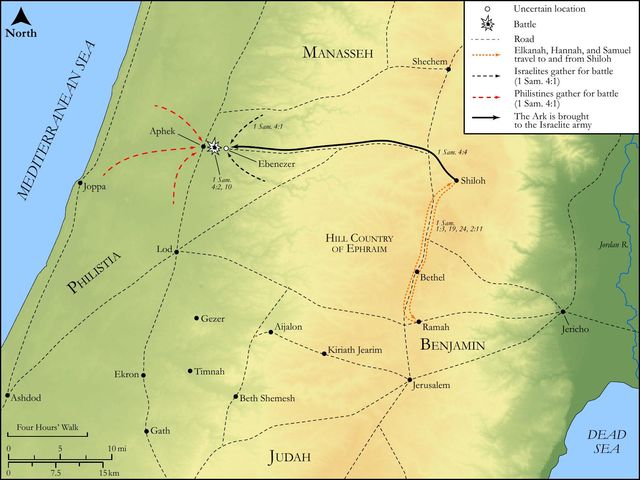
See on the biblical-era map
Study this verse
Public-domain commentary
Matthew Henry
From his Commentary on the Whole Bible. Henry comments on passages, not single verses — this entry covers 1 Samuel 1:1–8. His four-level outline is real structure in the source text, so it is rendered as structure.
We have here an account of the state of the family into which Samuel the prophet was born. His father's name was Elkanah, a Levite, and of the family of the Kohathites (the most honourable house of that tribe) as appears, Ch1 6:33, Ch1 6:34. His ancestor Zuph was an Ephrathite, that is, of Bethlehem-Judah, which was called Ephrathah, Ruth, Rut 1:2. There this family of the Levites was first seated, but one branch of it, in process of time, removed to Mount Ephraim, from which Elkanah descended. Micah's Levite came from Bethlehem to Mount Ephraim, Jdg 17:8. Perhaps notice is taken of their being originally Ephrathites to show their alliance to David. This Elkanah lived at Ramah, or Ramathaim, which signifies the double Ramah, the higher and lower town, the same with Arimathea of which Joseph was, here called Ramathaim-zophim. Zophim signifies watchmen; probably they had one of the schools of the prophets there, for prophets are called watchmen: the Chaldee paraphrase calls Elkanah a disciple of the prophets. But it seems to me that it was in Samuel that prophecy revived, before his time there being, for a great while, no open vision, Sa1 3:1. Nor is there any mention of a prophet of the Lord from Moses to Samuel, except Jdg 6:8. So that we have no reason to think that there was any nursery or college of prophets here till Samuel himself founded one, Jdg 19:19, Jdg 19:20. This is the account of Samuel's parentage, and the place of his nativity. Let us now take notice of the state of the family.
I.It was a devout family.
All the families of Israel should be so, but Levites' families in a particular manner. Ministers should be patterns of family religion. Elkanah went up at the solemn feasts to the tabernacle at Shiloh, to worship and to sacrifice to the Lord of hosts. I think this is the first time in scripture that God is called the Lord of hosts - Jehovah Sabaoth, a name by which he was afterwards very much called and known. Probably Samuel the prophet was the first that used this title of God, for the comfort of Israel, when in his time their hosts were few and feeble and those of their enemies many and mighty; then it would be a support to them to think that the God they served was Lord of hosts, of all the hosts both of heaven and earth; of them he has a sovereign command, and makes what use he pleases of them. Elkanah was a country Levite, and, for aught that appears, had not any place or office which required his attendance at the tabernacle, but he went up as a common Israelite, with his own sacrifices, to encourage his neighbours and set them a good example. When he sacrificed he worshipped, joining prayers and thanksgivings with his sacrifices. In this course of religion he was constant, for he went up yearly. And that which made it the more commendable in him was,
1.That there was a general decay and neglect of religion in the nations. Some among them worshipped other gods, and the generality were remiss in the service of the God of Israel, and yet Elkanah kept his integrity; whatever others did, his resolution was that he and his house should serve the Lord.
2.That Hophni and Phinehas, the sons of Eli, were the men that were now chiefly employed in the service of the house of God; and they were men that conducted themselves very ill in their place, as we shall find afterwards; yet Elkanah went up to sacrifice. God had then tied his people to one place and one altar, and forbidden them, under any pretence whatsoever, to worship elsewhere, and therefore, in pure obedience to that command, he attended at Shiloh. If the priests did not do their duty, he would do his. Thanks be to God, we, under the gospel, are not tied to any one place or family; but the pastors and teachers whom the exalted Redeemer has given to his church are those only whose ministration tends to the perfecting of the saints and the edifying of the body of Christ, Eph 4:11, Eph 4:12. None have dominion over our faith; but our obligation is to those that are the helpers of our holiness and joy, not to any that by their scandalous immoralities, like Hophni and Phinehas, make the sacrifices of the Lord to be abhorred, though still the validity and efficacy of the sacraments depend not on the purity of him that administers them.
II.Yet it was a divided family, and the divisions of it carried with them both guilt and grief.
Where there is piety, it is a pity but there should be unity. The joint-devotions of a family should put an end to divisions in it.
1.The original cause of this division was Elkanah's marrying two wives, which was a transgression of the original institution of marriage, to which our Saviour reduces it. Mat 19:5, Mat 19:8, From the beginning it was not so. It made mischief in Abraham's family, and Jacob's, and here in Elkanah's. How much better does the law of God provide for our comfort and ease in this world than we should, if we were left to ourselves! It is probable that Elkanah married Hannah first, and, because he had not children by her so soon as he hoped, he married Peninnah, who bore him children indeed, but was in other things a vexation to him. Thus are men often beaten with rods of their own making.
2.That which followed upon this error was that the two wives could not agree. They had different blessings: Peninnah, like Leah, was fruitful and had many children, which should have made her easy and thankful, though she was but a second wife, and was less beloved; Hannah, like Rachel, was childless indeed, but she was very dear to her husband, and he took all occasions to let both her and others know that she was so, and many a worthy portion he gave her (Sa1 1:5), and this should have made her easy and thankful. But they were of different tempers: Peninnah could not bear the blessing of fruitfulness, but she grew haughty and insolent; Hannah could not bear the affliction of barrenness, but she grew melancholy and discontented: and Elkanah had a difficult part to act between them.
(1.)Elkanah kept up his attendance at God's altar notwithstanding this unhappy difference in his family, and took his wives and children with him, that, if they could not agree in other things, they might agree to worship God together. If the devotions of a family prevail not to put an end to its divisions, yet let not the divisions put a stop to the devotions.
(2.)He did all he could to encourage Hannah, and to keep up her spirits under her affliction, Sa1 1:4, Sa1 1:5. At the feast he offered peace-offerings, to supplicate for peace in his family; and when he and his family were to eat their share of the sacrifice, in token of their communion with God and his altar, though he carved to Peninnah and her children competent portions, yet to Hannah he gave a worthy portion, the choicest piece that came to the table, the piece (whatever it was) that used to be given on such occasions to those that were most valued; this he did in token of his love to her, and to give all possible assurances of it. Observe,
[1.]Elkanah loved his wife never the less for her being barren. Christ loves his church, notwithstanding her infirmities, her barrenness; and so ought men to love their wives, Eph 5:25. To abate our just love to any relation for the sake of any infirmity which they cannot help, and which is not their sin but their affliction, is to make God's providence quarrel with his precept, and very unkindly to add affliction to the afflicted.
[2.]He studied to show his love so much the more because she was afflicted, insulted, and low-spirited. It is wisdom and duty to support the weakest, and to hold up those that are run down.
[3.]He showed his great love to her by the share he gave her of his peace-offerings. Thus we should testify our affection to our friends and relations, by abounding in prayer for them. The better we love them the more room let us give them in our prayers.
(3.)Peninnah was extremely peevish and provoking.
[1.]She upbraided Hannah with her affliction, despised her because she was barren, and gave her taunting language, as one whom Heaven did not favour.
[2.]She envied the interest she had in the love of Elkanah, and the more kind he was to her the more was she exasperated against her, which was all over base and barbarous.
[3.]She did this most when they went up to the house of the Lord, perhaps because then they were more together than at other times, or because then Elkanah showed his affection most to Hannah. But it was very sinful at such a time to show her malice, when pure hands were to be lifted up at God's altar without wrath and quarrelling. It was likewise very unkind at that time to vex Hannah, not only because then they were in company, and others would take notice of it, but then Hannah was to mind her devotions, and desired to be most calm and composed, and free from disturbance. The great adversary to our purity and peace is then most industrious to ruffle us when we should be most composed. When the sons of God come to present themselves before the Lord Satan will be sure to come among them, Job 1:6.
[4.]She continued to do this from year to year, not once or twice, but it was her constant practice; neither deference to her husband nor compassion to Hannah could break her of it.
[5.]That which she designed was to make her fret, perhaps in hopes to break her heart, that she might possess her husband's heart solely, or because she took a pleasure in her uneasiness, nor could Hannah gratify her more than by fretting. Note, It is an evidence of a base disposition to delight in grieving those that are melancholy and of a sorrowful spirit, and in putting those out of humour that are apt to fret and be uneasy. We ought to bear one another's burdens, not add to them.
(4.)Hannah (poor woman) could not hear the provocation: She wept, and did not eat, Sa1 1:7. It made her uneasy to herself and to all her relations. She did not eat of the feast; her trouble took away her appetite, made her unfit for any company, and a jar in the harmony of family-joy. It was of the feast upon the sacrifice that she did not eat, for they were not to eat of the holy things in their mourning, Deu 26:14; Lev 10:19. Yet it was her infirmity so far to give way to the sorrow of the world as to unfit herself for holy joy in God. Those that are of a fretful spirit, and are apt to lay provocations too much to heart, are enemies to themselves, and strip themselves very much of the comforts both of life and godliness. We find that God took notice of this ill effect of discontents and disagreements in the conjugal relation, that the parties aggrieved covered the altar of the Lord with tears, insomuch that he regarded not the offering, Mal 2:13.
(5.)Elkanah said what he could to her to comfort her. She did not upbraid him with his unkindness in marrying another wife as Sarah did, nor did she render to Peninnah railing for railing, but took the trouble wholly to herself, which made her an object of much compassion. Elkanah showed himself extremely grieved at her grief (Sa1 1:8): Hannah, why weepest thou?
[1.]He is much disquieted to see her thus overwhelmed with sorrow. Those that by marriage are made one flesh ought thus far to be of one spirit too, to share in each other's troubles, so that one cannot be easy while the other is uneasy.
[2.]He gives her a loving reproof for it: Why weepest thou? And why is thy heart grieved? As many as God loves he rebukes, and so should we. He puts her upon enquiring into the cause of her grief. Though she had just reason to be troubled, yet let her consider whether she had reason to be troubled to such a degree, especially so much as to be taken off by it from eating of the holy things. Note, Our sorrow upon any account is sinful and inordinate when it diverts us from our duty to God and embitters our comfort in him, when it makes us unthankful for the mercies we enjoy and distrustful of the goodness of God to us in further mercies, when it casts a damp upon our joy in Christ, and hinders us from doing the duty and taking the comfort of our particular relations.
[3.]He intimates that nothing should be wanting on his part to balance her grief: "Am not I better to thee than ten sons? Thou knowest thou hast my entire affection, and let that comfort thee." Note, We ought to take notice of our comforts, to keep us from grieving excessively for our crosses; for our crosses we deserve, but our comforts we have forfeited. If we would keep the balance even, we must look at that which is for us, as well as at that which is against us, else we are unjust to Providence and unkind to ourselves. God hath set the one over-against the other (Ecc 7:14) and so should we.
Historical interpretation
Five Centuries of Reception
4 surviving comments on this verse. Each one is dated, so this reads as a timeline rather than a list.
Select a marker to jump to its quote. Markers stagger vertically where authors wrote within a few decades of each other.
In this [figurative] way, therefore, I think the marriages of the elders are interpreted more fittingly; in this way the unions entered by the patriarchs in their now final and weakened age are understood nobly; in this way I hold the necessary begetting of children should be reckoned. For young men are not so well fitted as old men for such marriages and for offspring of this kind. For to the extent that someone is feeble in the flesh, to such an extent will he be stronger in virtue of the soul and more fit for the embraces of wisdom. So also that just man Elkanah in the Scriptures is reported to have had two wives at the same time, one of whom was called Peninnah, the other Hannah, that is, “conversion” and “grace.” And first, indeed, he is said to have had sons by Peninnah, that is, of conversion, and later by Hannah, that is, of grace.And indeed the Scripture designates the progress of the saints figuratively by marriages. Whence also you can, if you wish, be a husband of marriages of this kind. For example, if you freely practice hospitality, you will appear to have taken her as your wife. If you shall add to this care of the poor, you will appear to have obtained a second wife. But if you should also join patience to yourself and gentleness and the other virtues, you will appear to have taken as many wives as the virtues you enjoy.
Thence it is, therefore, that Scripture recounts that some of the patriarchs had many wives at the same time, that others took other wives when previous wives had died. The purpose of this is to indicate figuratively that some can exercise many virtues at the same time; others cannot begin those which follow before they have brought the former virtues to perfection.
That the church which before had been barren should have more children from among the Gentiles than what the synagogue had had before. Isaiah said, “Rejoice, O barren one, that barest not; break forth and shout, who has not been in labor, for the deserted one will have more children than she who has a husband.…” So also, to Abraham, when his first son was born of a bondwoman, Sarah remained long barren, but later, in her old age, bore him her promised son Isaac, who was a type of the Christ. Jacob also took two wives: the elder, Leah, with weak eyes, was a type of the synagogue; the younger and beautiful Rachel, a type of the church, who also remained long barren and afterwards brought forth Joseph, who also was himself a type of Christ. And in 1 Kings [Samuel] it is said that Elkanah has two wives: Peninnah, with her sons; and Hannah, barren, from whom is born not according to the order of generation but according to the mercy and promise of God, when she had prayed in the temple; and Samuel, being born, was a type of Christ. Again in 1 Kings [Samuel]: “The barren has born seven; and she who had many children has grown weak.”
And he had two wives, etc. Anna, whose name means 'grace,' represents the Church: Phenenna, whose name means 'conversion,' demonstrates the synagogue. And fittingly Anna is first, and Phenenna second; because the first times of the world had holy ones, who, living lives similar to ours without the ceremonies of legal sacrifices, sabbaths, new moons, circumcision, and various purifications, pleased God through the righteousness of faith alone, hoping to be saved by Christ’s grace alone, from the time his incarnation was shown to the patriarchs. Thus finally, the conversion of the Synagogue from Egypt to the Lord is celebrated.
And Phenenna had children, etc. The synagogue, ever since she was betrothed to the Lord, has never ceased to generate spiritual children for him through teaching. Gentilitas, however, although it never ceased to be subject to his grace in some, albeit few, could not generate for him children who live spiritually through preaching; because she neither deserved to receive his testament openly, nor the prophecies, nor the oracles of angels.
Continue studying 1 Samuel 1:2 across the web’s major study libraries — every link below opens this exact verse, chapter, or book on the destination site.
Read & Compare
 BibleGatewayThis verse in more than 200 translations and 70 languages.
 Bible.comThe YouVersion reader — hundreds of translations, reading plans, and highlights.
 ESV.orgCrossway's official English Standard Version reader.
 NET BibleThe NET translation with 60,000+ translators' notes on every rendering decision.
 STEP BibleTyndale House's free study tool — original text, vocabulary, and scholarly resources.
 BibliaLogos Bible Software's free web reader.
 USCCBThe New American Bible (Revised Edition) with the U.S. bishops' study notes.
Commentaries
 BibleHub CommentariesDozens of classic commentaries on this verse, gathered on one page.
 StudyLightMore than 100 commentary sets — the largest collection on the web.
 BibleRefPlain-English commentary on what this verse means, verse by verse.
 Enduring WordDavid Guzik's free commentary on this chapter, widely used by Bible teachers.
 Bible Study ToolsVerse commentary alongside Greek and Hebrew study aids.
Original Language & Research
- BibleHub InterlinearThe verse word by word — original language, transliteration, and English.
- BibleHub LexiconEvery word's original-language definition and Strong's entry.
 Blue Letter BibleDeep-study tools — Strong's numbers, concordance, and word studies.
 SefariaThe Hebrew text with Rashi and centuries of Jewish commentary.
Sermons, Hymns & Audio


TrulyRandomVerse is not affiliated with these sites and doesn’t control their content. They’re linked because they’re genuinely useful.
Summary
This verse introduces the immediate family structure of Elkanah, a Levite from Ramathaim-zophim in the hill country of Ephraim, establishing the central tension that drives the opening narrative of 1 Samuel. It starkly contrasts his two wives: Peninnah, who had borne him children, and Hannah, who was barren. This seemingly simple statement lays the groundwork for Hannah's deep personal anguish, her fervent prayers, and ultimately, God's miraculous intervention, which sets the stage for the birth and dedication of Samuel, a pivotal figure in Israel's history.
Context
ShowHideLiterary Context
1 Samuel 1:2 immediately follows the introduction of Elkanah in 1 Samuel 1:1. It serves as the narrative's inciting incident, establishing the domestic conflict and emotional distress that will propel the entire first chapter. The contrast between Peninnah's fertility and Hannah's barrenness is not merely descriptive but is the very catalyst for Hannah's desperate prayer and vow in 1 Samuel 1:10-11, leading directly to the birth of Samuel in 1 Samuel 1:20. This verse sets the personal, familial stage before the broader national and spiritual crises that Samuel will address.
Historical & Cultural Context
This narrative unfolds during the tumultuous period of the Judges, a time characterized by spiritual decline and societal instability (Judges 21:25). While God's original design for marriage was monogamous (Genesis 2:24), polygamy was practiced in ancient Israel, often leading to significant domestic strife and rivalry, as seen in the households of Abraham, Jacob, and now Elkanah. In this culture, children, especially sons, were considered an immense blessing from God, a sign of divine favor, and crucial for family lineage, inheritance, and social standing. Conversely, barrenness was a profound personal sorrow, often accompanied by societal stigma and deep emotional distress for women, sometimes even perceived as a sign of divine disfavor. The annual pilgrimage to Shiloh, mentioned in 1 Samuel 1:3, highlights the central role of this sanctuary as the primary place of worship before the construction of the Temple in Jerusalem.
Key Themes
ShowHideThe verse introduces several foundational themes that resonate throughout 1 Samuel and the broader biblical narrative. The most prominent is the theme of barrenness and divine intervention, echoing the stories of other matriarchs like Sarah, Rebekah, and Rachel, whose inability to conceive ultimately highlighted God's sovereign power to open the womb and bring forth life for His purposes. This underscores the sovereignty of God over human life, circumstances, and even biological functions. Furthermore, the presence of two wives immediately establishes a dynamic of family strife and rivalry, a common consequence of polygamy in the biblical record. This rivalry, fueled by Peninnah's taunting of Hannah (1 Samuel 1:6), is crucial for understanding Hannah's desperate plea to God. The verse also subtly introduces the importance of progeny in Israelite society, setting the stage for the miraculous birth of Samuel, a figure whose very existence is a testament to God's faithfulness and a turning point in Israel's history.
Exposition and Analysis
ShowHideKey Word Analysis
ShowHideMeaning "favored" or "grace." This name is profoundly significant, as Hannah's story is a testament to God's unmerited favor. Despite her barrenness and deep distress, she experiences God's grace in answering her prayer and granting her a child. Her name foreshadows the divine kindness she receives and the gracious character of God revealed through her narrative.
Probably feminine from a root meaning "pearl" or "precious stone." Ironically, while her name suggests value and beauty, her actions throughout the narrative—particularly her constant provocation of Hannah—are anything but precious or graceful. Her name stands in stark contrast to her character, highlighting the bitterness and envy that can arise within complex family dynamics.
Meaning "something born, i.e., a lad or offspring." This word is central to the verse's tension. The declaration that "Peninnah had children, but Hannah had no children" (using the negation of yeled) underscores the profound social and personal significance of progeny in ancient Israel. For Hannah, the absence of yeled represented not only a deep personal sorrow but also a cultural stigma, setting the stage for her desperate plea to God for a child.
Verse Breakdown
ShowHide"And he had two wives;"
This opening clause immediately introduces the polygamous household of Elkanah. In ancient Israel, while not God's original design, polygamy was practiced, often leading to the very domestic strife that characterizes this narrative. It sets the stage for inherent relational complexities within the family unit.
"the name of the one [was] Hannah, and the name of the other Peninnah:"
This clause introduces the two primary female characters, establishing their distinct identities. The naming is crucial as their names carry symbolic weight that will be explored through their actions and experiences, particularly in relation to their contrasting circumstances.
"and Peninnah had children, but Hannah had no children."
This is the pivotal statement of the verse, creating a stark and immediate juxtaposition. It highlights the contrasting fertility of the two wives, with Peninnah being fruitful and Hannah barren. This contrast is the source of Hannah's deep sorrow and the catalyst for the entire narrative that follows, setting up the conflict, the profound longing, and the eventual divine intervention.
Literary Devices
ShowHideThe verse employs several effective Literary Devices to establish its foundational themes. Juxtaposition is immediately evident in the stark contrast between Peninnah's fertility and Hannah's barrenness, which instantly creates tension and highlights Hannah's plight. This contrast is not merely descriptive but serves as the primary Conflict Introduction, laying the groundwork for the emotional and spiritual struggle that defines Hannah's story. The names themselves, Hannah ("grace") and Peninnah ("pearl"), provide Irony and Symbolism. Hannah's name foreshadows the divine grace she will receive, while Peninnah's name ironically contrasts with her un-precious and vexing behavior. Furthermore, Hannah's barrenness serves as powerful Foreshadowing, hinting at the extraordinary divine intervention required for the birth of Samuel, a pivotal figure whose arrival will be a testament to God's sovereign power and a turning point in Israel's history.
Theological and Thematic Connections
ShowHide1 Samuel 1:2 profoundly introduces the theme of God's sovereignty over life and death, particularly His control over the womb. Hannah's barrenness is not merely a biological condition but a divinely ordained circumstance that sets the stage for a miraculous birth, emphasizing that children are a gift from the Lord, not a human achievement. This narrative highlights that God often chooses to work through human weakness and inability to display His power and faithfulness, ensuring that the glory belongs to Him alone. It also underscores the deep human longing for fulfillment and purpose, often found in family and progeny, and how God meets these desires in His perfect timing and for His ultimate redemptive plan. The suffering of barrenness, though painful, becomes the crucible through which God raises up a prophet who will reshape the spiritual landscape of Israel.
Reflection and Application
ShowHideThe stark contrast presented in 1 Samuel 1:2—Peninnah's children versus Hannah's barrenness—resonates deeply with the human experience of unmet longings and the pain of comparison. Hannah's situation invites us to reflect on areas in our own lives where we feel barren, lacking, or overlooked, especially when others around us seem to flourish effortlessly. It challenges us to confront the temptation of envy and bitterness that can arise when our deepest desires remain unfulfilled. Hannah's subsequent response, turning her pain into fervent prayer and a vow to God, serves as a powerful model for how to navigate such seasons. This verse encourages us to trust in God's sovereign timing and His unique plan for our lives, recognizing that our perceived weaknesses or lacks can often be the very pathways through which God chooses to display His power and bring about His greater purposes. Our trials, like Hannah's barrenness, may be precisely what God uses to birth something significant for His kingdom and glory.
Questions for Reflection
ShowHideFAQ
ShowHideWhy was polygamy practiced in ancient Israel, and what does the Bible say about it?
ShowHidePolygamy, the practice of having more than one spouse, was indeed practiced in ancient Israel, as evidenced by figures like Abraham, Jacob, David, and Elkanah. While the Bible records its existence, it does not endorse it as God's ideal. God's original design for marriage, established in Genesis 2:24, was monogamous: "Therefore a man shall leave his father and his mother and hold fast to his wife, and they shall become one flesh." Throughout Scripture, polygamy is consistently associated with domestic strife, jealousy, and complicated family dynamics, as vividly illustrated in Jacob's household (Genesis 30:1-8) and here in Elkanah's. The Law of Moses regulated polygamy (e.g., Deuteronomy 21:15-17), but it did not command or encourage it. Instead, the New Testament consistently upholds the monogamous ideal for marriage (Matthew 19:4-6, 1 Timothy 3:2).
Christ-Centered Fulfillment
ShowHideThe narrative of Hannah's barrenness and the miraculous birth of Samuel, introduced in 1 Samuel 1:2, finds profound Christ-centered fulfillment. Hannah's name, meaning "grace," foreshadows the ultimate grace extended to humanity through Jesus Christ. Her inability to bear children highlights humanity's spiritual barrenness—our inherent inability to produce spiritual life or righteousness on our own. Just as God supernaturally intervened to open Hannah's womb, He supernaturally intervenes in our lives to grant us new spiritual birth through the Holy Spirit (John 3:3-8). Samuel, born of a miraculous divine act, becomes a prophet, priest, and judge, pointing forward to Christ, who is the ultimate Prophet, Priest, and King. The theme of God choosing the weak and barren to bring forth mighty things (1 Corinthians 1:27-29) is powerfully embodied in Hannah's story, culminating in the birth of the One who brings true spiritual fruitfulness to all who believe (Galatians 4:27). Ultimately, Hannah's story of longing, prayer, and divine provision serves as a beautiful micro-narrative of God's larger redemptive plan, where our deepest needs are met not by human effort, but by the sovereign, gracious intervention of God in Christ.