


Judges 8:30
Bible text: King James Version (1769 Blayney text) · Public domain
Bible text: Berean Standard Bible · Public domain
Bible text: American Standard Version (1901) · Public domain
Bible text: World English Bible, Messianic edition · Public domain
Bible text: Geneva Bible (1599) · Public domain
Bible text: Young's Literal Translation · Public domain
- וּלְגִדְעוֹןu·le·gid·'onand to GideonH1439Conj-w ¦ Prep-l ¦ N-proper-mNoun Proper MasculineוּandלְtoגִדְעוֹןGideon
- הָיוּha·Yuthey belongedH1961V-Qal-Perf-3cpVerb Qal Perfect 3rd Plural common gender
- שִׁבְעִיםshiv·'ImseventyH7657N-mpNoun Plural Masculine Absolute
- בָּנִיםba·NimsonsH1121N-mpNoun Plural Masculine Absolute
- יֹצְאֵיyo·tze·'Ei[who] came out ofH3318V-Qal-Prtcpl-mpVerb Qal Participle Plural Masculine Construct
- יְרֵכוֹye·re·Khohis thighH3409N-fsc ¦ 3msNoun Singular Feminine Constructיְרֵכthighוֹhis
- כִּיkiforH3588PrtParticle Conditional
- נָשִׁיםna·ShimwivesH802N-mpNoun Plural Masculine Absolute
- רַבּוֹתra·BotmanyH7227Adj-fpAdjective Plural Feminine Absolute
- הָיוּHa·yuthey belongedH1961V-Qal-Perf-3cpVerb Qal Perfect 3rd Plural common gender
- לוֹloto <the> himPrep-l ¦ 3msSuffix Personal 3rd Singular Masculineלto <the>וֹhim
English is a literal word-by-word gloss of the Hebrew, not the KJV's wording. Why?
This is the original text the KJV's translators worked from — each Hebrew word with its own literal English meaning in this verse, prepared by scholars at Tyndale House, Cambridge. The KJV translates whole sentences, not word by word, so its wording differs: one Hebrew word can become several English words, and the KJV may choose “the LORD” where the gloss reads “Yahweh”. Both are faithful — they answer different questions. For the KJV's own rendering, switch to the KJV text.
Details
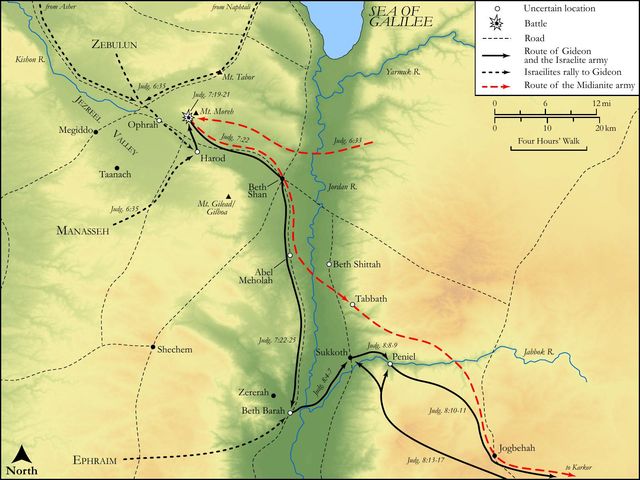
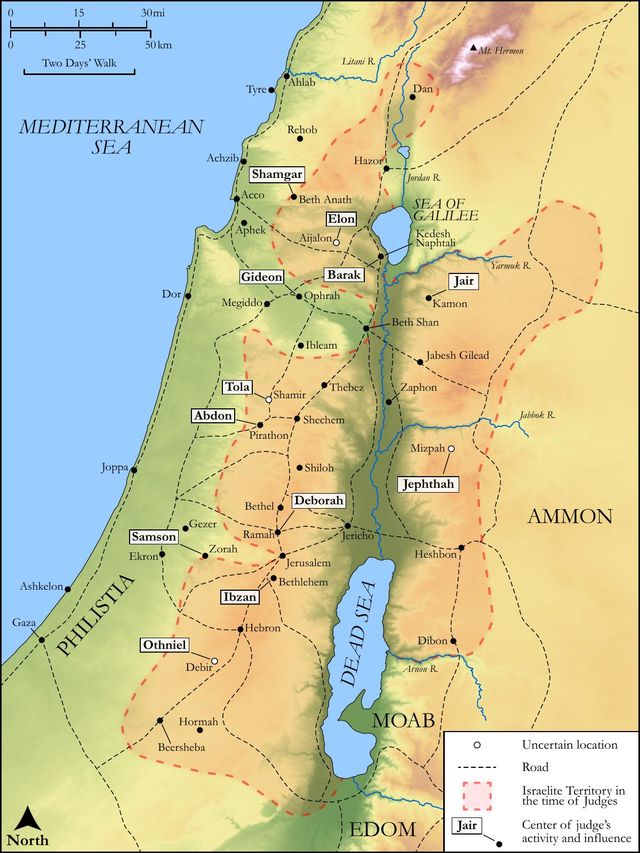
See on the biblical-era maps
Study this verse
Public-domain commentary
Matthew Henry
From his Commentary on the Whole Bible. Henry comments on passages, not single verses — this entry covers Judges 8:29–35.
We have here the conclusion of the story of Gideon. 1. He lived privately, Jdg 8:29. He was not puffed up with his great honours, did not covet a palace or castle to dwell in, but retired to the house he had lived in before his elevation. Thus that brave Roman Who was called from the plough upon a sudden occasion to command the army when the action was over returned to his plough again. 2. His family was multiplied. He had many wives (therein he transgressed the law); by them he had seventy sons (Jdg 8:30), but by a concubine he had one whom he named Abimelech (which signifies, my father a king), that proved the ruin of his family, Jdg 8:31. 3. He died in honour, in a good old age, when he had lived as long as he was capable of serving God and his country; and who would desire to live any longer? And he was buried in the sepulchre of his fathers. 4. After his death the people corrupted themselves, and went all to naught. As soon as ever Gideon was dead, who had kept them close to the worship of the God of Israel, they found themselves under no restraint, and then they went a whoring after Baalim, Jdg 8:33. They went a whoring first after another ephod (Jdg 8:27), for which irregularity Gideon had himself given them too much occasion, and now they went a whoring after another god. False worships made way for false deities. They now chose a new god (Jdg 5:8), a god of a new name, Baal-berith (a goddess, say some); Berith, some think, was Berytus, the place where the Phoenicians worshipped this idol. The name signifies the Lord of a covenant. Perhaps he was so called because his worshippers joined themselves by covenant to him, in imitation of Israel's covenanting with God; for the devil is God's ape. In this revolt of Israel to idolatry they showed, (1.) Great ingratitude to God (Jdg 8:34): They remembered not the Lord, not only who had delivered them into the hands of their enemies, to punish them for their idolatry, but who had also delivered them out of the hands of their enemies, to invite them back again into his service; both the judgments and the mercies were forgotten, and the impressions of them lost. (2.) Great ingratitude to Gideon, Jdg 8:35. A great deal of goodness he had shown unto Israel, as a father to his country, for which they ought to have been kind to his family when he was gone, for that is one way by which we ought to show ourselves grateful to our friends and benefactors, and may be returning their kindnesses when they are in their graves. But Israel showed not this kindness to Gideon's family, as we shall find in the next chapter. No wonder if those who forget their God forget their friends.
Continue studying Judges 8:30 across the web’s major study libraries — every link below opens this exact verse, chapter, or book on the destination site.
Read & Compare
 BibleGatewayThis verse in more than 200 translations and 70 languages.
 Bible.comThe YouVersion reader — hundreds of translations, reading plans, and highlights.
 ESV.orgCrossway's official English Standard Version reader.
 NET BibleThe NET translation with 60,000+ translators' notes on every rendering decision.
 STEP BibleTyndale House's free study tool — original text, vocabulary, and scholarly resources.
 BibliaLogos Bible Software's free web reader.
 USCCBThe New American Bible (Revised Edition) with the U.S. bishops' study notes.
Commentaries
 BibleHub CommentariesDozens of classic commentaries on this verse, gathered on one page.
 StudyLightMore than 100 commentary sets — the largest collection on the web.
 BibleRefPlain-English commentary on what this verse means, verse by verse.
 Enduring WordDavid Guzik's free commentary on this chapter, widely used by Bible teachers.
 Bible Study ToolsVerse commentary alongside Greek and Hebrew study aids.
Original Language & Research
- BibleHub InterlinearThe verse word by word — original language, transliteration, and English.
- BibleHub LexiconEvery word's original-language definition and Strong's entry.
 Blue Letter BibleDeep-study tools — Strong's numbers, concordance, and word studies.
 SefariaThe Hebrew text with Rashi and centuries of Jewish commentary.
Sermons, Hymns & Audio


TrulyRandomVerse is not affiliated with these sites and doesn’t control their content. They’re linked because they’re genuinely useful.
Summary
Judges 8:30 provides a succinct yet profoundly significant insight into the private life of Gideon, Israel's deliverer from Midian, immediately following his public triumphs. It reveals that despite his refusal of kingship, Gideon amassed a large personal household, fathering seventy sons from numerous wives. This verse serves as a critical bridge, transitioning from Gideon's divine calling and military victories to the complex and ultimately tragic domestic consequences of his choices, setting the stage for the tumultuous events that unfold in the subsequent chapter.
Context
ShowHideLiterary Context
This verse is strategically placed at the conclusion of Gideon's narrative, following his decisive victory over the Midianites, detailed in Judges 7 - Gideon's Victory, and his notable refusal of the people's offer to establish a dynastic kingship over Israel, recorded in Judges 8:23 - Gideon Refuses Kingship. While Gideon explicitly states that "the Lord shall rule over you," his actions, including the creation of a golden ephod that became a snare for Israel, as described in Judges 8:27 - The Ephod's Snare, and the extensive family described in this verse, subtly undermine his stated theological position. Judges 8:30 directly foreshadows the violent power struggle initiated by his son Abimelech, who sought to eliminate his brothers and seize power, demonstrating the destructive legacy of Gideon's choices that unfolds in Judges 9 - Abimelech's Reign.
Historical & Cultural Context
In Israel, a large progeny, especially of sons, was often seen as a sign of blessing, power, and status, ensuring the continuation of a family line and its influence. Polygamy, while not the ideal presented in the creation narrative of Genesis 2:24 - One Flesh Union, was a common practice among powerful men in this period, though it frequently led to internal strife, jealousy, and succession disputes within households. For Israel, while the Mosaic Law did not explicitly forbid polygamy for the general populace, it placed restrictions on kings regarding the accumulation of wives, recognizing the potential for distraction and apostasy, as seen in Deuteronomy 17:17 - Restrictions on Kings. Gideon's actions, therefore, while culturally understandable for a man of his stature, carried inherent risks and deviated from the spirit of God's ideal for leadership and family.
Key Themes
ShowHideJudges 8:30 contributes significantly to several key themes within the Book of Judges. It highlights the human imperfection amidst divine calling, illustrating that even God's chosen deliverers are fallible and their personal choices can have far-reaching, negative consequences. Gideon's extensive family, born of "many wives," introduces the theme of polygamy and its implications, directly leading to the dynastic conflict and bloodshed of Judges 9 - Abimelech's Reign. This verse also underscores the cyclical nature of Israel's apostasy and decline described in Judges, as the people's desire for human leadership and the leaders' own flawed choices perpetuate a cycle of instability, even after periods of divine deliverance. Gideon's personal choices, particularly his marital practices, set the stage for the very kind of internal strife and ungodly ambition that plagued Israel in the absence of a righteous king, fulfilling the book's overarching message that "everyone did what was right in his own eyes" (Judges 21:25 - Everyone Did What Was Right).
Exposition and Analysis
ShowHideKey Word Analysis
ShowHideThis number, "threescore and ten" in the KJV, signifies an exceptionally numerous progeny for a single individual in that era. In biblical numerology, seven often denotes completeness or perfection, and seventy (7x10) can amplify this, suggesting a full and perhaps overwhelming extent of something. In Gideon's case, it emphasizes the vastness of his direct male descendants, which, rather than being a pure blessing, becomes a source of future conflict and instability.
Literally meaning "thigh," this term is used euphemistically here to refer to the generative parts, signifying direct, biological fatherhood. The phrase "of his body begotten" emphasizes that these seventy sons were Gideon's legitimate, biological offspring, distinguishing them from adopted children or other male members of a large household. This detail is crucial for establishing the legitimacy of the sons as heirs and members of Gideon's lineage, making the subsequent fratricide by Abimelech even more heinous and a direct assault on Gideon's legacy and family line.
This word, appearing with the adjective "many" (Hebrew, rab - H7227), explicitly states Gideon's practice of polygamy. The Hebrew word rab means "abundant" or "numerous," indicating that Gideon had multiple wives, not just a concubine (as mentioned in Judges 8:31). This practice, while common among powerful men of that day, often led to complex family dynamics, rivalries among wives, and disputes over inheritance and succession among children, as tragically demonstrated in Gideon's own family. It stands in contrast to the divine ideal of monogamy established at creation and foreshadows the problems associated with similar practices among later Israelite kings.
Verse Breakdown
ShowHide"And Gideon had threescore and ten sons"
This clause immediately highlights the remarkable number of Gideon's male offspring. Seventy sons indicate a vast household and significant personal power and influence in ancient Israelite society, where male heirs were paramount for lineage and inheritance. This large number also immediately signals a potential for future dynastic issues, especially given the lack of a clear succession plan or a divinely appointed monarchy.
"of his body begotten"
This phrase clarifies that these seventy sons were Gideon's direct biological descendants. It emphasizes their legitimate claim to his lineage and potential inheritance, making the subsequent actions of Abimelech, who murders all but one of them, an act of extreme violence against his own family and a devastating blow to Gideon's legacy.
"for he had many wives"
This final clause provides the explanation for Gideon's numerous progeny. It explicitly states that Gideon practiced polygamy, indicating a lifestyle consistent with powerful rulers of the time, even though he had refused the title of king. This choice, while culturally accepted, was a deviation from God's original design for marriage and often introduced strife and competition into a family, directly contributing to the tragic events that follow Gideon's death.
Literary Devices
ShowHideJudges 8:30 employs several powerful literary devices. Foreshadowing is prominent, as the sheer number of sons from "many wives" immediately signals potential for future conflict and instability, which indeed erupts in the very next chapter with Abimelech's murderous ambition. The verse also contains a subtle irony: Gideon refused the title of king, yet his lifestyle, marked by a large harem and numerous heirs, mimicked that of a powerful monarch, creating the very dynastic problem he ostensibly rejected. This highlights the contrast between Gideon's pious words ("the Lord shall rule over you") and his worldly actions, revealing a deep inconsistency in his character that ultimately led to tragic consequences for his family and for Israel.
Theological and Thematic Connections
ShowHideJudges 8:30, though brief, is profoundly significant in its theological implications, revealing the persistent human tendency to deviate from God's ideal, even among those chosen for divine service. Gideon, a deliverer raised by God, ultimately succumbs to cultural norms and personal desires that contradict the spirit of God's law and the principles of righteous leadership. His accumulation of many wives and sons, while perhaps a sign of blessing in a worldly sense, directly contributes to the internal strife and bloodshed that plague Israel after his death, demonstrating that human choices, even seemingly private ones, can have devastating public and spiritual consequences. This verse underscores the Book of Judges' recurring theme that when there is no king in Israel (or when human leaders fail to truly follow God's kingship), "everyone did what was right in his own eyes," leading to moral decay and societal chaos.
Reflection and Application
ShowHideJudges 8:30 stands as a stark reminder that even those who experience profound divine favor and achieve great things for God can harbor significant personal flaws and make choices that have detrimental long-term effects. Gideon's extensive family, born of many wives, was not merely a private matter but directly contributed to the violent power struggles that followed his death. This teaches us the critical lesson that integrity and adherence to God's standards are not just for our public ministries but must permeate every aspect of our lives, including our most intimate family decisions. Our personal choices, even those considered culturally acceptable, can have unforeseen consequences that ripple through generations, impacting our legacy and the well-being of those around us. It challenges us to examine areas where we might compromise God's ideal for worldly gain or cultural conformity, reminding us that true blessing comes from wholehearted obedience and alignment with His revealed will.
Questions for Reflection
ShowHideFAQ
ShowHideWas polygamy forbidden in ancient Israel according to Mosaic Law?
ShowHideWhile the Mosaic Law did not explicitly forbid polygamy for the general populace, it certainly did not promote it as the ideal. The creation account in Genesis 2:24 - One Flesh Union establishes monogamy as God's original design for marriage, where "a man shall leave his father and his mother and hold fast to his wife, and they shall become one flesh." Furthermore, the Law placed specific restrictions on kings, explicitly warning them not to multiply wives for themselves (Deuteronomy 17:17 - King's Restrictions on Wives), recognizing the potential for distraction, division, and turning the king's heart away from God. Throughout biblical history, polygamous relationships, such as those of Abraham, Jacob, David, and Solomon, consistently led to jealousy, strife, and complex family problems, demonstrating the practical difficulties and spiritual pitfalls associated with the practice.
Why is the detail about Gideon's seventy sons and many wives so important to the narrative of Judges?
ShowHideThis seemingly simple detail is critically important because it sets the stage for the tragic events of Judges 9 - Abimelech's Reign. Gideon's refusal of kingship in Judges 8:23 - Gideon Refuses Kingship was commendable, but his subsequent lifestyle, including his many wives and large progeny, mimicked that of a powerful monarch, creating a de facto dynasty. This multitude of sons, legitimate heirs, became a breeding ground for power struggles. His son Abimelech, born of a concubine, ruthlessly murders all but one of his seventy half-brothers to seize power, directly illustrating the disastrous consequences of Gideon's choices and the inherent instability introduced by polygamy and the pursuit of worldly status. It highlights the recurring theme in Judges of Israel's internal decay and the failure of human leadership in the absence of true devotion to God.
Christ-Centered Fulfillment
ShowHideGideon's extensive progeny and the subsequent violent unraveling of his family in Judges 8:30 and Judges 9 - Abimelech's Reign powerfully underscore the inherent failures of human leadership and the brokenness of human attempts to establish lasting peace and order. Gideon, despite being a divinely appointed deliverer, could not establish a righteous and stable legacy through his own means, particularly through the culturally accepted but divinely problematic practice of polygamy. His "dynasty" was one of strife and bloodshed, ultimately failing to bring true rest to Israel. This narrative points forward to the ultimate and perfect King, Jesus Christ. Unlike Gideon, who fathered many sons from many wives, Jesus' lineage is pure and singular, tracing back to David and ultimately to God Himself, as seen in the genealogy of Jesus in Matthew 1:1-17. He does not establish a kingdom through human procreation or worldly power struggles, but through His perfect obedience, sacrificial death, and resurrection. Jesus is the true "Son of David" (Matthew 22:42 - Son of David), the one who establishes an eternal kingdom of righteousness and peace, not through the proliferation of human heirs, but through the spiritual regeneration of believers, making them "children of God" (John 1:12 - Children of God) by grace through faith. The failures of Gideon's household vividly illustrate the desperate need for the true Lamb of God, who alone can bring lasting peace and establish a perfect, eternal family for God, a multitude from every nation, as prophesied in Revelation 7:9-10 - The Multitude from Every Nation.