


2 Kings 10:1
Bible text: King James Version (1769 Blayney text) · Public domain
Bible text: King James Version with Strong's numbers · Public domain
Bible text: Berean Standard Bible · Public domain
Bible text: American Standard Version (1901) · Public domain
Bible text: World English Bible, Messianic edition · Public domain
Bible text: Geneva Bible (1599) · Public domain
Bible text: Young's Literal Translation · Public domain
- וּלְאַחְאָבu·le·'ach·'Avand [belonged] to AhabH256Conj-w ¦ Prep-l ¦ N-proper-mNoun Proper Masculineוּandלְ[belonged] toאַחְאָבAhab
- שִׁבְעִיםshiv·'ImseventyH7657N-mpNoun Plural Masculine Absolute
- בָּנִיםba·NimsonsH1121N-mpNoun Plural Masculine Absolute
- בְּשֹׁמְרוֹןbe·sho·me·Ronin SamariaH8111Prep-b ¦ N-properNoun Proper LocationבְּinשֹׁמְרוֹןSamaria
- וַיִּכְתֹּבvai·yikh·Toand he wroteH3789Conj-w ¦ V-Qal-ConsecImperf-3msVerb Qal Consecutive Imperfect 3rd Singular Masculineוַandיִּכְתֹּבhe wrote
- יֵהוּאye·Hu'JehuH3058N-proper-mNoun Proper Masculine
- סְפָרִיםse·fa·RimlettersH5612N-mpNoun Plural Masculine Absolute
- וַיִּשְׁלַחvai·yish·Lachand he sent [them]H7971Conj-w ¦ V-Qal-ConsecImperf-3msVerb Qal Consecutive Imperfect 3rd Singular Masculineוַandיִּשְׁלַחhe sent [them]
- שֹׁמְרוֹןsho·me·RonSamariaH8111N-properNoun Proper Location
- אֶל'eltoH413PrepPreposition
- שָׂרֵיsa·Rei[the] officials ofH8269N-mpcNoun Plural Masculine Construct
- יִזְרְעֶאלyiz·re·'eLJezreelH3157N-properNoun Proper Location
- הַזְּקֵנִיםha·ze·ke·Nimthe eldersH2205Art ¦ Adj-mpAdjective Plural Masculine Absoluteהַtheזְּקֵנִיםelders
- וְאֶלve·'eland toH413Conj-w ¦ PrepPrepositionוְandאֶלto
- הָאֹמְנִיםha·'o·me·Nimthe guardiansH539Art ¦ V-Qal-Prtcpl-mpVerb Qal Participle Plural Masculine Absoluteהָtheאֹמְנִיםguardians
- אַחְאָב'ach·'AvAhabH256N-proper-mNoun Proper Masculine
- לֵאמֹרle·Mor<to> sayingH559Prep-l ¦ V-Qal-InfVerb Qal Infinitive Constructלֵ<to>אמֹרsaying
English is a literal word-by-word gloss of the Hebrew, not the KJV's wording. Why?
This is the original text the KJV's translators worked from — each Hebrew word with its own literal English meaning in this verse, prepared by scholars at Tyndale House, Cambridge. The KJV translates whole sentences, not word by word, so its wording differs: one Hebrew word can become several English words, and the KJV may choose “the LORD” where the gloss reads “Yahweh”. Both are faithful — they answer different questions. For the KJV's own rendering, switch to the KJV text.
Details
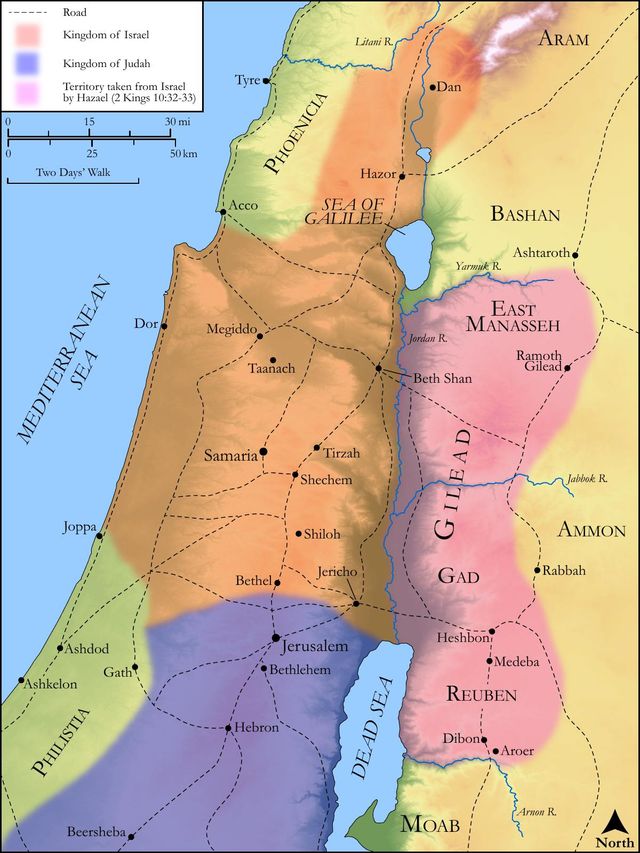
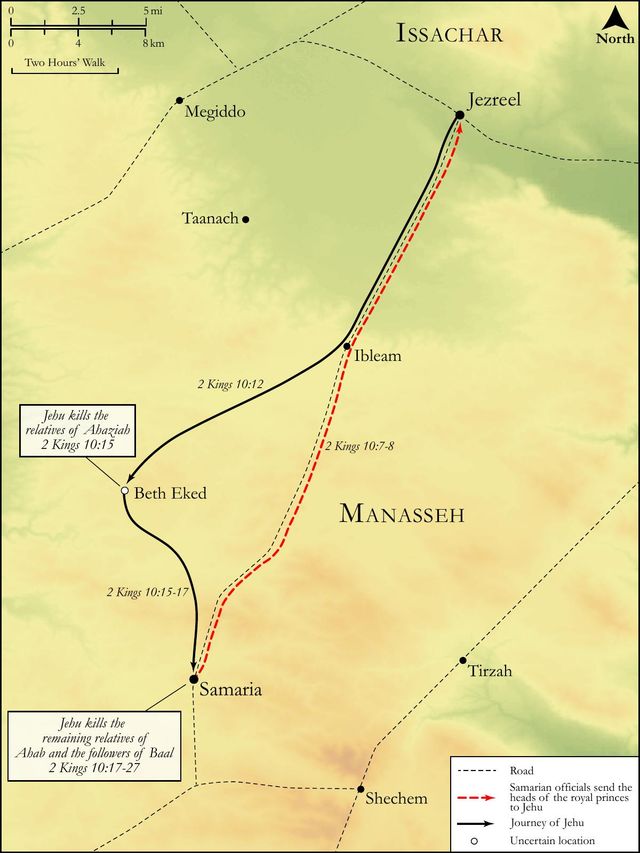
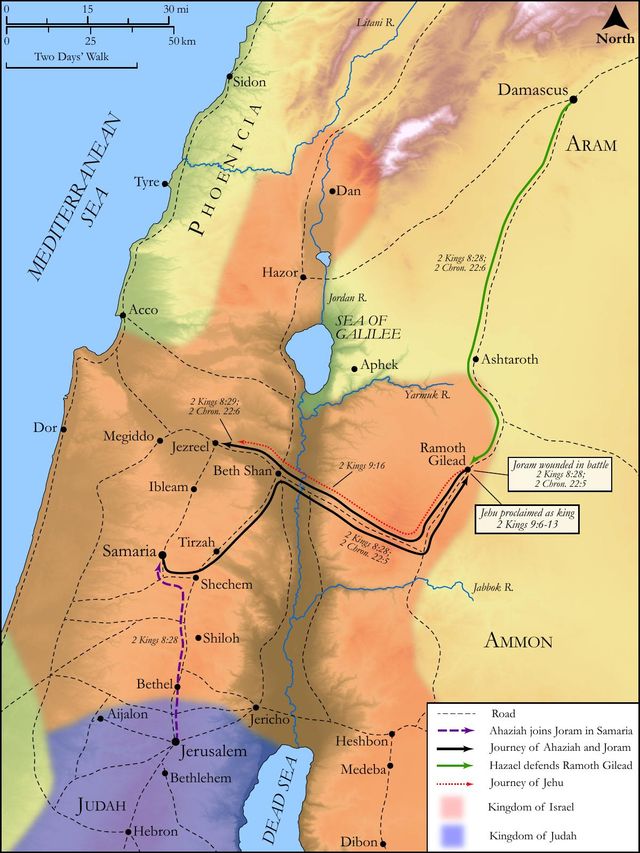
See on the biblical-era maps
Study this verse
Public-domain commentary
Matthew Henry
From his Commentary on the Whole Bible. Henry comments on passages, not single verses — this entry covers 2 Kings 10:1–14. His two-level outline is real structure in the source text, so it is rendered as structure.
We left Jehu in quiet possession of Jezreel, triumphing over Joram and Jezebel; and we must now attend his further motions. He knew the whole house of Ahab must be cut off, and therefore proceeded in this bloody work, and did not do it deceitfully, or by halves, Jer 48:10.
I.He got the heads of all the sons of Ahab cut off by their own guardians at Samaria.
Seventy sons (or grandsons) Ahab had, Gideon's number, Jdg 8:30. In such a number that bore his name his family was likely to be perpetuated, and yet it is extirpated all at once. Such a quiver full of arrows could not protect his house from divine vengeance. Numerous families, if vicious, must not expect to be long prosperous. These sons of Ahab were now at Samaria, a strong city, perhaps brought thither upon occasion of the war with Syria, as a place of safety, or upon notice of Jehu's insurrection; with them were the rulers of Jezreel, that is, the great officers of the court, who went to Samaria to secure themselves or to consult what was to be done. Those of them that were yet under tuition had their tutors with them, who were entrusted with their education in learning, agreeable to their birth and quality, but, it is to be feared, brought them up in the idolatries of their father's house and made them all worshippers of Baal. Jehu did not think fit to bring his forces to Samaria to destroy them, but, that the hand of God might appear the more remarkably in it, made their guardians their murderers.
1.He sent a challenge to their friends to stand by them, Kg2 10:2, Kg2 10:3. "You that are hearty well-wishers to the house of Ahab, and entirely in its interests, now is your time to appear for it. Samaria is a strong city; you are in possession of it; you have forces at command; you may choose out the likeliest person of all the royal family to head you; you know you are not tied to the eldest, unless he be the best and meetest of your master's sons. If you have any spirit in you, show it, and set one of them on his father's throne, and stand by him with your lives and fortunes." Not that he desired they should do this, or expected they would, but thus he upbraided them with their cowardice and utter inability to contest with the divine counsels. "Do if you dare, and see what will come of it." Those that have forsaken their religion have often, with it, lost both their sense and their courage, and deserve to be upbraided with it.
2.Hereby he gained from them a submission. They prudently reasoned with themselves: "Behold, two kings stood not before him, but fell as sacrifices to his rage; how then shall we stand?" Kg2 10:4. Therefore they sent him a surrender of themselves: "We are thy servants, thy subjects, and will do all that thou shalt bid us, right or wrong, and will set up nobody in competition with thee." They saw it was to no purpose to contend with him, and therefore it was their interest to submit to him. With much more reason may we thus argue ourselves into a subjection to the great God. Many kings and great men have fallen before his wrath, for their wickedness; and how then shall we stand? Do we provoke the Lord to jealousy? Are we stronger than he? No, we must either bend or break.
3.This was improved so far as to make them the executioners of those whom they had the tuition of (Kg2 10:6): If you be mine, bring me the heads of your master's sons by tomorrow at this time. Though he knew it must be done, and was loth to do it himself, one would think he could not expect they should do it. Could they betray such a trust? Could they be cruel to their master's sons? It seems, so low did they stoop in their adoration to the rising sun that they did it; they cut off the heads of those seventy princes, and sent them in baskets a present to Jehu, Kg2 10:7. Learn hence not to trust in a friend nor to put confidence in a guide not governed by conscience. One can scarcely expect that he who has been false to his God should ever be faithful to his prince. But observe God's righteousness in their unrighteousness. These elders of Jezreel had been wickedly obsequious to Jezebel's order for the murder of Naboth, Kg1 21:11. She gloried, it is likely, in the power she had over them; and now the same base spirit makes them as pliable to Jehu and as ready to obey his orders for the murder of Ahab's sons. Let none aim at arbitrary power, lest they be found rolling a stone which, some time or other, will return upon them. Princes that make their people slaves take the readiest way to make them rebels; and by forcing men's consciences, as Jezebel did, they lose their hold of them. When the separated heads were presented to Jehu, he slyly upbraided those that were the executioners of this vengeance. The heads were laid in two heaps at the gate, the proper place of judgment. There he acquitted the people before God and the world (Kg2 10:9, You are righteous), and, by what the rulers of Samaria had now done, comparatively acquitted himself: "I slew but one; they have slain all these: I did it by conspiracy and with design; they have done this merely in compliance and with an implicit obedience. Let not the people of Samaria, nor any of the friends of the house of Ahab, ever reproach me for what I have done, when their own elders, and the very guardians of the orphans, have done this." It is common for those who have done something base to attempt the mitigation of their own reproach by drawing others in to do something worse. But, (2.) He resolves all into the righteous judgment of God (Kg2 10:10): The Lord hath done that which he spoke by Elijah. God is not the author of any man's sin, but even by that which men do from bad principles God serves his own purposes and glorifies his own name; and he is righteous in that wherein men are unrighteous. When the Assyrian is made the rod of God's anger, and the instrument of his justice, he meaneth not so, neither does his heart think so, Isa 10:7.
II.He proceeded to destroy all that remained of the house of Ahab, not only those that descended from him, but those that were in any relation to him, all the officers of his household, ministers of state, and those in command under him, called here his great men (Kg2 10:11), all his kinsfolks and acquaintance, who had been partners with him in his wickedness, and his priests, or domestic chaplains, whom he employed in his idolatrous services and who strengthened his hand that he should not turn from his evil way. Having done this in Jezreel, he did the same in Samaria (Kg2 10:17), slew all that remained to Ahab in Samaria. This was bloody work, and is not now, in any case, to be drawn into a precedent. Let the guilty suffer, but not the guiltless for their sakes. Perhaps such terrible destructions as these were intended as types of the final destruction of all the ungodly. God has a sword, bathed in heaven, which will come down upon the people of his curse, and be filled with blood. Isa 34:5, Isa 34:6. Then his eye will not spare, neither will he pity.
III.Providence bringing the brethren of Ahaziah in his way, as he was going on with this execution, he slew them likewise, Kg2 10:12-14.
The brethren of Ahaziah were slain by the Arabians (Ch2 22:1), but these were the sons of his brethren, as it is there explained (Kg2 10:8), and they are said to be princes of Judah, and to minister to Ahaziah. Several things concurred to make them obnoxious to the vengeance Jehu was now executing.
1.They were branches of Ahab's house, being descended from Athaliah, and therefore fell within his commission.
2.They were tainted with the wickedness of the house of Ahab.
3.They were now going to make their court to the princes of the house of Ahab, to salute the children of the king and the queen, Joram and Jezebel, which showed that they were linked to them in affection as well as in affinity. These princes, forty-two in number, being appointed as sheep for the sacrifice, were slain with solemnity, at the pit of the shearing-house. The Lord is known by these judgments which he executeth.
Continue studying 2 Kings 10:1 across the web’s major study libraries — every link below opens this exact verse, chapter, or book on the destination site.
Read & Compare
 BibleGatewayThis verse in more than 200 translations and 70 languages.
 Bible.comThe YouVersion reader — hundreds of translations, reading plans, and highlights.
 ESV.orgCrossway's official English Standard Version reader.
 NET BibleThe NET translation with 60,000+ translators' notes on every rendering decision.
 STEP BibleTyndale House's free study tool — original text, vocabulary, and scholarly resources.
 BibliaLogos Bible Software's free web reader.
 USCCBThe New American Bible (Revised Edition) with the U.S. bishops' study notes.
Commentaries
 BibleHub CommentariesDozens of classic commentaries on this verse, gathered on one page.
 StudyLightMore than 100 commentary sets — the largest collection on the web.
 BibleRefPlain-English commentary on what this verse means, verse by verse.
 Enduring WordDavid Guzik's free commentary on this chapter, widely used by Bible teachers.
 Bible Study ToolsVerse commentary alongside Greek and Hebrew study aids.
Original Language & Research
- BibleHub InterlinearThe verse word by word — original language, transliteration, and English.
- BibleHub LexiconEvery word's original-language definition and Strong's entry.
 Blue Letter BibleDeep-study tools — Strong's numbers, concordance, and word studies.
 SefariaThe Hebrew text with Rashi and centuries of Jewish commentary.
Sermons, Hymns & Audio


TrulyRandomVerse is not affiliated with these sites and doesn’t control their content. They’re linked because they’re genuinely useful.
Summary
2 Kings 10:1 initiates Jehu's divinely mandated and strategically executed purge of the Omride dynasty, revealing the extensive network of Ahab's descendants and loyalists in Samaria. This verse sets the stage for a ruthless consolidation of power by detailing Jehu's cunning approach: rather than a direct military assault on the fortified capital, he sends calculated letters to the city's most influential authorities, compelling them to participate in the eradication of the royal lineage and thereby implicating them in the unfolding judgment against a house steeped in idolatry and wickedness.
Context
ShowHideLiterary Context
This verse immediately follows the dramatic events of 2 Kings 9, where Jehu, anointed by a prophet from Elisha, swiftly executed King Joram of Israel and King Ahaziah of Judah, and orchestrated the gruesome death of Queen Jezebel in Jezreel. The narrative has rapidly shifted from the Omride dynasty's reign to Jehu's divinely appointed role as an instrument of judgment against Ahab's house. Having dealt with the immediate royal figures in Jezreel, Jehu now strategically turns his attention to the remaining members of Ahab's extensive family, specifically his "seventy sons" residing in Samaria. This move highlights Jehu's calculated and comprehensive approach to fully eradicate the Omride legacy, fulfilling the prophecies against Ahab's house. The sending of letters, rather than a direct military siege, signals a shift in tactics, emphasizing psychological warfare and internal manipulation to achieve his objectives.
Historical & Cultural Context
Samaria was the fortified capital city of the Northern Kingdom of Israel, built by Omri and further developed by Ahab, making it a formidable stronghold difficult to take by direct assault. The "rulers," "elders," and "them that brought up Ahab's [children]" represent the established power structures and loyalists within Samaria. "Elders" (Hebrew: zâqên) were respected community leaders, often holding significant judicial and administrative authority. "Them that brought up Ahab's [children]" (Hebrew: ʼâman) refers to guardians, tutors, or foster parents, who would have been highly trusted individuals responsible for the upbringing and loyalty of the royal heirs, indicating their significant influence and connection to the Omride regime. Among the kings of Israel, the complete eradication of a deposed king's male lineage was a common, albeit brutal, practice to prevent future claims to the throne and ensure the stability of the new dynasty, as when Baasha smote all the house of Jeroboam. This act, though shocking to modern sensibilities, was understood within the political realities of the time as a necessary step for a new king to secure his reign and fulfill a divine mandate.
Key Themes
ShowHideThis verse powerfully introduces and reinforces several major themes central to the book of Kings. Firstly, it underscores the fulfillment of divine prophecy, specifically the judgment pronounced by Elijah against Ahab's house in 1 Kings 21:21-22 and reiterated to Jehu in 2 Kings 9:7-8. Secondly, it exemplifies divine judgment and justice against persistent idolatry and wickedness, particularly the Baal worship promoted by Ahab and Jezebel, which had led Israel astray (1 Kings 16:30-33). Thirdly, Jehu's actions demonstrate strategic leadership and shrewdness as he leverages existing power structures to achieve his objectives without a costly direct confrontation. Finally, the presence of "seventy sons" highlights the fragility of dynastic power when it stands in opposition to God's will, emphasizing that no human institution, no matter how numerous or entrenched, can withstand divine judgment.
Exposition and Analysis
ShowHideKey Word Analysis
ShowHideWhile bên (H1121) primarily means "son" or "male offspring," in biblical usage, it can encompass a broader range of relationships, including descendants, relatives, or even heirs and protégés within a household or dynasty. The phrase "seventy sons" (H7657, shibʻîym + H1121, bên) here likely signifies the extensive nature of Ahab's royal lineage and the comprehensive scope of the impending judgment, rather than a literal count of direct male children. The number "seventy" often denotes completeness or a large, comprehensive group in biblical numerology.
The term zâqên (H2205) refers to an "old" person, an "aged" individual, or specifically an "elder." In the context of ancient Israel, elders were respected community leaders who held significant judicial, administrative, and political authority. Their inclusion as recipients of Jehu's letters underscores their pivotal role in the governance of Samaria and their potential influence over the city's loyalty to the Omride dynasty.
The Hebrew root ʼâman (H539) means "to build up or support" and, by implication, "to foster as a parent or nurse." In this context, "them that brought up Ahab's [children]" refers to the guardians, tutors, or foster parents of the royal children. These individuals would have been highly trusted and influential figures within the royal court, responsible for the education, care, and loyalty of the young princes. Their inclusion as recipients of Jehu's letters underscores their significant position and their presumed allegiance to the Omride dynasty, making their complicity in the purge a crucial element of Jehu's strategy.
Verse Breakdown
ShowHide"And Ahab had seventy sons in Samaria."
This opening clause immediately establishes the formidable scale of the royal family that Jehu intends to eliminate. The presence of "seventy sons" (likely encompassing male descendants and prominent relatives) residing in Samaria, the capital, signifies the deep roots of Ahab's dynasty and the formidable challenge Jehu faces. It also emphasizes the comprehensive nature of the judgment to come, targeting the entire male lineage of the Omrides.
"And Jehu wrote letters, and sent to Samaria,"
This clause reveals Jehu's strategic brilliance and calculated approach. Instead of launching a direct military assault on the heavily fortified capital, he employs psychological warfare and political maneuvering. The act of writing and sending letters indicates a deliberate, non-confrontational initial approach, designed to exploit internal divisions and loyalties within Samaria. It also demonstrates Jehu's burgeoning authority, even from Jezreel, to issue commands to the capital.
"unto the rulers of Jezreel, to the elders, and to them that brought up Ahab's [children], saying,"
This specifies the powerful and influential recipients of Jehu's letters within Samaria. While the KJV mentions "rulers of Jezreel," most modern translations interpret this as "rulers of the city" (referring to Samaria) or "rulers of Samaria," which aligns better with Jehu sending letters to Samaria. By addressing "the rulers" (H8269, sar), "the elders" (H2205, zâqên), and "them that brought up Ahab's children" (H539, ʼâman), Jehu targets the core of Samaria's leadership and the most trusted custodians of the royal family. This move forces these key figures to make an immediate and public choice regarding their allegiance, effectively turning them into instruments of his will and implicating them in the purge, thereby securing his position without shedding his own blood in a costly siege.
Literary Devices
ShowHideThe verse employs several literary devices to heighten the drama and emphasize Jehu's strategic prowess. Foreshadowing is prominently used as the mention of "seventy sons" and Jehu's letters immediately signals the coming, comprehensive purge of Ahab's house, a direct fulfillment of earlier divine prophecies. There is a subtle yet profound Irony in Jehu, the newly anointed king, not directly attacking the capital but instead using written communication to manipulate the city's own leaders into executing the royal family. This highlights Jehu's cunning and the internal vulnerability of the Omride regime, which is undone from within. The use of Strategic Communication through letters serves as a powerful narrative device, demonstrating Jehu's intelligence and his ability to exert control from a distance, turning the very power structures of Samaria against themselves.
Theological and Thematic Connections
ShowHideThis verse is a stark testament to God's unwavering commitment to holiness and His sovereign judgment against idolatry and wickedness. The eradication of Ahab's house, beginning with the strategic move against his "seventy sons," is not merely a political coup but a divinely ordained cleansing of Israel from the deep spiritual corruption introduced by Ahab and Jezebel. It underscores that God's patience has limits, and persistent rebellion against His covenant will inevitably lead to severe consequences. Jehu acts as God's instrument, demonstrating that even through ruthless means, God works to uphold His righteousness and restore His people to proper worship. This passage reminds us that God is actively involved in human history, orchestrating events to fulfill His purposes, and that no human power, however entrenched, can ultimately thwart His will.
Reflection and Application
ShowHideThe narrative of Jehu's purge, initiated in this verse, while set in a specific historical and cultural context that differs vastly from our own, offers profound spiritual lessons for believers today. It serves as a powerful reminder of the gravity of sin, particularly idolatry and leading others astray, and the certainty of divine justice. While we are not called to execute physical purges, the principle of decisive action against spiritual corruption remains vital. This passage challenges believers to examine their own lives and communities for any form of idolatry—anything that takes God's rightful place, whether it be wealth, power, comfort, or worldly approval—and to act decisively in repentance and spiritual cleansing. It encourages us to recognize God's sovereignty over all earthly powers and to trust that His justice will ultimately prevail, even when evil seems deeply entrenched. It also calls us to be instruments of God's will, not through violence, but through faithful obedience, prayer, and advocating for righteousness and truth in a world that desperately needs spiritual renewal and the transforming power of the Gospel.
Questions for Reflection
ShowHideFAQ
ShowHideWhy "seventy sons"? Was it a literal count, or does it have another meaning?
ShowHideWhile it's possible Ahab had a large number of direct male offspring, the "seventy sons" (Hebrew: shibʻîym bên) likely signifies a comprehensive group of Ahab's male descendants, heirs, and prominent male relatives within the royal household. In biblical numerology, "seventy" often denotes completeness or a full representation (e.g., the seventy nations in Genesis 10, the seventy elders of Israel in Exodus 24:1). Therefore, it emphasizes the extensive nature of the Omride dynasty and the thoroughness of the judgment Jehu was commissioned to execute against the entire house of Ahab, ensuring no potential claimant to the throne remained.
Why did Jehu send letters to Samaria instead of directly attacking the city?
ShowHideJehu's decision to send letters was a shrewd and highly strategic move. Samaria was a heavily fortified capital, and a direct military assault would have been costly, prolonged, and risked significant casualties for Jehu's forces. By sending letters to the "rulers," "elders," and "them that brought up Ahab's [children]," Jehu employed psychological warfare and political leverage. He forced the city's most influential figures to choose sides and become complicit in the purge of the royal family. This tactic allowed Jehu to achieve his objective—the complete eradication of Ahab's lineage—without a siege, by leveraging internal power dynamics and compelling the Samarian leadership to carry out the bloody work themselves, thereby implicating them and solidifying his own claim to the throne without expending his own resources.
Christ-Centered Fulfillment
ShowHideThe brutal purge initiated by Jehu in 2 Kings 10:1, though a historical act of divine judgment against a wicked dynasty, finds its ultimate Christ-centered fulfillment in the spiritual cleansing and righteous judgment brought about by Jesus Christ. Jehu was an instrument of God's judgment, tasked with eradicating the physical manifestation of idolatry and evil from Israel. Similarly, Christ came not to bring a physical sword to establish an earthly kingdom, but to wield a spiritual sword that divides between light and darkness, truth and falsehood (Matthew 10:34). He is the ultimate purifier, whose coming was prophesied to be like a refiner's fire and fuller's soap, cleansing His people from sin and unrighteousness (Malachi 3:2-3). While Jehu executed a physical judgment on the "sons" of Ahab, representing the old, corrupt order, Christ's work on the cross and His resurrection secured victory over sin and death, purging the spiritual "sons of disobedience" from their bondage and establishing a new covenant of grace and truth (Colossians 2:13-15). Ultimately, Christ will return as the righteous Judge, not merely to cleanse a nation, but to bring final justice upon all the earth, eradicating all evil and establishing His eternal kingdom of righteousness (Revelation 19:11-16). Jehu's actions foreshadow the comprehensive, decisive nature of God's judgment, which finds its perfect and redemptive expression in the person and work of Jesus Christ, who purifies His people and will one day purge all evil from creation.