


Judges 12:14
Bible text: King James Version (1769 Blayney text) · Public domain
Bible text: Berean Standard Bible · Public domain
Bible text: American Standard Version (1901) · Public domain
Bible text: World English Bible, Messianic edition · Public domain
Bible text: Geneva Bible (1599) · Public domain
Bible text: Young's Literal Translation · Public domain
- וַיְהִיvay·hiand it belongedH1961Conj-w ¦ V-Qal-ConsecImperf-3msVerb Qal Consecutive Imperfect 3rd Singular Masculineוַandיְהִיit belonged
- לוֹloto <the> himPrep-l ¦ 3msSuffix Personal 3rd Singular Masculineלto <the>וֹhim
- אַרְבָּעִים'ar·ba·'ImfortyH705N-mpNoun Plural Masculine Absolute
- בָּנִיםba·NimsonsH1121N-mpNoun Plural Masculine Absolute
- וּשְׁלֹשִׁיםu·she·lo·Shimand thirtyH7970Conj-w ¦ N-mpNoun Plural Masculine Absoluteוּandשְׁלֹשִׁיםthirty
- בְּנֵיbe·Neisons ofH1121N-mpcNoun Plural Masculine Construct
- בָנִיםva·NimsonsH1121N-mpNoun Plural Masculine Absolute
- רֹכְבִיםro·khe·Vim[who] rodeH7392V-Qal-Prtcpl-mpVerb Qal Participle Plural Masculine Absolute
- עַל'alonH5921PrepPreposition
- שִׁבְעִיםshiv·'ImseventyH7657N-mpNoun Plural Masculine Absolute
- עֲיָרִם'a·ya·RimdonkeysH5895N-mpNoun Plural Masculine Absolute
- וַיִּשְׁפֹּטvai·yish·Potand he judgedH8199Conj-w ¦ V-Qal-ConsecImperf-3msVerb Qal Consecutive Imperfect 3rd Singular Masculineוַandיִּשְׁפֹּטhe judged
- אֶת'et<obj.>H853DirObjMParticle Object Indicator
- יִשְׂרָאֵלYis·ra·'ElIsraelH3478N-properNoun Proper Location
- שְׁמֹנֶהshe·mo·NeheightH8083N-csNoun Singular common gender Absolute
- שָׁנִיםsha·NimyearsH8141N-mpNoun Plural Masculine Absolute
English is a literal word-by-word gloss of the Hebrew, not the KJV's wording. Why?
This is the original text the KJV's translators worked from — each Hebrew word with its own literal English meaning in this verse, prepared by scholars at Tyndale House, Cambridge. The KJV translates whole sentences, not word by word, so its wording differs: one Hebrew word can become several English words, and the KJV may choose “the LORD” where the gloss reads “Yahweh”. Both are faithful — they answer different questions. For the KJV's own rendering, switch to the KJV text.
Details
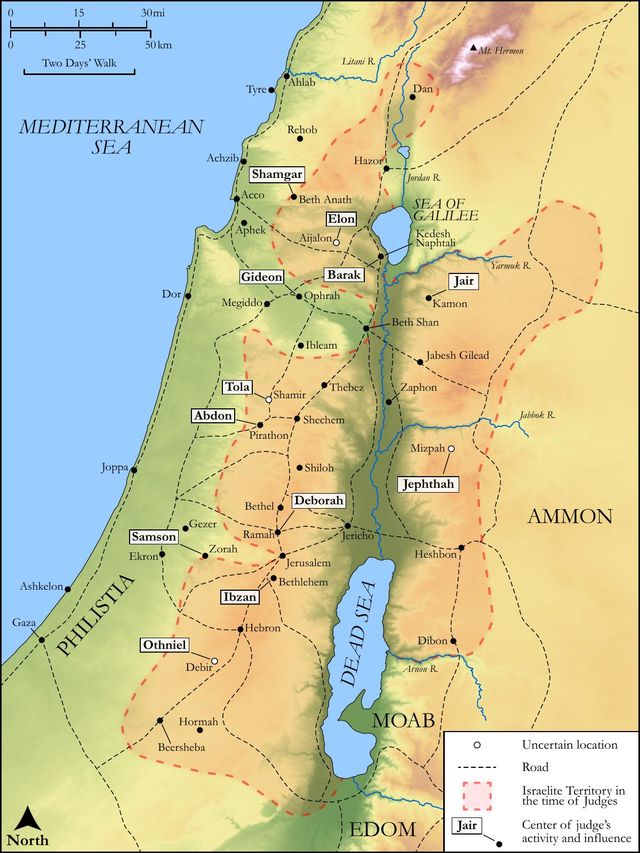
See on the biblical-era maps
Study this verse
Public-domain commentary
Matthew Henry
From his Commentary on the Whole Bible. Henry comments on passages, not single verses — this entry covers Judges 12:8–15. His two-level outline is real structure in the source text, so it is rendered as structure.
We have here a short account of the short reigns of three more of the judges of Israel, the first of whom governed but seven years, the second ten, and the third eight. For the transgression of a land, many are the princes thereof, many in a short time, successively (Pro 28:2), good men being removed in the beginning of their usefulness and by the time that they have applied themselves to their business.
I.Ibzan of Bethlehem, most probably Bethlehem of Judah, David's city, not that in Zebulun, which is only mentioned once, Jos 19:15.
He ruled but seven years, but by the number of his children, and his disposing of them all in marriage himself, it appears that he lived long; and probably the great increase of his family, and the numerous alliances he made, added to his personal merits, made him the more fit to be either chosen by the people as Jephthah was, or called of God immediately, as Gideon was, to be Israel's judge, to keep up and carry on the work of God among them. That which is remarkable concerning him is,
1.That he had many children, sixty in all, a quiver full of these arrows. Thus was Bethlehem of old famous for increase, the very city where he was to be born whose spiritual seed should be as the stars of heaven.
2.That he had an equal number of each sex, thirty sons and thirty daughters, a thing which does not often happen in the same family, yet, in the great family of mankind, he that at first made two, male and female, by his wise providence preserves a succession of both in some sort of equality as far as is requisite to the keeping up of the generations of men upon earth.
3.That he took care to marry them all. His daughters he sent abroad, et maritis dedit, so the vulgar Latin adds - he provided husbands for them; and, as it were in exchange, and both ways, strengthening his interest, he took in thirty daughters from abroad for his sons. The Jews say, Every father owes three things to his son: to teach him to read the law, give him a trade, and get him a wife. What a difference was there between Ibzan's family and that of his immediate predecessor Jephthah! Ibzan has sixty children and all married, Jephthah but one, a daughter, that dies or lives unmarried. Some are increased, others are diminished: both are the Lord's doing.
II.Elon of Zebulun, in the north of Canaan, was next raised up to preside in public affairs, to administer justice, and to reform abuses.
Ten years he continued a blessing to Israel, and then died, Jdg 12:11, Jdg 12:12. Dr. Lightfoot computes that in the beginning of his time the forty years' oppression by the Philistines began (spoken of Jdg 13:1), and about that time Samson was born. Probably, his residence being in the north, the Philistines who bordered upon the southern parts of Canaan took the opportunity of making incursions upon them.
III.Abdon, of the tribe of Ephraim, succeeded, and in him that illustrious tribe begins to recover its reputation, having not afforded any person of note since Joshua; for Abimelech the Shechemite was rather a scandal to it. This Abdon was famous for the multitude of his offspring (v. 14): he had forty sons and thirty grandsons, all of whom he lived to see grown up, and they rode on seventy ass-colts either as judges and officers or as gentlemen and persons of distinction. It was a satisfaction to him thus to see his children's children, but it is feared he did not see peace upon Israel, for by this time the Philistines had begun to break in upon them. Concerning this, and the rest of these judges that have ever so short an account given of them, yet notice is taken where they were buried (Jdg 12:7, Jdg 12:10, Jdg 12:12, Jdg 12:15), perhaps because the inscriptions upon their monuments (for such were anciently used, Kg2 23:17) would serve for the confirmation and enlargement of their story, and might be consulted by such as desired further information concerning them. Peter, having occasion to speak of David, says, His sepulchre is with us unto this day, Act 2:29. Or it is intended for the honour of the places where they laid their bones, but may be improved for the lessening of our esteem of all worldly glory, of which death and the grave will stain the pride. These judges, that were as gods to Israel, died like men, and all their honour was laid in the dust.
It is very strange that in the history of all these judges, some of whose actions are very particularly related, there is not so much as once mention made of the high priest, or any other priest or Levite, appearing either for counsel or action in any public affair, from Phinehas (Jdg 20:28) to Eli, which may well be computed 250 years; only the names of the high priests at that time are preserved, Ch1 6:4-7; and Ezr 7:3-5. How can this strange obscurity of that priesthood for so long a time, now in the beginning of its days, agree with that mighty splendour with which it was introduced and the figure which the institution of it makes in the law of Moses? Surely it intimates that the institution was chiefly intended to be typical, and that the great benefits that seemed to be promised by it were to be chiefly looked for in its antitype, the everlasting priesthood of our Lord Jesus, in comparison of the superior glory of which that priesthood had no glory, Co2 3:10.
Continue studying Judges 12:14 across the web’s major study libraries — every link below opens this exact verse, chapter, or book on the destination site.
Read & Compare
 BibleGatewayThis verse in more than 200 translations and 70 languages.
 Bible.comThe YouVersion reader — hundreds of translations, reading plans, and highlights.
 ESV.orgCrossway's official English Standard Version reader.
 NET BibleThe NET translation with 60,000+ translators' notes on every rendering decision.
 STEP BibleTyndale House's free study tool — original text, vocabulary, and scholarly resources.
 BibliaLogos Bible Software's free web reader.
 USCCBThe New American Bible (Revised Edition) with the U.S. bishops' study notes.
Commentaries
 BibleHub CommentariesDozens of classic commentaries on this verse, gathered on one page.
 StudyLightMore than 100 commentary sets — the largest collection on the web.
 BibleRefPlain-English commentary on what this verse means, verse by verse.
 Enduring WordDavid Guzik's free commentary on this chapter, widely used by Bible teachers.
 Bible Study ToolsVerse commentary alongside Greek and Hebrew study aids.
Original Language & Research
- BibleHub InterlinearThe verse word by word — original language, transliteration, and English.
- BibleHub LexiconEvery word's original-language definition and Strong's entry.
 Blue Letter BibleDeep-study tools — Strong's numbers, concordance, and word studies.
 SefariaThe Hebrew text with Rashi and centuries of Jewish commentary.
Sermons, Hymns & Audio


TrulyRandomVerse is not affiliated with these sites and doesn’t control their content. They’re linked because they’re genuinely useful.
Summary
Judges 12:14 provides a concise yet rich account of Abdon, one of Israel's "minor judges," emphasizing his considerable family size, significant material wealth, and the eight-year duration of his judicial tenure. This brief but informative verse offers a glimpse into a period of relative internal stability and administrative leadership within Israel, contrasting with the more dramatic military deliverances associated with other judges, while affirming God's continued provision of diverse leaders for His people.
Context
ShowHideLiterary Context
Judges 12:14 is situated within the latter half of the Book of Judges, which chronicles the turbulent era between the conquest of Canaan and the establishment of the monarchy. Specifically, it follows the contentious and morally complex narrative of Jephthah, including his tragic vow and the brutal conflict with the Ephraimites at the Jordan fords. Abdon's brief mention, alongside those of Ibzan and Elon (Judges 12:8-12), functions as a literary interlude, providing a sense of chronological progression and a temporary respite from the intense cycles of apostasy, oppression, and deliverance. These "minor judges" are typically characterized by short, formulaic entries that focus on their family, wealth, and judicial tenure rather than extensive military exploits. This suggests a different kind of leadership—one focused on internal administration and civil order rather than external conflict—and highlights the book's broader depiction of Israel's fragmented and often chaotic state, where various forms of divine provision were necessary.
Historical & Cultural Context
The period of the Judges (roughly 14th-11th centuries BCE) was a decentralized era in Israel's history, marked by the absence of a central government or king, famously encapsulated by the recurring phrase, "In those days there was no king in Israel; everyone did what was right in his own eyes" Judges 17:6. Leadership emerged on a tribal or regional basis, often in response to specific crises or to maintain local order. Wealth in ancient Israel was primarily measured by land, livestock, and family size, which collectively represented labor, security, and social influence. The ownership of "threescore and ten ass colts" (70 donkeys) was a significant indicator of prosperity and high status, as donkeys were indispensable for transport, agriculture, and trade. This detail suggests Abdon was a man of considerable means, likely a prominent figure in his community, perhaps from the tribe of Ephraim, as implied by his burial place in Pirathon Judges 12:15. His role as a judge would have involved settling disputes, administering justice, and maintaining civil order within his sphere of influence, a vital function in a society lacking formal legal institutions and central authority.
Key Themes
ShowHideAbdon's brief account contributes to several key themes prevalent in the Book of Judges. Firstly, it underscores the theme of God's Enduring Provision of Leadership, even in an era marked by spiritual decline and moral compromise. Despite Israel's repeated failures, God continued to raise up individuals to guide and govern His people, whether through dramatic military victories or quiet judicial administration. This demonstrates the multifaceted nature of divine leadership. Secondly, the verse highlights the theme of Prosperity and Social Status as indicators of influence and the capacity for leadership in ancient Israel. Abdon's large family and extensive animal wealth signify not only personal success but also the resources and network necessary to effectively "judge Israel," suggesting a period of relative peace and stability during his tenure. Lastly, Abdon's role as a "judge" emphasizes the theme of Internal Order and Justice, a crucial aspect of national well-being often overshadowed by the more dramatic accounts of external deliverance. His eight years of service reflect a period where the focus might have shifted from battling foreign adversaries to maintaining peace and administering law within the tribal confederacy, echoing the importance of justice found throughout the law and prophets, such as in Deuteronomy 16:18-20 and Amos 5:24.
Exposition and Analysis
ShowHideKey Word Analysis
ShowHideFrom the root meaning "to build," this word primarily means "a son" but carries a wide semantic range, encompassing literal and figurative relationships, including "grandson," "nephew," "child," or even "youth." In Judges 12:14, the mention of "forty sons" and "thirty nephews" (which the KJV translates from a construct of bên, literally "sons of sons" or "grandsons") highlights Abdon's extensive male progeny. This was a profound sign of blessing, strength, and social influence in ancient Israel, ensuring the continuation of the family line and its legacy.
This term refers to a young ass, specifically one that is "just broken to a load." In Judges 12:14, the detail of "threescore and ten ass colts" (70 donkeys) is a significant indicator of Abdon's substantial wealth and high social status. Donkeys were highly valued animals in ancient Israel, serving as primary beasts of burden for transportation, agriculture, and trade. Owning such a large number would signify considerable economic power, a large estate requiring their use, and the ability to project influence within the community, perhaps even for administrative or logistical purposes.
This primitive root means "to judge," "to pronounce sentence (for or against)," and by implication, "to vindicate or punish." By extension, it also means "to govern" or "to rule." In the Book of Judges, this term encompasses more than just presiding over legal disputes; it implies leadership, governance, and the maintenance of order. For "minor judges" like Abdon, whose narratives lack military campaigns, the emphasis on "judging" suggests their primary role was one of internal civil administration, ensuring the functioning of society and upholding the covenant laws within their sphere of influence. This highlights a crucial, often unsung, aspect of leadership in a decentralized Israel.
Verse Breakdown
ShowHide"And he had forty sons"
This clause immediately establishes Abdon's standing through his extensive progeny. In ancient Israelite culture, having many sons was a sign of divine blessing, prosperity, and a strong legacy. Forty sons would represent a significant household, providing labor, protection, and a vast network of family connections, underscoring his social prominence and influence.
"and thirty nephews"
As clarified in the Key Word Analysis, "nephews" here refers to "grandsons" (literally "sons of sons"). The addition of thirty grandsons further magnifies Abdon's patriarchal status and the sheer size of his extended family. This detail emphasizes the multi-generational nature of his household and the depth of his lineage, reinforcing his position as a respected and powerful figure within his community.
"that rode on threescore and ten ass colts"
This phrase directly links Abdon's family size with their material wealth and means of transportation. "Threescore and ten" is 70. The fact that his sons and grandsons "rode on" these 70 donkeys signifies not only their personal mobility but also their collective status and ability to travel for business, trade, or judicial duties. It paints a vivid picture of a large, affluent, and influential clan.
"and he judged Israel eight years"
This final clause states the duration and nature of Abdon's leadership. Unlike other judges who "delivered" Israel through military action, Abdon "judged" for eight years. This implies a period of civil administration, maintaining order, settling disputes, and upholding justice, rather than leading military campaigns. His relatively brief tenure (compared to some major judges) still represents a significant period of stability and governance in a tumultuous era.
Literary Devices
ShowHideJudges 12:14 employs several literary devices to convey information concisely and effectively. Numerology is prominent, with the specific numbers "forty sons," "thirty nephews" (grandsons), and "threescore and ten ass colts" (70 donkeys). These numbers, while literal, also carry symbolic weight, often representing completeness, a significant multitude, or a generation, emphasizing Abdon's extensive family and wealth. The mention of his sons and grandsons riding on donkeys functions as Synecdoche, where the part (donkeys) represents the whole (Abdon's vast wealth, social standing, and the mobility of his influential clan). The verse also exhibits remarkable Conciseness, a characteristic of the "minor judge" accounts in Judges. This brevity, focusing on key biographical details rather than narrative action, serves to provide a chronological framework for the period while subtly highlighting the different forms of leadership God raised up. The formulaic presentation of his family, wealth, and tenure also suggests a Formulaic Structure common to these shorter entries, providing a consistent pattern for the reader.
Theological and Thematic Connections
ShowHideJudges 12:14, though brief, offers significant theological and thematic insights into God's ongoing relationship with Israel during a challenging period. It demonstrates that God's provision of leadership was not limited to dramatic military deliverers but also encompassed those who maintained civil order and administered justice. Abdon's prosperity, while a mark of human achievement, can also be seen as a sign of God's blessing and the relative peace that could exist even amidst the broader cycles of apostasy and oppression. His leadership, focused on judging, underscores the importance of internal righteousness and societal function as much as external deliverance. The verse subtly reminds us that faithfulness in less prominent roles is equally valuable in God's economy, as His overarching purpose for His people continues through various means and individuals, highlighting the diverse ways God works through His chosen servants.
Reflection and Application
ShowHideAbdon's story, though a mere two verses in the biblical narrative, serves as a powerful reminder that not all significant contributions to God's kingdom are marked by grand public spectacles or heroic military feats. His leadership was characterized by stability, internal order, and the administration of justice – vital functions for any flourishing society, especially one as fragmented as Israel during the Judges period. In our own lives, we are often tempted to seek prominence or dramatic impact, overlooking the quiet faithfulness required in everyday roles. Abdon teaches us that God values consistent, righteous service, whether it involves settling disputes, raising a godly family, managing resources wisely, or simply being a person of integrity in our community. Our faithfulness in the "small" things, our commitment to justice and order in our spheres of influence, and our willingness to serve where God has placed us, regardless of public recognition, are what truly matter. This verse encourages us to embrace our unique callings, understanding that every act of obedience contributes to God's overarching plan for His people and the world, and that true impact is often measured not by fame, but by faithfulness.
Questions for Reflection
ShowHideFAQ
ShowHideWhat is the significance of Abdon having "forty sons and thirty nephews" and "seventy ass colts"?
ShowHideThis detail is highly significant as it underscores Abdon's immense wealth, social status, and influence in ancient Israel. In a patriarchal society, a large male lineage (40 sons and 30 grandsons, or "nephews" as translated by the KJV) signified divine blessing, strength, and the continuation of the family name. It also meant a large workforce and a strong network of family ties, providing both labor and protection. The "seventy ass colts" (donkeys) further highlight his prosperity. Donkeys were valuable assets, used for transportation, agriculture, and trade. Owning such a large number indicated considerable economic power and the ability to travel and conduct business widely, cementing his position as a prominent and respected leader in his community. This combined description paints a picture of a man with substantial resources and a broad sphere of influence, enabling him to effectively "judge Israel" and maintain order.
Why is Abdon considered a "minor judge" compared to figures like Gideon or Samson?
ShowHideAbdon is categorized as a "minor judge" because the biblical narrative provides very brief details about his tenure, focusing primarily on his family, wealth, and the duration of his leadership, rather than recounting specific military deliverances or dramatic acts of heroism against foreign oppressors. Unlike "major judges" such as Gideon Judges 6-8, Jephthah Judges 11-12, or Samson Judges 13-16, whose stories involve extensive narratives of God raising them up to rescue Israel from specific enemies, Abdon's role appears to have been more focused on maintaining internal order, administering justice, and providing civil governance during a period of relative peace. His account, along with those of Ibzan and Elon, serves to fill chronological gaps and demonstrate that God provided various forms of leadership, not all of which involved dramatic military campaigns, but were equally vital for the functioning of society.
Christ-Centered Fulfillment
ShowHideWhile Abdon's story is brief and seemingly focused on earthly measures of success—family size, wealth, and judicial tenure—it subtly points to the ultimate and perfect Judge, King, and Provider, Jesus Christ. Abdon, like all judges in Israel, was a temporary and imperfect leader, providing a measure of order and justice for a limited time within a specific region. His role as one who "judged Israel" foreshadows Christ, who is not merely a judge of disputes but the righteous Judge of all the earth, whose judgment is perfect and eternal. Unlike Abdon, whose influence was limited to his region and lifespan, Christ's reign is eternal and universal, establishing a kingdom of perfect justice and righteousness that knows no end Isaiah 9:7. Furthermore, Abdon's prosperity and status, while significant in his day, pale in comparison to the true riches and authority of Christ, who, though He was rich, yet for your sakes He became poor that we might become spiritually rich in Him. The peace and order Abdon brought were fleeting and localized; Christ, however, is the Prince of Peace who brings eternal reconciliation and true spiritual order through His atoning work, making peace by the blood of His cross Colossians 1:20. Thus, Abdon, as a divinely appointed leader who maintained a measure of peace and justice, serves as a faint echo of the coming Messiah, the true and eternal King and Judge, who perfectly fulfills all aspects of righteous leadership and provides ultimate peace and order for His people.