


Judges 12:10
Bible text: King James Version (1769 Blayney text) · Public domain
Bible text: Berean Standard Bible · Public domain
Bible text: American Standard Version (1901) · Public domain
Bible text: World English Bible, Messianic edition · Public domain
Bible text: Geneva Bible (1599) · Public domain
Bible text: Young's Literal Translation · Public domain
- וַיָּמָתvai·Ya·motand he diedH4191Conj-w ¦ V-Qal-ConsecImperf-3msVerb Qal Consecutive Imperfect 3rd Singular Masculineוַandיָּמָתhe died
- אִבְצָן'iv·TzanIbzanH78N-proper-mNoun Proper Masculine
- וַיִּקָּבֵרvai·yi·ka·Verand he was buriedH6912Conj-w ¦ V-Niphal-ConsecImperf-3msVerb Niphal Consecutive Imperfect 3rd Singular Masculineוַandיִּקָּבֵרhe was buried
- בְּבֵיתbe·Veitin Beth-H1035Prep-b ¦ N-properNoun Proper LocationבְּinבֵיתBeth-
- לָחֶםLa·chem-lehemH1035N-properNoun Proper Location
English is a literal word-by-word gloss of the Hebrew, not the KJV's wording. Why?
This is the original text the KJV's translators worked from — each Hebrew word with its own literal English meaning in this verse, prepared by scholars at Tyndale House, Cambridge. The KJV translates whole sentences, not word by word, so its wording differs: one Hebrew word can become several English words, and the KJV may choose “the LORD” where the gloss reads “Yahweh”. Both are faithful — they answer different questions. For the KJV's own rendering, switch to the KJV text.
Details
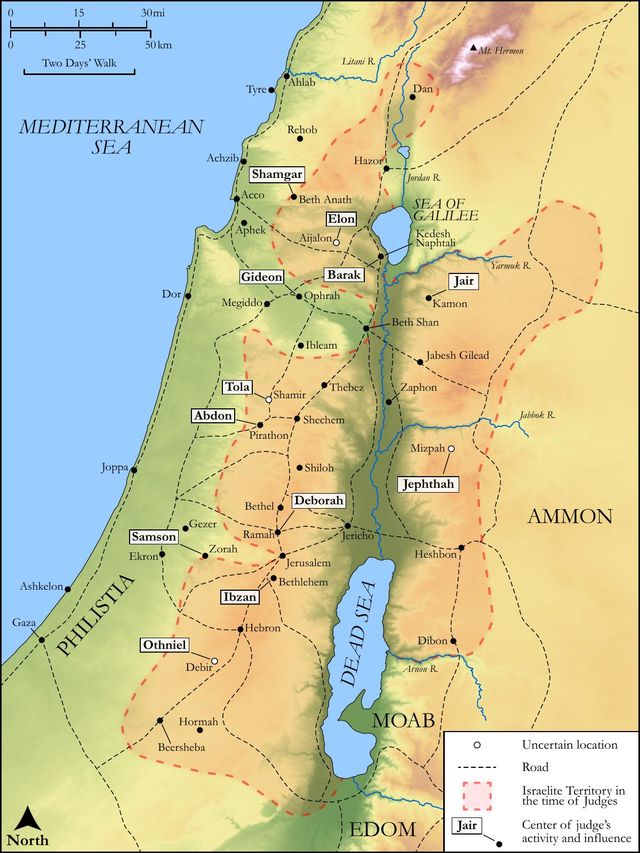
See on the biblical-era maps
Study this verse
Public-domain commentary
Matthew Henry
From his Commentary on the Whole Bible. Henry comments on passages, not single verses — this entry covers Judges 12:8–15. His two-level outline is real structure in the source text, so it is rendered as structure.
We have here a short account of the short reigns of three more of the judges of Israel, the first of whom governed but seven years, the second ten, and the third eight. For the transgression of a land, many are the princes thereof, many in a short time, successively (Pro 28:2), good men being removed in the beginning of their usefulness and by the time that they have applied themselves to their business.
I.Ibzan of Bethlehem, most probably Bethlehem of Judah, David's city, not that in Zebulun, which is only mentioned once, Jos 19:15.
He ruled but seven years, but by the number of his children, and his disposing of them all in marriage himself, it appears that he lived long; and probably the great increase of his family, and the numerous alliances he made, added to his personal merits, made him the more fit to be either chosen by the people as Jephthah was, or called of God immediately, as Gideon was, to be Israel's judge, to keep up and carry on the work of God among them. That which is remarkable concerning him is,
1.That he had many children, sixty in all, a quiver full of these arrows. Thus was Bethlehem of old famous for increase, the very city where he was to be born whose spiritual seed should be as the stars of heaven.
2.That he had an equal number of each sex, thirty sons and thirty daughters, a thing which does not often happen in the same family, yet, in the great family of mankind, he that at first made two, male and female, by his wise providence preserves a succession of both in some sort of equality as far as is requisite to the keeping up of the generations of men upon earth.
3.That he took care to marry them all. His daughters he sent abroad, et maritis dedit, so the vulgar Latin adds - he provided husbands for them; and, as it were in exchange, and both ways, strengthening his interest, he took in thirty daughters from abroad for his sons. The Jews say, Every father owes three things to his son: to teach him to read the law, give him a trade, and get him a wife. What a difference was there between Ibzan's family and that of his immediate predecessor Jephthah! Ibzan has sixty children and all married, Jephthah but one, a daughter, that dies or lives unmarried. Some are increased, others are diminished: both are the Lord's doing.
II.Elon of Zebulun, in the north of Canaan, was next raised up to preside in public affairs, to administer justice, and to reform abuses.
Ten years he continued a blessing to Israel, and then died, Jdg 12:11, Jdg 12:12. Dr. Lightfoot computes that in the beginning of his time the forty years' oppression by the Philistines began (spoken of Jdg 13:1), and about that time Samson was born. Probably, his residence being in the north, the Philistines who bordered upon the southern parts of Canaan took the opportunity of making incursions upon them.
III.Abdon, of the tribe of Ephraim, succeeded, and in him that illustrious tribe begins to recover its reputation, having not afforded any person of note since Joshua; for Abimelech the Shechemite was rather a scandal to it. This Abdon was famous for the multitude of his offspring (v. 14): he had forty sons and thirty grandsons, all of whom he lived to see grown up, and they rode on seventy ass-colts either as judges and officers or as gentlemen and persons of distinction. It was a satisfaction to him thus to see his children's children, but it is feared he did not see peace upon Israel, for by this time the Philistines had begun to break in upon them. Concerning this, and the rest of these judges that have ever so short an account given of them, yet notice is taken where they were buried (Jdg 12:7, Jdg 12:10, Jdg 12:12, Jdg 12:15), perhaps because the inscriptions upon their monuments (for such were anciently used, Kg2 23:17) would serve for the confirmation and enlargement of their story, and might be consulted by such as desired further information concerning them. Peter, having occasion to speak of David, says, His sepulchre is with us unto this day, Act 2:29. Or it is intended for the honour of the places where they laid their bones, but may be improved for the lessening of our esteem of all worldly glory, of which death and the grave will stain the pride. These judges, that were as gods to Israel, died like men, and all their honour was laid in the dust.
It is very strange that in the history of all these judges, some of whose actions are very particularly related, there is not so much as once mention made of the high priest, or any other priest or Levite, appearing either for counsel or action in any public affair, from Phinehas (Jdg 20:28) to Eli, which may well be computed 250 years; only the names of the high priests at that time are preserved, Ch1 6:4-7; and Ezr 7:3-5. How can this strange obscurity of that priesthood for so long a time, now in the beginning of its days, agree with that mighty splendour with which it was introduced and the figure which the institution of it makes in the law of Moses? Surely it intimates that the institution was chiefly intended to be typical, and that the great benefits that seemed to be promised by it were to be chiefly looked for in its antitype, the everlasting priesthood of our Lord Jesus, in comparison of the superior glory of which that priesthood had no glory, Co2 3:10.
Continue studying Judges 12:10 across the web’s major study libraries — every link below opens this exact verse, chapter, or book on the destination site.
Read & Compare
 BibleGatewayThis verse in more than 200 translations and 70 languages.
 Bible.comThe YouVersion reader — hundreds of translations, reading plans, and highlights.
 ESV.orgCrossway's official English Standard Version reader.
 NET BibleThe NET translation with 60,000+ translators' notes on every rendering decision.
 STEP BibleTyndale House's free study tool — original text, vocabulary, and scholarly resources.
 BibliaLogos Bible Software's free web reader.
 USCCBThe New American Bible (Revised Edition) with the U.S. bishops' study notes.
Commentaries
 BibleHub CommentariesDozens of classic commentaries on this verse, gathered on one page.
 StudyLightMore than 100 commentary sets — the largest collection on the web.
 BibleRefPlain-English commentary on what this verse means, verse by verse.
 Enduring WordDavid Guzik's free commentary on this chapter, widely used by Bible teachers.
 Bible Study ToolsVerse commentary alongside Greek and Hebrew study aids.
Original Language & Research
- BibleHub InterlinearThe verse word by word — original language, transliteration, and English.
- BibleHub LexiconEvery word's original-language definition and Strong's entry.
 Blue Letter BibleDeep-study tools — Strong's numbers, concordance, and word studies.
 SefariaThe Hebrew text with Rashi and centuries of Jewish commentary.
Sermons, Hymns & Audio


TrulyRandomVerse is not affiliated with these sites and doesn’t control their content. They’re linked because they’re genuinely useful.
Summary
Judges 12:10 serves as a succinct epilogue to the brief account of Ibzan's seven-year judgeship, marking his death and burial in Bethlehem. This terse statement, characteristic of the "minor judges" narratives, underscores the universal reality of human mortality and the transient nature of earthly leadership, while simultaneously highlighting God's enduring sovereignty and the continuity of His redemptive plan, subtly pointing to the profound future significance of Bethlehem within salvation history.
Context
ShowHideLiterary Context
Judges 12:10 functions as the concluding statement for Ibzan's narrative, directly following the description of his judgeship in Judges 12:8-9. His story is remarkably concise, focusing primarily on his large family and strategic marital alliances rather than military exploits or spiritual revivals, setting him apart from "major judges" like Gideon or Samson. The verse acts as a literary transition, closing Ibzan's tenure and immediately preceding the introduction of his successor, Elon, in Judges 12:11. This pattern of a judge's rise, a period of peace (or lack of explicit conflict), and then their death and burial, is a recurring structural device throughout the book of Judges, emphasizing the cyclical nature of Israel's relationship with God—marked by apostasy, oppression, and divinely appointed deliverance—and the succession of temporary human leaders within that cycle.
Historical & Cultural Context
The period of the Judges (approximately 14th-11th centuries BCE) was a decentralized era in Israelite history, characterized by a loose tribal confederation rather than a unified monarchy. Without a central king, leadership often emerged through charismatic figures (judges) whom God raised up to deliver His people from foreign oppressors or internal strife. Burial practices in ancient Israel were deeply significant, typically involving interment in family tombs, caves, or rock-cut chambers, often near the deceased's ancestral land. The mention of a specific burial location, even for a "minor" judge like Ibzan, underscores the cultural importance of land, lineage, and proper burial rites. Bethlehem, though not explicitly identified as "Bethlehem of Judah" in this verse, was a known town in the tribal territory of Judah, and its mention grounds the narrative in a specific geographical reality, even if its profound future role in God's redemptive plan was yet to be revealed.
Key Themes
ShowHideThis verse, despite its brevity, contributes to several overarching themes within the book of Judges and the broader biblical narrative. Firstly, it powerfully reiterates the transience of human leadership; every judge, regardless of their accomplishments or impact, is mortal and serves for a finite period. Their death underscores the ultimate need for God's enduring sovereignty and provision, as human authority is always temporary. Secondly, it reinforces the theme of divine continuity amidst human change. Despite the passing of one leader, God's covenant plan for Israel persists, and He faithfully raises up another to continue His work. This cyclical succession, seen throughout Judges 2:16-19, highlights God's steadfastness. Finally, the seemingly incidental mention of Bethlehem, a town that would become central to the lineage of King David and, most significantly, the prophesied birthplace of the Messiah, subtly introduces the theme of God's long-term redemptive plan. This plan unfolds through seemingly minor details and locations across generations, as prophetically declared in Micah 5:2.
Exposition and Analysis
ShowHideKey Word Analysis
ShowHideA primitive root meaning "to die" (literally or figuratively) or "to kill." In Judges 12:10, it denotes the literal cessation of life for Ibzan. This fundamental verb emphasizes the universal and inevitable reality of human mortality, a recurring theme throughout Scripture that highlights the finite nature of all earthly existence and power, including that of divinely appointed leaders.
From a root meaning "splendid." Ibzan is presented as one of Israel's "minor judges," whose seven-year tenure is notable for its brevity and focus on his large family (thirty sons and thirty daughters) and their strategic marriages, rather than military victories. His name, though its precise etymology is debated by scholars, signifies his identity as a specific individual within the lineage of Israel's leaders, whose life, like all human lives, reached its appointed end.
Literally meaning "house of bread," or "house of food." This is the well-known town in Judah. Its mention as Ibzan's burial place is a seemingly minor geographical detail that carries immense prophetic and theological weight within the broader biblical narrative. As the future birthplace of King David and, crucially, the Messiah, Bethlehem's appearance here subtly connects the transient judgeship era to the unfolding of God's grand redemptive plan.
Verse Breakdown
ShowHide"Then died Ibzan,"
This clause succinctly declares the end of Ibzan's life and, by extension, his judgeship. The Hebrew verb for "died" (וַיָּמָת, vayyāmāṯ) is direct and unadorned, emphasizing the stark reality of human mortality. This abrupt statement serves as a literary marker, signaling a clear transition in the narrative of the judges, concluding one period of leadership and preparing the reader for the introduction of the next. It underscores that even leaders chosen by God are subject to the same physical limitations as all humanity, highlighting the temporary nature of their earthly authority.
"and was buried at Bethlehem."
This second clause provides the specific location of Ibzan's interment. The act of burial was a vital cultural and religious practice in ancient Israel, signifying respect for the deceased, proper closure, and the return of the body to the earth. The precise mention of "Bethlehem" is significant not only for its geographical grounding but also for its profound prophetic resonance. While Ibzan's personal connection to Bethlehem is not elaborated upon, this detail subtly embeds his story within the historical tapestry of a town destined for extraordinary future significance in God's redemptive plan, particularly as the birthplace of the Messiah.
Literary Devices
ShowHideThe brevity of Judges 12:10, mirroring the entire account of Ibzan's judgeship, functions as a potent literary device. This Conciseness highlights the transient nature of human life and leadership, especially when contrasted with the more elaborate narratives of other judges. The verse also employs Juxtaposition by placing the simple statement of death and burial against the preceding verses' focus on Ibzan's large family and strategic marriages, subtly emphasizing that even a legacy of numerous offspring does not exempt one from mortality. Furthermore, the specific mention of Bethlehem functions as a Geographical Marker or Toponymy, grounding the narrative in a real-world location. This seemingly minor detail takes on immense Symbolism when viewed through the lens of the broader biblical narrative, foreshadowing Bethlehem's future role as the birthplace of King David and, ultimately, the Messiah.
Theological and Thematic Connections
ShowHideJudges 12:10, though brief, carries profound theological weight, reinforcing the biblical truth of human mortality and the enduring sovereignty of God. It serves as a stark reminder that all human leaders, no matter how divinely appointed or effective, are temporary. Their lives are finite, and their tenures are limited, underscoring the ultimate transience of earthly power and the eternal, unchanging nature of God's reign. This verse subtly points to the continuity of God's covenant plan for Israel, which transcends the lifespan of any individual. Even as one judge passes away, God's purpose for His people remains steadfast, and He continues to raise up leaders to guide and deliver them according to His will. The seemingly mundane record of death and burial thus becomes a quiet testament to God's faithfulness across generations, ensuring His divine narrative unfolds regardless of human comings and goings, always moving towards its ultimate fulfillment.
Reflection and Application
ShowHideJudges 12:10 serves as a poignant reminder of life's brevity and the universal reality of death. For the Israelites, it marked the conclusion of an era, however quiet, under Ibzan's leadership, and the anticipation of a new one. For us today, this verse invites profound reflection on our own mortality and the temporary nature of all earthly endeavors, positions of authority, and personal legacies. It calls us to consider how we steward the time, talents, and influence God has graciously entrusted to us, recognizing that our ultimate hope and security do not rest in human leaders, institutions, or our own achievements, but in the eternal, faithful God who remains constant through all generations. The seemingly incidental mention of Bethlehem also subtly encourages us to cultivate an awareness of God's hand at work in seemingly insignificant details and overlooked places, as He often uses the ordinary and the obscure to accomplish His extraordinary, long-term purposes, weaving a grand narrative that extends far beyond our immediate understanding and perception.
Questions for Reflection
ShowHideFAQ
ShowHideWho was Ibzan, and why is his account so brief in the Book of Judges?
ShowHideIbzan was one of the "minor judges" of Israel, serving for seven years, as recorded in Judges 12:8-10. His account is notably brief, focusing primarily on his large family of thirty sons and thirty daughters, all of whom he married off outside his immediate family. This conciseness is characteristic of the "minor judges" (e.g., Tola, Jair, Elon, Abdon), whose narratives lack the detailed military exploits or spiritual revivals associated with "major judges" like Gideon, Samson, or Deborah. Scholars suggest this brevity might indicate a period of relative peace and stability, where the judge's role was more administrative or social, rather than military. It also serves a literary purpose, highlighting the cyclical nature of leadership and the rapid succession of figures in the turbulent period of the Judges, emphasizing that no human leader is permanent.
Why is Bethlehem mentioned as Ibzan's burial place, and is it the same Bethlehem known from other biblical stories?
ShowHideYes, it is almost certainly the same Bethlehem, specifically Bethlehem of Judah, which is most famous in biblical history. While the Bible doesn't elaborate on Ibzan's personal connection to Bethlehem, its mention here is profoundly significant due to the town's later prominence in God's redemptive plan. Bethlehem is famously the hometown of King David and, most crucially, the prophesied birthplace of the Messiah, Jesus Christ, as foretold in Micah 5:2. The inclusion of this geographical detail, even in such a brief verse, subtly weaves Ibzan's story into the larger tapestry of God's unfolding plan, highlighting how seemingly minor details in the Old Testament can foreshadow major developments in salvation history.
Christ-Centered Fulfillment
ShowHideJudges 12:10, with its terse declaration of Ibzan's death and burial, profoundly points to Christ in several compelling ways. The transience of Ibzan's judgeship, like all human leaders, stands in stark contrast to the eternal and perfect reign of Jesus Christ. While judges like Ibzan provided temporary deliverance and leadership, they ultimately succumbed to death, underscoring humanity's desperate need for a permanent, unfailing deliverer. Jesus, however, is the eternal King and the perfect Judge, whose reign knows no end and whose sacrifice provides ultimate and lasting salvation from sin and death. Furthermore, the mention of Bethlehem, the "house of bread," as Ibzan's burial place, is a powerful prophetic echo. Centuries later, this very town would be the birthplace of Jesus, the Bread of Life, who came to satisfy the deepest spiritual hunger of humanity. Thus, even in the quiet passing of a minor judge, the biblical narrative subtly directs our gaze to the coming of the Messiah, who would transcend all earthly limitations, conquer death, and establish an everlasting kingdom from the very town where a temporary judge was laid to rest, fulfilling God's promise of an enduring King from Bethlehem.