


Joshua 19:15
Bible text: King James Version (1769 Blayney text) · Public domain
Bible text: Berean Standard Bible · Public domain
Bible text: American Standard Version (1901) · Public domain
Bible text: World English Bible, Messianic edition · Public domain
Bible text: Geneva Bible (1599) · Public domain
Bible text: Young's Literal Translation · Public domain
- וְקַטָּתve·ka·Tatand KattahH7005Conj-w ¦ N-properNoun Proper LocationוְandקַטָּתKattah
- וְנַהֲלָלve·na·ha·Laland NahalalH5096Conj-w ¦ N-properNoun Proper LocationוְandנַהֲלָלNahalal
- וְשִׁמְרוֹןve·shim·Ronand ShimronH8110Conj-w ¦ N-properNoun Proper LocationוְandשִׁמְרוֹןShimron
- וְיִדְאֲלָהve·yid·'a·Lahand IdalahH3030Conj-w ¦ N-properNoun Proper LocationוְandיִדְאֲלָהIdalah
- וּבֵיתu·Veitand Beth-H1035Conj-w ¦ N-properNoun Proper LocationוּandבֵיתBeth-
- לָחֶםLa·chem-lehemH1035N-properNoun Proper Location
- עָרִים'a·RimcitiesH5892N-mpNoun Plural Masculine Absolute
- שְׁתֵּיםshe·teimtwo [plus]H8147Adj-fdAdjective Numerical Dual Feminine Absolute
- עֶשְׂרֵה'es·RehtenH6240Adj-csAdjective Numerical Singular common gender Absolute
- וְחַצְרֵיהֶןve·chatz·rei·Henand their villagesH2691Conj-w ¦ N-mpc ¦ 3fpNoun Plural Masculine Constructוְandחַצְרֵיvillagesהֶןtheir
English is a literal word-by-word gloss of the Hebrew, not the KJV's wording. Why?
This is the original text the KJV's translators worked from — each Hebrew word with its own literal English meaning in this verse, prepared by scholars at Tyndale House, Cambridge. The KJV translates whole sentences, not word by word, so its wording differs: one Hebrew word can become several English words, and the KJV may choose “the LORD” where the gloss reads “Yahweh”. Both are faithful — they answer different questions. For the KJV's own rendering, switch to the KJV text.
Details
See on the biblical-era maps
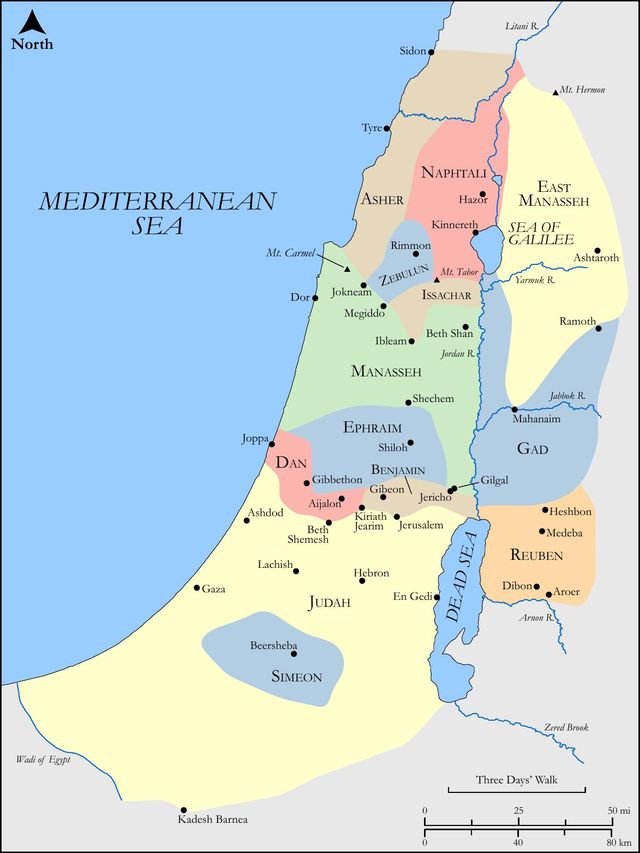
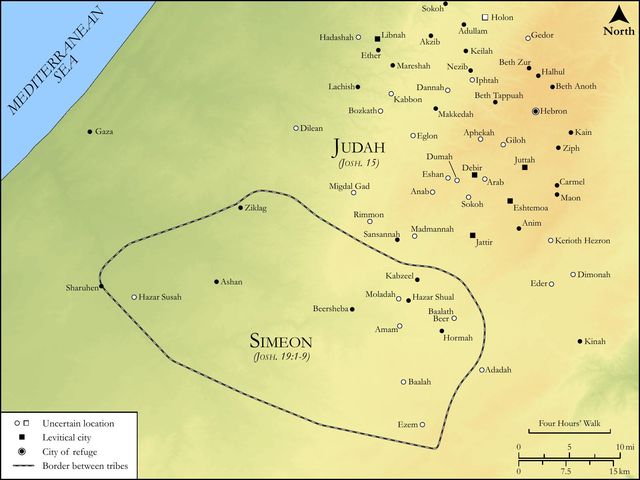
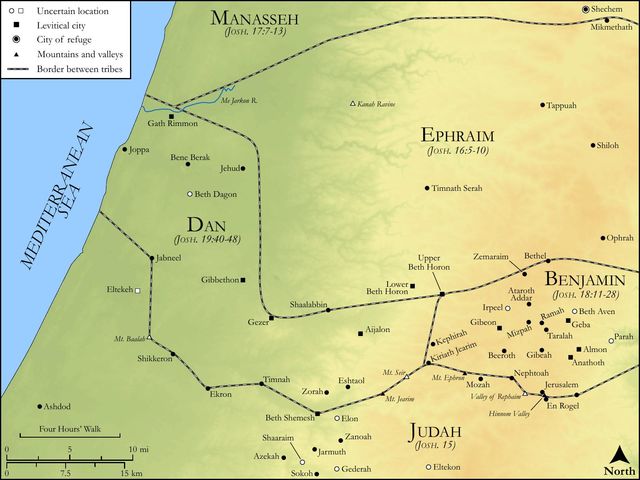
Study this verse
Public-domain commentary
Matthew Henry
From his Commentary on the Whole Bible. Henry comments on passages, not single verses — this entry covers Joshua 19:10–16.
This is the lot of Zebulun, who, though born of Leah after Issachar, yet was blessed by Jacob and Moses before him; and therefore it was so ordered that his lot was drawn before that of Issachar, north of which it lay and south of Asher. 1. The lot of this tribe was washed by the great sea on the west, and by the sea of Tiberias on the east, answering Jacob's prophecy (Gen 49:13), Zebulun shall be a haven of ships, trading ships on the great sea and fishing ships on the sea of Galilee. 2. Though there were some places in this tribe which were made famous in the Old Testament, especially Mount Carmel, on which the famous trial was between God and Baal in Elijah's time, yet it was made much more illustrious in the New Testament; for within the lot of this tribe was Nazareth, where our blessed Saviour spent so much of his time on earth, and from which he was called Jesus of Nazareth, and Mount Tabor on which he was transfigured, and that coast of the sea of Galilee on which Christ preached so many sermons and wrought so many miracles.
Continue studying Joshua 19:15 across the web’s major study libraries — every link below opens this exact verse, chapter, or book on the destination site.
Read & Compare
 BibleGatewayThis verse in more than 200 translations and 70 languages.
 Bible.comThe YouVersion reader — hundreds of translations, reading plans, and highlights.
 ESV.orgCrossway's official English Standard Version reader.
 NET BibleThe NET translation with 60,000+ translators' notes on every rendering decision.
 STEP BibleTyndale House's free study tool — original text, vocabulary, and scholarly resources.
 BibliaLogos Bible Software's free web reader.
 USCCBThe New American Bible (Revised Edition) with the U.S. bishops' study notes.
Commentaries
 BibleHub CommentariesDozens of classic commentaries on this verse, gathered on one page.
 StudyLightMore than 100 commentary sets — the largest collection on the web.
 BibleRefPlain-English commentary on what this verse means, verse by verse.
 Enduring WordDavid Guzik's free commentary on this chapter, widely used by Bible teachers.
 Bible Study ToolsVerse commentary alongside Greek and Hebrew study aids.
Original Language & Research
- BibleHub InterlinearThe verse word by word — original language, transliteration, and English.
- BibleHub LexiconEvery word's original-language definition and Strong's entry.
 Blue Letter BibleDeep-study tools — Strong's numbers, concordance, and word studies.
 SefariaThe Hebrew text with Rashi and centuries of Jewish commentary.
Sermons, Hymns & Audio


TrulyRandomVerse is not affiliated with these sites and doesn’t control their content. They’re linked because they’re genuinely useful.
Summary
Joshua 19:15 concludes the meticulous description of the territorial inheritance allotted to the tribe of Zebulun, listing five specific cities—Kattath, Nahallal, Shimron, Idalah, and Bethlehem—that fell within their boundaries. This verse then summarizes Zebulun's urban centers by stating "twelve cities with their villages," indicating that these five, combined with others mentioned earlier in the tribal description, comprised the total number of principal cities within their divinely appointed territory in the Promised Land, thereby affirming the completeness and precision of the land distribution.
Context
ShowHideLiterary Context
Joshua 19:15 is situated within the latter half of the book of Joshua, specifically in the detailed account of the land distribution among the Israelite tribes (chapters 13-19). Following the initial conquests and the establishment of the tabernacle at Shiloh, these chapters meticulously document the fulfillment of God's promise to give Israel the land. Chapter 19 focuses on the allotments for Simeon, Zebulun, Issachar, Asher, Naphtali, and Dan. Verses 10-14 of Joshua 19 describe the initial boundaries and cities of Zebulun's lot, and verse 15 serves as a concluding summary, providing a final list of prominent cities and the total count of their urban centers. This detailed cataloging underscores the legal and historical significance of the land grants, emphasizing the divine order and the precise fulfillment of God's covenant promises.
Historical & Cultural Context
The period immediately following the conquest of Canaan was one of transition for the Israelite tribes, from nomadic life to settled agricultural existence. The division of the land was a monumental administrative and theological act, establishing the tribal identities and their permanent stake in the Promised Land. Land inheritance was foundational to Israelite society, ensuring family lineage, economic stability, and adherence to the covenant. The meticulous listing of cities and boundaries served as a legal deed, preventing future disputes and affirming divine ownership and distribution. It is crucial to note the geographical distinction of "Bethlehem" in this verse. Unlike the famous Bethlehem of Judah, which would later be known as the birthplace of King David and Jesus Christ, the Bethlehem mentioned in Joshua 19:15 was located in the northern territory of Zebulun, near Nazareth. This highlights the commonality of place names in ancient lands and the importance of contextual geographical understanding.
Key Themes
ShowHideThis verse, as part of the broader land distribution narrative, powerfully illustrates several key theological themes. Firstly, it highlights Divine Faithfulness and Fulfillment, demonstrating God's unwavering commitment to His ancient covenant promises made to Abraham, Isaac, and Jacob, that their descendants would inherit the land of Canaan (e.g., Genesis 12:7). The detailed enumeration of cities and boundaries underscores the precision of His divine plan. Secondly, it emphasizes Order and Provision, showcasing God's systematic and comprehensive care for His people, as each tribe received a distinct and sufficient inheritance (e.g., Joshua 18:1). Lastly, it solidifies Tribal Identity and Inheritance, providing a meticulous record that served as a legal and historical document, affirming each tribe's unique place and permanent stake in the Promised Land, a foundational aspect of their national and spiritual identity, as seen throughout the land division in Joshua 13-19.
Exposition and Analysis
ShowHideKey Word Analysis
ShowHideLiterally meaning "house of bread." While the name itself is common, its significance here lies in its geographical placement within Zebulun's territory, distinguishing it from the more famous Bethlehem in Judah. This northern Bethlehem was a distinct settlement, underscoring the importance of precise geographical and historical context in biblical interpretation. Its name, "house of bread," might reflect its agricultural productivity and the sustenance it provided.
Refers to a city, a place guarded by watching or a watch, in the widest sense, even of a mere encampment or post. In this context, it denotes the principal urban centers allotted to the tribe of Zebulun, serving as administrative, social, and economic hubs within their territory. The meticulous counting of these "cities" emphasizes the thoroughness and completeness of the land division.
Refers to a yard (as enclosed by a fence) or a hamlet (as similarly surrounded with walls). In this verse, it signifies the smaller, dependent settlements, agricultural hamlets, or outlying communities that were associated with and belonged to the main cities. Their inclusion indicates that the inheritance encompassed not just the urban centers but also their surrounding rural areas, completing the full extent of the tribal allotment.
Verse Breakdown
ShowHide"And Kattath, and Nahallal, and Shimron, and Idalah, and Bethlehem"
This clause lists five specific cities that were part of Zebulun's inheritance. These names, along with others mentioned earlier in Joshua 19:10-14, constitute the urban centers within the tribe's designated territory. The listing of these specific locations serves as a precise geographical marker, confirming the boundaries and contents of Zebulun's lot as divinely ordained.
"twelve cities with their villages."
This concluding phrase provides a numerical summary of Zebulun's inherited urban centers. It indicates that the five cities just listed, combined with the others previously mentioned, totaled twelve principal cities. The addition of "with their villages" signifies that the inheritance included not just the main cities but also their surrounding satellite communities, agricultural lands, and dependent settlements, encompassing the full extent of their allocated territory. This meticulous accounting underscores the completeness and legal precision of the land division.
Literary Devices
ShowHideThe primary literary device at play in Joshua 19:15 is Cataloging, specifically a List of place names. This meticulous enumeration of cities (Kattath, Nahallal, Shimron, Idalah, Bethlehem) serves to provide precise geographical detail and legal documentation of the land distribution. Following this list, a Summary Statement ("twelve cities with their villages") is used to provide a concise numerical overview, reinforcing the completeness and exactitude of the tribal inheritance. This combination of detailed listing and summary is characteristic of the administrative and historical nature of the land division accounts in Joshua, emphasizing divine order and the fulfillment of promises.
Theological and Thematic Connections
ShowHideJoshua 19:15, though a seemingly mundane list of cities, is deeply significant within the overarching narrative of God's faithfulness and Israel's inheritance. It serves as tangible proof of God's covenant promises being fulfilled, demonstrating His meticulous care in providing for His people. The land, with its specific boundaries and cities, was not merely a physical possession but a theological symbol of God's presence, provision, and the security found in His covenant. This detailed distribution underscores the principle that God's promises are not vague but are fulfilled with precision and intentionality, down to every "house of bread" and its surrounding "villages." It foreshadows a greater, spiritual inheritance that God promises to His people through Christ, which is equally sure and meticulously prepared.
Reflection and Application
ShowHideJoshua 19:15 reminds us that God is a God of detail and faithfulness. Just as He meticulously allotted land to each tribe, ensuring their provision and identity, He is intimately involved in the specifics of our lives. This seemingly dry list of ancient cities becomes a powerful testament to God's commitment to His promises. We can find comfort and confidence in knowing that our "inheritance" in Christ is not vague or uncertain, but precisely prepared and guaranteed by a faithful God. This also challenges us to pay careful attention to the details of God's Word, recognizing that even the most obscure verses contribute to the grand narrative of His redemptive plan. Understanding the context, as exemplified by the two Bethlehems, is crucial for accurate interpretation and application, safeguarding us from misinterpretations and encouraging a deeper, more rigorous engagement with Scripture, thereby enriching our spiritual understanding and walk.
Questions for Reflection
ShowHideFAQ
ShowHideWhy is there a Bethlehem in Zebulun, and how is it different from the Bethlehem where Jesus was born?
ShowHideThe Bethlehem mentioned in Joshua 19:15 is a distinct town located in the northern territory allotted to the tribe of Zebulun. It is approximately 7 miles northwest of Nazareth, in the Galilee region. This is entirely separate from the more famous Bethlehem of Judah, often referred to as Bethlehem Ephrathah, which is located south of Jerusalem and is renowned as the birthplace of King David and, later, Jesus Christ (Matthew 2:1-6). The existence of two towns with the same name (Bethlehem simply means "house of bread") was not uncommon in ancient times and underscores the critical importance of paying attention to geographical and tribal context when reading the Bible to avoid misidentification.
What is the significance of "twelve cities with their villages" in this verse?
ShowHideThe phrase "twelve cities with their villages" serves as a summary statement for the urban centers within the tribal inheritance of Zebulun. It signifies the total number of principal cities, along with their surrounding dependent settlements and agricultural lands, that were officially allotted to the tribe. This numerical summary emphasizes the completeness and precision of the land division process. It highlights that God's provision was thorough and meticulously accounted for, ensuring that each tribe received its full and proper inheritance, down to every city and its associated rural areas. This meticulous accounting also served as a legal and historical record for future generations, preventing disputes over land ownership, as documented in the broader context of Joshua 13-19.
Christ-Centered Fulfillment
ShowHideWhile Joshua 19:15 describes a literal, earthly inheritance, its deeper theological resonance points to the ultimate and perfect inheritance found in Jesus Christ. The land of Canaan, with its meticulous division and promise of rest, served as a type or shadow of the spiritual rest and eternal inheritance that believers receive in Christ. Just as the Israelites entered a physical land of promise, believers now enter into a spiritual reality of God's promised blessings through faith in Jesus. He is the true "land" and the ultimate "rest" (Hebrews 4:9-10). The security and permanence of Zebulun's inheritance, documented in detail, foreshadow the absolute certainty of our spiritual inheritance in Christ, which is "imperishable, undefiled, and unfading, kept in heaven for you" (1 Peter 1:3-4). Furthermore, Christ, as the "Lamb of God" (John 1:29), fulfills the Abrahamic covenant, ensuring that the true heirs are not merely those of physical descent but all who believe in Him, receiving spiritual blessings "in Christ" (Ephesians 1:3). Thus, the precise allotment of land in Joshua ultimately directs our gaze to the boundless and eternal inheritance secured for us by our Savior, who is the fulfillment of all God's promises (2 Corinthians 1:20).