


Joshua 19:14
Bible text: King James Version (1769 Blayney text) · Public domain
Bible text: King James Version with Strong's numbers · Public domain
Bible text: Berean Standard Bible · Public domain
Bible text: American Standard Version (1901) · Public domain
Bible text: World English Bible, Messianic edition · Public domain
Bible text: Geneva Bible (1599) · Public domain
Bible text: Young's Literal Translation · Public domain
- וְנָסַבve·na·Savand it turnsH5437Conj-w ¦ V-Niphal-ConsecPerf-3msVerb Niphal Consecutive Perfect 3rd Singular Masculineוְandנָסַבit turns
- אֹתוֹ'o·To<obj.> itselfH853DirObjM ¦ 3msParticle Object Indicatorאֹת<obj.>וֹitself
- הַגְּבוּלha·ge·Vulthe borderH1366Art ¦ N-msNoun Singular Masculine Absoluteהַtheגְּבוּלborder
- מִצְּפוֹןmi·tze·Fonfrom [the] northH6828Prep-m ¦ N-fscNoun Singular Feminine Constructמִfromצְּפוֹן[the] north
- חַנָּתֹןcha·na·TonHannathonH2615N-properNoun Proper Location
- וְהָיוּve·ha·Yuand they areH1961Conj-w ¦ V-Qal-ConsecPerf-3cpVerb Qal Consecutive Perfect 3rd Plural common genderוְandהָיוּthey are
- תֹּצְאֹתָיוto·tze·'o·Tavits extremitiesH8444N-fpc ¦ 3msNoun Plural Feminine Constructתֹּצְאֹתָיextremitiesוits
- גֵּיgei[the] valley ofH1516N-cscNoun Singular common gender Construct
- יִפְתַּחyif·tachIphtahH3317N-properNoun Proper Location
- אֵל'ElElH3317N-properNoun Proper Location
English is a literal word-by-word gloss of the Hebrew, not the KJV's wording. Why?
This is the original text the KJV's translators worked from — each Hebrew word with its own literal English meaning in this verse, prepared by scholars at Tyndale House, Cambridge. The KJV translates whole sentences, not word by word, so its wording differs: one Hebrew word can become several English words, and the KJV may choose “the LORD” where the gloss reads “Yahweh”. Both are faithful — they answer different questions. For the KJV's own rendering, switch to the KJV text.
Details
See on the biblical-era maps
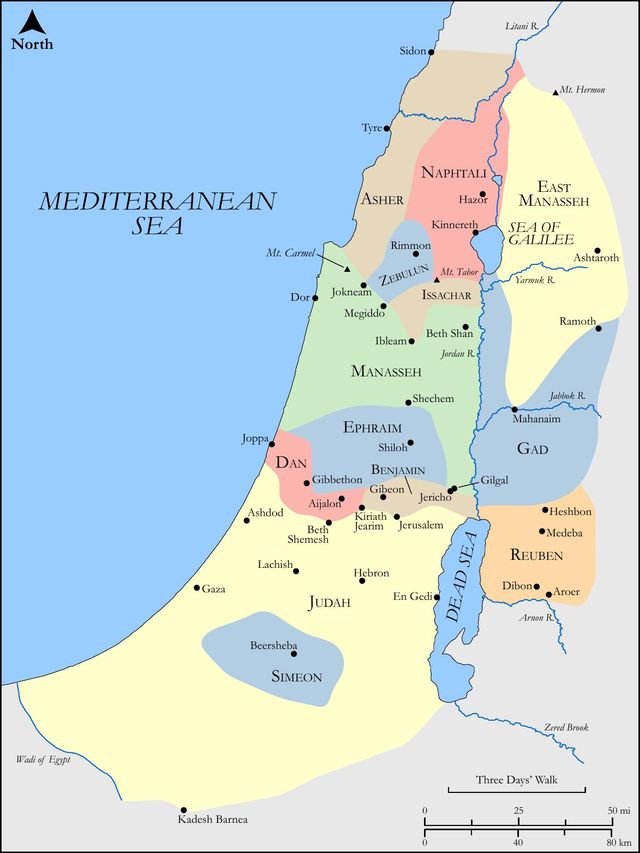
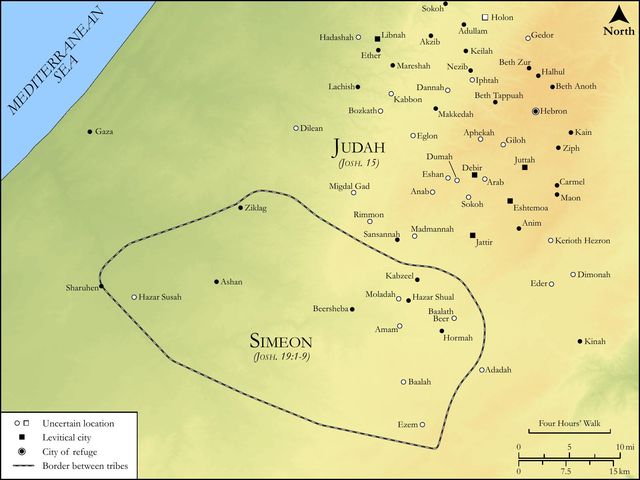
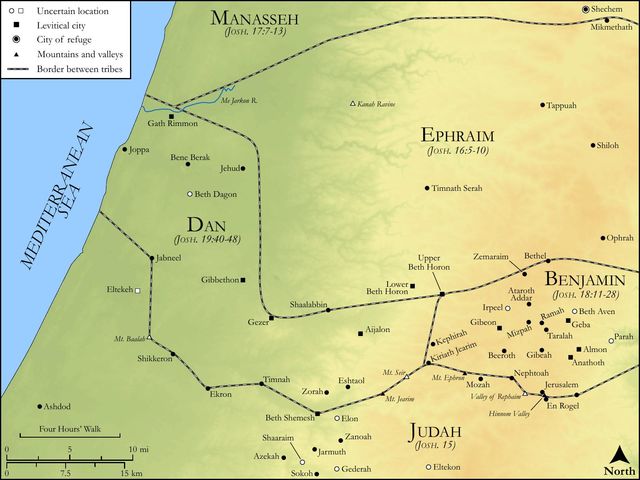
Study this verse
Public-domain commentary
Matthew Henry
From his Commentary on the Whole Bible. Henry comments on passages, not single verses — this entry covers Joshua 19:10–16.
This is the lot of Zebulun, who, though born of Leah after Issachar, yet was blessed by Jacob and Moses before him; and therefore it was so ordered that his lot was drawn before that of Issachar, north of which it lay and south of Asher. 1. The lot of this tribe was washed by the great sea on the west, and by the sea of Tiberias on the east, answering Jacob's prophecy (Gen 49:13), Zebulun shall be a haven of ships, trading ships on the great sea and fishing ships on the sea of Galilee. 2. Though there were some places in this tribe which were made famous in the Old Testament, especially Mount Carmel, on which the famous trial was between God and Baal in Elijah's time, yet it was made much more illustrious in the New Testament; for within the lot of this tribe was Nazareth, where our blessed Saviour spent so much of his time on earth, and from which he was called Jesus of Nazareth, and Mount Tabor on which he was transfigured, and that coast of the sea of Galilee on which Christ preached so many sermons and wrought so many miracles.
Continue studying Joshua 19:14 across the web’s major study libraries — every link below opens this exact verse, chapter, or book on the destination site.
Read & Compare
 BibleGatewayThis verse in more than 200 translations and 70 languages.
 Bible.comThe YouVersion reader — hundreds of translations, reading plans, and highlights.
 ESV.orgCrossway's official English Standard Version reader.
 NET BibleThe NET translation with 60,000+ translators' notes on every rendering decision.
 STEP BibleTyndale House's free study tool — original text, vocabulary, and scholarly resources.
 BibliaLogos Bible Software's free web reader.
 USCCBThe New American Bible (Revised Edition) with the U.S. bishops' study notes.
Commentaries
 BibleHub CommentariesDozens of classic commentaries on this verse, gathered on one page.
 StudyLightMore than 100 commentary sets — the largest collection on the web.
 BibleRefPlain-English commentary on what this verse means, verse by verse.
 Enduring WordDavid Guzik's free commentary on this chapter, widely used by Bible teachers.
 Bible Study ToolsVerse commentary alongside Greek and Hebrew study aids.
Original Language & Research
- BibleHub InterlinearThe verse word by word — original language, transliteration, and English.
- BibleHub LexiconEvery word's original-language definition and Strong's entry.
 Blue Letter BibleDeep-study tools — Strong's numbers, concordance, and word studies.
 SefariaThe Hebrew text with Rashi and centuries of Jewish commentary.
Sermons, Hymns & Audio


TrulyRandomVerse is not affiliated with these sites and doesn’t control their content. They’re linked because they’re genuinely useful.
Summary
Joshua 19:14 precisely delineates a segment of the northern boundary for the tribe of Zebulun, specifying Hannathon as a key landmark and the Valley of Jiphthahel as the area where its border extended. This verse is an integral part of the meticulous biblical record detailing the land distribution to the remaining seven Israelite tribes, powerfully underscoring God's unwavering faithfulness in fulfilling His covenant promises to provide a tangible and divinely appointed inheritance for His people. It highlights the divine order, precision, and meticulous care involved in the establishment of Israel's tribal territories, ensuring each group received its specific and undisputed portion.
Context
ShowHideLiterary Context
Joshua 19 continues the detailed account of the land allocation to the Israelite tribes, following the initial distributions to Judah, Ephraim, and Manasseh in preceding chapters. Specifically, verses 10-16 meticulously outline the inheritance of the tribe of Zebulun, describing its geographical boundaries and the towns situated within its borders. Joshua 19:14 serves as a precise geographical marker within this description, detailing a specific segment of Zebulun's northern frontier. The painstaking enumeration of towns and boundaries throughout this chapter, and indeed the entire book of Joshua, emphasizes the literal and tangible fulfillment of God's ancient promise to give the land of Canaan as an inheritance to Abraham's descendants, transforming a divine decree into a concrete reality on the ground. This detailed recording underscores the divine authority and permanence of these land grants.
Historical & Cultural Context
The period described in the book of Joshua marks a pivotal transition for the Israelites, moving from generations of nomadic wandering to becoming settled inhabitants of the Promised Land. In ancient Israelite society, land ownership was not merely an economic asset but the foundational element for tribal identity, economic stability, and social structure. Each tribe's inheritance was understood as a divinely sanctioned possession, intrinsically tied to their covenant relationship with Yahweh. Establishing clear, undisputed boundaries, as meticulously detailed in this verse and throughout the allocation chapters, was absolutely crucial for preventing inter-tribal conflicts and ensuring the long-term peace, security, and prosperity of the nascent nation. The naming of specific geographical features like Hannathon and the Valley of Jiphthahel reflects the practice of using prominent, identifiable landmarks to define territorial limits, a practice essential in an era predating modern cartography and surveying techniques.
Key Themes
ShowHideThe meticulous geographical descriptions found in Joshua 19:14 and throughout the book contribute to several overarching theological and narrative themes. First, they powerfully demonstrate Divine Faithfulness and Provision, showcasing God's unwavering commitment to His covenant promises, particularly the pledge of land made to Abraham in Genesis 12:7 and reiterated to his descendants. The precise mapping of tribal boundaries, including specific locations like Hannathon and the Valley of Jiphthahel, illustrates God's meticulous care in providing a specific, tangible inheritance for each tribe. Second, these details underscore Order and Structure, reflecting God's nature as a God of precision and organization. The clearly defined boundaries, as outlined in Numbers 34:2, were designed to prevent disputes and ensure each tribe understood its divinely appointed portion, fostering communal harmony and preventing chaos. Finally, the verse highlights the theme of Inheritance and Possession, moving beyond mere promise to the practical reality of the Israelites taking hold of their God-given land. It signifies the culmination of centuries of divine guidance and human obedience, where God's promises required human action and cooperation to be fully realized.
Exposition and Analysis
ShowHideKey Word Analysis
ShowHideThis word (H1366) refers to a boundary, limit, or the territory enclosed by such a limit. In Joshua 19:14, it precisely denotes the defined line that separates Zebulun's territory from its northern neighbors. Its inclusion emphasizes the legal and divinely sanctioned nature of the land division, establishing clear and unambiguous territorial rights for the tribe, thereby preventing future disputes.
The verb (H5437) means "to revolve," "to surround," or "to border." Here, it describes the action of the boundary line as it encircles or extends around a specific part of Zebulun's territory. It conveys the idea of an encompassing or enclosing movement, indicating that the border is not merely a straight line but curves or wraps around the designated area, making its extent clear and definitive.
This plural collective noun (H8444) refers to "exits," "boundaries," or "goings forth." In this context, it describes the points where the border line extends to or terminates, particularly in the Valley of Jiphthahel. It signifies the extremities or the final stretches of the boundary, marking the precise points where the tribal territory concludes in a particular direction.
Verse Breakdown
ShowHide"And the border compasseth it on the north side to Hannathon"
This clause establishes the direction and a key landmark for Zebulun's boundary. The pronoun "it" refers to the territory of Zebulun, whose northern boundary is being described. The border "compasseth," or encircles/extends along, a portion of this territory, specifically along its northern edge. The mention of "Hannathon" provides a precise, identifiable point on this northern arc, indicating that the border reached this specific locality and likely turned or continued from there. This detail is crucial for accurately mapping the tribe's divinely appointed inheritance.
"and the outgoings thereof are in the valley of Jiphthahel"
This second clause describes where the border's "outgoings" (its extensions or terminal points) are located. The term "outgoings" suggests the final stretch or the point where the boundary line concludes its course in that particular direction. The "valley of Jiphthahel" serves as the natural geographical feature that defines this endpoint or the general area where the border concludes its northern extent. Valleys often served as natural and easily identifiable boundaries in ancient land divisions, signifying either a natural barrier or a significant topographical marker that marked the limits of the tribal territory.
Literary Devices
ShowHideThe meticulous geographical descriptions in Joshua 19:14, like those found throughout the land allocation chapters, primarily employ Precision and Detailing. The exact naming of towns (Hannathon) and natural features (Valley of Jiphthahel) provides a highly specific, almost cartographic, account of the tribal boundaries. This granular level of detail serves to authenticate the narrative, demonstrating the literal fulfillment of God's promises and the tangible reality of the inheritance He bestowed upon His people. Furthermore, there is an element of Repetition throughout Joshua's land allocation chapters, where similar formulas of boundary description are used for each tribe, reinforcing the systematic and divinely ordered nature of the process. The land itself, with its specified boundaries, functions as profound Symbolism, representing God's covenant faithfulness, His abundant provision for His people, and the security and identity found within His established order. The very act of defining these borders can also be seen as a form of Legal Documentation, providing a written, divinely sanctioned record of land tenure for future generations, ensuring clarity and preventing disputes.
Theological and Thematic Connections
ShowHideJoshua 19:14, though seemingly a dry geographical detail, is profoundly significant as it underscores the meticulous faithfulness of God in fulfilling His ancient promises. The precise demarcation of tribal lands, down to specific towns and valleys, demonstrates that God's covenant with Abraham was not a vague spiritual concept but a tangible, land-based reality for His people. This attention to detail reveals a God who is intimately involved in the practical affairs of His people, providing for their physical needs and establishing order for their communal life. It speaks to the absolute reliability of God's Word: what He promises, He performs, often with a level of precision that far exceeds human expectation. The land inheritance was a foundational element of Israel's identity and security, a visible and enduring sign of God's unwavering commitment to His chosen nation, embodying His steadfast love and provision.
Reflection and Application
ShowHideThe detailed description of Zebulun's border in Joshua 19:14 offers a powerful and comforting lesson in God's character and His dealings with humanity. It reminds us that God is a God of incredible precision and unwavering faithfulness, attending even to the minute details of His grand plans. Just as He meticulously planned and provided a physical inheritance for the tribes of Israel, He also cares deeply about the specifics of our individual lives, guiding our paths and providing for our needs with the same divine exactness. This verse encourages us to trust implicitly in God's precise plan for our lives, knowing that He is faithful to lead us, provide for us, and establish our boundaries, even in what may seem like mundane or overlooked details. Furthermore, the establishment of clear boundaries serves as a profound metaphor for the importance of spiritual and moral boundaries in our lives. God's Word provides clear guidelines and moral markers, just as these geographical markers provided clear divisions, to ensure we walk in His ways and live within the blessings of His provision and protection. We can find immense comfort in the knowledge that the God who meticulously planned the borders of Zebulun's territory also cares deeply about the intricate details of our individual journeys, demonstrating His great faithfulness in every aspect of our lives, from the grand narrative of salvation to the daily steps we take.
Questions for Reflection
ShowHideFAQ
ShowHideWhy are these geographical details so important in the Bible, especially in the book of Joshua?
ShowHideThese geographical details are crucial for several profound reasons. First, they underscore the divine faithfulness of God in literally fulfilling His ancient promises to Abraham and his descendants to give them a specific, tangible land. Second, they serve as legal documentation of the tribal inheritance, preventing disputes and establishing clear ownership and tribal identity in ancient Israelite society. Third, they lend historical authenticity to the biblical narrative, demonstrating that these events occurred in real places and times, not merely as abstract stories or myths. Finally, they highlight God's order and precision, showing His meticulous involvement in the affairs of His people, providing for them in a tangible, organized, and equitable manner. The detailed allocation also foreshadows the precision of God's ultimate plan of salvation for all humanity, as seen in Ephesians 1:11.
What is the specific significance of "Hannathon" and "Jiphthahel" being named in this verse?
ShowHideThe specific naming of "Hannathon" and the "Valley of Jiphthahel" is highly significant because they represent identifiable landmarks that served as fixed points for defining the border. In an era without detailed maps or modern surveying techniques, natural features like valleys and established towns were essential for marking and recognizing boundaries. Their inclusion indicates the highly practical and precise nature of the land allocation process. These names are not just arbitrary; they are specific geographical markers that would have been known to the Israelites of that time, making the divinely ordained inheritance a concrete reality on the ground. They testify to the exactness of God's provision and the meticulous record-keeping of the biblical authors, ensuring that the boundaries of each tribe, including Zebulun, were clearly understood and recognized, as God had commanded in Numbers 34-2-12.
Christ-Centered Fulfillment
ShowHideWhile Joshua 19:14 describes a physical inheritance of land, its ultimate theological fulfillment is found in Christ, who embodies and secures the spiritual inheritance for all believers. The land of Canaan, with its divinely appointed boundaries, foreshadowed the greater "rest" and "inheritance" that God provides through His Son. Just as Israel entered a physical land, believers in Christ enter into a spiritual reality of salvation, peace, and eternal life. Jesus is the true "Promised Land," in whom all of God's promises find their "Yes" and "Amen" (2 Corinthians 1:20). Our inheritance is no longer a plot of ground but a spiritual dwelling in Christ, where we are made "heirs of God and co-heirs with Christ" (Romans 8:17). The meticulous detail of Zebulun's border points to the absolute certainty and precision of the spiritual blessings we receive in Him, including "every spiritual blessing in the heavenly places in Christ" (Ephesians 1:3). He is our ultimate rest, the one who leads us into the true Sabbath rest of God (Hebrews 4-9-10), fulfilling the longing for a secure and divinely appointed home that the land of Canaan represented. Through faith in Him, we become "heirs according to the promise" (Galatians 3:29), inheriting not merely a physical territory but eternal life and a glorious future with God in His heavenly kingdom, a kingdom whose boundaries are eternal and secure.