


Joshua 19:13
Bible text: King James Version (1769 Blayney text) · Public domain
Bible text: King James Version with Strong's numbers · Public domain
Bible text: Berean Standard Bible · Public domain
Bible text: American Standard Version (1901) · Public domain
Bible text: World English Bible, Messianic edition · Public domain
Bible text: Geneva Bible (1599) · Public domain
Bible text: Young's Literal Translation · Public domain
- וּמִשָּׁםu·mi·Shamand from thereH8033Conj-w ¦ Prep-m ¦ AdvAdverbוּandמִfromשָּׁםthere
- עָבַר'a·Varit passes onH5674V-Qal-Perf-3msVerb Qal Perfect 3rd Singular Masculine
- קֵדְמָהKe·de·maheast -wardH6924N-ms ¦ SfxNoun Singular Masculine Absoluteקֵדְמָeastה-ward
- מִזְרָחָהmiz·Ra·chaheast -wardH4217N-ms ¦ SfxNoun Singular Masculine Absoluteמִזְרָחָeastה-ward
- גִּתָּהgi·TahGath towardsH1662N-proper ¦ SfxNoun Proper LocationגִּתָּGathהtowards
- חֵפֶרChe·ferHepherH1662N-properNoun Proper Location
- עִתָּה'i·TahEth towardsH6278N-proper ¦ SfxNoun Proper LocationעִתָּEthהtowards
- קָצִיןka·TzinKazinH6278N-properNoun Proper Location
- וְיָצָאve·ya·Tza'and it goes outH3318Conj-w ¦ V-Qal-ConsecPerf-3msVerb Qal Consecutive Perfect 3rd Singular Masculineוְandיָצָאit goes out
- רִמּוֹןri·MonRimmonH7417N-properNoun Proper Location
- הַמְּתֹאָרha·me·to·'Arwhich is turnedH8388Art ¦ V-Pual-PassPrtcpl-msVerb Pual Participle Passive Singular Masculine Absoluteהַwhichמְּתֹאָרis turned
- הַנֵּעָהha·ne·'Ah<the> NeahH5269Art ¦ N-properNoun Proper Locationהַ<the>נֵּעָהNeah
English is a literal word-by-word gloss of the Hebrew, not the KJV's wording. Why?
This is the original text the KJV's translators worked from — each Hebrew word with its own literal English meaning in this verse, prepared by scholars at Tyndale House, Cambridge. The KJV translates whole sentences, not word by word, so its wording differs: one Hebrew word can become several English words, and the KJV may choose “the LORD” where the gloss reads “Yahweh”. Both are faithful — they answer different questions. For the KJV's own rendering, switch to the KJV text.
Details
See on the biblical-era maps
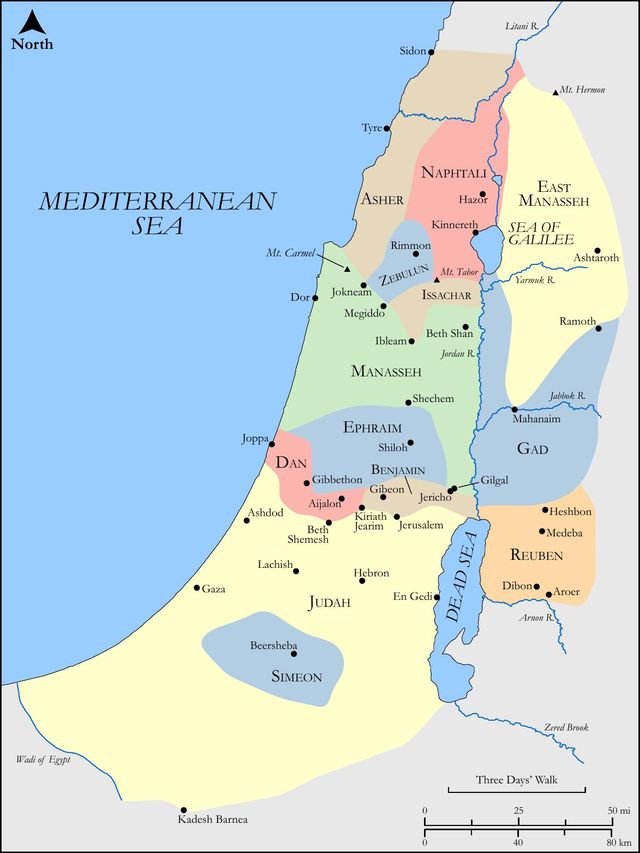
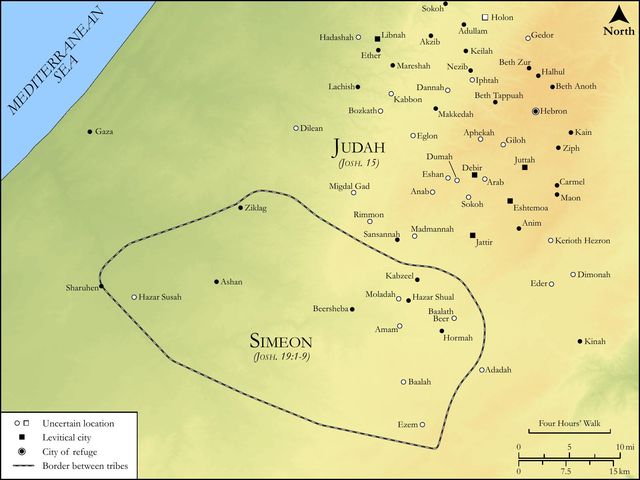
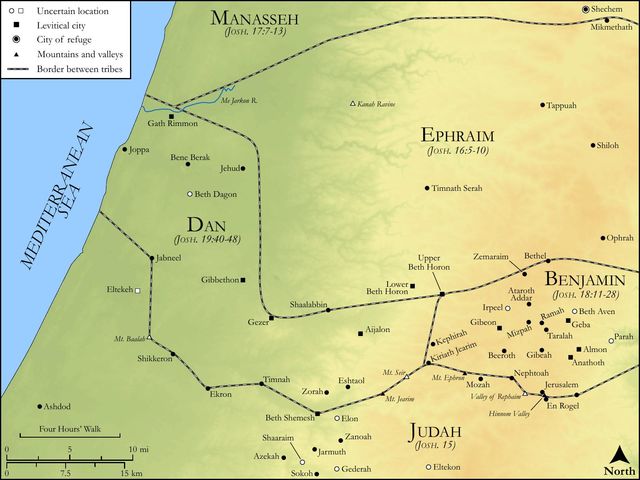
Study this verse
Public-domain commentary
Matthew Henry
From his Commentary on the Whole Bible. Henry comments on passages, not single verses — this entry covers Joshua 19:10–16.
This is the lot of Zebulun, who, though born of Leah after Issachar, yet was blessed by Jacob and Moses before him; and therefore it was so ordered that his lot was drawn before that of Issachar, north of which it lay and south of Asher. 1. The lot of this tribe was washed by the great sea on the west, and by the sea of Tiberias on the east, answering Jacob's prophecy (Gen 49:13), Zebulun shall be a haven of ships, trading ships on the great sea and fishing ships on the sea of Galilee. 2. Though there were some places in this tribe which were made famous in the Old Testament, especially Mount Carmel, on which the famous trial was between God and Baal in Elijah's time, yet it was made much more illustrious in the New Testament; for within the lot of this tribe was Nazareth, where our blessed Saviour spent so much of his time on earth, and from which he was called Jesus of Nazareth, and Mount Tabor on which he was transfigured, and that coast of the sea of Galilee on which Christ preached so many sermons and wrought so many miracles.
Continue studying Joshua 19:13 across the web’s major study libraries — every link below opens this exact verse, chapter, or book on the destination site.
Read & Compare
 BibleGatewayThis verse in more than 200 translations and 70 languages.
 Bible.comThe YouVersion reader — hundreds of translations, reading plans, and highlights.
 ESV.orgCrossway's official English Standard Version reader.
 NET BibleThe NET translation with 60,000+ translators' notes on every rendering decision.
 STEP BibleTyndale House's free study tool — original text, vocabulary, and scholarly resources.
 BibliaLogos Bible Software's free web reader.
 USCCBThe New American Bible (Revised Edition) with the U.S. bishops' study notes.
Commentaries
 BibleHub CommentariesDozens of classic commentaries on this verse, gathered on one page.
 StudyLightMore than 100 commentary sets — the largest collection on the web.
 BibleRefPlain-English commentary on what this verse means, verse by verse.
 Enduring WordDavid Guzik's free commentary on this chapter, widely used by Bible teachers.
 Bible Study ToolsVerse commentary alongside Greek and Hebrew study aids.
Original Language & Research
- BibleHub InterlinearThe verse word by word — original language, transliteration, and English.
- BibleHub LexiconEvery word's original-language definition and Strong's entry.
 Blue Letter BibleDeep-study tools — Strong's numbers, concordance, and word studies.
 SefariaThe Hebrew text with Rashi and centuries of Jewish commentary.
Sermons, Hymns & Audio


TrulyRandomVerse is not affiliated with these sites and doesn’t control their content. They’re linked because they’re genuinely useful.
Summary
Joshua 19:13 meticulously delineates a specific segment of the eastern boundary for the tribal inheritance of Zebulun, listing ancient place names like Gittahhepher, Ittahkazin, Remmonmethoar, and Neah. This precise geographical detail, within the broader context of Israel's land distribution, powerfully underscores God's unwavering faithfulness in fulfilling His covenant promises to His people by providing a tangible, precisely defined land inheritance, thereby establishing order, security, and a distinct identity for the tribe within the Promised Land.
Context
ShowHideLiterary Context
Joshua 19:13 is situated within the extensive and highly detailed account of the land distribution among the twelve tribes of Israel, as recorded in Joshua chapters 13-21. Specifically, this verse is part of the description of the territory allotted to the tribe of Zebulun, outlined in Joshua 19:10-16. Following the initial allocations to Judah, Ephraim, and Manasseh, the remaining seven tribes received their portions by lot at Shiloh, a process meticulously documented. The narrative in Joshua 19 systematically outlines the boundaries and cities for each of these tribes, ensuring every family had a stake in the Promised Land. Verse 13, therefore, functions as a precise geographical marker, continuing the delineation of Zebulun's eastern border, which began in earlier verses of the chapter, providing concrete points of reference for their divinely appointed territory.
Historical & Cultural Context
The period described in Joshua 19:13 is immediately following the successful conquest of Canaan, marking Israel's pivotal transition from a nomadic, military encampment to a settled agrarian society. Land ownership was profoundly significant in ancient Israelite culture, intrinsically linked to tribal identity, lineage, economic stability, and covenantal blessing. The meticulous division of land by lot, as seen in Joshua 18:10, emphasized the divine sovereignty in the allocation process, ensuring that each tribe received its portion directly from God, rather than through human negotiation or conquest alone. The specific place names mentioned in verse 13 were likely well-known landmarks at the time, serving as crucial legal and administrative markers for property rights, preventing future disputes, and establishing a stable foundation for the nascent nation of Israel. This precision reflects the importance of clear boundaries among the nations, but here, it is divinely sanctioned and executed, highlighting God's direct involvement in establishing His people.
Key Themes
ShowHideThe detailed geographical descriptions, including Joshua 19:13, underscore several major theological and narrative themes central to the book of Joshua and the broader Old Testament. Foremost is Divine Faithfulness and Fulfillment, as God meticulously fulfills His ancient promises to Abraham regarding the land (e.g., Genesis 15:18). The precision of the boundaries highlights God's Order and Precision, demonstrating that His plans are not vague but are executed with exactitude, establishing a stable and organized society for His people. This division also emphasizes Inheritance and Identity, as the land was inextricably linked to the tribe's unique identity, its future, and its covenantal relationship with God. Furthermore, the entire process, including the casting of lots (Joshua 18:10), powerfully illustrates the Sovereignty of God over the destiny and dwelling place of His people, confirming that their possession of the land was a divine gift, not a human achievement.
Exposition and Analysis
ShowHideKey Word Analysis
ShowHideMeaning "wine-press of (the) well." This was a significant town in Zebulun, traditionally identified as the birthplace of the prophet Jonah (2 Kings 14:25). Its inclusion as a boundary marker underscores the tangible and specific nature of the land division, indicating that these were real, identifiable locations at the time of the allocation.
Meaning "time of a judge." Like Gittahhepher, its presence in the list serves as another precise geographical point along Zebulun's border, reinforcing the meticulousness with which the land was surveyed and assigned. The name itself might reflect a historical or administrative significance of the location.
This name is particularly illustrative. "Rimmon" (H7417) means "pomegranate," and "methoar" (derived from the root H8388, tāʾar) means "marked off" or "designated by a line." Thus, the compound could be understood as "pomegranate [tree] of the marked boundary" or "pomegranate [tree] of the measuring line." This element strongly suggests a landmark that was specifically used for surveying and demarcating the border, further emphasizing the exactness and intentionality of the land distribution.
Verse Breakdown
ShowHide"And from thence passeth on along on the east"
This initial phrase indicates a continuation of the boundary description from a previously mentioned point, establishing the precise direction of the border. The specification "on the east" (Hebrew, mizrâch qedem) is crucial for understanding the geographical flow of Zebulun's territory, signifying movement eastward from a preceding landmark, thereby providing clarity for the tribal allocation.
"to Gittahhepher, to Ittahkazin"
These are two specific towns or identifiable landmarks that the border line traverses. Their inclusion provides concrete, identifiable points for the tribal boundary, ensuring clarity and preventing disputes among the tribes regarding their precise territories. The border is not vague but passes through known and established locations, reinforcing the legal and administrative precision of the divine allocation.
"and goeth out to Remmonmethoar to Neah;"
This clause further extends the boundary line, indicating its trajectory towards and perhaps encompassing these final two named locations in this segment. "Remmonmethoar," as discussed, suggests a marked boundary point, while "Neah" (Hebrew, Nêʻâh, possibly meaning "motion" or "boundary") might represent a terminal point or a significant turn in the border. The repetition of verbs like "passeth on" (H5674, ʿâbar) and "goeth out" (H3318, yâtsâʾ) emphasizes the continuous, surveyed, and clearly defined nature of the border, highlighting the thoroughness of the divine allocation.
Literary Devices
ShowHideThe primary literary device employed in Joshua 19:13, and indeed throughout the land distribution chapters of Joshua, is Cataloging/Listing. This technique involves an extensive enumeration of place names, which serves to provide precise geographical detail. The purpose is not merely to list, but to emphasize the meticulous fulfillment of God's promise and the tangible, verifiable reality of the land division. The very obscurity of some names to modern readers paradoxically lends an air of Verisimilitude/Realism to the ancient text, suggesting they were real, known locations at the time of writing, grounding the theological claims in specific historical and geographical facts. Furthermore, the repetition of directional phrases and verbs of movement ("passeth on," "goeth out") functions as Repetition to reinforce the continuous, surveyed, and defined nature of the boundary, highlighting the thoroughness of the divine allocation.
Theological and Thematic Connections
ShowHideThe meticulous detail of Joshua 19:13, though seemingly mundane in its listing of ancient place names, powerfully illustrates God's unwavering faithfulness to His covenant promises, specifically the land grant made to Abraham's descendants (e.g., Genesis 12:7). It demonstrates divine order and precision in establishing the nation of Israel, providing a tangible inheritance that was foundational to their identity, security, and future as a people set apart. This detailed allocation foreshadows the precision and certainty of God's redemptive plan, where every promise finds its "yes" and "amen" in Christ, ensuring a spiritual inheritance that is far more enduring than any earthly territory.
Reflection and Application
ShowHideWhile Joshua 19:13 details ancient borders and obscure place names, it speaks profoundly to the contemporary believer about the character of God and the nature of His provision. This verse reminds us that God is a God of meticulous detail and unwavering faithfulness. Just as He precisely fulfilled His promises to Israel, down to the geographical coordinates of Zebulun's inheritance, He is equally attentive to the specifics of our lives and His promises to us. This passage encourages us to trust in God's sovereign plan, even when our path seems unclear or filled with details we don't fully comprehend. It also highlights the importance of understanding and living within the boundaries God sets for us—whether spiritual, relational, or ethical—as these boundaries are designed for our peace, security, and flourishing, much like the clearly defined borders provided stability for the tribes of Israel. Our "inheritance" in Christ is not vague but concrete, though spiritual, requiring us to actively embrace and live into the blessings of salvation and discipleship, trusting in the divine architect of our lives.
Questions for Reflection
ShowHideFAQ
ShowHideWhy are these place names so obscure, and do they still exist today?
ShowHideMany of the place names listed in Joshua, including those in Joshua 19:13, were specific local landmarks or villages in ancient Canaan. While their exact modern identifications are often debated by archaeologists and scholars, their inclusion in the biblical text indicates they were well-known and crucial for defining boundaries at the time of the land distribution. Some may correspond to modern towns or archaeological sites, while others have been lost to history or are only identifiable through textual analysis. The obscurity to us today does not diminish their historical reality or their profound significance to the original Israelite audience, who relied on these precise markers for their tribal identity and property rights. Their very specificity underscores the historical veracity of the biblical account.
What is the significance of "going out" or "passing on" in these boundary descriptions?
ShowHideThe verbs "passeth on" (Hebrew, ʿâbar, H5674) and "goeth out" (Hebrew, yâtsâʾ, H3318) are common in biblical boundary descriptions, as seen throughout Joshua chapters 15-19. They signify the continuous movement and demarcation of the border line from one point to the next. This linguistic pattern emphasizes the precise, surveyed nature of the land division, indicating that the boundaries were not merely conceptual but were physically traced and recognized. It highlights the thoroughness with which the land was allotted, ensuring legal clarity and preventing disputes among the tribes regarding their respective territories, ultimately fulfilling God's promise of a stable and secure inheritance. These verbs convey a sense of purposeful progression and definitive establishment.
Christ-Centered Fulfillment
ShowHideWhile Joshua 19:13 meticulously details a physical land inheritance for the tribe of Zebulun, its deeper theological resonance points to the spiritual inheritance believers receive in Christ. Just as God precisely allotted land to Israel, ensuring their identity and security within the Promised Land, so too has He, in Christ, provided an "inheritance that is imperishable, undefiled, and unfading, kept in heaven for you" (1 Peter 1:4). The earthly boundaries of Zebulun foreshadow the boundless spiritual blessings we possess in union with Christ, who is our ultimate "Promised Land" and the fulfillment of all God's promises (Ephesians 1:3; 2 Corinthians 1:20). Through His redemptive work, we are not merely given a plot of land, but are made "heirs of God and fellow heirs with Christ" (Romans 8:17), receiving a spiritual citizenship in a "heavenly country" (Hebrews 11:16). The precision of Zebulun's border finds its ultimate counterpart in the perfect, complete, and eternally secure salvation offered through the Lamb of God who takes away the sin of the world, whose finished work establishes an unshakeable and glorious inheritance for all who believe, an inheritance secured not by human effort but by divine grace.