


Joshua 19:12
Bible text: King James Version (1769 Blayney text) · Public domain
Bible text: Berean Standard Bible · Public domain
Bible text: American Standard Version (1901) · Public domain
Bible text: World English Bible, Messianic edition · Public domain
Bible text: Geneva Bible (1599) · Public domain
Bible text: Young's Literal Translation · Public domain
- וְשָׁבve·Shavand it turns backH7725Conj-w ¦ V-Qal-ConsecPerf-3msVerb Qal Consecutive Perfect 3rd Singular Masculineוְandשָׁבit turns back
- מִשָּׂרִידmi·sa·Ridfrom SaridH8301Prep-m ¦ N-properNoun Proper LocationמִfromשָּׂרִידSarid
- קֵדְמָהKe·de·maheast -wardH6924N-ms ¦ SfxNoun Singular Masculine Absoluteקֵדְמָeastה-ward
- מִזְרַחmiz·Rach[the] rising ofH4217N-mscNoun Singular Masculine Construct
- הַשֶּׁמֶשׁha·She·meshthe sunH8121Art ¦ N-csNoun Singular common gender Absoluteהַtheשֶּׁמֶשׁsun
- עַל'altoH5921PrepPreposition
- גְּבוּלge·Vul[the] border ofH1366N-mscNoun Singular Masculine Construct
- כִּסְלֹתkis·LotKislothH3696N-properNoun Proper Location
- תָּבֹרta·VorTaborH3696N-properNoun Proper Location
- וְיָצָאve·ya·Tza'and it goes outH3318Conj-w ¦ V-Qal-ConsecPerf-3msVerb Qal Consecutive Perfect 3rd Singular Masculineוְandיָצָאit goes out
- אֶל'eltoH413PrepPreposition
- הַדָּבְרַתha·da·ve·Rat<the> DaberathH1705Art ¦ N-properNoun Proper Locationהַ<the>דָּבְרַתDaberath
- וְעָלָהve·'a·Lahand it goes upH5927Conj-w ¦ V-Qal-ConsecPerf-3msVerb Qal Consecutive Perfect 3rd Singular Masculineוְandעָלָהit goes up
- יָפִיעַya·Fi·a'JaphiaH3309N-properNoun Proper Location
English is a literal word-by-word gloss of the Hebrew, not the KJV's wording. Why?
This is the original text the KJV's translators worked from — each Hebrew word with its own literal English meaning in this verse, prepared by scholars at Tyndale House, Cambridge. The KJV translates whole sentences, not word by word, so its wording differs: one Hebrew word can become several English words, and the KJV may choose “the LORD” where the gloss reads “Yahweh”. Both are faithful — they answer different questions. For the KJV's own rendering, switch to the KJV text.
Details
See on the biblical-era maps
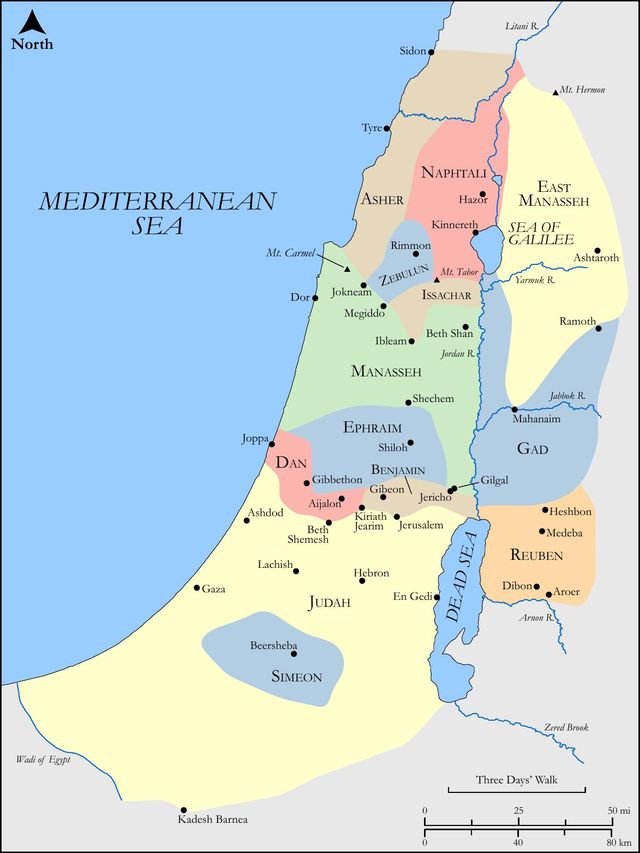
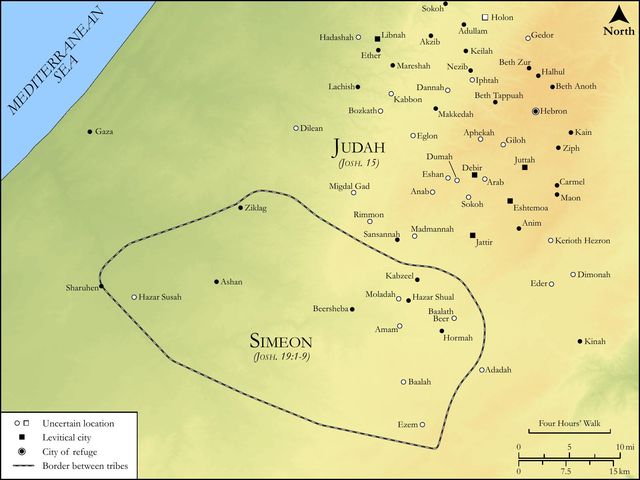
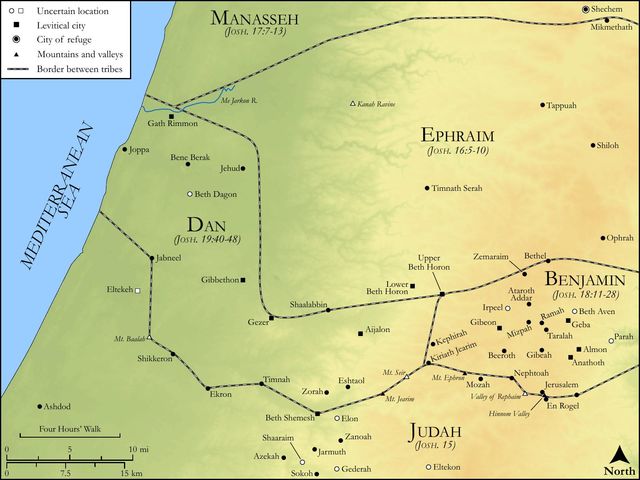
Study this verse
Public-domain commentary
Matthew Henry
From his Commentary on the Whole Bible. Henry comments on passages, not single verses — this entry covers Joshua 19:10–16.
This is the lot of Zebulun, who, though born of Leah after Issachar, yet was blessed by Jacob and Moses before him; and therefore it was so ordered that his lot was drawn before that of Issachar, north of which it lay and south of Asher. 1. The lot of this tribe was washed by the great sea on the west, and by the sea of Tiberias on the east, answering Jacob's prophecy (Gen 49:13), Zebulun shall be a haven of ships, trading ships on the great sea and fishing ships on the sea of Galilee. 2. Though there were some places in this tribe which were made famous in the Old Testament, especially Mount Carmel, on which the famous trial was between God and Baal in Elijah's time, yet it was made much more illustrious in the New Testament; for within the lot of this tribe was Nazareth, where our blessed Saviour spent so much of his time on earth, and from which he was called Jesus of Nazareth, and Mount Tabor on which he was transfigured, and that coast of the sea of Galilee on which Christ preached so many sermons and wrought so many miracles.
Continue studying Joshua 19:12 across the web’s major study libraries — every link below opens this exact verse, chapter, or book on the destination site.
Read & Compare
 BibleGatewayThis verse in more than 200 translations and 70 languages.
 Bible.comThe YouVersion reader — hundreds of translations, reading plans, and highlights.
 ESV.orgCrossway's official English Standard Version reader.
 NET BibleThe NET translation with 60,000+ translators' notes on every rendering decision.
 STEP BibleTyndale House's free study tool — original text, vocabulary, and scholarly resources.
 BibliaLogos Bible Software's free web reader.
 USCCBThe New American Bible (Revised Edition) with the U.S. bishops' study notes.
Commentaries
 BibleHub CommentariesDozens of classic commentaries on this verse, gathered on one page.
 StudyLightMore than 100 commentary sets — the largest collection on the web.
 BibleRefPlain-English commentary on what this verse means, verse by verse.
 Enduring WordDavid Guzik's free commentary on this chapter, widely used by Bible teachers.
 Bible Study ToolsVerse commentary alongside Greek and Hebrew study aids.
Original Language & Research
- BibleHub InterlinearThe verse word by word — original language, transliteration, and English.
- BibleHub LexiconEvery word's original-language definition and Strong's entry.
 Blue Letter BibleDeep-study tools — Strong's numbers, concordance, and word studies.
 SefariaThe Hebrew text with Rashi and centuries of Jewish commentary.
Sermons, Hymns & Audio


TrulyRandomVerse is not affiliated with these sites and doesn’t control their content. They’re linked because they’re genuinely useful.
Summary
Joshua 19:12 meticulously delineates a specific segment of the southern boundary for the tribe of Zebulun. It traces an eastward progression from Sarid, through the vicinity of Chislothtabor, then extending to Daberath, and finally ascending to Japhia. This precise geographical description is an integral part of the larger divine allocation of the Promised Land among the twelve tribes, powerfully underscoring God's unwavering faithfulness in fulfilling His ancient covenant promises and establishing an ordered, tangible inheritance for His people in the land of Canaan.
Context
ShowHideLiterary Context
Joshua 19:12 is embedded within the extensive and detailed section of the book of Joshua (chapters 13-19) that meticulously records the division of the land of Canaan among the Israelite tribes. Following the successful military campaigns that secured the land, Joshua, acting under divine instruction and through the casting of lots, systematically allocates territories. This particular verse forms a crucial part of the detailed description of Zebulun's inheritance, which commences in Joshua 19:10 and concludes with Joshua 19:16. The preceding chapters delineate the territories of Judah, Ephraim, Manasseh, Simeon, and Dan, while subsequent chapters address the remaining tribal allotments and the establishment of cities of refuge, culminating in the final acts of Joshua's leadership. This granular geographical detail serves not only to legally establish the tribal boundaries, thereby preventing future disputes, but also to emphatically confirm the precise fulfillment of God's ancient promises.
Historical & Cultural Context
The period depicted in the book of Joshua immediately follows the Israelite conquest of Canaan, typically dated to approximately 1400-1200 BC. In Israel, land ownership was not merely an economic asset but a foundational element of identity, security, and social structure. The precise demarcation of tribal boundaries, often relying on a combination of natural landmarks (like mountains, rivers, and wadis) and named towns, was indispensable for administrative purposes, taxation, and maintaining peace and order among various tribal groups. The concept of "inheritance" (Hebrew: nachalah) held profound theological and cultural significance, representing not just property but a divinely granted, inalienable possession passed down through generations. This concept was deeply rooted in God's covenant with Abraham, where the promise of land was central (e.g., Genesis 15:18-21). The detailed listing of towns and geographical features in Joshua reflects the practical necessity of defining these inheritances in a newly settled land, ensuring that each tribe received its promised portion as a tangible manifestation of God's faithfulness and provision.
Key Themes
ShowHideThough seemingly a dry geographical listing, Joshua 19:12 contributes significantly to several overarching themes present within the book of Joshua and the broader Pentateuch. Foremost among these is the theme of Divine Faithfulness and Fulfillment, as God meticulously delivers on His promise to give the land to Israel, a promise reiterated throughout the Pentateuch (e.g., Numbers 34). The precision of the boundaries also highlights God's Order and Providence, demonstrating His careful and intentional orchestration of every minute detail in His grand plan for His people. Furthermore, the verse underscores the concept of Inheritance and Identity, as each tribe receives a specific, unique portion of the land, thereby solidifying their distinct identity and role within the twelve tribes of Israel, a theme powerfully echoed in Joshua 13:6. This detailed mapping reinforces the idea that God's blessings are concrete, specific, and designed to establish His people securely in their promised dwelling place, demonstrating His commitment to His covenant.
Exposition and Analysis
ShowHideKey Word Analysis
ShowHideThis term (H8301), often identified with modern Tel Shadud, served as a crucial geographical marker for the tribal boundary. In the context of land allocation, "Sarid" functions as a precise starting or turning point, indicating a specific, identifiable location from which the border's trajectory is defined. Its inclusion underscores the meticulous detail with which the land was divided, relying on known landmarks to establish clear, undisputed lines of demarcation for the tribe of Zebulun.
Meaning "flanks of Tabor" or "loins of Tabor" (H3696), this designation refers to a location at the base or on the slopes of Mount Tabor, a prominent and easily recognizable mountain in Lower Galilee. The phrase "unto the border of Chislothtabor" signifies that the boundary reached the vicinity or "border" (H1366, gᵉbûwl') of this significant landmark, using a well-known geographical feature to define a segment of the tribal line. Its strategic position would have made it an unmistakable reference point for the ancient Israelites.
This town (H1705), commonly identified with modern Daburiyeh, is listed as another specific point along Zebulun's border. The inclusion of specific towns like Daberath and Japhia (H3309, Yâphîyaʻ') alongside natural features demonstrates a comprehensive approach to defining boundaries, integrating both natural topography and human settlements. These urban centers would have been known entities, providing concrete, verifiable markers for the tribal inheritance as the border "goeth out" (H3318, yâtsâʼ') to them.
Verse Breakdown
ShowHide"And turned from Sarid eastward toward the sunrising"
This initial clause establishes the precise starting point of this particular segment of Zebulun's southern border as Sarid. The direction "eastward toward the sunrising" (H6924, qedem' and H4217, mizrâch' from H8121, shemesh') provides a clear, unambiguous trajectory for the boundary line, indicating its general movement across the landscape. This directional clarity was essential for practical land demarcation and understanding the flow of the border.
"unto the border of Chislothtabor"
This phrase specifies the extent of the eastward movement, indicating that the boundary reached the area or "border" (H1366, gᵉbûwl') of Chislothtabor, which is the region at the foot of Mount Tabor. This landmark served as a significant waypoint, defining a key turn or segment of the tribal line, marking a clear geographical limit for this portion of the boundary.
"and then goeth out to Daberath"
Following the reference to Chislothtabor, the boundary continues its course, now specifically passing "out" (H3318, yâtsâʼ') to Daberath. This indicates that Daberath was either directly on the border or a significant town that defined the border's path, further detailing the precise route and connecting it to a known settlement.
"and goeth up to Japhia"
The final clause in this verse describes the border's progression as it "goeth up" (H5927, ʻâlâh') to Japhia. The verb "goeth up" implies an ascent or movement to a higher elevation, which is consistent with the topography of the region. Japhia, like Daberath, serves as another specific town marker, completing this segment of Zebulun's southern boundary description with concrete, identifiable points.
Literary Devices
ShowHideWhile Joshua 19:12 is primarily a geographical listing, it effectively employs Cataloging or Enumeration as its principal literary device. The meticulous listing of towns and geographical features (Sarid, Chislothtabor, Daberath, Japhia) serves to create a precise and undeniable record of the tribal inheritance. This detailed enumeration functions as a legal and historical document, emphasizing the divine order and the tangible fulfillment of God's promises. The repetition of directional cues ("eastward toward the sunrising," "goeth out," "goeth up") provides a sense of methodical progression, guiding the reader along the described boundary and reinforcing the careful, step-by-step nature of the land division. The use of specific, identifiable place names also grounds the theological narrative in concrete, verifiable reality, reinforcing the historical veracity of the land distribution and God's faithfulness to His word.
Theological and Thematic Connections
ShowHideJoshua 19:12, though a detailed geographical description, profoundly illustrates God's meticulous faithfulness and the tangible reality of His covenant promises. The precise demarcation of land for Zebulun, like for all the tribes, underscores that God's blessings are not vague or abstract but concrete and specific, providing a secure and defined inheritance for His people. This divine attention to detail reflects God's ordered nature and His unwavering commitment to fulfilling every word He has spoken, ensuring that each tribe received its designated portion without ambiguity or dispute. It serves as a powerful reminder that God's promises are utterly trustworthy and perfectly executed, even in the minutiae of geographical boundaries.
Reflection and Application
ShowHideJoshua 19:12, while a seemingly dry list of ancient place names, carries profound spiritual weight for believers today, inviting us into a deeper understanding of God's character. It reminds us that our God is a God of meticulous detail and unwavering faithfulness. Just as He precisely allocated land to each tribe, ensuring their inheritance and security, He is intimately involved in the intricate details of our lives, orchestrating circumstances and fulfilling His promises to us. This verse invites us to trust in His providence, knowing that no aspect of our existence is too small for His attention or beyond His perfect, sovereign plan. It encourages us to find our ultimate security not in our own efforts or earthly possessions, but in the divine inheritance we have in Christ, an inheritance far more glorious, eternal, and incorruptible than any earthly territory. Furthermore, it challenges us to live within the "boundaries" of God's revealed will, recognizing that His commands and guidance are for our protection, flourishing, and ultimate good, leading us into the fullness of the spiritual blessings He has prepared.
Questions for Reflection
ShowHideFAQ
ShowHideWhy are these geographical details so important in the book of Joshua?
ShowHideThese geographical details are critically important for several profound reasons. First, they serve as a tangible and undeniable demonstration of God's faithfulness in fulfilling His ancient covenant promises to Abraham, Isaac, and Jacob, that their descendants would inherit the land of Canaan (e.g., Genesis 12:7). The precise mapping confirms that God delivered exactly what He promised, down to the specific territories. Second, these detailed boundaries established legal and administrative clarity for the newly settled tribes, preventing disputes over land ownership and ensuring an orderly and peaceful society. Third, they underscore the concept of inheritance (Hebrew: nachalah), which was not merely property but a divinely granted, inalienable possession that defined tribal identity, economic stability, and a sense of belonging to God's chosen people. Finally, the specificity grounds the biblical narrative in historical reality, showing that these were real places and real events, not mere myths, thereby bolstering the credibility of the divine account.
What is the significance of "Sarid," "Chislothtabor," "Daberath," and "Japhia" today?
ShowHideWhile their primary significance in antiquity was as precise boundary markers for the tribe of Zebulun, their modern identification helps us to better understand the geography of ancient Israel and connect the biblical narrative to the physical landscape. Sarid is often identified with modern Tel Shadud, an archaeological mound in the Jezreel Valley. Chislothtabor refers to the area at the base of Mount Tabor, a prominent and unmistakable landmark in Lower Galilee, which remains a significant geographical feature today. Daberath is commonly identified with the modern Arab village of Daburiyeh, situated northeast of Mount Tabor. Japhia is widely believed to be the ancient village now known as Yafa an-Naseriyye, located southwest of Nazareth. These identifications allow archaeologists and biblical scholars to trace the ancient tribal boundaries, providing a concrete link between the biblical text and the enduring physical landscape of Israel, reminding us that the events of the Bible took place in real, identifiable locations.
Christ-Centered Fulfillment
ShowHideWhile Joshua 19:12 describes a physical inheritance of land, it powerfully foreshadows the spiritual inheritance believers receive in Christ. Just as God meticulously prepared and allocated the Promised Land to Israel, demonstrating His precise faithfulness, so too has He prepared an eternal inheritance for those who are in Christ—an inheritance that is "imperishable, undefiled, and unfading, kept in heaven for you" (1 Peter 1:4). The precision of Zebulun's boundary points to the certainty and specificity of God's grand redemptive plan, culminating in Jesus Christ, who is the ultimate "Yes" and "Amen" to all God's promises (2 Corinthians 1:20). Through His sacrificial death and glorious resurrection, Christ has secured for us not merely a piece of land, but a spiritual kingdom, a new creation, and an eternal dwelling with God. Our true "Promised Land" is found in Him, where we are made "heirs of God and fellow heirs with Christ" (Romans 8:17), receiving "every spiritual blessing in the heavenly places in Christ" (Ephesians 1:3). The meticulous detail of Joshua 19:12 thus serves as a profound testament to the faithful God who, in Christ, perfectly fulfills His grand design for humanity's redemption and eternal blessing, far surpassing any earthly allocation.