


Joshua 13:6
Bible text: King James Version (1769 Blayney text) · Public domain
Bible text: King James Version with Strong's numbers · Public domain
Bible text: Berean Standard Bible · Public domain
Bible text: American Standard Version (1901) · Public domain
Bible text: World English Bible, Messianic edition · Public domain
Bible text: Geneva Bible (1599) · Public domain
Bible text: Young's Literal Translation · Public domain
- כָּלkolallH3605N-mscNoun Singular Masculine Construct
- יֹשְׁבֵיyo·she·Vei[the] inhabitants ofH3427V-Qal-Prtcpl-mpVerb Qal Participle Plural Masculine Construct
- הָהָרHa·horthe hill countryH2022Art ¦ N-msNoun Singular Masculine Absoluteהָtheהָרhill country
- מִןminfromH4480PrepPreposition
- הַלְּבָנוֹןha·le·va·Non<the> LebanonH3844Art ¦ N-properNoun Proper Locationהַ<the>לְּבָנוֹןLebanon
- עַד'adtoH5704PrepPreposition
- מִשְׂרְפֹתmis·re·FotMisrephothH4956N-properNoun Proper Location
- מַיִםma·yimMaimH4956N-properNoun Proper Location
- כָּלkolallH3605N-mscNoun Singular Masculine Construct
- צִידֹנִיםtzi·do·Nim[the] SidoniansH6722N-mpNoun Gentilic Plural Masculine Absolute
- אָנֹכִי'a·no·KhiIH595Pro-1csPronoun Personal 1st Singular common gender
- אוֹרִישֵׁם'o·ri·ShemI will dispossess themH3423V-Hiphil-Imperf-1cs ¦ 3mpVerb Hiphil Imperfect 1st Singular common genderאוֹרִישֵׁI will dispossessםthem
- מִפְּנֵיmi·pe·Neifrom beforeH6440Prep-m ¦ N-mpcNoun Plural Masculine Constructמִfromפְּנֵיbefore
- בְּנֵיbe·Nei[the] people ofH1121N-mpcNoun Plural Masculine Construct
- יִשְׂרָאֵלYis·ra·'ElIsraelH3478N-properNoun Proper Location
- רַקrakonlyH7535AdvAdverb
- הַפִּלֶהָha·pi·Le·hamake fall itH5307V-Hiphil-Imp-2ms ¦ 3fsVerb Hiphil Imperative 2nd Singular Masculineהַפִּלֶmake fallהָit
- לְיִשְׂרָאֵלle·Yis·ra·'Elto IsraelH3478Prep-l ¦ N-properNoun Proper LocationלְtoיִשְׂרָאֵלIsrael
- בְּנַחֲלָהbe·na·cha·Lah<in> an inheritanceH5159Prep-b ¦ N-fsNoun Singular Feminine Absoluteבְּ<in>נַחֲלָהan inheritance
- כַּאֲשֶׁרka·'a·Sherjust asH834Prep-k ¦ RelParticle Relativeכַּjustאֲשֶׁרas
- צִוִּיתִיךָtzi·vi·Ti·khaI have commanded youH6680V-Piel-Perf-1cs ¦ 2msVerb Piel Perfect 1st Singular common genderצִוִּיתִיI have commandedךָyou
English is a literal word-by-word gloss of the Hebrew, not the KJV's wording. Why?
This is the original text the KJV's translators worked from — each Hebrew word with its own literal English meaning in this verse, prepared by scholars at Tyndale House, Cambridge. The KJV translates whole sentences, not word by word, so its wording differs: one Hebrew word can become several English words, and the KJV may choose “the LORD” where the gloss reads “Yahweh”. Both are faithful — they answer different questions. For the KJV's own rendering, switch to the KJV text.
Details
See on the biblical-era maps
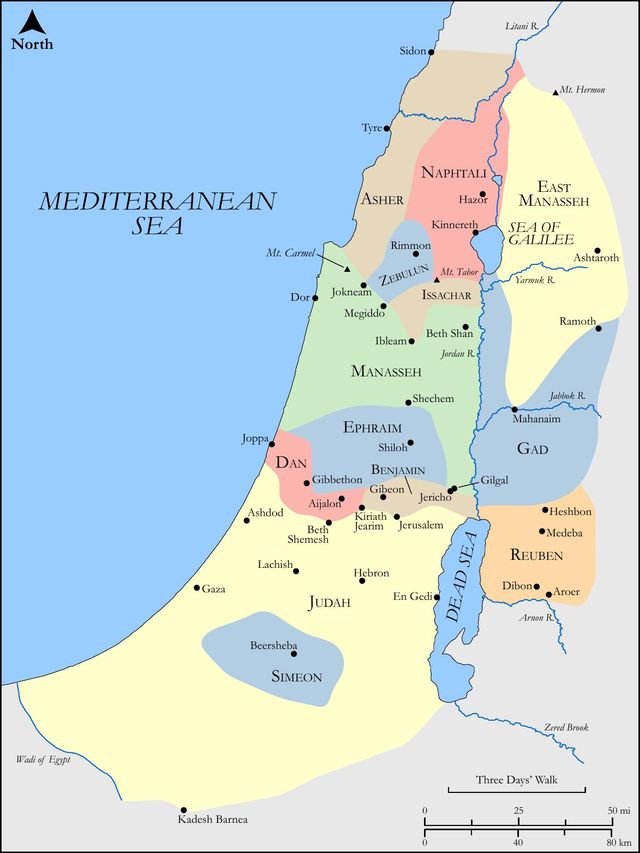
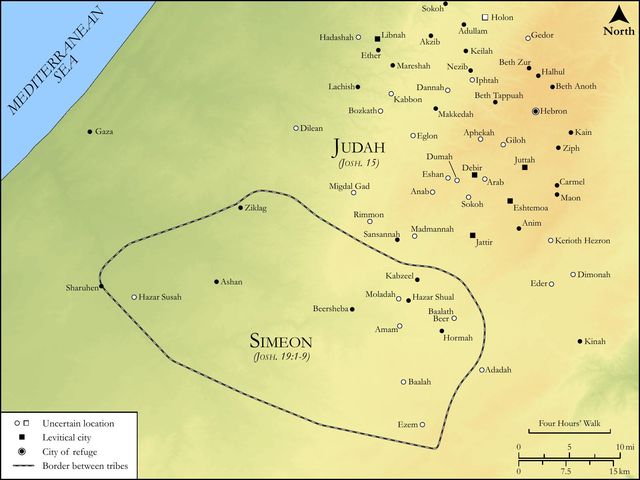
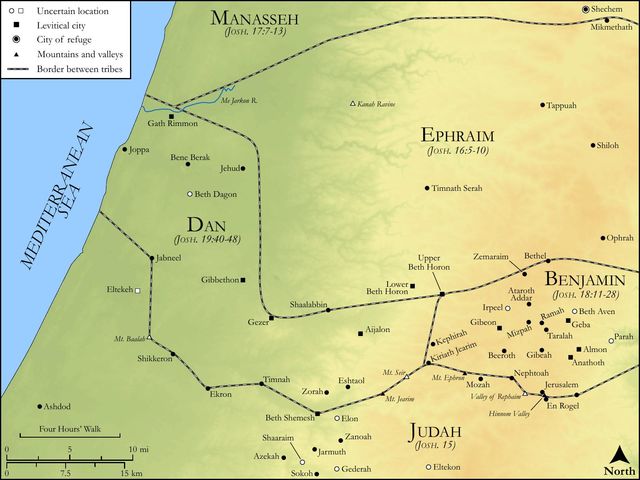
Study this verse
Public-domain commentary
Matthew Henry
From his Commentary on the Whole Bible. Henry comments on passages, not single verses — this entry covers Joshua 13:1–6. His two-level outline is real structure in the source text, so it is rendered as structure.
Here, I. God puts Joshua in mind of his old age, v. 1. 1. It is said that Joshua was old and stricken in years, and he and Caleb were at this time the only old men among the thousands of Israel, none except them of all those who were numbered at Mount Sinai being now alive. He had been a man of war from his youth (Exo 17:10); but now he yielded to the infirmities of age, with which it is in vain for the stoutest to think of contesting. It should seem Joshua had not the same strength and vigour in his old age that Moses had; all that come to old age do not find it alike good; generally, the days of old age are evil days, and such as there is no pleasure in, nor expectation of service from. 2. God takes notice of it to him: God said to him, Thou art old. Note, It is good for those who are old and stricken in years to be put in remembrance of their being so. Some have gray hairs here and there upon them, and perceive it not (Hos 7:9); they do not care to think of it, and therefore need to be told of it, that they may be quickened to do the work of life, and make preparation for death, which is coming towards them apace. But God mentions Joshua's age and growing infirmities, (1.) As a reason why he should now lay by the thoughts of pursuing the war; he cannot expect to see an end of it quickly, for there remained much land, more perhaps than he thought, to be possessed, in several parts remote from each other: and it was not fit that at his age he should be put upon the fatigue of renewing the war, and carrying it to such distant places; no, it was enough for him that he had reduced the body of the country. "Let him be gathered to rest with honour and the thanks of his people for the good services he had done them, and let the conquering of the skirts of the country be left for those that shall come after." As he had entered into the labours of Moses, so let others enter into his, and bring forth the top-stone, the doing of which was reserved for David long after. Observe, God considers the frame of his people, and would not have them burdened with work above their strength. It cannot be expected that old people should do as they have done for God and their country. (2.) As a reason why he should speedily apply himself to the dividing of that which he had conquered. That work must be done, and done quickly; it was necessary that he should preside in the doing of it, and therefore, he being old and stricken in years, and not likely to continue long, let him make this his concluding piece of service to God and Israel. All people, but especially old people, should set themselves to do that quickly which must be done before they die, lest death prevent them, Ecc 9:10.
II.He gives him a particular account of the land that yet remained unconquered, which was intended for Israel, and which, in due time, they should be masters of if they did not put a bar in their own door. Divers places are here mentioned, some in the south, as the country of the Philistines, governed by five lords, and the land that lay towards Egypt (Jos 13:2, Jos 13:3), some westward, as that which lay towards the Sidonians (Jos 13:4), some eastward, as all Lebanon (Jos 13:5), some towards the north, as that in the entering in of Hamath, Jos 13:5. Joshua is told this, and he made the people acquainted with it,
1.That they might be the more affected with God's goodness to them in giving them this good land, and might thereby be engaged to love and serve him; for, if this which they had was too little, God would moreover give them such and such things, Sa2 12:8.
2.That they might not be tempted to make any league, or contract any dangerous familiarity with these their neighbours so as to learn their way, but might rather be jealous of them, as a people that kept them from their right and that they had just cause of quarrel with.
3.That they might keep themselves in a posture for war, and not think of putting off the harness so long as there remained any land to be possessed. Nor must we lay aside our spiritual armour, nor be off our watch, till our victory be completed in the kingdom of glory.
III.He promises that he would make the Israelites masters of all those countries that were yet unsubdued, though Joshua was old and not able to do it, old and not likely to live to see it done. Whatever becomes of us, and however we may be laid aside as despised broken vessels, God will do his own work in his own time (Jos 13:6): I will drive them out. The original is emphatic: "It is I that will do it, I that can do it when thou are dead and gone, and will do it if Israel be not wanting to themselves." "I will do it by my Word," so the Chaldee here, as in many other places, "by the eternal Word, the captain of the hosts of the Lord." This promise that he would drive them out from before the children of Israel plainly supposes it as the condition of the promise that the children of Israel must themselves attempt their extirpation, must go up against them, else they could not be said to be driven out before them; if afterwards Israel, through sloth, or cowardice, or affection to these idolaters, sit still and let them alone, they must blame themselves, and not God, if they be not driven out. We must work out our salvation, and then God will work in us and work with us; we must resist our spiritual enemies, and then God will tread them under our feet; we must go forth to our Christian work and warfare, and then God will go forth before us.
Historical interpretation
Historical reception
1 surviving comment on this verse from the historical church.
After these things, when he had enumerated very many nations, of the Sidonites alone he said, “And I shall exterminate all the Sidonites from the face of the sons of Israel.” The Canaanites were also named, and those who were opposite Egypt were mentioned, and those who were from the region of Ekron and from the left portions of the river, and very many other nations; but concerning the Sidonites alone, the Lord says that he will destroy them. Just as we have said previously, however, the Sidonites are called “hunters.” Who, therefore, do we understand as those evil hunters that the Lord exterminates if not those opposing powers of whom the prophet says, “They have prepared snares for my feet,” [snares] by which they pursue and ensnare souls for sin? So then, the Lord exterminates them. For when such hunters as these have perished, when at last there will be no one who “stretches out snares” and nets in order to entrap souls in sin, then “each person will rest under his own vine and under his own fig tree.”
Continue studying Joshua 13:6 across the web’s major study libraries — every link below opens this exact verse, chapter, or book on the destination site.
Read & Compare
 BibleGatewayThis verse in more than 200 translations and 70 languages.
 Bible.comThe YouVersion reader — hundreds of translations, reading plans, and highlights.
 ESV.orgCrossway's official English Standard Version reader.
 NET BibleThe NET translation with 60,000+ translators' notes on every rendering decision.
 STEP BibleTyndale House's free study tool — original text, vocabulary, and scholarly resources.
 BibliaLogos Bible Software's free web reader.
 USCCBThe New American Bible (Revised Edition) with the U.S. bishops' study notes.
Commentaries
 BibleHub CommentariesDozens of classic commentaries on this verse, gathered on one page.
 StudyLightMore than 100 commentary sets — the largest collection on the web.
 BibleRefPlain-English commentary on what this verse means, verse by verse.
 Enduring WordDavid Guzik's free commentary on this chapter, widely used by Bible teachers.
 Bible Study ToolsVerse commentary alongside Greek and Hebrew study aids.
Original Language & Research
- BibleHub InterlinearThe verse word by word — original language, transliteration, and English.
- BibleHub LexiconEvery word's original-language definition and Strong's entry.
 Blue Letter BibleDeep-study tools — Strong's numbers, concordance, and word studies.
 SefariaThe Hebrew text with Rashi and centuries of Jewish commentary.
Sermons, Hymns & Audio


TrulyRandomVerse is not affiliated with these sites and doesn’t control their content. They’re linked because they’re genuinely useful.
Summary
Joshua 13:6 captures a pivotal moment in the unfolding narrative of Israel's inheritance, where God, addressing an aging Joshua, reaffirms His unwavering commitment to complete the conquest of the Promised Land. Despite significant northern territories—including the formidable hill country extending to Lebanon and the coastal Sidonian regions—remaining under the control of their original inhabitants, God emphatically declares His sovereign intention to personally dispossess these peoples. Simultaneously, He issues a clear command to Joshua: proceed with the division of this yet-to-be-fully-subdued land by lot among the Israelite tribes, thereby underscoring both divine faithfulness in fulfilling promises and human responsibility in acting upon them by faith.
Context
ShowHideLiterary Context
Joshua 13 marks a crucial pivot in the book, transitioning from the narratives of Israel's initial military conquests (Joshua 1-12) to the detailed and extensive accounts of land distribution among the tribes (Joshua 13-21). The preceding chapters describe God's powerful hand in securing major victories for Israel over various Canaanite kings, establishing a significant foothold in the central and southern regions of Canaan. However, Joshua 13:1 immediately sets the stage for this new phase by revealing God's direct address to Joshua, stating, "Thou art old and stricken in years, and there remaineth yet very much land to be possessed." This divine acknowledgment of incomplete conquest provides the essential backdrop for the seemingly paradoxical command in verse 6. Specifically, verse 6 addresses the unconquered northern territories, emphasizing that despite the ongoing presence of indigenous peoples, the divine promise of inheritance remains steadfast and must be acted upon by faith. The subsequent verses (Joshua 13:7-33) then meticulously detail the specific boundaries and tribal allocations, underscoring the profound trust required to apportion land that was not yet fully subdued by Israel's own hand.
Historical & Cultural Context
At the time of this divine directive, Israel had been engaged in military campaigns for several years, achieving remarkable victories under Joshua's leadership but not total subjugation of all Canaanite inhabitants. The phrase "hill country from Lebanon unto Misrephothmaim" refers to the rugged mountainous regions extending northward from Israel's settled territories, encompassing parts of what would later become Phoenicia. "Misrephothmaim" (מִשְׂרְפוֹת מַיִם), meaning "burning of waters" or "water-burnings," was likely a significant coastal site, possibly associated with industrial activities such as smelting or lime kilns, indicating a strategic and potentially fortified location. The "Sidonians" were the powerful inhabitants of Sidon, a dominant Phoenician city-state located on the Mediterranean coast, renowned for its extensive maritime trade, advanced craftsmanship (especially in purple dye and cedar), and polytheistic worship, often involving deities like Baal and Asherah. These northern areas represented formidable, well-established peoples and territories that Israel had not yet, and in some cases would never fully, conquer. The command to divide the land by "lot" (גּוֹרָל, goral) was a means of discerning the will of the LORD and ensuring fair distribution, for "The lot is cast into the lap; but the whole disposing thereof is of the LORD," reinforcing the profound theological idea that the land was a divine allocation, not merely a human acquisition through military might.
Key Themes
ShowHideThis verse powerfully encapsulates several overarching themes central to the book of Joshua and the broader Old Testament narrative. Firstly, it underscores Divine Sovereignty and Faithfulness, as God reiterates His unwavering commitment to His covenant promises, assuring Israel that He will personally "drive out" the remaining inhabitants. This highlights that the ultimate success of the land possession rests on God's power and faithfulness, not solely on Israel's military might, echoing earlier promises made in Exodus 23:27-30. Secondly, it emphasizes Human Responsibility and Faith, as Joshua is commanded to "only divide thou it by lot" even before the land is fully subdued. This requires an act of radical trust and obedience, demonstrating that while God is sovereign and guarantees the outcome, human participation in faith is essential for the realization of His plans. Israel was called to claim their inheritance by faith, much like Abraham was called to walk through the land promised to him in Genesis 13:14-17. Finally, the concept of Inheritance is paramount, portraying the land not merely as conquered territory but as a divine gift, an "inheritance" (נַחֲלָה, nachalah) fulfilling the ancient covenant made with Abraham and his descendants (e.g., Genesis 12:7). This division by lot underscored God's providential hand in distributing His gift to each tribe according to His perfect will.
Exposition and Analysis
ShowHideKey Word Analysis
ShowHideThis geographical marker, meaning "burning of waters" or "water-burnings," likely refers to a specific location along the northern Phoenician coast. While its precise identification remains debated, it suggests a place where some form of industrial activity (perhaps smelting or lime kilns) occurred near a water source, indicating a developed and potentially fortified area. Its mention here signifies the northernmost extent of the unconquered territory that God still promised to deliver, highlighting the full scope of the divine intention for Israel's inheritance and the magnitude of the task that remained.
These were the inhabitants of Sidon, one of the oldest and most powerful Phoenician city-states, located north of Tyre on the Mediterranean coast. Renowned for their extensive maritime trade, advanced craftsmanship (especially in purple dye and cedar), and polytheistic worship (often involving Baal and Asherah), the Sidonians represented a formidable, culturally distinct, and militarily strong people who remained outside Israelite control. Their inclusion in God's promise highlights the vastness of the promised inheritance and the magnitude of the task that remained, yet was assured by God's sovereign power to "drive out" even such entrenched adversaries.
This term is crucial throughout the Old Testament, particularly in the Pentateuch and Joshua. It denotes a possession, an allotted portion, or an estate, often specifically referring to the land given by God to Israel as a permanent possession. It carries strong theological connotations, emphasizing that the land was not earned by conquest but was a divine gift, a fulfillment of covenant promises. The act of dividing it by lot underscored its divine origin and distribution, making it a sacred trust rather than mere spoils of war. This "inheritance" was the tangible manifestation of God's faithfulness to His covenant.
Verse Breakdown
ShowHide"All the inhabitants of the hill country from Lebanon unto Misrephothmaim, [and] all the Sidonians"
This opening clause meticulously defines the specific northern territories and peoples that remain unconquered. It delineates a significant geographical expanse, from the formidable mountain range of Lebanon in the far north, westward along the coast to the strategic point of Misrephothmaim, and encompassing the powerful city-state of Sidon and its inhabitants. This detailed enumeration underscores the scale of the remaining task and the formidable nature of the adversaries, setting the stage for God's powerful declaration that follows.
"them will I drive out from before the children of Israel"
This is a powerful divine declaration, asserting God's sovereign agency in the ultimate dispossessing of the remaining inhabitants. The emphatic "I" (Hebrew: אָנֹכִי, anokhi) underscores that this is not dependent on Israel's military prowess alone, but on God's direct intervention and faithfulness to His covenant promises. It reassures Israel that despite the current incomplete state of conquest, the final victory and full possession of the land are guaranteed by God Himself. This promise serves as the theological bedrock for the subsequent command, providing the foundational assurance for Israel's faith and obedience.
"only divide thou it by lot unto the Israelites for an inheritance, as I have commanded thee."
This final clause contains God's direct command to Joshua, which appears paradoxical given the preceding declaration. Despite the fact that these territories are still occupied by powerful peoples, Joshua is instructed to proceed with their allocation to the tribes through the sacred practice of casting lots. This command requires an extraordinary act of faith and obedience from Joshua and the Israelites. They are to claim and apportion land that is not yet fully subdued, trusting implicitly in God's future action to fulfill His promise to drive out the inhabitants. The phrase "as I have commanded thee" reinforces the divine authority and unwavering nature of this directive, linking it back to earlier instructions regarding the land's distribution, such as those found in Numbers 26:53-56.
Literary Devices
ShowHideJoshua 13:6 employs several impactful literary devices that deepen its theological significance. The most prominent is Juxtaposition, where God's declarative "them will I drive out" stands in direct tension with the imperative "only divide thou it by lot." This contrast highlights the interplay between divine sovereignty and human responsibility, a recurring motif throughout biblical narratives. The detailed enumeration of specific geographical locations ("Lebanon," "Misrephothmaim," "Sidonians") serves as Geographical Specificity, grounding the divine promise in concrete, tangible territories and emphasizing the vastness of the yet-to-be-possessed land. This specificity also underscores the formidable nature of the remaining task and the magnitude of God's assured intervention. Furthermore, the repeated use of the term "inheritance" (Thematic Repetition) reinforces a core theological concept, reminding the audience that the land is a divine gift, not merely a military conquest, thereby elevating the significance of the division beyond mere logistical planning to a sacred act of covenant fulfillment.
Theological and Thematic Connections
ShowHideJoshua 13:6 stands as a profound theological statement on God's unwavering faithfulness and the nature of His covenant with Israel. It demonstrates that God's promises are not contingent upon Israel's perfect performance but are rooted in His own character and sovereign will. Even as Israel faces the daunting reality of unconquered territories, God reaffirms His commitment to complete the work He began, underscoring that the ultimate victory belongs to Him. Simultaneously, the command to divide the land by lot, despite its current occupation, calls Israel to a radical act of faith—to claim what God has promised even before its full manifestation. This tension between divine sovereignty and human responsibility is a foundational principle of biblical theology, teaching that God's people are called to act in faith on His promises, trusting that He will accomplish what He has declared. This passage serves as a powerful reminder that God's "yes" to His people is always accompanied by a call to obedient trust, inviting them to participate in His grand redemptive plan.
Reflection and Application
ShowHideJoshua 13:6 offers a powerful paradigm for the Christian life, particularly for navigating seasons where God's promises seem to outpace present realities. We often find ourselves in situations where God has given us a clear promise, a divine vision, or a spiritual calling, but the circumstances on the ground appear incomplete, overwhelming, or even contradictory. Just as God commanded Joshua to divide land that was not yet fully conquered, we are called to step out in faith and claim the spiritual inheritance and promises God has given us, even when the "giants" of our circumstances, spiritual battles, or personal limitations still loom large. This requires trusting implicitly in God's sovereign power to "drive out" the obstacles in our lives, recognizing that ultimate victory and fulfillment belong to Him. Our role is not passive waiting, but active, courageous, and obedient stewardship of the gifts, callings, and truths He has entrusted to us, knowing that He will complete what He has begun. This verse challenges us to move beyond a sight-based understanding of reality and instead to actively engage with His promises, living as if His word is already fully realized, because in His divine economy, it is. It encourages us to live by faith, not by sight, in every area of our lives, from personal growth to ministry endeavors.
Questions for Reflection
ShowHideFAQ
ShowHideWhy would God command Joshua to divide land that was not yet fully conquered?
ShowHideThis command highlights a crucial theological principle: God's promises are absolutely sure, even if their full realization requires ongoing human faith and obedience. By commanding Joshua to divide the land by lot, God was calling Israel to an act of radical trust. They were to claim their inheritance by faith, believing that God would fulfill His promise to "drive out" the remaining inhabitants. This demonstrates that the land was a divine gift, an "inheritance" (נַחֲלָה, nachalah), distributed by God's will, not merely a reward for military conquest. It also served to prepare the tribes for future campaigns, giving them a clear vision of their allotted territory and motivating them to complete the task of possession. This principle is echoed throughout Scripture, where believers are called to live by faith, claiming spiritual blessings that are already theirs in Christ, even as they contend with the realities of a fallen world (e.g., Ephesians 1:3 and Ephesians 6:12).
Who were the "Sidonians" and why were they significant in this context?
ShowHideThe "Sidonians" were the inhabitants of Sidon, a powerful and ancient Phoenician city-state located on the Mediterranean coast, north of Israel. Sidon was a major maritime and commercial hub, known for its wealth, advanced culture, and strong military capabilities. Their inclusion in this verse is significant because they represented a formidable, well-established, and culturally distinct people group that remained outside Israelite control. Their presence underscored the vastness of the promised land and the magnitude of the remaining task for Israel. God's promise to "drive out" the Sidonians, despite their strength, emphasized His sovereign power and His commitment to fully deliver the promised inheritance to Israel, even against seemingly insurmountable foes. While Israel never fully dispossessed the Sidonians, this verse reveals God's original, comprehensive intention and the full scope of the inheritance He offered.
Christ-Centered Fulfillment
ShowHideJoshua 13:6, with its profound tension between an unfulfilled promise and a present command to claim an inheritance by faith, finds its ultimate Christ-centered fulfillment in the New Covenant. Just as God promised to sovereignly "drive out" the inhabitants before Israel, Christ has definitively conquered sin, death, and the powers of darkness through His crucifixion and resurrection, becoming the ultimate "driver out" of all that opposes God's kingdom (Colossians 2:15). Believers in Christ have already received a spiritual "inheritance" that is infinitely greater and more secure than any earthly land—an inheritance described as "imperishable, undefiled, and unfading, kept in heaven for you" (1 Peter 1:4). Yet, like Joshua, we are called to "divide it by lot" in the present age, meaning we are to live by faith, actively claiming and walking in the reality of what Christ has already accomplished for us, even as we await the full consummation of His kingdom at His return. We are to live as those who have already been given "every spiritual blessing in the heavenly places in Christ" (Ephesians 1:3), even while we still contend with spiritual battles in this world (Ephesians 6:12). Our "promised land" is not a physical territory but a spiritual reality in Christ, fully secured by His finished work, yet requiring our active faith and obedience to experience its fullness in our daily lives until His glorious return, when we will fully inherit all things as "heirs of God and fellow heirs with Christ" (Romans 8:17).