


Joshua 19:11
Bible text: King James Version (1769 Blayney text) · Public domain
Bible text: Berean Standard Bible · Public domain
Bible text: American Standard Version (1901) · Public domain
Bible text: World English Bible, Messianic edition · Public domain
Bible text: Geneva Bible (1599) · Public domain
Bible text: Young's Literal Translation · Public domain
- וְעָלָהve·'a·Lahand it goes upH5927Conj-w ¦ V-Qal-ConsecPerf-3msVerb Qal Consecutive Perfect 3rd Singular Masculineוְandעָלָהit goes up
- גְבוּלָםge·vu·Lamtheir borderH1366N-msc ¦ 3mpNoun Singular Masculine Constructגְבוּלָborderםtheir
- לַיָּמָּהlai·Ya·mahto the west <towards>H3220Prep-l ¦ N-ms ¦ SfxNoun Singular Masculine Absoluteלַto theיָּמָּwestה<towards>
- וּמַרְעֲלָהu·mar·'a·Lahand MaralahH4831Conj-w ¦ N-properNoun Proper LocationוּandמַרְעֲלָהMaralah
- וּפָגַעu·fa·Ga'and it touchesH6293Conj-w ¦ V-Qal-ConsecPerf-3msVerb Qal Consecutive Perfect 3rd Singular Masculineוּandפָגַעit touches
- בְּדַבָּשֶׁתbe·da·Ba·shet<on> DabbeshethH1708Prep-b ¦ N-properNoun Proper Locationבְּ<on>דַבָּשֶׁתDabbesheth
- וּפָגַעu·fa·Ga'and it touchesH6293Conj-w ¦ V-Qal-ConsecPerf-3msVerb Qal Consecutive Perfect 3rd Singular Masculineוּandפָגַעit touches
- אֶל'el<to>H413PrepPreposition
- הַנַּחַלha·Na·chalthe wadiH5158Art ¦ N-msNoun Singular Masculine Absoluteהַtheנַּחַלwadi
- אֲשֶׁר'a·SherwhichH834RelParticle Relative
- עַל'al[is] onH5921PrepPreposition
- פְּנֵיpe·Nei[the] face ofH6440N-mpcNoun Plural Masculine Construct
- יָקְנְעָםya·ke·ne·'AmJokneamH3362N-properNoun Proper Location
English is a literal word-by-word gloss of the Hebrew, not the KJV's wording. Why?
This is the original text the KJV's translators worked from — each Hebrew word with its own literal English meaning in this verse, prepared by scholars at Tyndale House, Cambridge. The KJV translates whole sentences, not word by word, so its wording differs: one Hebrew word can become several English words, and the KJV may choose “the LORD” where the gloss reads “Yahweh”. Both are faithful — they answer different questions. For the KJV's own rendering, switch to the KJV text.
Details
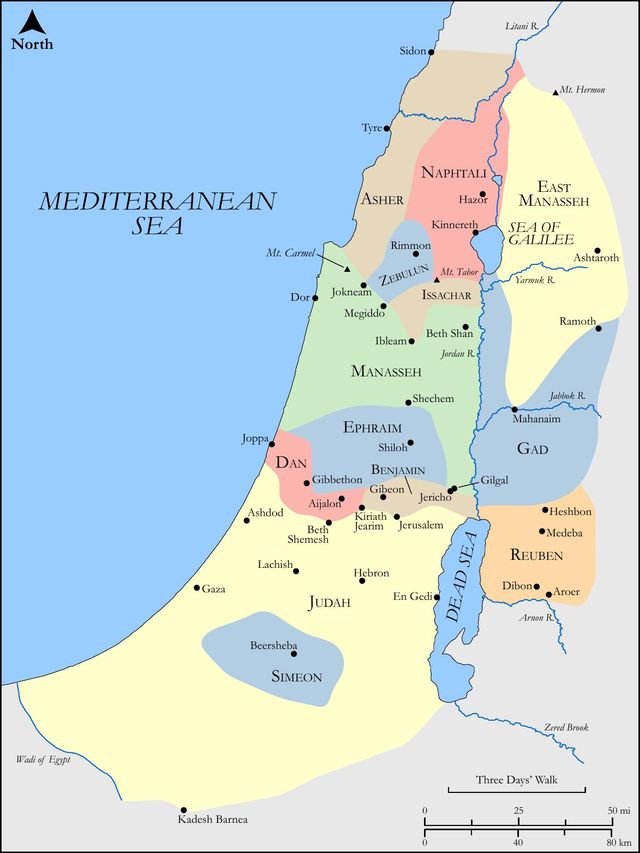
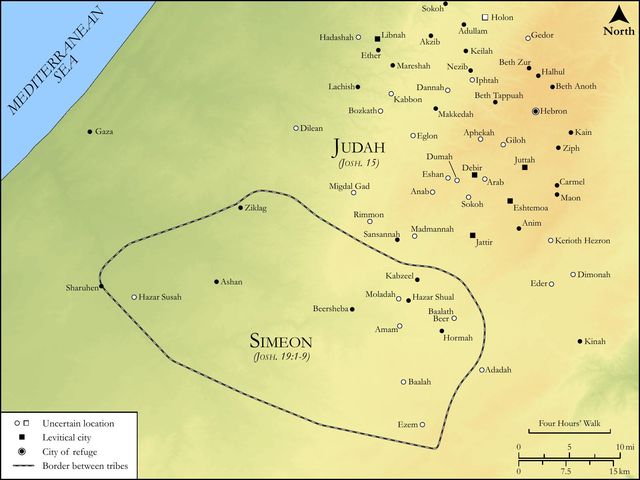
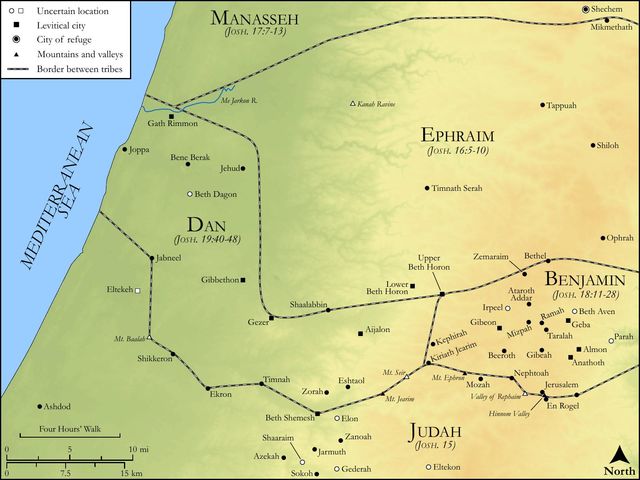
See on the biblical-era maps
Study this verse
Public-domain commentary
Matthew Henry
From his Commentary on the Whole Bible. Henry comments on passages, not single verses — this entry covers Joshua 19:10–16.
This is the lot of Zebulun, who, though born of Leah after Issachar, yet was blessed by Jacob and Moses before him; and therefore it was so ordered that his lot was drawn before that of Issachar, north of which it lay and south of Asher. 1. The lot of this tribe was washed by the great sea on the west, and by the sea of Tiberias on the east, answering Jacob's prophecy (Gen 49:13), Zebulun shall be a haven of ships, trading ships on the great sea and fishing ships on the sea of Galilee. 2. Though there were some places in this tribe which were made famous in the Old Testament, especially Mount Carmel, on which the famous trial was between God and Baal in Elijah's time, yet it was made much more illustrious in the New Testament; for within the lot of this tribe was Nazareth, where our blessed Saviour spent so much of his time on earth, and from which he was called Jesus of Nazareth, and Mount Tabor on which he was transfigured, and that coast of the sea of Galilee on which Christ preached so many sermons and wrought so many miracles.
Continue studying Joshua 19:11 across the web’s major study libraries — every link below opens this exact verse, chapter, or book on the destination site.
Read & Compare
 BibleGatewayThis verse in more than 200 translations and 70 languages.
 Bible.comThe YouVersion reader — hundreds of translations, reading plans, and highlights.
 ESV.orgCrossway's official English Standard Version reader.
 NET BibleThe NET translation with 60,000+ translators' notes on every rendering decision.
 STEP BibleTyndale House's free study tool — original text, vocabulary, and scholarly resources.
 BibliaLogos Bible Software's free web reader.
 USCCBThe New American Bible (Revised Edition) with the U.S. bishops' study notes.
Commentaries
 BibleHub CommentariesDozens of classic commentaries on this verse, gathered on one page.
 StudyLightMore than 100 commentary sets — the largest collection on the web.
 BibleRefPlain-English commentary on what this verse means, verse by verse.
 Enduring WordDavid Guzik's free commentary on this chapter, widely used by Bible teachers.
 Bible Study ToolsVerse commentary alongside Greek and Hebrew study aids.
Original Language & Research
- BibleHub InterlinearThe verse word by word — original language, transliteration, and English.
- BibleHub LexiconEvery word's original-language definition and Strong's entry.
 Blue Letter BibleDeep-study tools — Strong's numbers, concordance, and word studies.
 SefariaThe Hebrew text with Rashi and centuries of Jewish commentary.
Sermons, Hymns & Audio


TrulyRandomVerse is not affiliated with these sites and doesn’t control their content. They’re linked because they’re genuinely useful.
Summary
Joshua 19:11 precisely delineates a segment of the northern boundary for the tribe of Zebulun within the Promised Land. This verse meticulously traces the border's trajectory from the vicinity of the sea, through specific geographical markers like Maralah and Dabbasheth, and concluding at the river situated near Jokneam. This detailed demarcation is an integral part of the larger narrative of land distribution in the Book of Joshua, serving as a powerful testament to God's unwavering faithfulness in fulfilling His covenant promises to Israel by providing them with a secure, defined, and tangible inheritance.
Context
ShowHideLiterary Context
Joshua 19 is situated within the latter half of the Book of Joshua (chapters 13-21), which meticulously details the division of the land of Canaan among the twelve tribes of Israel. Following the initial conquests and the establishment of a central sanctuary at Shiloh, the narrative shifts from military campaigns to the practical fulfillment of God's promise of inheritance. Chapters 13-17 describe the portions allotted to Reuben, Gad, the half-tribe of Manasseh, Judah, Ephraim, and the other half-tribe of Manasseh. Chapter 18 notes the surveying of the remaining land, and chapter 19 then details the inheritances for the remaining seven tribes, with Zebulun being the first listed among them. This verse, therefore, provides a specific geographical detail within a larger administrative and theological process of settlement and possession, immediately preceded by the general description of Zebulun's lot and followed by the continuation of its boundaries and a list of its cities. It underscores the methodical and divine precision in the allocation of the Promised Land.
Historical & Cultural Context
The division of land in ancient Israel was a monumental undertaking, reflecting the tribal order of the house of Jacob in land tenure and organization, guided by divine instruction. The process involved casting lots, as seen in Joshua 18:6, which underscored divine sovereignty in the allocation. The meticulous detailing of boundaries, often involving natural features like rivers and hills, alongside specific towns, was crucial for preventing inter-tribal disputes and establishing clear ownership. Zebulun's territory, located primarily in the fertile Jezreel Valley and extending towards the Mediterranean coast (even if not directly touching it in all places), would have been strategically important for agriculture and trade. The mention of "the sea" (the Mediterranean) and proximity to routes near Jokneam (a key city often associated with trade routes) aligns with ancient blessings that hint at Zebulun's future involvement in commerce and maritime activity, as prophesied by Jacob in Genesis 49:13 and Moses in Deuteronomy 33:18-19.
Key Themes
ShowHideThis verse, as part of the land distribution narrative, powerfully underscores several key themes central to the Book of Joshua and the broader biblical narrative. Firstly, it highlights Divine Faithfulness to the Abrahamic covenant, where God promised the land to Abraham's descendants (e.g., Genesis 15:18-21). The precise fulfillment of this promise, down to specific geographical markers, demonstrates God's unwavering commitment to His word. Secondly, it emphasizes Order and Organization, illustrating the structured and intentional way God establishes His people in their inheritance, avoiding chaos and ensuring equity among the tribes. This meticulous detail reflects a divine blueprint for societal structure and governance. Thirdly, the theme of Inheritance and Possession is central. After generations of wandering and conquest, this verse signifies the tangible reality of Israel entering into and possessing the land that God had prepared for them, moving from promise to fulfillment, as seen in the overarching narrative of Joshua. It is a testament to God's provision for His people.
Exposition and Analysis
ShowHideKey Word Analysis
ShowHideThis term, used extensively throughout the land distribution chapters, properly signifies a cord (as twisted), which by implication refers to a boundary. It denotes a clearly defined, surveyed, and fixed boundary, often referring not just to an abstract line but to the physical markers—stones, natural features, or even specific settlements—that delineate the extent of a territory. Its repeated use emphasizes the precision and permanence of the tribal allotments, reflecting divine order and preventing future disputes over land.
A primitive root meaning "to ascend," this verb often implies movement upwards, either literally in elevation or figuratively in direction (e.g., northward or inland from a lower point like the sea). In geographical descriptions, it marks a progression along a boundary, indicating a specific directional flow of the border line. Here, it suggests the border ascended from a lower elevation, such as the coastal plain, towards the specified inland points, or simply indicates a general westward/northwestward trajectory from the initial starting point of Zebulun's territory.
This primitive root means "to impinge," "to touch," "to extend to," or "to arrive at." It is used repeatedly in these boundary descriptions to indicate points of contact or termination for a specific segment of the border. Its repetition underscores the exactness with which each landmark was identified as a precise point on the tribal boundary, leaving no ambiguity about the extent of the territory and ensuring a clear demarcation.
Verse Breakdown
ShowHide"And their border went up toward the sea"
This initial phrase sets the general direction for this segment of Zebulun's boundary. "The sea" refers to the Mediterranean Sea, indicating that this part of Zebulun's territory extended westward, potentially reaching close to the coastal plain or having access to maritime routes, even if not directly possessing a long coastline. The phrase "went up" suggests a movement from a lower elevation (perhaps from the eastern parts of Zebulun's territory or the Jezreel Valley) towards higher ground or simply a general westward/northwestward trajectory.
"and Maralah"
Following the general direction, Maralah is the first specific landmark mentioned. It was an ancient town or a distinct geographical feature that served as a fixed point on Zebulun's northwestern boundary. While its exact location is debated by modern scholars, it was clearly identifiable in the ancient Israelite landscape as a crucial marker for the tribal inheritance.
"and reached to Dabbasheth"
The border continued its precise path from Maralah to Dabbasheth, another identified landmark. The use of "reached to" emphasizes the exact connection and continuity between these points, indicating a defined segment of the boundary line. Dabbasheth, like Maralah, is a site whose precise ancient location is uncertain today but was a known and undisputed marker for the Israelites.
"and reached to the river that [is] before Jokneam"
The final point in this segment of the boundary is a river located "before" (or "in front of," often implying "east of" or "adjacent to") Jokneam. Jokneam was a significant Canaanite royal city, mentioned in Joshua 12:22, and is often identified with Tell Qaimun at the entrance to the Jezreel Valley. The river, likely the Kishon or one of its tributaries, served as a natural and unmistakable boundary marker, extending the border to a prominent geographical feature near a well-known city, thus completing this portion of Zebulun's inheritance.
Literary Devices
ShowHideThe primary literary device employed in Joshua 19:11, and indeed throughout the land distribution chapters (Joshua 13-21), is Cataloging or Detailed Listing. This involves the systematic enumeration of specific geographical points, towns, and natural features to precisely define the boundaries of each tribe. This meticulous cataloging serves a crucial theological purpose: it authenticates the fulfillment of God's promises, providing an undeniable, verifiable record of the inheritance. It also functions as a form of Legal Documentation, establishing the tribal claims and minimizing future disputes over territory. The repetitive use of phrases like "went up toward" and "reached to" creates a sense of Precision and Verifiable Accuracy, emphasizing the divine order and thoroughness in the allocation process. While not overtly poetic, the very act of listing these ancient place names imbues the text with an air of Historical Realism, grounding the divine narrative in tangible, identifiable geography, thus reinforcing the truthfulness of God's actions.
Theological and Thematic Connections
ShowHideJoshua 19:11, while seemingly a dry geographical description, is deeply theological, serving as a profound testament to God's unwavering faithfulness to His covenant promises, particularly the land grant to Abraham's descendants (Genesis 12:7). The meticulous detail underscores the divine order and precision in fulfilling these promises, demonstrating that God is not vague in His commitments but executes them with exactitude and care. This precision also highlights the concept of divine provision; God not only promised a land but ensured each family and tribe received a specific, identifiable, and sufficient portion, tailored to their needs. The land, therefore, becomes a tangible symbol of God's blessing, His abiding presence among His people, and the security He provides. This earthly inheritance also prefigures the ultimate, spiritual inheritance that believers receive in Christ, a reality far exceeding any earthly territory in its scope and eternal significance.
Reflection and Application
ShowHideJoshua 19:11, though a geographical marker from ancient Israel, offers profound spiritual insights for believers today. Just as God meticulously defined the boundaries for Zebulun, He provides clear guidelines and boundaries for our lives through His inspired Word. These divine "borders" are not restrictive but are designed for our flourishing, protection, and true freedom, leading us into the "good inheritance" He has prepared for us. This verse reminds us that God is a God of order, precision, and unwavering faithfulness. He fulfills His promises, often in ways that require patience and trust in His detailed and perfect plan. We are called to trust in His sovereign providence, knowing that He has a specific place and purpose for each of us within His vast kingdom. Understanding our spiritual inheritance in Christ—our identity, our immeasurable blessings, and our divine calling—allows us to live within the abundant life He has ordained, confident that His promises are "Yes" and "Amen" in Him. We are invited to explore the "boundaries" of His grace and truth, finding security, purpose, and ultimate fulfillment within them.
Questions for Reflection
ShowHideFAQ
ShowHideWhy is so much detail given to geographical boundaries in the book of Joshua?
ShowHideThe extensive geographical details in Joshua, including verses like Joshua 19:11, serve multiple crucial purposes, reflecting God's character and His dealings with His people. Firstly, they provide historical and legal validation for Israel's claim to the land, demonstrating the precise and undeniable fulfillment of God's ancient promises to Abraham regarding the land of Canaan (Genesis 15:18). Secondly, these detailed descriptions establish clear tribal identities and ownership, preventing future disputes over territory among the twelve tribes, thus reflecting God's desire for order, justice, and peace within His covenant community. Thirdly, these details highlight the tangible reality of God's faithfulness—He didn't just promise a land in general terms, but a specific, measurable, and identifiable inheritance for each family and tribe, ensuring every Israelite knew their place and portion within the Promised Land, a testament to His meticulous care and provision.
Christ-Centered Fulfillment
ShowHideWhile Joshua 19:11 describes a physical boundary for an earthly tribe, it powerfully points forward to the ultimate, spiritual inheritance found in Christ. The meticulous division of land in Canaan foreshadows the precise and comprehensive nature of the spiritual blessings and eternal inheritance secured for believers in the New Covenant. Just as Zebulun received a defined territory as a tangible expression of God's promise, believers receive a spiritual inheritance that is "imperishable, undefiled, and unfading, kept in heaven for you" (1 Peter 1:4). Jesus Christ is the true "Promised Land," the ultimate fulfillment of all God's promises, in whom "every spiritual blessing in the heavenly places" is found (Ephesians 1:3). He is the one who establishes the "boundaries" of our new life, defining our identity, purpose, and eternal dwelling place in Him. Through His atoning work and resurrection, we are granted access to a "heavenly country" (Hebrews 11:16) and become "heirs of God and fellow heirs with Christ" (Romans 8:17). The earthly inheritance of Zebulun, with its specific borders, serves as a tangible type of the boundless, eternal, and glorious inheritance that is ours by grace through faith in Jesus, who is our ultimate possession and our eternal home.