


Joshua 19:10
Bible text: King James Version (1769 Blayney text) · Public domain
Bible text: Berean Standard Bible · Public domain
Bible text: American Standard Version (1901) · Public domain
Bible text: World English Bible, Messianic edition · Public domain
Bible text: Geneva Bible (1599) · Public domain
Bible text: Young's Literal Translation · Public domain
- וַיַּעַלvai·Ya·'aland it came upH5927Conj-w ¦ V-Qal-ConsecImperf-3msVerb Qal Consecutive Imperfect 3rd Singular Masculineוַandיַּעַלit came up
- הַגּוֹרָלha·go·Ralthe lotH1486Art ¦ N-msNoun Singular Masculine Absoluteהַtheגּוֹרָלlot
- הַשְּׁלִישִׁיha·she·li·Shi<the> thirdH7992Art ¦ Adj-msAdjective Numerical Position Singular Masculine Absoluteהַ<the>שְּׁלִישִׁיthird
- לִבְנֵיliv·Neifor [the] descendants ofH1121Prep-l ¦ N-mpcNoun Plural Masculine Constructלִforבְנֵי[the] descendants of
- זְבוּלֻןze·vu·LunZebulunH2074N-proper-mNoun Proper Masculine
- לְמִשְׁפְּחֹתָםle·mish·pe·cho·Tamto their clansH4940Prep-l ¦ N-fpc ¦ 3mpNoun Plural Feminine Constructלְtoמִשְׁפְּחֹתָclansםtheir
- וַיְהִיvay·Hiand it wasH1961Conj-w ¦ V-Qal-ConsecImperf-3msVerb Qal Consecutive Imperfect 3rd Singular Masculineוַandיְהִיit was
- גְּבוּלge·Vul[the] border ofH1366N-mscNoun Singular Masculine Construct
- נַחֲלָתָםna·cha·la·Tamtheir inheritanceH5159N-fsc ¦ 3mpNoun Singular Feminine Constructנַחֲלָתָinheritanceםtheir
- עַד'adtoH5704PrepPreposition
- שָׂרִידsa·RidSaridH8301N-properNoun Proper Location
English is a literal word-by-word gloss of the Hebrew, not the KJV's wording. Why?
This is the original text the KJV's translators worked from — each Hebrew word with its own literal English meaning in this verse, prepared by scholars at Tyndale House, Cambridge. The KJV translates whole sentences, not word by word, so its wording differs: one Hebrew word can become several English words, and the KJV may choose “the LORD” where the gloss reads “Yahweh”. Both are faithful — they answer different questions. For the KJV's own rendering, switch to the KJV text.
Details
See on the biblical-era maps
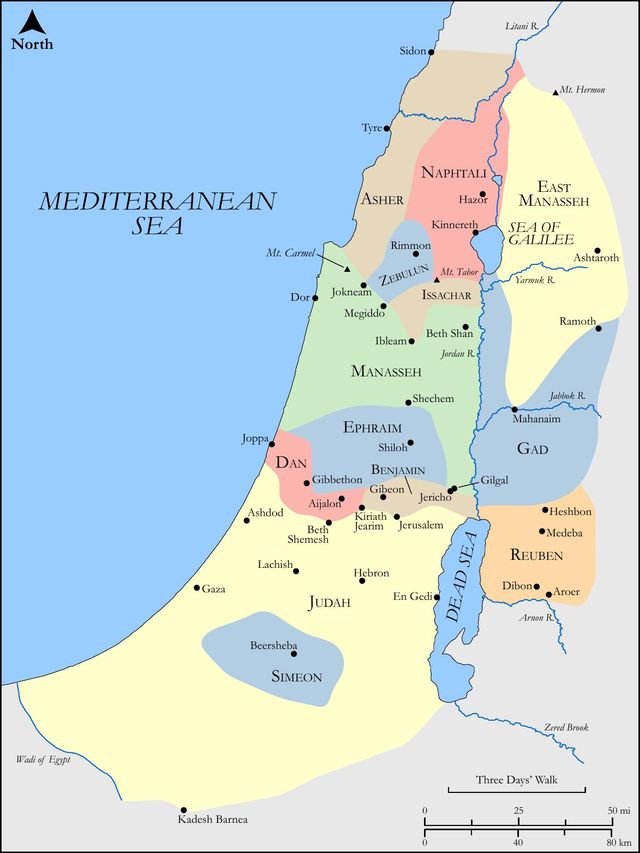
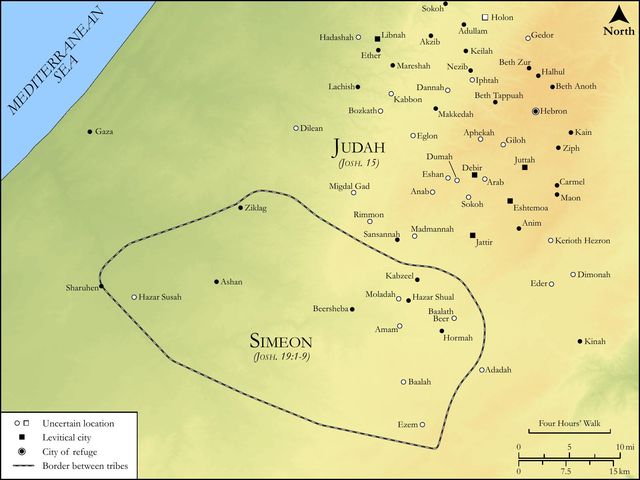
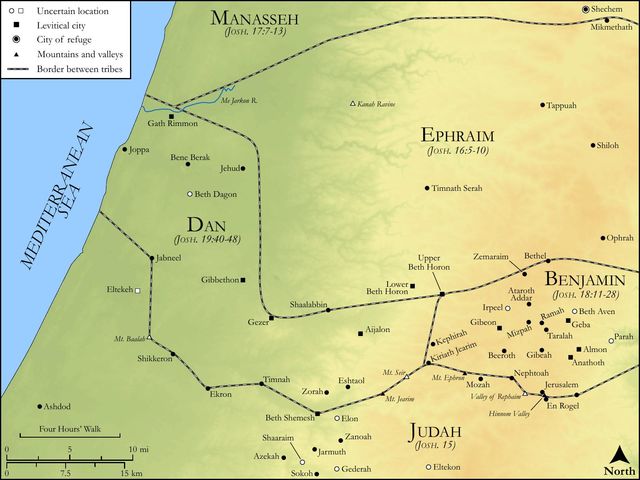
Study this verse
Public-domain commentary
Matthew Henry
From his Commentary on the Whole Bible. Henry comments on passages, not single verses — this entry covers Joshua 19:10–16.
This is the lot of Zebulun, who, though born of Leah after Issachar, yet was blessed by Jacob and Moses before him; and therefore it was so ordered that his lot was drawn before that of Issachar, north of which it lay and south of Asher. 1. The lot of this tribe was washed by the great sea on the west, and by the sea of Tiberias on the east, answering Jacob's prophecy (Gen 49:13), Zebulun shall be a haven of ships, trading ships on the great sea and fishing ships on the sea of Galilee. 2. Though there were some places in this tribe which were made famous in the Old Testament, especially Mount Carmel, on which the famous trial was between God and Baal in Elijah's time, yet it was made much more illustrious in the New Testament; for within the lot of this tribe was Nazareth, where our blessed Saviour spent so much of his time on earth, and from which he was called Jesus of Nazareth, and Mount Tabor on which he was transfigured, and that coast of the sea of Galilee on which Christ preached so many sermons and wrought so many miracles.
Continue studying Joshua 19:10 across the web’s major study libraries — every link below opens this exact verse, chapter, or book on the destination site.
Read & Compare
 BibleGatewayThis verse in more than 200 translations and 70 languages.
 Bible.comThe YouVersion reader — hundreds of translations, reading plans, and highlights.
 ESV.orgCrossway's official English Standard Version reader.
 NET BibleThe NET translation with 60,000+ translators' notes on every rendering decision.
 STEP BibleTyndale House's free study tool — original text, vocabulary, and scholarly resources.
 BibliaLogos Bible Software's free web reader.
 USCCBThe New American Bible (Revised Edition) with the U.S. bishops' study notes.
Commentaries
 BibleHub CommentariesDozens of classic commentaries on this verse, gathered on one page.
 StudyLightMore than 100 commentary sets — the largest collection on the web.
 BibleRefPlain-English commentary on what this verse means, verse by verse.
 Enduring WordDavid Guzik's free commentary on this chapter, widely used by Bible teachers.
 Bible Study ToolsVerse commentary alongside Greek and Hebrew study aids.
Original Language & Research
- BibleHub InterlinearThe verse word by word — original language, transliteration, and English.
- BibleHub LexiconEvery word's original-language definition and Strong's entry.
 Blue Letter BibleDeep-study tools — Strong's numbers, concordance, and word studies.
 SefariaThe Hebrew text with Rashi and centuries of Jewish commentary.
Sermons, Hymns & Audio


TrulyRandomVerse is not affiliated with these sites and doesn’t control their content. They’re linked because they’re genuinely useful.
Summary
Joshua 19:10 meticulously records the divine allocation of land to the tribe of Zebulun, marking the third lot drawn for the remaining Israelite tribes at Shiloh. This verse details the initial geographical boundary of their inheritance, extending to Sarid, thereby underscoring God's unwavering faithfulness in fulfilling His ancient covenant promises to Israel through a process that emphasized divine sovereignty in the precise division of the Promised Land among His people, establishing their permanent dwelling and identity within the land.
Context
ShowHideLiterary Context
Joshua 19:10 is situated within the extensive narrative of land distribution found in Joshua chapters 13-21. Specifically, it follows the initial major allocations to Judah, Ephraim, and Manasseh, and directly succeeds the detailed description of Simeon's inheritance in Joshua 19:1-9. The preceding chapter, Joshua 18, establishes the crucial setting at Shiloh, where the Tabernacle was erected and the remaining seven tribes were to receive their portions by lot after the land had been surveyed. This verse, therefore, is part of a meticulous record that systematically documents the fulfillment of God's promise to give Israel a homeland, emphasizing the orderliness, divine oversight, and comprehensive nature of the entire process of settlement and inheritance, ensuring every tribe received its divinely appointed place.
Historical & Cultural Context
The division of land by "lot" was a culturally significant practice among the nations, often employed to settle disputes or determine divine will. In the Israelite context, as seen in Proverbs 16:33, it was understood as a means by which God's sovereign hand directed outcomes, rather than mere chance. This method ensured that the land, the very foundation of Israel's covenant identity and economic stability, was distributed fairly and according to God's precise plan for each tribe and family, preventing human favoritism or conflict. The concept of "inheritance" (Hebrew: nachalah) was paramount, signifying a permanent, inalienable possession passed down through generations, crucial for maintaining tribal identity and preventing land accumulation. Sarid, likely modern Tell Shadud, was a strategic location in the fertile Jezreel Valley, indicating Zebulun's territory would encompass rich agricultural lands and access to vital trade routes, fulfilling the ancient prophecies concerning their prosperity (Genesis 49:13).
Key Themes
ShowHideThis verse powerfully illustrates the theme of Divine Sovereignty and Providence, as the "lot" unequivocally points to God's direct and meticulous involvement in the distribution of the land, ensuring that each tribe received its divinely appointed portion without human bias. It serves as a tangible demonstration of the Fulfillment of God's Covenant Promises, specifically the land promise made to Abraham (e.g., Genesis 12:7) and reaffirmed throughout the Pentateuch, showcasing God's faithfulness in bringing His people into their long-awaited inheritance. Furthermore, the concept of "inheritance" (Hebrew: naḥălâ) is central, signifying not just a temporary possession but a permanent, divinely apportioned legacy that fundamentally shaped the Identity and Future of each family and tribe within the nascent nation of Israel, establishing their place and purpose in the land God had prepared for them, as detailed throughout Joshua 19.
Exposition and Analysis
ShowHideKey Word Analysis
ShowHideThis term (H1486) refers to a small object, such as a stone or pebble, cast to determine an outcome or divide portions. In the biblical context, particularly in the division of the land, its use signifies that the decision was not left to human discretion or chance but was believed to be guided by divine intervention. It underscores God's direct involvement and sovereign appointment of each tribe's territory, removing human bias and ensuring the fulfillment of His perfect will in the land distribution for the children of Israel.
This proper noun (H2074) refers to one of the sons of Jacob and Leah, and subsequently, the tribe descended from him. The name itself means "habitation," which is fitting given that this verse describes the allocation of their permanent dwelling place. The mention of Zebulun here highlights the specific, personal nature of God's covenant faithfulness, as He provides a distinct and secure inheritance for each of Jacob's descendants, fulfilling ancient patriarchal blessings.
More than merely a temporary possession or property, nachălâh (H5159) denotes a permanent, inalienable, and divinely apportioned legacy. It signifies a familial and tribal portion of the land given by God, intended to be passed down through generations. This concept was foundational to Israelite identity, livelihood, and their covenant relationship with God in the Promised Land, representing both a physical dwelling and a spiritual blessing that cemented their place as God's chosen people.
This term (H1366) signifies a boundary or limit, often marked by physical features or landmarks. In the context of land division, the "border" was crucial for legally defining the extent of each tribe's territory. The precise demarcation of borders, as seen with Sarid, emphasizes the tangible reality of God's fulfilled promise and the legal establishment of Israel's presence in Canaan, providing clear and undisputed boundaries for each tribe's dwelling, economic activity, and defense, ensuring order and preventing disputes.
Verse Breakdown
ShowHide"And the third lot came up for the children of Zebulun"
This clause establishes the sequence of land distribution, identifying Zebulun as the recipient of the third portion among the remaining seven tribes whose inheritance was yet to be determined at Shiloh. The phrase "came up" (Hebrew: ʻâlâh) vividly describes the drawing of the lot, emphasizing the divine action behind the selection. It underscores that this allocation was not arbitrary but part of a divinely ordained process.
"according to their families"
This crucial phrase emphasizes the meticulous and equitable nature of the division. It highlights that the land was apportioned not just to the tribe as a collective, but specifically to its constituent clans and households, reflecting the patriarchal structure and the importance of familial lineage in Israelite society. This ensured a fair and lasting legacy for each household, reinforcing the covenantal promise of land as a permanent possession for every family.
"and the border of their inheritance was unto Sarid"
This specifies the initial geographical marker of Zebulun's newly acquired territory. Sarid served as a key reference point, indicating the southern boundary of their land. The precise demarcation of borders throughout the Book of Joshua underscores the tangible reality of God's promise fulfilled and the legal establishment of Israel's presence in Canaan, providing clear and undisputed boundaries for each tribe's dwelling, economic activity, and defense, thereby securing their divinely appointed portion.
Literary Devices
ShowHideThe primary literary device employed in Joshua 19:10 and the surrounding chapters is Cataloging or Detailed Listing. The meticulous enumeration of tribal territories and their specific boundaries serves to emphasize the comprehensive and precise fulfillment of God's promises regarding the land. This exhaustive detail lends an air of historical veracity and divine intentionality to the narrative, reinforcing the idea that every aspect of the settlement was divinely ordained and meticulously executed. Furthermore, the repeated mention of the "lot" functions as a powerful Symbolism, representing divine sovereignty and the providential hand of God guiding the distribution, ensuring that the land was not merely conquered and divided by human might, but divinely apportioned according to His perfect will. The very act of listing the boundaries also employs Geographical Realism, grounding the theological narrative in tangible, verifiable locations, thereby reinforcing the historical truth of the conquest and settlement, and demonstrating the concrete nature of God's faithfulness.
Theological and Thematic Connections
ShowHideJoshua 19:10, in its precise detailing of Zebulun's inheritance, serves as a powerful testament to God's unwavering faithfulness and meticulous care for His people. The distribution by lot underscores His sovereign control over every detail of their lives and destiny, ensuring that each tribe received its divinely appointed portion. This act of giving inheritance in the Promised Land is a tangible fulfillment of the ancient covenant promises made to Abraham, demonstrating that God's word is always true and His plans are perfectly executed. It reminds believers that God is not only a God of grand promises but also of intricate details, working out His purposes with precision and love, establishing a secure and permanent place for His people. This divine provision of a homeland was foundational to Israel's identity and their ability to live out their covenant relationship with Yahweh.
Reflection and Application
ShowHideJoshua 19:10, though seemingly a dry geographical detail, offers profound spiritual lessons for contemporary believers. It invites us to consider the meticulous nature of God's providence in our own lives. Just as He precisely allotted physical land to His people Israel, He also orchestrates the circumstances, opportunities, and even the "borders" of our lives, ensuring that we are positioned for His purposes. This verse encourages a deep trust in God's sovereign plan, reminding us that our true inheritance is not earthly but spiritual, secured in Christ. It prompts us to find contentment and purpose within the sphere God has appointed for us, knowing that He is faithful to provide and guide, even in the seemingly mundane details. Our call is to live faithfully within the "inheritance" He has given us, whether it be our gifts, our relationships, our vocations, or our sphere of influence, stewarding them for His glory and recognizing His hand in every aspect of our existence. This divine ordering provides a profound sense of security and purpose, knowing that our lives are not left to chance but are carefully orchestrated by a loving and sovereign God.
Questions for Reflection
ShowHideFAQ
ShowHideWhy was the land divided by "lot," and what does this signify?
ShowHideThe land was divided by "lot" (Hebrew: gôrāl') as commanded by God (Numbers 26:55-56). This method was not based on mere chance but was understood as a divine means of revealing God's will and ensuring impartiality. In ancient Israelite culture, casting lots was a way to discern God's sovereign decision, as explicitly stated in Proverbs 16:33: "The lot is cast into the lap; but the whole disposing thereof is of the LORD." This signifies that the land distribution was not arbitrary or subject to human favoritism, but was divinely ordained and perfectly aligned with God's plan for each tribe's inheritance. It underscored God's absolute sovereignty over the Promised Land and His faithfulness in fulfilling His covenant promises to His people, establishing their permanent dwelling.
What is the significance of "Sarid" in Zebulun's inheritance?
ShowHideSarid is mentioned in Joshua 19:10 as a key boundary marker for the tribe of Zebulun. While its exact modern location is debated, it is generally identified with Tell Shadud, a strategic site in the fertile Jezreel Valley. Its inclusion in the description of Zebulun's border highlights the meticulous detail with which the land was surveyed and apportioned. Each boundary marker, like Sarid, served to legally define and secure the tribal inheritance, preventing disputes and ensuring that God's promise of a specific homeland was tangibly fulfilled for each family and clan within Zebulun. It grounds the theological narrative in geographical reality, demonstrating the concrete nature of God's provision and the precision of His fulfillment of covenant promises.
Christ-Centered Fulfillment
ShowHideWhile Joshua 19:10 meticulously details a physical inheritance of land, its ultimate Christ-centered fulfillment points to the spiritual and eternal inheritance believers receive through Jesus Christ. Just as God meticulously allotted portions of the Promised Land to His people Israel, demonstrating His faithfulness and sovereign care, so too has He, in His infinite grace, prepared an eternal inheritance for those who are in Christ. This spiritual inheritance is not a geographical plot but a participation in the divine nature and the boundless blessings of the new covenant, far surpassing any earthly possession. Jesus, as the true Joshua (Yeshua), leads His people into a greater rest and a more glorious inheritance, purchased by His perfect sacrifice on the cross. Through Him, we are made "heirs of God and joint heirs with Christ" (Romans 8:17), receiving "an inheritance that is imperishable, undefiled, and unfading, kept in heaven for you" (1 Peter 1:4). The precise and divinely ordained division of land in Joshua foreshadows the perfect and secure spiritual blessings we receive in Christ, our ultimate and eternal portion, who has opened the way to our true and heavenly home and secured our place in the new heavens and new earth.