


Joshua 18:11
Bible text: King James Version (1769 Blayney text) · Public domain
Bible text: King James Version with Strong's numbers · Public domain
Bible text: Berean Standard Bible · Public domain
Bible text: American Standard Version (1901) · Public domain
Bible text: World English Bible, Messianic edition · Public domain
Bible text: Geneva Bible (1599) · Public domain
Bible text: Young's Literal Translation · Public domain
- וַיַּעַלvai·Ya·'aland it came upH5927Conj-w ¦ V-Qal-ConsecImperf-3msVerb Qal Consecutive Imperfect 3rd Singular Masculineוַandיַּעַלit came up
- גּוֹרַלgo·Ral[the] lot ofH1486N-mscNoun Singular Masculine Construct
- מַטֵּהma·Teh[the] tribe ofH4294N-mscNoun Singular Masculine Construct
- בְנֵיve·nei[the] descendants ofH1121N-mpcNoun Plural Masculine Construct
- בִנְיָמִןvin·ya·MinBenjaminH1144N-proper-mNoun Proper Masculine
- לְמִשְׁפְּחֹתָםle·mish·pe·cho·Tamto their clansH4940Prep-l ¦ N-fpc ¦ 3mpNoun Plural Feminine Constructלְtoמִשְׁפְּחֹתָclansםtheir
- וַיֵּצֵאvai·ye·Tze'and it went outH3318Conj-w ¦ V-Qal-ConsecImperf-3msVerb Qal Consecutive Imperfect 3rd Singular Masculineוַandיֵּצֵאit went out
- גְּבוּלge·Vul[the] territory ofH1366N-mscNoun Singular Masculine Construct
- גּוֹרָלָםgo·ra·Lamtheir lotH1486N-msc ¦ 3mpNoun Singular Masculine Constructגּוֹרָלָlotםtheir
- בֵּיןbein[was] betweenH996Adj-mscAdjective Numerical Singular Masculine Construct
- בְּנֵיbe·Nei[the] descendants ofH1121N-mpcNoun Plural Masculine Construct
- יְהוּדָהye·hu·DahJudahH3063N-properNoun Proper Location
- וּבֵיןu·Veinand betweenH996Conj-w ¦ Adj-mscAdjective Numerical Singular Masculine Constructוּandבֵיןbetween
- בְּנֵיbe·Nei[the] descendants ofH1121N-mpcNoun Plural Masculine Construct
- יוֹסֵףyo·SefJosephH3130N-proper-mNoun Proper Masculine
English is a literal word-by-word gloss of the Hebrew, not the KJV's wording. Why?
This is the original text the KJV's translators worked from — each Hebrew word with its own literal English meaning in this verse, prepared by scholars at Tyndale House, Cambridge. The KJV translates whole sentences, not word by word, so its wording differs: one Hebrew word can become several English words, and the KJV may choose “the LORD” where the gloss reads “Yahweh”. Both are faithful — they answer different questions. For the KJV's own rendering, switch to the KJV text.
Details
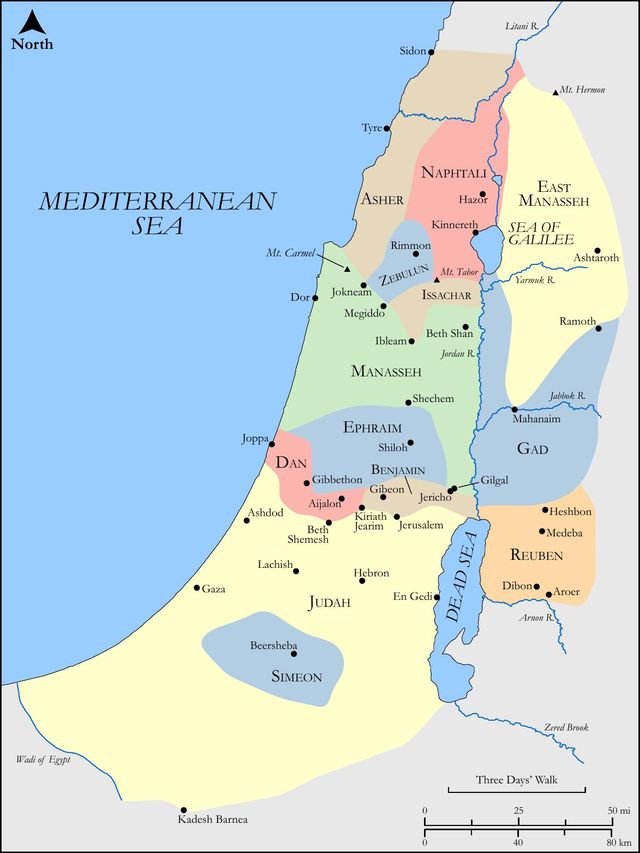
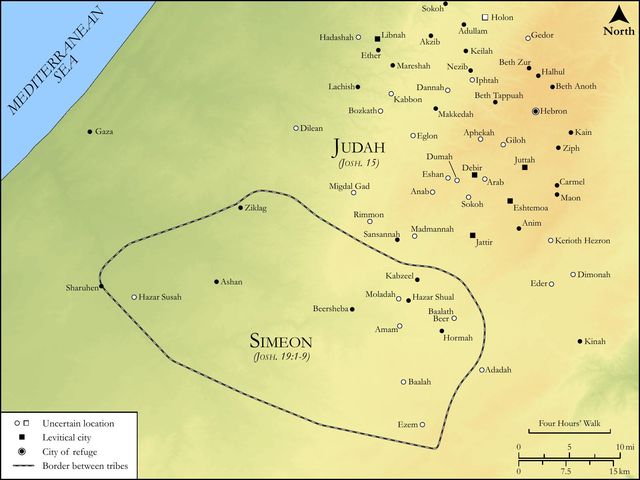
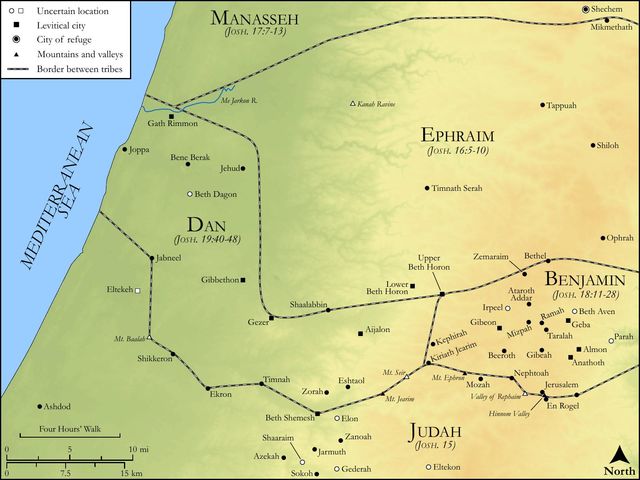
See on the biblical-era maps
Study this verse
Public-domain commentary
Matthew Henry
From his Commentary on the Whole Bible. Henry comments on passages, not single verses — this entry covers Joshua 18:11–28.
We have here the lot of the tribe of Benjamin, which Providence cast next to Joseph on the one hand, because Benjamin was own and only brother to Joseph, and was little Benjamin (Psa 68:27), that needed the protection of great Joseph, and yet had a better protector, for the Lord shall cover him all the day long, Deu 33:12. And it was next to Judah on the other hand, that this tribe might hereafter unite with Judah in an adherence to the throne of David and the temple at Jerusalem. Here we have, 1. The exact borders and limits of this tribe, which we need not be exact in the explication of. As it had Judah on the south and Joseph on the north, so it had Jordan on the east and Dan on the west. The western border is said to compass the corner of the sea southward (Jos 18:14), whereas no part of the lot of this tribe came near to the great sea. Bishop Patrick thinks the meaning is that it ran along in a parallel line to the great sea, though at a distance. Dr. Fuller suggests that since it is not called the great sea, but only the sea, which often signifies any lake or mere, it may be meant of the pool of Gibeon, which may be called a corner or canton of the sea; it is called the great waters of Gibeon (Jer 41:12), and it is compassed by the western border of this tribe. 2. The particular cities in this tribe, not all, but the most considerable. Twenty-six are here named. Jericho is put first, though dismantled, and forbidden to be rebuilt as a city with gates and walls, because it might be built and inhabited as a country village, and so was not useless to this tribe. Gilgal, where Israel first encamped when Saul was made king (Sa1 11:15), was in this tribe. It was afterwards a very profane place. Hos 9:15, All their wickedness is in Gilgal. Beth-el was in this tribe, a famous place. Though Benjamin adhered to the house of David, yet Beth-el, it seems, was in the possession of the house of Joseph (Jdg 1:23-25), and there Jeroboam set up one of his calves. In this tribe was Gibeon, where the altar was in the beginning of Solomon's time, Ch2 1:3. Gibeah likewise, that infamous place where the Levite's concubine was abused. Mizpeh, and near it Samuel's Ebenezer, and also Anathoth, Jeremiah's city, were in this tribe, as was the northern part of Jerusalem. Paul was the honour of this tribe (Rom 11:1; Phi 3:5); but where his land lay we know not: he sought the better country.
Continue studying Joshua 18:11 across the web’s major study libraries — every link below opens this exact verse, chapter, or book on the destination site.
Read & Compare
 BibleGatewayThis verse in more than 200 translations and 70 languages.
 Bible.comThe YouVersion reader — hundreds of translations, reading plans, and highlights.
 ESV.orgCrossway's official English Standard Version reader.
 NET BibleThe NET translation with 60,000+ translators' notes on every rendering decision.
 STEP BibleTyndale House's free study tool — original text, vocabulary, and scholarly resources.
 BibliaLogos Bible Software's free web reader.
 USCCBThe New American Bible (Revised Edition) with the U.S. bishops' study notes.
Commentaries
 BibleHub CommentariesDozens of classic commentaries on this verse, gathered on one page.
 StudyLightMore than 100 commentary sets — the largest collection on the web.
 BibleRefPlain-English commentary on what this verse means, verse by verse.
 Enduring WordDavid Guzik's free commentary on this chapter, widely used by Bible teachers.
 Bible Study ToolsVerse commentary alongside Greek and Hebrew study aids.
Original Language & Research
- BibleHub InterlinearThe verse word by word — original language, transliteration, and English.
- BibleHub LexiconEvery word's original-language definition and Strong's entry.
 Blue Letter BibleDeep-study tools — Strong's numbers, concordance, and word studies.
 SefariaThe Hebrew text with Rashi and centuries of Jewish commentary.
Sermons, Hymns & Audio


TrulyRandomVerse is not affiliated with these sites and doesn’t control their content. They’re linked because they’re genuinely useful.
Summary
Joshua 18:11 records the divinely orchestrated allocation of territory to the tribe of Benjamin in the Promised Land. Through the sacred practice of casting lots, Benjamin's inheritance was precisely determined, strategically positioning it between the powerful tribal domains of Judah to the south and the collective tribes of Joseph (Ephraim and Manasseh) to the north. This central location was not coincidental but a testament to God's meticulous provision and faithfulness in fulfilling His ancient covenant promises, setting the stage for Benjamin's significant role in Israelite history.
Context
ShowHideLiterary Context
Joshua 18:11 is embedded within the extensive narrative of Israel's land distribution, which commences in Joshua 13 and concludes in Joshua 19. Prior to this verse, the tribes of Judah, Ephraim, and Manasseh had already received their portions. With seven tribes still awaiting their inheritance, Joshua initiated a comprehensive land survey, as detailed in Joshua 18:4-6, to ensure an orderly and equitable division. The subsequent casting of lots at Shiloh, before the tabernacle, underscored the divine sanction of the process. Joshua 18:11 specifically announces the outcome for Benjamin, the first of the remaining tribes to receive its inheritance, thereby setting the foundation for the detailed boundary descriptions that follow in Joshua 18:12-28.
Historical & Cultural Context
The allocation of Canaanite land to the Israelite tribes represented the tangible fulfillment of God's centuries-old promise to Abraham (Genesis 12:7). Land inheritance was paramount to Israelite identity, economic stability, and covenant fidelity, symbolizing their permanent establishment as God's people in their own sovereign territory. The practice of casting lots (Hebrew: goral) was a method widespread among the nations for making crucial decisions, but for Israel, it was uniquely understood as a sacred means of discerning God's direct will, not a mere game of chance (Proverbs 16:33). The selection of Shiloh as the site for the tabernacle and the land distribution (Joshua 18:1) further emphasized the religious and divine authority behind the entire process. Benjamin's strategic placement between the formidable tribes of Judah and Joseph would later prove to be a significant factor in the political and military landscape of Israel, particularly during the tumultuous periods of the judges and the monarchy.
Key Themes
ShowHideThis verse powerfully articulates several foundational themes. Firstly, Divine Providence and Sovereignty are prominently displayed, as the casting of lots unequivocally demonstrates God's direct and meticulous involvement in the precise allocation of land, ensuring each tribe received its divinely appointed inheritance. This was a divine decree, not a human negotiation. Secondly, it highlights the Fulfillment of God's Covenant Promises, particularly the ancient pledge to Abraham that his descendants would inherit the land of Canaan. Benjamin's portion, like all others, served as a tangible and undeniable testament to God's unwavering faithfulness (Joshua 21:43-45). Thirdly, the verse underscores Tribal Identity and Inheritance, as the detailed boundaries reinforced each tribe's distinct place within the Promised Land and their specific portion within the larger community of Israel. Finally, the Strategic Importance of Location is subtly introduced, as Benjamin's territory, nestled between the dominant tribes of Judah and Joseph, would later become a crucial geopolitical nexus, notably encompassing the future capital city of Jerusalem (Judges 1:21).
Exposition and Analysis
ShowHideKey Word Analysis
ShowHideFrom an unused root meaning to be rough (as stone); properly, a pebble, i.e. a lot (small stones being used for that purpose); figuratively, a portion or destiny (as if determined by lot). In this context, "lot" refers to the method of divine determination for land allocation. It signifies that the inheritance was not a result of human negotiation or chance, but a direct revelation of God's sovereign will, ensuring an impartial and divinely sanctioned distribution.
From גָּבַל; properly, a cord (as twisted), i.e. (by implication) a boundary; by extension the territory inclosed; border, bound, coast. While "coast" in modern English often implies a shoreline, the Hebrew term here denotes a precisely defined boundary or border. It emphasizes the exact and delineated nature of Benjamin's allotted territory, highlighting the meticulous detail of God's provision and the orderly establishment of tribal inheritances.
From בָּנָה; a son (as a builder of the family name), in the widest sense (of literal and figurative relationship, including grandson, subject, nation, quality or condition, etc., (like father or brother), etc.). This term, appearing multiple times ("children of Benjamin," "children of Judah," "children of Joseph"), emphasizes the tribal and familial identity of the groups receiving the land. It underscores the patriarchal structure of Israelite society and the generational continuity of God's covenant promises, where inheritance passed down through family lines.
Verse Breakdown
ShowHide"¶ And the lot of the tribe of the children of Benjamin came up according to their families:"
This opening clause establishes the central event: the determination of Benjamin's inheritance. The phrase "the lot... came up" signifies the divine selection, indicating that God, through this sacred method, revealed the specific portion designated for Benjamin. The addition "according to their families" is crucial, emphasizing that the land division was not merely tribal but extended to the individual family units within the tribe, ensuring that each household received its rightful portion, as divinely mandated (Numbers 26:52-56). This meticulous detail underscores God's comprehensive care for every segment of His people.
"and the coast of their lot came forth between the children of Judah and the children of Joseph."
This second clause precisely defines the geographical placement of Benjamin's allotted territory. The "coast" or "boundary" of their inheritance was uniquely situated, acting as a crucial nexus or buffer between the two most dominant and influential tribal blocs: Judah to the south and the "children of Joseph" (primarily Ephraim and Manasseh) to the north. The verb "came forth" (יָצָא, yatsa) reiterates the outcome of the lot-casting, reinforcing that this specific, divinely ordained boundary was revealed. This central location would prove to be of immense strategic importance, as it included key cities and would later become a focal point for the kingdom of Israel, notably encompassing the future capital city of Jerusalem.
Literary Devices
ShowHideJoshua 18:11 effectively employs several literary devices to convey its significant message. The primary device is Descriptive Language, used to precisely detail the process of land allocation and the resulting geographical placement. The repetition of the concept of "lot" (both as a noun and implicitly through the verbs "came up" and "came forth") serves as a form of Anaphora or Repetition, emphasizing the divine sovereignty and intentionality behind the distribution. The phrases "came up" and "came forth" also subtly employ Personification of the lot, giving it agency as if it actively reveals God's will. The specific mention of "between the children of Judah and the children of Joseph" is a powerful instance of Geographical Specification, which not only provides clear spatial context but also subtly Foreshadows the future political and historical significance of Benjamin's central location, particularly its role as a bridge or buffer between the two major tribal powers. This precise detailing underscores the meticulous and purposeful nature of God's plan for His people's inheritance.
Theological and Thematic Connections
ShowHideJoshua 18:11 stands as a profound testament to God's meticulous care, unwavering faithfulness, and sovereign control over the lives and destinies of His people. The casting of lots was not a random act but a sacred and divinely sanctioned means by which Israel acknowledged God's ultimate authority in determining their inheritance. This divine allocation ensured that the land, a tangible symbol of God's covenant promises, was distributed according to His perfect will, providing security, identity, and a sense of belonging to each tribe and family. It serves as a powerful reminder that God is a God of order and purpose, who orchestrates events and circumstances, even those that might appear to be chance occurrences, to fulfill His overarching redemptive plan. The strategic positioning of Benjamin's territory, divinely ordained, subtly foreshadows its crucial role in Israelite history, including its eventual inclusion of Jerusalem, a city central to God's redemptive purposes and the future seat of the Davidic kingdom.
Reflection and Application
ShowHideJoshua 18:11 offers profound and enduring insights for contemporary believers. Just as God meticulously and sovereignly allocated specific land to each tribe, so too does He possess a unique plan and purpose for our individual lives. This verse encourages us to cultivate a deep trust in God's perfect provision and guidance, even when our circumstances appear uncertain or are influenced by external factors beyond our control. While the practice of casting lots is no longer a prescribed method for discerning God's will in the New Covenant, the underlying principle of seeking God's direction through prayer, diligent study of His Word, and wise counsel remains paramount. Our "inheritance" today may not be a physical plot of land, but it encompasses the immeasurable spiritual blessings we receive in Christ, the unique gifts and talents He bestows, and our specific calling within His kingdom. Understanding that our position, abilities, and even the challenges we face are part of God's sovereign design can bring profound peace, clarity, and purpose. This passage challenges us to embrace our unique place in God's grand redemptive narrative, recognizing that our individual lives, much like Benjamin's strategically located territory, have a vital role to play in His unfolding plan for the world.
Questions for Reflection
ShowHideFAQ
ShowHideWhat was the significance of Benjamin's territory being "between the children of Judah and the children of Joseph"?
ShowHideBenjamin's territory held immense strategic significance due to its central location, nestled between the two most powerful and influential tribal blocs in Israel: Judah to the south and the descendants of Joseph (Ephraim and Manasseh) to the north. This central position meant that Benjamin often served as a vital buffer or a crucial bridge between these two dominant groups, making it a key area for political and military control throughout Israel's history. Most notably, the future capital city of Jerusalem, though initially inhabited by Jebusites, lay within or on the immediate border of Benjamin's territory (Joshua 18:28 and Judges 1:21). This central location would later become a point of significant contention and importance, particularly during the divided monarchy, as it bordered both the northern kingdom (Israel/Ephraim) and the southern kingdom (Judah).
How did the casting of lots work, and why was it used for land distribution?
ShowHideThe precise mechanics of casting lots (Hebrew: goral) are not extensively detailed in the Bible, but it generally involved using small objects like stones, marked sticks, or dice-like items that were cast or drawn from a container to determine an outcome. The fundamental belief was that the outcome was controlled by God, not by human chance or manipulation. Proverbs 16:33 succinctly states, "The lot is cast into the lap, but its every decision is from the LORD." This method was employed for various important decisions, such as identifying culprits (e.g., Joshua 7:16-18), selecting leaders (e.g., 1 Samuel 10:20-21), and, as seen in Joshua, for the equitable division of land. Its use for land distribution ensured that the allocation was perceived as divinely ordained, preventing disputes among the tribes and reinforcing the profound understanding that the land was God's gracious gift, distributed according to His sovereign and perfect will.
Christ-Centered Fulfillment
ShowHideThe meticulous division of the land by lot, as vividly portrayed in Joshua 18:11, serves as a profound foreshadowing of the ultimate and perfect spiritual inheritance that believers receive in Christ. Just as the tribes of Israel were granted a tangible, geographical inheritance as a direct fulfillment of God's covenant promises, so too do believers in the New Covenant receive an eternal, spiritual inheritance through their faith in Jesus Christ. This inheritance is not a piece of earthly land but encompasses a reconciled relationship with God, full access to His kingdom, and the glorious promise of eternal life (Ephesians 1:11-14). The casting of lots, symbolizing divine sovereignty in the allocation of earthly territory, points to the even greater divine sovereignty in the work of salvation, where God, according to His perfect will, has chosen us in Christ before the foundation of the world (Ephesians 1:4). Benjamin's strategic location, bordering Judah—the very tribe from which the Messiah would come—subtly prefigures how the old covenant promises and the earthly inheritance find their ultimate and complete fulfillment in Jesus Christ, who is the true Lamb of God who takes away the sin of the world and the ultimate heir of all things. Our true "Promised Land" and eternal security are found exclusively in Him, where we are granted every spiritual blessing "in the heavenly places" (Ephesians 1:3) and become co-heirs with Christ Himself (Romans 8:17).