


Joshua 19:9
Bible text: King James Version (1769 Blayney text) · Public domain
Bible text: King James Version with Strong's numbers · Public domain
Bible text: Berean Standard Bible · Public domain
Bible text: American Standard Version (1901) · Public domain
Bible text: World English Bible, Messianic edition · Public domain
Bible text: Geneva Bible (1599) · Public domain
Bible text: Young's Literal Translation · Public domain
- מֵחֶבֶלme·Che·vel[was] from [the] portion ofH2256Prep-m ¦ N-cscNoun Singular common gender Constructמֵ[was] fromחֶבֶל[the] portion of
- בְּנֵיbe·Nei[the] descendants ofH1121N-mpcNoun Plural Masculine Construct
- יְהוּדָהye·hu·DahJudahH3063N-properNoun Proper Location
- נַחֲלַתna·cha·Lat[the] inheritance ofH5159N-fscNoun Singular Feminine Construct
- בְּנֵיbe·Nei[the] descendants ofH1121N-mpcNoun Plural Masculine Construct
- שִׁמְעוֹןshim·'onSimeonH8095N-proper-mNoun Proper Masculine
- כִּיkiforH3588PrtParticle Conditional
- הָיָהha·Yahit wasH1961V-Qal-Perf-3msVerb Qal Perfect 3rd Singular Masculine
- חֵלֶקChe·lek[the] portion ofH2506N-mscNoun Singular Masculine Construct
- בְּנֵיbe·nei[the] descendants ofH1121N-mpcNoun Plural Masculine Construct
- יְהוּדָהye·hu·DahJudahH3063N-properNoun Proper Location
- רַבrav[too] greatH7227Adj-msAdjective Singular Masculine Absolute
- מֵהֶםme·Hemfor themPrep-m ¦ 3mpSuffix Personal 3rd Plural Masculineמֵforהֶםthem
- וַיִּנְחֲלוּvai·yin·cha·Luand they received their inheritanceH5157Conj-w ¦ V-Qal-ConsecImperf-3mpVerb Qal Consecutive Imperfect 3rd Plural Masculineוַandיִּנְחֲלוּthey received their inheritance
- בְנֵיve·nei[the] descendants ofH1121N-mpcNoun Plural Masculine Construct
- שִׁמְעוֹןshim·'onSimeonH8095N-proper-mNoun Proper Masculine
- בְּתוֹךְbe·Tokhin [the] midst ofH8432Prep-b ¦ N-mscNoun Singular Masculine Constructבְּinתוֹךְ[the] midst of
- נַחֲלָתָםna·cha·la·Tamtheir inheritanceH5159N-fsc ¦ 3mpNoun Singular Feminine Constructנַחֲלָתָinheritanceםtheir
English is a literal word-by-word gloss of the Hebrew, not the KJV's wording. Why?
This is the original text the KJV's translators worked from — each Hebrew word with its own literal English meaning in this verse, prepared by scholars at Tyndale House, Cambridge. The KJV translates whole sentences, not word by word, so its wording differs: one Hebrew word can become several English words, and the KJV may choose “the LORD” where the gloss reads “Yahweh”. Both are faithful — they answer different questions. For the KJV's own rendering, switch to the KJV text.
Details
See on the biblical-era maps
Study this verse
Public-domain commentary
Matthew Henry
From his Commentary on the Whole Bible. Henry comments on passages, not single verses — this entry covers Joshua 19:1–9. His two-level outline is real structure in the source text, so it is rendered as structure.
Simeon's lot was drawn after Judah's, Joseph's, and Benjamin's, because Jacob had put that tribe under disgrace; yet it is put before the two younger sons of Leah and the three sons of the handmaids. Not one person of note, neither judge nor prophet, was of this tribe, that we know of.
I.The situation of their lot was within that of Judah (Jos 19:1) and was taken from it, Jos 19:9.
It seems, those that first surveyed the land thought it larger than it was, and that it would have held out to give every tribe in proportion as large a share as they had carved out for Judah; but, upon a more strict enquiry, it was found that it would not reach (Jos 19:9): The part of the children of Judah was too much for them, more than they needed, and more, as it proved, than fell to their share. Yet God did not by the lot lessen it, but left it to their prudence and care afterwards to discover and rectify the mistake, which when they did,
1.The men of Judah did not oppose the taking away of the cities again, which by the first distribution fell within their border, when they were convinced that they had more than their proportion. In all such cases errors must be excepted and a review admitted if there be occasion. Though, in strictness, what fell to their lot was their right against all the world, yet they would not insist upon it when it appeared that another tribe would want what they had to spare. Note, We must look on the things of others, and not on our own only. The abundance of some must supply the wants of others, that there may be somewhat of an equality, for which there may be equity where there is not law.
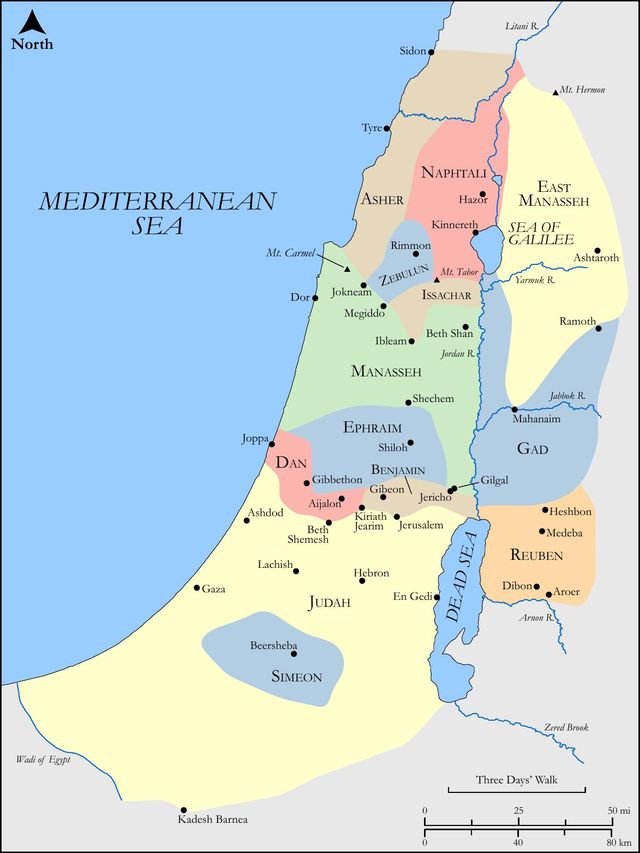
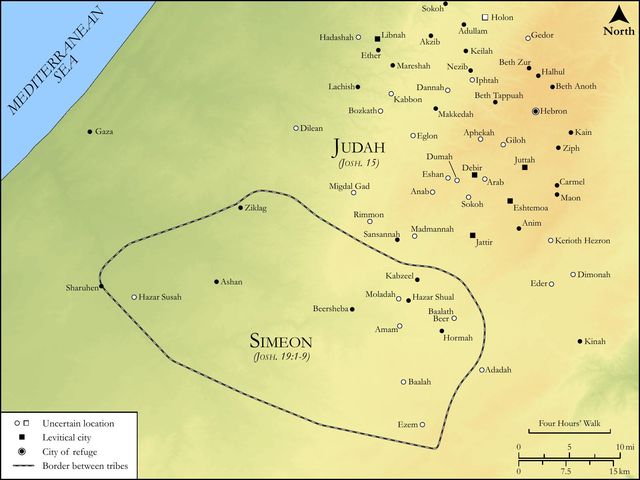
2.That which was thus taken off from Judah to be put into a new lot Providence directed to the tribe of Simeon, that Jacob's prophecy concerning this tribe might be fulfilled, I will divide them in Jacob. The cities of Simeon were scattered in Judah, with which tribe they were surrounded, except on that side towards the sea. This brought them into a confederacy with the tribe of Judah (Jdg 1:3), and afterwards was a happy occasion of the adherence of many of this tribe to the house of David, at the time of the revolt of the ten tribes to Jeroboam. Ch2 15:9, out of Simeon they fell to Asa in abundance. It is good being in a good neighbourhood.
II.The cities within their lot are here named.
Beersheba, or Sheba, for these names seem to refer to the same place, is put first. Ziklag, which we read of in David's story, is one of them. What course they took to enlarge their borders and make room for themselves we find Ch1 4:39, etc.
Continue studying Joshua 19:9 across the web’s major study libraries — every link below opens this exact verse, chapter, or book on the destination site.
Read & Compare
 BibleGatewayThis verse in more than 200 translations and 70 languages.
 Bible.comThe YouVersion reader — hundreds of translations, reading plans, and highlights.
 ESV.orgCrossway's official English Standard Version reader.
 NET BibleThe NET translation with 60,000+ translators' notes on every rendering decision.
 STEP BibleTyndale House's free study tool — original text, vocabulary, and scholarly resources.
 BibliaLogos Bible Software's free web reader.
 USCCBThe New American Bible (Revised Edition) with the U.S. bishops' study notes.
Commentaries
 BibleHub CommentariesDozens of classic commentaries on this verse, gathered on one page.
 StudyLightMore than 100 commentary sets — the largest collection on the web.
 BibleRefPlain-English commentary on what this verse means, verse by verse.
 Enduring WordDavid Guzik's free commentary on this chapter, widely used by Bible teachers.
 Bible Study ToolsVerse commentary alongside Greek and Hebrew study aids.
Original Language & Research
- BibleHub InterlinearThe verse word by word — original language, transliteration, and English.
- BibleHub LexiconEvery word's original-language definition and Strong's entry.
 Blue Letter BibleDeep-study tools — Strong's numbers, concordance, and word studies.
 SefariaThe Hebrew text with Rashi and centuries of Jewish commentary.
Sermons, Hymns & Audio


TrulyRandomVerse is not affiliated with these sites and doesn’t control their content. They’re linked because they’re genuinely useful.
Summary
Joshua 19:9 precisely delineates the land inheritance of the tribe of Simeon, clarifying that their allotted territory was not a distinct, contiguous block but rather comprised cities and surrounding areas carved out from within the larger, initially excessive portion assigned to the tribe of Judah. This unique arrangement served as a pragmatic adjustment to Judah's expansive territory, ensuring a more equitable distribution of the Promised Land and, significantly, fulfilling ancient prophecy regarding Simeon's unique destiny within the nation of Israel.
Context
ShowHideLiterary Context
Joshua 19:9 is situated within the meticulously detailed section of the book of Joshua (chapters 13-21) that chronicles the division of the Promised Land among the twelve tribes of Israel. Following the initial military conquests, this administrative phase was paramount for establishing the tribal identities, their territorial boundaries, and the practical implementation of God's covenant promises. The process, overseen by Joshua, Eleazar the priest, and ten tribal leaders, involved casting lots to determine the general location for each tribe, followed by detailed surveying to define precise borders. This particular verse addresses the second lot drawn (after Judah's), specifically for Simeon, and explains a crucial modification to Judah's initial allocation. It underscores the careful, divinely guided process that ensured every tribe received its inheritance, even when practical adjustments were necessary to optimize settlement and resource management.
Historical & Cultural Context
In ancient Israel, land inheritance was of supreme importance, transcending mere property ownership. It represented a tangible expression of God's covenant faithfulness, the foundation of tribal identity, the source of livelihood, and a perpetual possession passed down through generations. The concept of "too much" land for Judah, the largest and most prominent tribe, likely refers not only to the sheer physical acreage but also to the practical challenges of effectively settling, managing, and defending such a vast territory with their current population. The adjustment for Simeon reflects a pragmatic and divinely guided approach to land distribution, ensuring that resources were allocated efficiently and equitably, preventing any single tribe from being overwhelmed or undersupplied. This also highlights the communal aspect of Israelite society, where adjustments could be made for the common good and the fulfillment of divine purposes.
Key Themes
ShowHideThis verse contributes significantly to several overarching themes in Joshua and the broader Old Testament narrative. Firstly, it powerfully illustrates Divine Providence and Fulfillment of Prophecy. The seemingly administrative detail of Simeon's inheritance being embedded within Judah's territory directly aligns with Jacob's ancient prophetic words concerning Simeon and Levi in Genesis 49:7: "I will divide them in Jacob, and scatter them in Israel." While Levi received no territorial inheritance (only cities), Simeon's portion being interspersed within Judah's effectively scattered them, preventing them from having a distinct, contiguous land mass of their own. Secondly, it underscores God's Meticulous Planning and Faithfulness. Even in the seemingly mundane task of land distribution, God's precise and detailed care for each tribe is evident, demonstrating His unwavering faithfulness to His covenant promises made to Abraham and his descendants. The adjustment for Simeon demonstrates that God's plan accounts for practical realities and ensures equitable, though sometimes unexpected, outcomes for His people. Lastly, it subtly touches upon Inter-Tribal Relationships and Stewardship. Judah's willingness to share from its abundance, presumably with divine guidance, underscores a spirit of cooperation and communal responsibility among the tribes, even as they established their distinct identities and boundaries within the unified nation of Israel.
Exposition and Analysis
ShowHideKey Word Analysis
ShowHideThis term literally refers to a "rope" or "measuring line." By implication, it denotes a measured lot, a portion of land, or an inheritance. In this context, it emphasizes the precise and deliberate nature of the land division, indicating that Simeon's inheritance was a defined, measured segment, even though it was situated within another tribe's larger territory. It highlights the methodical and ordered way God's promises were being fulfilled.
This word signifies "abundant" or "great" in quantity. When applied to Judah's land, it indicates an excess or superabundance beyond what was immediately necessary or manageable for Judah's current population and capacity to settle effectively. It suggests a practical, rather than punitive, reason for the adjustment, implying Judah's initial allocation was disproportionately vast for their immediate needs.
This crucial preposition means "in the midst of," "inside," or "among." Its use here clearly indicates that Simeon's inheritance was not adjacent to Judah's but rather consisted of enclaves or pockets of land situated geographically inside Judah's larger boundaries. This specific spatial arrangement had profound implications for Simeon's future identity, integration, and eventual absorption within the broader tribal structure of Israel.
Verse Breakdown
ShowHide"Out of the portion of the children of Judah [was] the inheritance of the children of Simeon:"
This opening clause immediately establishes the unique source of Simeon's land. Unlike most tribes who received their own distinct, contiguous territory, Simeon's inheritance was not a newly designated area but was derived from, or carved out of, the land already designated for Judah. This sets the stage for understanding the exceptional nature of Simeon's settlement within the Promised Land.
"for the part of the children of Judah was too much for them:"
This provides the divine and practical rationale for the aforementioned arrangement. Judah, being the largest and most influential tribe, had initially received an exceedingly vast territory. This land was deemed "too much" not in a negative sense, but in that it exceeded their immediate capacity to fully occupy, cultivate, and defend. This excess made it practical and necessary to reallocate a portion of it.
"therefore the children of Simeon had their inheritance within the inheritance of them."
This concluding phrase states the direct outcome of Judah's superabundant portion. Because Judah's inheritance was excessive, Simeon's inheritance was strategically placed "within" Judah's boundaries. This meant Simeon did not possess a unified, separate tribal territory, but rather cities and surrounding lands embedded within Judah's larger domain, a geographical reality that profoundly shaped Simeon's future and led to their eventual absorption, thereby fulfilling ancient prophecy.
Literary Devices
ShowHideJoshua 19:9 employs several significant literary techniques. The most prominent is Precision and Detail, which is characteristic of the entire land distribution narrative in Joshua. The meticulous accounting of tribal boundaries and the specific adjustments, such as Simeon's, underscore the divine order and thoroughness in fulfilling God's promises. The verse also functions as Prophetic Fulfillment, subtly referencing and confirming Jacob's ancient prophecy in Genesis 49:7 regarding Simeon's scattering. While not explicitly stated as a direct fulfillment within this verse, the geographical arrangement serves as a clear demonstration of God's sovereign hand guiding historical events to align with His spoken word. Furthermore, the verse highlights Practicality and Divine Accommodation, showing how God's overarching plan is not rigid but accommodates the realities of human population and land management, ensuring fairness and efficient settlement for His people, even through unexpected means.
Theological and Thematic Connections
ShowHideJoshua 19:9 serves as a profound illustration of God's meticulous sovereignty, demonstrating His unwavering faithfulness to His covenant promises and His intricate involvement in the details of His people's lives. The land distribution, though seemingly administrative, was a direct and tangible fulfillment of the Abrahamic covenant, providing a physical inheritance for the nation of Israel. This verse, in particular, showcases how God orchestrates even the practical adjustments to fulfill ancient prophecies, revealing His long-term plan unfolding across generations. It also subtly teaches about the principles of equitable distribution and the responsibilities of those blessed with abundance to share for the common good, fostering unity and interdependence within the community of faith.
Reflection and Application
ShowHideJoshua 19:9, though a seemingly minor detail in the grand narrative of Israel's inheritance, offers profound insights for believers today. It reminds us that God's plans are often intricate and account for details we might overlook or deem insignificant. His meticulous care in distributing the land, even making adjustments like Simeon's, assures us that He is intimately involved in the specifics of our lives, orchestrating circumstances and relationships for His purposes. This verse also subtly teaches about the principle of stewardship and generosity: when God blesses us with "too much" (whether resources, talents, or opportunities), He often intends for us to share from our abundance for the benefit of others and the community. It encourages humility and a willingness to adapt our own plans in alignment with God's broader design, trusting that His provision, even if unexpected or seemingly "scattered," is always perfect and purposefully designed for our good and His glory.
Questions for Reflection
ShowHideFAQ
ShowHideWhy was Judah's portion "too much" for them?
ShowHideJudah's portion was considered "too much" not necessarily because it was physically unmanageable in its entirety, but because it was disproportionately large for their immediate needs and population at the time of the land division. The initial allocation was generous due to Judah's size and prominence, but as the land was surveyed and tribes began to settle, it became evident that Judah could not effectively occupy, cultivate, and defend all of its vast territory. This excess allowed for a practical and divinely guided adjustment, ensuring that Simeon, a smaller tribe, received its inheritance without creating new, unmanageable borders, and simultaneously fulfilling an ancient prophecy regarding Simeon's unique destiny.
What were the long-term implications for Simeon living within Judah?
ShowHideThe long-term implications for Simeon were significant. Living "within" Judah meant they did not possess a distinct, contiguous tribal territory, which was crucial for maintaining a separate tribal identity and political autonomy in ancient Israel. Over time, Simeon's identity largely merged with that of Judah. Historical and archaeological evidence suggests that Simeon's distinct tribal presence diminished, and many of their cities became Judahite. This geographical arrangement led to their effective "scattering" within Israel, preventing them from forming a strong, independent tribal unit, thereby fulfilling Jacob's prophecy in Genesis 49:7 where he declared, "I will divide them in Jacob, and scatter them in Israel." This unique inheritance pattern highlights God's sovereignty over the destinies of nations and tribes.
Christ-Centered Fulfillment
ShowHideJoshua 19:9, with its meticulous detail of land inheritance and prophetic fulfillment, points powerfully to the ultimate and eternal inheritance found in Christ. Just as the land of Canaan was a tangible promise and inheritance for Israel, believers in Christ receive an eternal, spiritual inheritance that is far greater, incorruptible, and unfading (1 Peter 1:4). The "too much" portion of Judah, from which Simeon received its share, can be seen as a shadow of God's superabundant grace and provision in Christ, which is more than sufficient for all who believe and is immeasurable (Ephesians 1:7-8). Furthermore, the scattering of Simeon within Judah's territory, a precise fulfillment of prophecy, foreshadows the divine plan for the "scattering" of the gospel to all nations, gathering a people for God from every tribe and tongue into the one body of Christ (Matthew 28:19; Revelation 7:9). Ultimately, the true and lasting inheritance is not a piece of land, but fellowship with God through Jesus, the Lamb of God, who came from the tribe of Judah (Revelation 5:5), making us co-heirs with Him in His glorious kingdom (Romans 8:17).