


Joshua 19:8
Bible text: King James Version (1769 Blayney text) · Public domain
Bible text: King James Version with Strong's numbers · Public domain
Bible text: Berean Standard Bible · Public domain
Bible text: American Standard Version (1901) · Public domain
Bible text: World English Bible, Messianic edition · Public domain
Bible text: Geneva Bible (1599) · Public domain
Bible text: Young's Literal Translation · Public domain
- וְכָלve·kholand allH3605Conj-w ¦ N-mscNoun Singular Masculine Constructוְandכָלall
- הַחֲצֵרִיםha·cha·tze·Rimthe villagesH2691Art ¦ N-mpNoun Plural Masculine Absoluteהַtheחֲצֵרִיםvillages
- אֲשֶׁר'a·SherwhichH834RelParticle Relative
- סְבִיבוֹתse·vi·Vot[were] aroundH5439N-cpcNoun Plural common gender Construct
- הֶעָרִיםhe·'a·Rimthe citiesH5892Art ¦ N-mpNoun Plural Masculine Absoluteהֶtheעָרִיםcities
- הָאֵלֶּהha·'E·leh<the> theseH428Art ¦ PrtParticle Demonstrativeהָ<the>אֵלֶּהthese
- עַד'adtoH5704PrepPreposition
- בַּעֲלַתba·'a·LatBaalathH1192N-properNoun Proper Location
- בְּאֵרbe·'ErBeerH1192N-properNoun Proper Location
- רָאמַתRa·matof RamahH7414N-fscNoun Singular Feminine Construct
- נֶגֶבNe·gevNegevH5045N-properNoun Proper Location
- זֹאתZotthisH2063PrtParticle Demonstrative
- נַחֲלַתna·cha·Lat[was] [the] inheritance ofH5159N-fscNoun Singular Feminine Construct
- מַטֵּהma·Teh[the] tribe ofH4294N-mscNoun Singular Masculine Construct
- בְנֵיve·nei[the] descendants ofH1121N-mpcNoun Plural Masculine Construct
- שִׁמְעוֹןshim·'onSimeonH8095N-proper-mNoun Proper Masculine
- לְמִשְׁפְּחֹתָםle·mish·pe·cho·Tamto their clansH4940Prep-l ¦ N-fpc ¦ 3mpNoun Plural Feminine Constructלְtoמִשְׁפְּחֹתָclansםtheir
English is a literal word-by-word gloss of the Hebrew, not the KJV's wording. Why?
This is the original text the KJV's translators worked from — each Hebrew word with its own literal English meaning in this verse, prepared by scholars at Tyndale House, Cambridge. The KJV translates whole sentences, not word by word, so its wording differs: one Hebrew word can become several English words, and the KJV may choose “the LORD” where the gloss reads “Yahweh”. Both are faithful — they answer different questions. For the KJV's own rendering, switch to the KJV text.
Details
See on the biblical-era maps
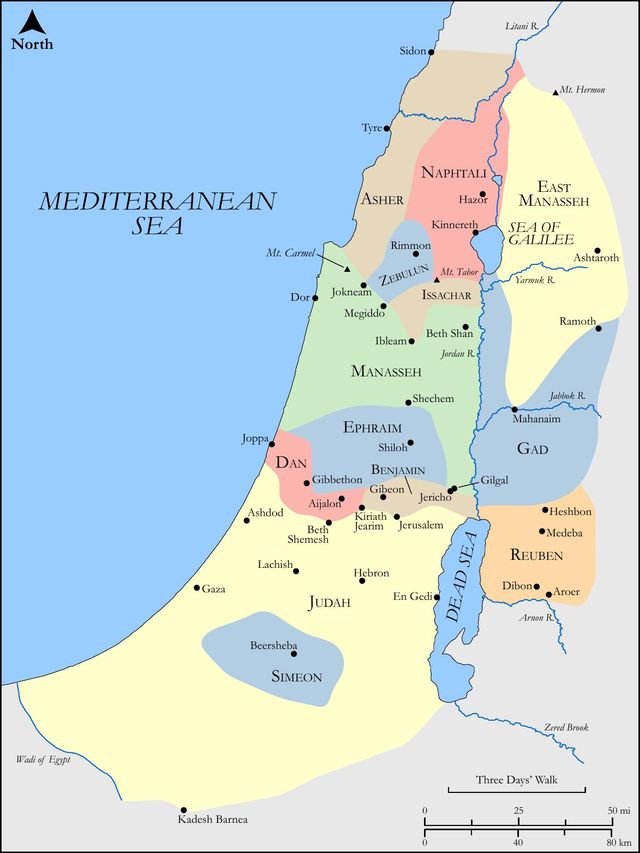
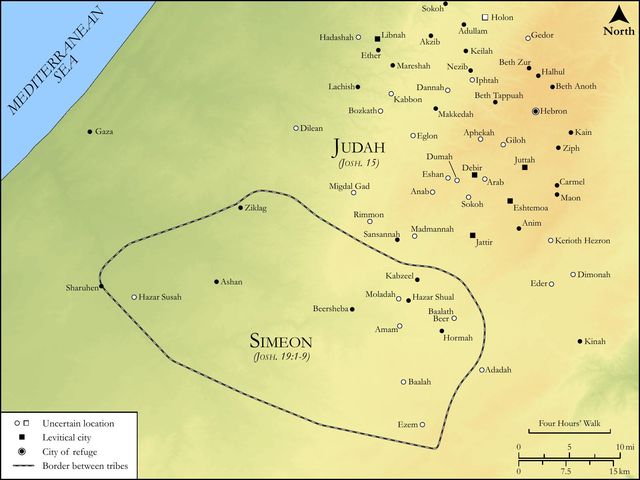
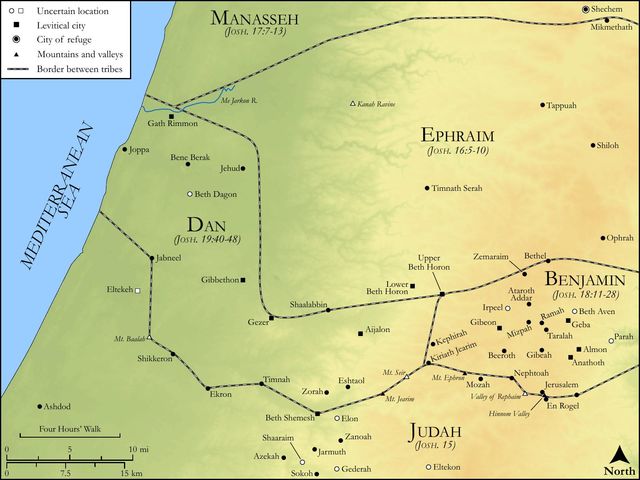
Study this verse
Public-domain commentary
Matthew Henry
From his Commentary on the Whole Bible. Henry comments on passages, not single verses — this entry covers Joshua 19:1–9. His two-level outline is real structure in the source text, so it is rendered as structure.
Simeon's lot was drawn after Judah's, Joseph's, and Benjamin's, because Jacob had put that tribe under disgrace; yet it is put before the two younger sons of Leah and the three sons of the handmaids. Not one person of note, neither judge nor prophet, was of this tribe, that we know of.
I.The situation of their lot was within that of Judah (Jos 19:1) and was taken from it, Jos 19:9.
It seems, those that first surveyed the land thought it larger than it was, and that it would have held out to give every tribe in proportion as large a share as they had carved out for Judah; but, upon a more strict enquiry, it was found that it would not reach (Jos 19:9): The part of the children of Judah was too much for them, more than they needed, and more, as it proved, than fell to their share. Yet God did not by the lot lessen it, but left it to their prudence and care afterwards to discover and rectify the mistake, which when they did,
1.The men of Judah did not oppose the taking away of the cities again, which by the first distribution fell within their border, when they were convinced that they had more than their proportion. In all such cases errors must be excepted and a review admitted if there be occasion. Though, in strictness, what fell to their lot was their right against all the world, yet they would not insist upon it when it appeared that another tribe would want what they had to spare. Note, We must look on the things of others, and not on our own only. The abundance of some must supply the wants of others, that there may be somewhat of an equality, for which there may be equity where there is not law.
2.That which was thus taken off from Judah to be put into a new lot Providence directed to the tribe of Simeon, that Jacob's prophecy concerning this tribe might be fulfilled, I will divide them in Jacob. The cities of Simeon were scattered in Judah, with which tribe they were surrounded, except on that side towards the sea. This brought them into a confederacy with the tribe of Judah (Jdg 1:3), and afterwards was a happy occasion of the adherence of many of this tribe to the house of David, at the time of the revolt of the ten tribes to Jeroboam. Ch2 15:9, out of Simeon they fell to Asa in abundance. It is good being in a good neighbourhood.
II.The cities within their lot are here named.
Beersheba, or Sheba, for these names seem to refer to the same place, is put first. Ziklag, which we read of in David's story, is one of them. What course they took to enlarge their borders and make room for themselves we find Ch1 4:39, etc.
Continue studying Joshua 19:8 across the web’s major study libraries — every link below opens this exact verse, chapter, or book on the destination site.
Read & Compare
 BibleGatewayThis verse in more than 200 translations and 70 languages.
 Bible.comThe YouVersion reader — hundreds of translations, reading plans, and highlights.
 ESV.orgCrossway's official English Standard Version reader.
 NET BibleThe NET translation with 60,000+ translators' notes on every rendering decision.
 STEP BibleTyndale House's free study tool — original text, vocabulary, and scholarly resources.
 BibliaLogos Bible Software's free web reader.
 USCCBThe New American Bible (Revised Edition) with the U.S. bishops' study notes.
Commentaries
 BibleHub CommentariesDozens of classic commentaries on this verse, gathered on one page.
 StudyLightMore than 100 commentary sets — the largest collection on the web.
 BibleRefPlain-English commentary on what this verse means, verse by verse.
 Enduring WordDavid Guzik's free commentary on this chapter, widely used by Bible teachers.
 Bible Study ToolsVerse commentary alongside Greek and Hebrew study aids.
Original Language & Research
- BibleHub InterlinearThe verse word by word — original language, transliteration, and English.
- BibleHub LexiconEvery word's original-language definition and Strong's entry.
 Blue Letter BibleDeep-study tools — Strong's numbers, concordance, and word studies.
 SefariaThe Hebrew text with Rashi and centuries of Jewish commentary.
Sermons, Hymns & Audio


TrulyRandomVerse is not affiliated with these sites and doesn’t control their content. They’re linked because they’re genuinely useful.
Summary
Joshua 19:8 serves as a definitive conclusion to the list of Simeon's cities within the detailed account of Simeon's tribal inheritance (19:1-9), specifying that their allotted territory encompassed not only the previously enumerated cities but also "all the villages that were round about these cities." This verse meticulously defines the geographical extent of their portion, reaching to precise landmarks such as Baalathbeer and Ramath of the south, and emphatically reiterates that this distribution was "according to their families," thereby underscoring the divinely ordained, meticulous, and familial basis of God's provision for His covenant people.
Context
ShowHideLiterary Context
This verse provides the concluding summary for the specific enumeration of cities and their dependent villages assigned to the tribe of Simeon, a detailed list found in Joshua 19:2-7. It is situated within the broader section of the book of Joshua (chapters 13-19) that meticulously records the division of the Promised Land among the twelve tribes of Israel following their initial conquests. Simeon's inheritance is distinct in that it is explicitly stated to be "within the inheritance of the children of Judah" (Joshua 19:1), indicating that their portion consisted of enclaves or cities with their dependent villages rather than a contiguous block of land. Joshua 19:8 functions as a final, definitive declaration of the full scope of Simeon's portion, bringing a conclusive statement to the list of cities in their specific allotment narrative, which the next verse closes by noting that Simeon's portion lay within Judah's, before the text transitions to describe Zebulun's territory.
Historical & Cultural Context
The division of the land was a foundational act for the nascent Israelite nation, establishing their identity, economy, and social structure as a settled people. Land ownership was paramount, serving as the basis for tribal and family identity, economic stability, and the fulfillment of God's covenant promises. Simeon's unique placement within Judah's vast territory is often understood in light of Jacob's prophetic words in Genesis 49:7, where he declared, "I will divide them in Jacob, and scatter them in Israel." While Levi was scattered throughout Israel as a priestly tribe, Simeon's scattering manifested geographically, leading to their eventual absorption into the larger tribe of Judah. The mention of "villages" (Hebrew: ḥaṣērîm) highlights the ancient agricultural and pastoral economy, where fortified cities served as administrative and defensive centers, but the surrounding unwalled settlements and fields were essential for daily life and sustenance, providing the necessary resources for survival and prosperity.
Key Themes
ShowHideThe meticulous detailing of land boundaries and inheritances throughout Joshua, including this verse, underscores several profound theological and narrative themes. Firstly, it powerfully demonstrates Divine Providence and Fulfillment, showcasing God's unwavering faithfulness in bringing to pass His ancient promises to Abraham, Isaac, and Jacob regarding the land of Canaan. Every boundary, every city, and every village was divinely ordained, testifying to God's sovereign control over history and geography. Secondly, it emphasizes Tribal Identity and Inheritance, highlighting the importance of the familial unit ("according to their families") as the basis for land distribution, which secured the long-term social and economic stability of each clan. Despite Simeon's unusual placement, their designated territory was clearly delineated and secured by divine decree. Finally, the entire process of land distribution, from the largest tribes to the smallest, illustrates God's Orderly Plan and Justice, ensuring that every tribe received its due portion "according to their families," preventing disputes and establishing a just foundation for the nation, as also outlined in Numbers 26:54.
Exposition and Analysis
ShowHideKey Word Analysis
ShowHideThis term refers to unwalled settlements or hamlets that were dependent on a nearby fortified city. Their explicit inclusion in Simeon's inheritance indicates that the tribe's portion encompassed not just the named urban centers but also the full agricultural and pastoral lands and smaller communities associated with them. This ensured the tribe had sufficient resources for sustenance and growth beyond the confines of city walls, vital for their economic viability.
Literally "Mistress of a well." This place name likely indicates a site with a significant water source, possibly associated with a local deity (Baal) before Israelite possession. In this context, it functions as a precise geographical marker, defining the extent or a specific boundary point of Simeon's territory. Such precise markers were crucial for delineating tribal lands in ancient Israel, preventing future disputes.
Properly something inherited, i.e., occupancy, or an heirloom; generally an estate, patrimony or portion. This word underscores the fundamental concept of the land as a divinely given, permanent possession passed down through families. It signifies not merely temporary occupation but a secure, hereditary right to the land, forming the economic and social bedrock of the Israelite tribal system and fulfilling God's covenant promises.
Verse Breakdown
ShowHide"And all the villages that [were] round about these cities"
This clause significantly expands the scope of Simeon's inheritance beyond the specific fortified cities listed in the preceding verses (Joshua 19:2-7). It clarifies that the tribal allotment included not just the urban centers but also their surrounding satellite communities, agricultural lands, and pastures. This comprehensive inclusion was vital for the economic viability and self-sufficiency of the tribe, providing essential resources for their livelihood.
"to Baalathbeer, Ramath of the south"
These phrases function as geographical termini or boundary markers. They specify the precise extent of the territory, indicating that the inheritance stretched to these named locations. This precision underscores the meticulous nature of the land distribution, leaving no ambiguity regarding the divinely appointed boundaries and ensuring a clear demarcation of tribal lands.
"This [is] the inheritance of the tribe of the children of Simeon according to their families"
This final statement serves as a definitive summary and confirmation. It reiterates that the described territory constitutes the complete and official inheritance for Simeon. The crucial phrase "according to their families" highlights that the land was not merely given to the tribe as a whole, but was meticulously divided among the individual family units within Simeon, ensuring equitable distribution and establishing the foundational basis for their social and economic life for generations.
Literary Devices
ShowHideJoshua 19:8, as an integral part of a larger section detailing tribal allotments, employs several significant literary devices. Enumeration is evident throughout the preceding verses of the chapter, with this verse serving as the culminating item in the list of Simeon's cities and territories. The verse itself functions as a powerful Summary Statement, providing a concise and authoritative wrap-up of Simeon's portion after the preceding detailed enumeration. The inclusion of specific geographical names like Baalathbeer and Ramath of the south serves as precise Geographical Markers, anchoring the abstract concept of "inheritance" to concrete, identifiable locations. This precision emphasizes the tangible and divinely ordained nature of the land distribution. Furthermore, the recurring phrase "according to their families" (or similar phrasing throughout Joshua) acts as a form of Repetition, reinforcing the underlying principle of familial ownership and the meticulous, equitable division of the land based on tribal and clan structures.
Theological and Thematic Connections
ShowHideJoshua 19:8, though seemingly a dry geographical detail, is profoundly theological in its implications. It underscores God's meticulous faithfulness in fulfilling His ancient covenant promises to Abraham and his descendants regarding the land of Canaan. The precise delineation of "villages" and specific boundary markers like Baalathbeer and Ramath of the south reveals a God who is not vague but precise in His provision and sovereign in His distribution. This verse affirms that every detail of the Promised Land's apportionment was part of God's perfect plan, ensuring that each tribe, and indeed each family within the tribe, received its divinely appointed portion. Even for Simeon, whose inheritance was uniquely situated within Judah, God's promise was meticulously fulfilled, demonstrating His unwavering commitment to His people and His covenant.
Reflection and Application
ShowHideThe detailed account of Simeon's inheritance, including its villages and specific boundaries, serves as a powerful reminder of God's meticulous care and unwavering faithfulness. Just as He precisely allocated land to each tribe and family, down to the surrounding villages and specific geographical markers, He continues to have a specific plan and purpose for each individual and community today. This verse encourages us to trust implicitly in God's sovereign design, even when our "placement" or circumstances seem unique or challenging, as Simeon's was within the larger territory of Judah. Our "inheritance" in Christ, though spiritual rather than geographical, is equally secure and divinely appointed, a testament to God's unwavering commitment to His children. We are called to live faithfully within the "boundaries" God has set for us, recognizing that His provision is always sufficient and perfectly tailored to our needs, enabling us to thrive and bear fruit in the unique place and calling He has given us.
Questions for Reflection
ShowHideFAQ
ShowHideWhy was Simeon's inheritance within Judah's territory, unlike other tribes?
ShowHideSimeon's inheritance was unique because it was allotted from within the vast territory given to the larger tribe of Judah, rather than being a distinct, contiguous block of land. This arrangement is often understood as a fulfillment of Jacob's prophetic words in Genesis 49:7, where he declared that Simeon and Levi would be "divided in Jacob, and scattered in Israel." While Levi was scattered throughout Israel as a priestly tribe with no single land inheritance, Simeon's "scattering" manifested as enclaves within Judah. This unique placement likely reflected Simeon's smaller population size relative to Judah, and historically, it led to Simeon's gradual absorption into the identity and territory of Judah over time. It highlights God's sovereignty even in the specific, sometimes challenging, circumstances of tribal life, demonstrating His faithful, albeit sometimes surprising, fulfillment of His word.
What is the significance of the phrase "according to their families" in the context of land distribution?
ShowHideThe phrase "according to their families" (or similar variations like "according to their clans" or "according to their numbers") is crucial throughout the land distribution narrative in Joshua and Numbers. It emphasizes the fundamental principle that the land was not merely given to the tribe as a whole, but was meticulously divided among the individual family units within each tribe. This ensured that every family had a secure, hereditary possession, which was vital for their economic stability, social identity, and the long-term preservation of the tribal structure. It prevented land from being concentrated in the hands of a few and guaranteed that future generations would inherit their ancestral portion, reflecting God's commitment to justice and order within His covenant people. This principle is clearly articulated in passages like Numbers 26:54, which states, "To the more you shall give the more inheritance, and to the fewer you shall give the less inheritance; to each according to those who were numbered of them shall their inheritance be given."
Christ-Centered Fulfillment
ShowHideThe meticulous detail of Simeon's inheritance in Joshua 19:8, with its designated cities, villages, and precise boundaries, points forward to the ultimate and perfect inheritance found in Jesus Christ. The physical land of Canaan, a place of rest and provision for Israel, was a tangible shadow of the spiritual and eternal rest and inheritance that believers receive in Christ. Just as Simeon's portion was divinely appointed and secured, our spiritual inheritance is guaranteed by God's unwavering faithfulness, not through geographical boundaries but through our union with Christ. He is the true "Promised Land," the one in whom all God's promises find their "Yes" and "Amen" (2 Corinthians 1:20). Through His atoning work, we are given an "inheritance that is imperishable, undefiled, and unfading, kept in heaven for you" (1 Peter 1:4). Our "place" is not merely in a physical territory but profoundly "in Christ," where we are made "heirs of God and fellow heirs with Christ" (Romans 8:17). The meticulous distribution to Simeon, even within Judah, foreshadows God's perfect plan to gather all His chosen ones into the ultimate, eternal rest and dwelling place prepared by the Lord Jesus Himself (John 14:2), fulfilling the deepest longings for security, identity, and belonging that the land inheritance could only partially satisfy.