


Joshua 19:1
Bible text: King James Version (1769 Blayney text) · Public domain
Bible text: King James Version with Strong's numbers · Public domain
Bible text: Berean Standard Bible · Public domain
Bible text: American Standard Version (1901) · Public domain
Bible text: World English Bible, Messianic edition · Public domain
Bible text: Geneva Bible (1599) · Public domain
Bible text: Young's Literal Translation · Public domain
- וַיֵּצֵאvai·ye·Tze'and it came outH3318Conj-w ¦ V-Qal-ConsecImperf-3msVerb Qal Consecutive Imperfect 3rd Singular Masculineוַandיֵּצֵאit came out
- הַגּוֹרָלha·go·Ralthe lotH1486Art ¦ N-msNoun Singular Masculine Absoluteהַtheגּוֹרָלlot
- הַשֵּׁנִיha·she·Ni<the> secondH8145Art ¦ Adj-msAdjective Numerical Position Singular Masculine Absoluteהַ<the>שֵּׁנִיsecond
- לְשִׁמְעוֹןle·shim·'onfor SimeonH8095Prep-l ¦ N-proper-mNoun Proper MasculineלְforשִׁמְעוֹןSimeon
- לְמַטֵּהle·ma·Tehfor [the] tribe ofH4294Prep-l ¦ N-mscNoun Singular Masculine Constructלְforמַטֵּה[the] tribe of
- בְנֵיve·nei[the] descendants ofH1121N-mpcNoun Plural Masculine Construct
- שִׁמְעוֹןshim·'onSimeonH8095N-proper-mNoun Proper Masculine
- לְמִשְׁפְּחוֹתָםle·mish·pe·cho·Tamto their clansH4940Prep-l ¦ N-fpc ¦ 3mpNoun Plural Feminine Constructלְtoמִשְׁפְּחוֹתָclansםtheir
- וַיְהִיvay·Hiand it wasH1961Conj-w ¦ V-Qal-ConsecImperf-3msVerb Qal Consecutive Imperfect 3rd Singular Masculineוַandיְהִיit was
- נַחֲלָתָםna·cha·la·Tamtheir inheritanceH5159N-fsc ¦ 3mpNoun Singular Feminine Constructנַחֲלָתָinheritanceםtheir
- בְּתוֹךְbe·Tokhin [the] midst ofH8432Prep-b ¦ N-mscNoun Singular Masculine Constructבְּinתוֹךְ[the] midst of
- נַחֲלַתna·cha·Lat[the] inheritance ofH5159N-fscNoun Singular Feminine Construct
- בְּנֵיbe·nei[the] descendants ofH1121N-mpcNoun Plural Masculine Construct
- יְהוּדָהye·hu·DahJudahH3063N-properNoun Proper Location
English is a literal word-by-word gloss of the Hebrew, not the KJV's wording. Why?
This is the original text the KJV's translators worked from — each Hebrew word with its own literal English meaning in this verse, prepared by scholars at Tyndale House, Cambridge. The KJV translates whole sentences, not word by word, so its wording differs: one Hebrew word can become several English words, and the KJV may choose “the LORD” where the gloss reads “Yahweh”. Both are faithful — they answer different questions. For the KJV's own rendering, switch to the KJV text.
Details
See on the biblical-era maps
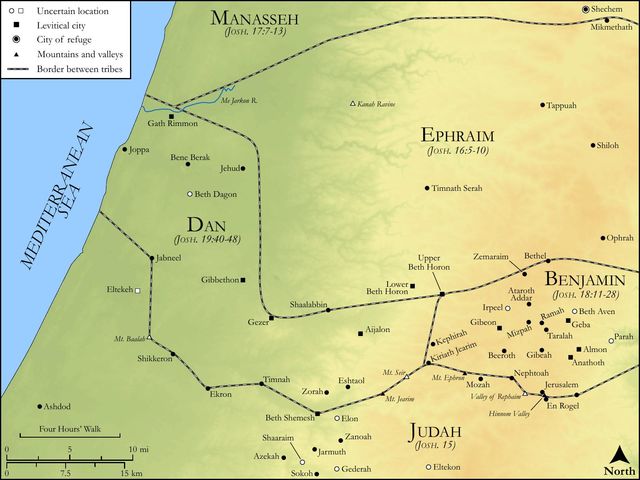
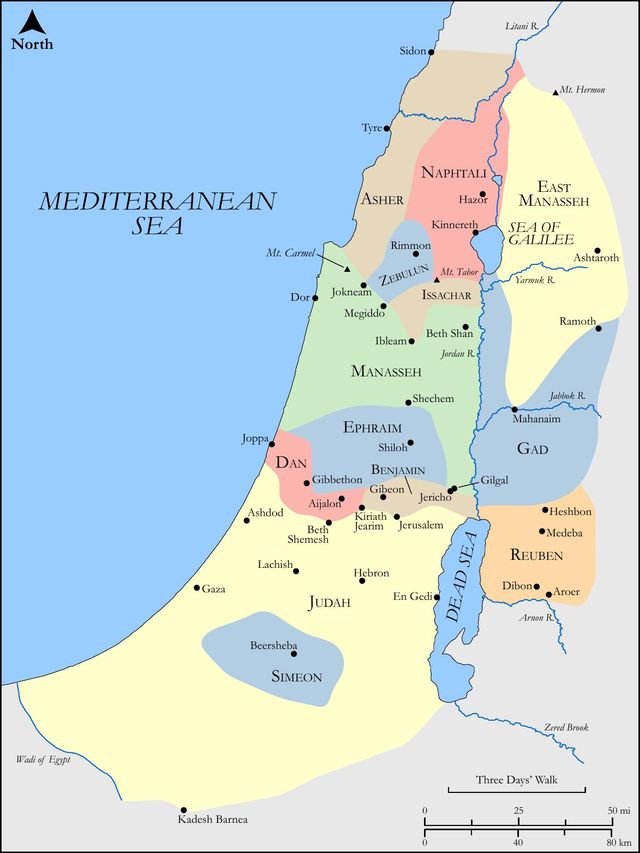
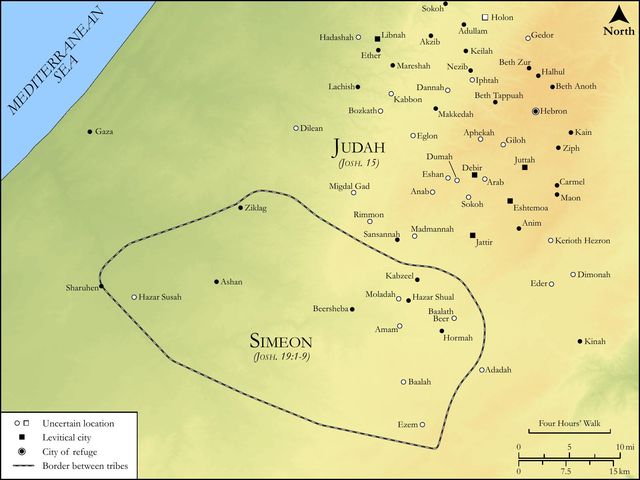
Study this verse
Public-domain commentary
Matthew Henry
From his Commentary on the Whole Bible. Henry comments on passages, not single verses — this entry covers Joshua 19:1–9. His two-level outline is real structure in the source text, so it is rendered as structure.
Simeon's lot was drawn after Judah's, Joseph's, and Benjamin's, because Jacob had put that tribe under disgrace; yet it is put before the two younger sons of Leah and the three sons of the handmaids. Not one person of note, neither judge nor prophet, was of this tribe, that we know of.
I.The situation of their lot was within that of Judah (Jos 19:1) and was taken from it, Jos 19:9.
It seems, those that first surveyed the land thought it larger than it was, and that it would have held out to give every tribe in proportion as large a share as they had carved out for Judah; but, upon a more strict enquiry, it was found that it would not reach (Jos 19:9): The part of the children of Judah was too much for them, more than they needed, and more, as it proved, than fell to their share. Yet God did not by the lot lessen it, but left it to their prudence and care afterwards to discover and rectify the mistake, which when they did,
1.The men of Judah did not oppose the taking away of the cities again, which by the first distribution fell within their border, when they were convinced that they had more than their proportion. In all such cases errors must be excepted and a review admitted if there be occasion. Though, in strictness, what fell to their lot was their right against all the world, yet they would not insist upon it when it appeared that another tribe would want what they had to spare. Note, We must look on the things of others, and not on our own only. The abundance of some must supply the wants of others, that there may be somewhat of an equality, for which there may be equity where there is not law.
2.That which was thus taken off from Judah to be put into a new lot Providence directed to the tribe of Simeon, that Jacob's prophecy concerning this tribe might be fulfilled, I will divide them in Jacob. The cities of Simeon were scattered in Judah, with which tribe they were surrounded, except on that side towards the sea. This brought them into a confederacy with the tribe of Judah (Jdg 1:3), and afterwards was a happy occasion of the adherence of many of this tribe to the house of David, at the time of the revolt of the ten tribes to Jeroboam. Ch2 15:9, out of Simeon they fell to Asa in abundance. It is good being in a good neighbourhood.
II.The cities within their lot are here named.
Beersheba, or Sheba, for these names seem to refer to the same place, is put first. Ziklag, which we read of in David's story, is one of them. What course they took to enlarge their borders and make room for themselves we find Ch1 4:39, etc.
Continue studying Joshua 19:1 across the web’s major study libraries — every link below opens this exact verse, chapter, or book on the destination site.
Read & Compare
 BibleGatewayThis verse in more than 200 translations and 70 languages.
 Bible.comThe YouVersion reader — hundreds of translations, reading plans, and highlights.
 ESV.orgCrossway's official English Standard Version reader.
 NET BibleThe NET translation with 60,000+ translators' notes on every rendering decision.
 STEP BibleTyndale House's free study tool — original text, vocabulary, and scholarly resources.
 BibliaLogos Bible Software's free web reader.
 USCCBThe New American Bible (Revised Edition) with the U.S. bishops' study notes.
Commentaries
 BibleHub CommentariesDozens of classic commentaries on this verse, gathered on one page.
 StudyLightMore than 100 commentary sets — the largest collection on the web.
 BibleRefPlain-English commentary on what this verse means, verse by verse.
 Enduring WordDavid Guzik's free commentary on this chapter, widely used by Bible teachers.
 Bible Study ToolsVerse commentary alongside Greek and Hebrew study aids.
Original Language & Research
- BibleHub InterlinearThe verse word by word — original language, transliteration, and English.
- BibleHub LexiconEvery word's original-language definition and Strong's entry.
 Blue Letter BibleDeep-study tools — Strong's numbers, concordance, and word studies.
 SefariaThe Hebrew text with Rashi and centuries of Jewish commentary.
Sermons, Hymns & Audio


TrulyRandomVerse is not affiliated with these sites and doesn’t control their content. They’re linked because they’re genuinely useful.
Summary
Joshua 19:1 marks the commencement of the land distribution for the remaining seven tribes of Israel, specifically detailing the inheritance allocated to the tribe of Simeon. This verse reveals a distinctive arrangement: Simeon's portion was not a contiguous, independent territory but was instead situated entirely "within" the expansive inheritance already designated to the tribe of Judah. This unique geographical placement underscores a significant departure from the typical tribal allocations, hinting at Simeon's future trajectory and its deep interconnectedness with, and eventual absorption into, its more dominant southern neighbor.
Context
ShowHideLiterary Context
Joshua 19:1 is strategically placed within the latter half of the Book of Joshua (chapters 13-21), which meticulously chronicles the division of the Promised Land among the twelve tribes of Israel. Following the initial major allocations to Reuben, Gad, the half-tribe of Manasseh, Judah, Ephraim, and the other half-tribe of Manasseh (Joshua 13-18), this verse initiates the distribution for the remaining seven tribes. The preceding chapters describe the establishment of the central sanctuary at Shiloh and the meticulous process of surveying the land and casting lots under Joshua's supervision. Thus, Joshua 19:1 serves as a pivotal transition, shifting the narrative focus from the larger, more prominent tribal inheritances to the specific, often more intricate, portions of the remaining tribes, with Simeon being the first among them to receive its lot. This systematic approach highlights the orderly fulfillment of God's promises.
Historical & Cultural Context
The division of the land by lot was a profoundly significant act in ancient Israel, understood not as a random chance but as a divinely guided process for discerning God's will and ensuring a just and equitable distribution. This method underscored God's sovereign hand in fulfilling His ancient covenant promises to Abraham, Isaac, and Jacob that their descendants would indeed inherit the land of Canaan, as articulated in Proverbs 16:33. For an Israelite tribe, land ownership was absolutely foundational to their identity, economic security, and the perpetuation of their covenant relationship with Yahweh. Simeon's unique placement "within" Judah's territory was highly unusual and carried profound implications for its future. This arrangement suggests a degree of dependence rather than independent tribal strength, reflecting not only divine decree but also the historical realities of tribal power dynamics, demographic size, and alliances in the nascent Israelite nation.
Key Themes
ShowHideJoshua 19:1 powerfully contributes to several overarching themes woven throughout the Book of Joshua and the broader Pentateuch. Foremost among these is Divine Faithfulness, demonstrating God's unwavering commitment to His ancient covenant promises to provide a land for His people, a promise reiterated from the call of Abraham (e.g., Genesis 12:7). The casting of the lot emphatically highlights Divine Sovereignty, illustrating that God, not human strategy or military might, determined the precise boundaries, relationships, and destinies of the tribes, even in seemingly unconventional arrangements like Simeon's. Furthermore, Simeon's specific inheritance within Judah's territory serves as a remarkable Fulfillment of Prophecy, particularly Jacob's ancient pronouncement in Genesis 49:7, where he declared that Simeon and Levi would be "divided in Jacob and scattered in Israel." While Levi was scattered as the priestly tribe without a contiguous land inheritance, Simeon's land absorption into Judah's territory directly led to its eventual diminishment and integration, showcasing God's intricate and precise working of His prophetic word across generations.
Exposition and Analysis
ShowHideKey Word Analysis
ShowHideThis term refers to a small object, typically a pebble or stone, cast or drawn to determine a decision or outcome. In the biblical context, especially concerning the division of the land, the "lot" was understood not as a random chance but as a divinely guided mechanism through which God's will was revealed and His sovereign plan executed. It underscored that the land distribution was divinely ordained, not based on human negotiation, military conquest, or tribal preference, thus emphasizing God's ultimate authority over the land and its allocation.
More than mere property or possession, nachălâh signifies a divinely given possession, a legacy, or an enduring portion passed down. For the tribes of Israel, their inheritance in the land of Canaan represented the tangible fulfillment of God's covenant promises to their forefathers. It was considered a permanent, inalienable gift from God, symbolizing their identity, security, and their unique covenant relationship with Him. The concept extends beyond the physical land to encompass a spiritual legacy.
This preposition is critically important in Joshua 19:1, indicating inclusion, enclosure, or the center of something. The phrase "within the inheritance of the children of Judah" is highly significant because it denotes that Simeon's territory was not merely contiguous or adjacent to Judah's but was geographically embedded or enclosed within Judah's much larger boundaries. This unique arrangement points to Simeon's lesser status, its lack of independent territorial integrity, and foreshadows its eventual absorption into the dominant tribe of Judah, rather than maintaining a distinct and separate tribal identity.
Verse Breakdown
ShowHide"And the second lot came forth to Simeon"
This initial clause immediately establishes the divine nature of the land allocation process. The "lot" signifies God's sovereign choice and direct involvement in assigning territory to each tribe. Simeon is identified as the recipient of the "second" lot among the group of seven remaining tribes, highlighting its turn in the systematic and orderly fulfillment of God's promise to provide land for His people. This underscores the intentionality behind the distribution.
"[even] for the tribe of the children of Simeon according to their families"
This specification clarifies that the allocation was for the entire tribe of Simeon, meticulously delineated by its constituent families. This detail emphasizes the equitable and thorough nature of the land division, ensuring that each family unit within the tribe received its rightful portion. It reflects the profound importance of familial lineage and tribal structure in Israelite society and the principle of inherited land tenure.
"and their inheritance was within the inheritance of the children of Judah"
This is the most distinctive and impactful part of the verse, revealing the extraordinary geographical arrangement for Simeon. Unlike other tribes that received their own distinct, contiguous territories, Simeon's land was not separate but was enclosed by or embedded within the much larger territory of Judah. This unique placement was highly unusual and foreshadowed Simeon's future historical trajectory, characterized by a lack of independent strength, eventual integration, or even absorption into its more powerful neighbor, Judah.
Literary Devices
ShowHideThe verse employs Foreshadowing by subtly hinting at Simeon's future. The placement of Simeon's inheritance "within" Judah's territory is not merely a geographical detail but a prophetic indicator of Simeon's eventual decline, diminishment, and absorption. This arrangement directly fulfills Jacob's ancient and somewhat ominous prophecy concerning Simeon in Genesis 49:7. This geographical detail also functions as Symbolism, where the physical land allocation symbolizes the spiritual and historical destiny of the tribe. The land, a tangible representation of God's promise and covenant faithfulness, here also symbolizes the inter-tribal dynamics and the consequences of past actions. Furthermore, the casting of the lot itself is a profound literary and theological device demonstrating Divine Sovereignty, emphasizing that God is the ultimate director of events, meticulously orchestrating even the seemingly mundane act of land distribution to accomplish His overarching purposes.
Theological and Thematic Connections
ShowHideJoshua 19:1 profoundly illustrates the intricate outworking of God's sovereign plan and His unwavering faithfulness to His covenant promises. The precise, divinely ordained placement of Simeon's inheritance, even within the territory of Judah, underscores that no detail of God's will is arbitrary or left to chance. It highlights how God orchestrates circumstances, even those seemingly disadvantageous or unconventional from a human perspective, to fulfill His ancient prophetic declarations and to shape the destiny of His people. This verse reminds us that God's promises are not only broad in scope but also meticulously detailed, impacting individual tribal identities and inter-tribal relationships within the larger tapestry of Israel's history, all according to His perfect wisdom.
Reflection and Application
ShowHideJoshua 19:1 offers a powerful and counter-intuitive lesson in trusting God's sovereign plan, especially when our "inheritance" or life circumstances appear unexpected, unconventional, or less prominent than what we might envision for ourselves or others. Simeon's story reminds us that God works out His purposes not always through independent strength or expansive autonomy, but sometimes through interdependence, integration, and even a degree of diminishment for a greater, overarching divine design. It challenges us to embrace our unique place within God's larger community, recognizing that our individual journeys are often intricately intertwined with others, and that God's faithfulness extends to every detail of our lives, fulfilling His promises in ways we may not initially comprehend. Just as Simeon found its place within the greater inheritance of Israel, we are called to find our ultimate purpose, security, and identity within the body of Christ, trusting that our true and eternal inheritance is securely found in Him, regardless of our earthly circumstances.
Questions for Reflection
ShowHideFAQ
ShowHideWhy was Simeon's inheritance placed within Judah's territory?
ShowHideSimeon's unique placement within Judah's territory is widely understood as a direct and remarkable fulfillment of Jacob's ancient prophecy in Genesis 49:7, where he declared that Simeon and Levi would be "divided in Jacob and scattered in Israel." While Levi was scattered throughout Israel as the priestly tribe without a distinct land inheritance, Simeon's land was absorbed into Judah's, leading to its eventual diminishment and integration. Historically, Simeon was a smaller tribe, as evidenced by the census of Numbers 26:14, and likely lacked the military and demographic strength to secure and maintain a fully independent territory. Its placement within Judah's larger, more powerful domain provided a measure of protection and resources, but ultimately led to its loss of distinct tribal identity over time, aligning perfectly with the prophetic word.
What happened to the tribe of Simeon later in Israel's history?
ShowHideFollowing the initial land allocation described in Joshua, the tribe of Simeon gradually lost its distinct identity and was largely absorbed into the more dominant tribe of Judah. While they initially cooperated with Judah in some conquests (e.g., Judges 1:3-4), Simeon is rarely mentioned as an independent entity in later biblical narratives. Their territory effectively became part of Judah's, and the Simeonites are often simply counted with Judah or disappear from the historical record as a separate tribal force. This historical trajectory, marked by a lack of independent political and military power, aligns perfectly with the prophetic implications of their initial land inheritance being "within" Judah, foreshadowing their eventual integration and loss of unique tribal prominence.
Christ-Centered Fulfillment
ShowHideThe inheritance of the land in Joshua, culminating in verses like Joshua 19:1, serves as a powerful type pointing forward to the ultimate and eternal inheritance found in Jesus Christ. Just as the physical land was a tangible fulfillment of God's promise to Israel, Christ Himself is the true and ultimate inheritance for all believers, a spiritual reality far surpassing any earthly territory or tribal portion. Simeon's unique placement within Judah's inheritance foreshadows the profound truth that all who are "in Christ" are spiritually grafted into the lineage of Judah, the royal tribe from which the Messiah came. Our spiritual inheritance is not a separate parcel, but is found entirely "within" Christ, who is our peace, our righteousness, our wisdom, and our complete portion (Ephesians 1:3-14 and Colossians 1:12). The fragmented, often diminished, and temporary earthly inheritances of the tribes find their glorious and secure fulfillment in the indivisible and eternal kingdom of God, inaugurated by the Lamb of God, who takes away the sin of the world (John 1:29). In Christ, all God's promises find their "Yes" and "Amen" (2 Corinthians 1:20), providing a secure and eternal dwelling place for all who believe, not based on tribal lot or earthly lineage, but on divine grace and perfect redemption.