


Joshua 19:2
Bible text: King James Version (1769 Blayney text) · Public domain
Bible text: King James Version with Strong's numbers · Public domain
Bible text: Berean Standard Bible · Public domain
Bible text: American Standard Version (1901) · Public domain
Bible text: World English Bible, Messianic edition · Public domain
Bible text: Geneva Bible (1599) · Public domain
Bible text: Young's Literal Translation · Public domain
- וַיְהִיvay·Hiand it belongedH1961Conj-w ¦ V-Qal-ConsecImperf-3msVerb Qal Consecutive Imperfect 3rd Singular Masculineוַandיְהִיit belonged
- לָהֶםla·Hemto <the> themPrep-l ¦ 3mpSuffix Personal 3rd Plural Masculineלָto <the>הֶםthem
- בְּנַחֲלָתָםbe·na·cha·la·Tam<in> their inheritanceH5159Prep-b ¦ N-fsc ¦ 3mpNoun Singular Feminine Constructבְּ<in>נַחֲלָתָinheritanceםtheir
- בְּאֵרbe·'erBeerH884N-properNoun Proper Location
- שֶׁבַעShe·va'ShebaH884N-properNoun Proper Location
- וְשֶׁבַעve·She·va'and ShebaH7652Conj-w ¦ N-properNoun Proper LocationוְandשֶׁבַעSheba
- וּמוֹלָדָהu·mo·la·Dahand MoladahH4137Conj-w ¦ N-properNoun Proper LocationוּandמוֹלָדָהMoladah
English is a literal word-by-word gloss of the Hebrew, not the KJV's wording. Why?
This is the original text the KJV's translators worked from — each Hebrew word with its own literal English meaning in this verse, prepared by scholars at Tyndale House, Cambridge. The KJV translates whole sentences, not word by word, so its wording differs: one Hebrew word can become several English words, and the KJV may choose “the LORD” where the gloss reads “Yahweh”. Both are faithful — they answer different questions. For the KJV's own rendering, switch to the KJV text.
Details
See on the biblical-era maps
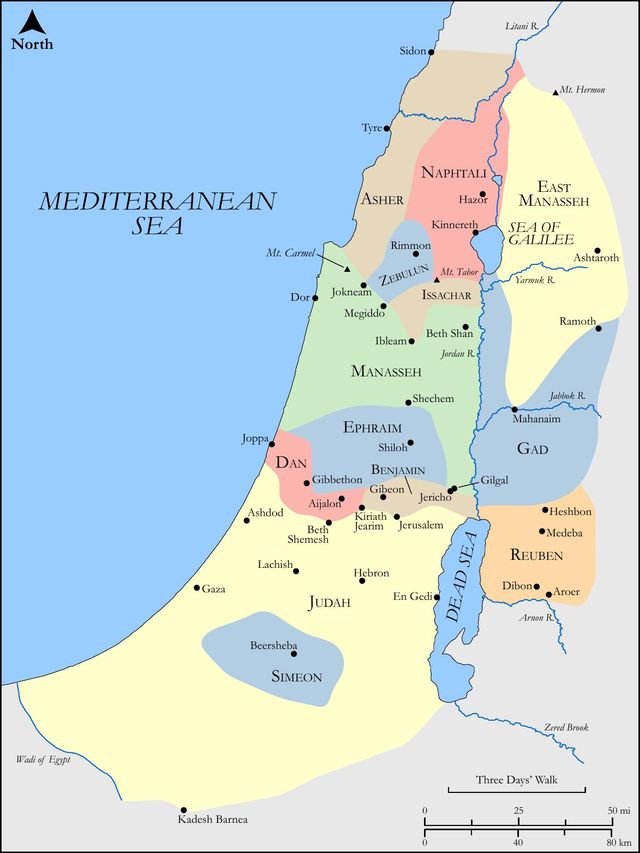
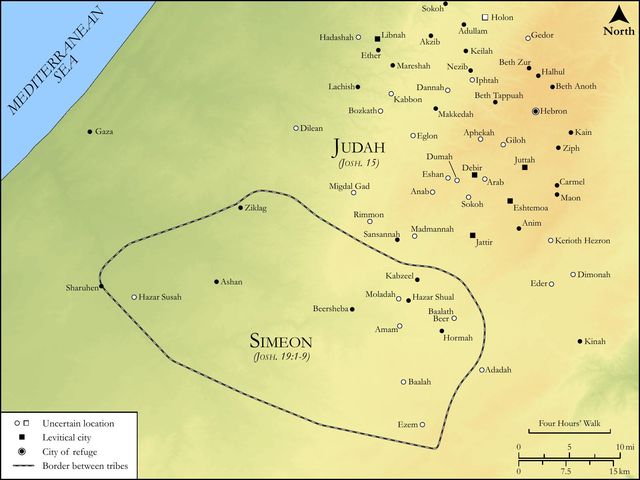
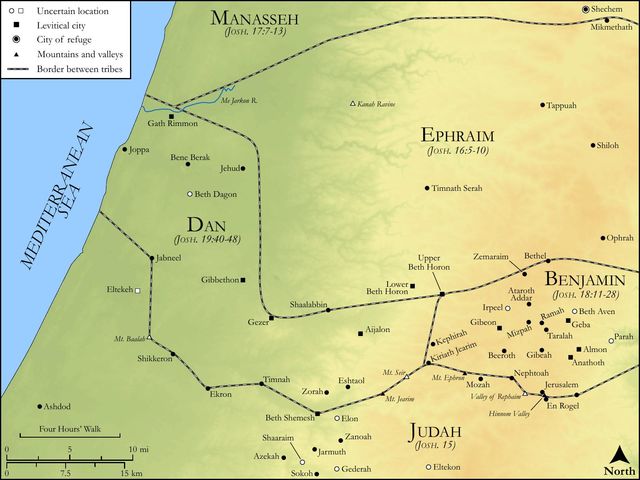
Study this verse
Public-domain commentary
Matthew Henry
From his Commentary on the Whole Bible. Henry comments on passages, not single verses — this entry covers Joshua 19:1–9. His two-level outline is real structure in the source text, so it is rendered as structure.
Simeon's lot was drawn after Judah's, Joseph's, and Benjamin's, because Jacob had put that tribe under disgrace; yet it is put before the two younger sons of Leah and the three sons of the handmaids. Not one person of note, neither judge nor prophet, was of this tribe, that we know of.
I.The situation of their lot was within that of Judah (Jos 19:1) and was taken from it, Jos 19:9.
It seems, those that first surveyed the land thought it larger than it was, and that it would have held out to give every tribe in proportion as large a share as they had carved out for Judah; but, upon a more strict enquiry, it was found that it would not reach (Jos 19:9): The part of the children of Judah was too much for them, more than they needed, and more, as it proved, than fell to their share. Yet God did not by the lot lessen it, but left it to their prudence and care afterwards to discover and rectify the mistake, which when they did,
1.The men of Judah did not oppose the taking away of the cities again, which by the first distribution fell within their border, when they were convinced that they had more than their proportion. In all such cases errors must be excepted and a review admitted if there be occasion. Though, in strictness, what fell to their lot was their right against all the world, yet they would not insist upon it when it appeared that another tribe would want what they had to spare. Note, We must look on the things of others, and not on our own only. The abundance of some must supply the wants of others, that there may be somewhat of an equality, for which there may be equity where there is not law.
2.That which was thus taken off from Judah to be put into a new lot Providence directed to the tribe of Simeon, that Jacob's prophecy concerning this tribe might be fulfilled, I will divide them in Jacob. The cities of Simeon were scattered in Judah, with which tribe they were surrounded, except on that side towards the sea. This brought them into a confederacy with the tribe of Judah (Jdg 1:3), and afterwards was a happy occasion of the adherence of many of this tribe to the house of David, at the time of the revolt of the ten tribes to Jeroboam. Ch2 15:9, out of Simeon they fell to Asa in abundance. It is good being in a good neighbourhood.
II.The cities within their lot are here named.
Beersheba, or Sheba, for these names seem to refer to the same place, is put first. Ziklag, which we read of in David's story, is one of them. What course they took to enlarge their borders and make room for themselves we find Ch1 4:39, etc.
Continue studying Joshua 19:2 across the web’s major study libraries — every link below opens this exact verse, chapter, or book on the destination site.
Read & Compare
 BibleGatewayThis verse in more than 200 translations and 70 languages.
 Bible.comThe YouVersion reader — hundreds of translations, reading plans, and highlights.
 ESV.orgCrossway's official English Standard Version reader.
 NET BibleThe NET translation with 60,000+ translators' notes on every rendering decision.
 STEP BibleTyndale House's free study tool — original text, vocabulary, and scholarly resources.
 BibliaLogos Bible Software's free web reader.
 USCCBThe New American Bible (Revised Edition) with the U.S. bishops' study notes.
Commentaries
 BibleHub CommentariesDozens of classic commentaries on this verse, gathered on one page.
 StudyLightMore than 100 commentary sets — the largest collection on the web.
 BibleRefPlain-English commentary on what this verse means, verse by verse.
 Enduring WordDavid Guzik's free commentary on this chapter, widely used by Bible teachers.
 Bible Study ToolsVerse commentary alongside Greek and Hebrew study aids.
Original Language & Research
- BibleHub InterlinearThe verse word by word — original language, transliteration, and English.
- BibleHub LexiconEvery word's original-language definition and Strong's entry.
 Blue Letter BibleDeep-study tools — Strong's numbers, concordance, and word studies.
 SefariaThe Hebrew text with Rashi and centuries of Jewish commentary.
Sermons, Hymns & Audio


TrulyRandomVerse is not affiliated with these sites and doesn’t control their content. They’re linked because they’re genuinely useful.
Summary
Joshua 19:2 meticulously delineates a specific segment of the tribal inheritance allotted to Simeon within the Promised Land, identifying the cities of Beersheba, Sheba, and Moladah. This verse, embedded within the broader account of land distribution, powerfully underscores God's unwavering faithfulness in fulfilling His ancient covenant promises to Israel, demonstrating His sovereign provision and meticulous care in establishing His chosen people securely within the territory He had sworn to bestow upon them.
Context
ShowHideLiterary Context
Joshua 19:2 is situated within the latter portion of the book of Joshua, specifically within the detailed accounts of land distribution to the remaining seven tribes of Israel (Joshua 18-19). Following the initial allotments to Judah, Ephraim, and Manasseh, this chapter focuses on the territories assigned by lot at Shiloh. The unique aspect of Simeon's inheritance, introduced in Joshua 19:1, is that its territory was carved out from within the larger portion of the tribe of Judah. This arrangement is not merely a geographical detail but carries significant theological weight, reflecting earlier prophetic utterances regarding Simeon's future. The precise enumeration of cities, including Beersheba, Sheba, and Moladah, provides concrete evidence of the meticulous fulfillment of God's promises and the systematic execution of the land distribution, signaling the completion of the conquest phase and the beginning of Israel's settled life.
Historical & Cultural Context
The period immediately following the conquest of Canaan involved the monumental and complex task of transitioning a formerly nomadic people into a settled, agrarian society. The division of territory was paramount for establishing tribal identity, ensuring economic stability, and solidifying a national presence in the land. Beersheba, listed first, held profound historical and cultural significance, frequently serving as a prominent southern landmark and often marking the extreme southern boundary of Israel ("from Dan to Beersheba"). It was a site deeply associated with the patriarchs, where Abraham dug a well and made a covenant and Isaac also settled and built an altar. The inclusion of "Sheba" alongside Beersheba, possibly as an alternative name or a closely associated satellite settlement, highlights the interconnectedness of ancient towns. The entire process of land allocation was understood as a divinely orchestrated act, ensuring that each tribe received its designated portion according to God's sovereign plan, even for tribes like Simeon, whose inheritance was integrated into another's, perhaps due to their relatively smaller size or as a fulfillment of the prophecy found in Genesis 49:7.
Key Themes
ShowHideThis verse, and the broader context of Joshua 19, powerfully illustrates several key theological themes. Foremost is Divine Faithfulness, as God meticulously fulfills His ancient covenant promise to Abraham to give his descendants the land of Canaan. The detailed enumeration of cities serves as tangible proof of this faithfulness, demonstrating God's commitment to His word. Another prominent theme is Sovereign Order and Provision. God's precise organization in allocating specific cities to each tribe, even down to the individual towns within Simeon's portion, underscores His meticulous care for His people and His ability to provide for their every need. The unique placement of Simeon's inheritance within Judah's territory also highlights the theme of Prophetic Fulfillment, specifically Jacob's pronouncement that Simeon and Levi would be "divided in Jacob, and scattered in Israel". This verse thus contributes to the overarching narrative of God's covenant-keeping character and His detailed orchestration of Israel's destiny.
Exposition and Analysis
ShowHideKey Word Analysis
ShowHideFrom the root meaning "to inherit," this term properly refers to something inherited, signifying occupancy, an heirloom, or generally an estate, patrimony, or portion. In the context of the Promised Land, "inheritance" is a deeply theological concept, representing a permanent, divinely bestowed possession that secures a tribe's identity, future, and place within God's covenant people. It emphasizes that the land was not merely conquered but was a gracious gift from God, fulfilling His ancient promises.
Meaning "well of an oath" or "well of seven," Beersheba was a highly significant landmark in ancient Israel, often marking its southern border. Its name reflects its patriarchal history, where covenants were made and wells were dug by Abraham and Isaac. Its inclusion in Simeon's inheritance ties the tribal land distribution directly to the foundational narratives of Israel's patriarchs, grounding the present fulfillment in the historical acts of God.
Derived from a root meaning "to be born" or "birth," this city's name means "birth" or "nativity." It is another specific location allotted to Simeon. Its inclusion, alongside the more famous Beersheba, emphasizes the precise and detailed nature of the land distribution, ensuring that Simeon, despite its unique integration into Judah's territory, received a clearly defined and identifiable inheritance, demonstrating God's meticulous provision even for the smaller, less prominent settlements.
Verse Breakdown
ShowHide"And they had in their inheritance"
This opening phrase refers to the tribe of Simeon, indicating the formal, divinely sanctioned possession of land. The term "inheritance" (Hebrew: nachălâh) is crucial, signifying a permanent, God-given possession that secured the tribe's identity and future within the Promised Land. It highlights that their claim to this land was not merely by conquest but by divine decree and covenant promise, underscoring God's active role in establishing His people.
"Beersheba, or Sheba"
This clause names the most significant city in Simeon's initial allotment. The conjunction "or" (Hebrew: 'o) presents two main interpretations: either "Sheba" is an alternative or shorter name for Beersheba itself, implying a single, highly important location referred to by two names; or it refers to a distinct, but closely associated, satellite town or settlement near Beersheba. In either case, Beersheba's historical and strategic importance as a southern frontier city, rich with patriarchal associations, made it a cornerstone of Simeon's portion, linking their present possession to the foundational promises of God.
"and Moladah"
This final clause lists another specific town within Simeon's inheritance. The precise enumeration of towns like Moladah, alongside the more prominent Beersheba, further emphasizes the meticulous nature of the land division. It demonstrates God's detailed provision, ensuring that even a tribe whose inheritance was intertwined with another's received a clear and distinct set of designated cities, leaving no ambiguity regarding their divinely appointed territory.
Literary Devices
ShowHideThe primary literary device at play in Joshua 19:2, and indeed throughout the land distribution chapters, is Cataloging or Enumeration. The detailed listing of cities and boundaries serves to underscore the tangible and precise fulfillment of God's promises. This meticulous inventory provides a sense of authenticity and historical accuracy, demonstrating that the inheritance was not vague but concretely defined, leaving no doubt as to the divine execution of the covenant. Another significant device is Geographical Specificity, which grounds the theological narrative in real-world locations, making God's faithfulness observable and verifiable. The mention of Beersheba also employs Allusion, referencing the rich patriarchal history associated with that location, thereby connecting the present fulfillment of the land promise directly to the foundational covenant narratives of Abraham and Isaac. The consistent pattern of listing cities and boundaries across the various tribal allotments also creates a sense of Repetition, reinforcing the overarching themes of divine order, comprehensive provision, and the undeniable reality of God's covenant-keeping character.
Theological and Thematic Connections
ShowHideJoshua 19:2, though a seemingly mundane listing of cities, is profoundly theological. It stands as a testament to God's unwavering faithfulness to His covenant promises, particularly the Abrahamic covenant to give the land of Canaan to Abraham's descendants. The meticulous detail in the land distribution, even for a tribe like Simeon whose inheritance was uniquely situated within Judah's larger territory, reveals God's sovereign hand in orchestrating every aspect of His people's lives and destiny. It demonstrates that God's promises are not vague generalities but specific, tangible realities that He brings to pass with precision and care. This verse also implicitly highlights the theme of divine provision, showing how God ensures that each part of His people receives its due portion, confirming His commitment to their well-being, security, and identity within the land.
Reflection and Application
ShowHideThe detailed account of Simeon's inheritance, including the specific cities listed in Joshua 19:2, offers profound lessons for contemporary believers. It reminds us that God is a God of meticulous detail and unfailing faithfulness. Just as He precisely fulfilled His promise to provide an inheritance for each tribe, He also cares for the intricate details of our lives, orchestrating circumstances and providing for our needs according to His perfect plan. Even when our "inheritance" or path seems unconventional, or intertwined with others, like Simeon's within Judah, we can trust in God's sovereign design. This passage encourages us to look for and appreciate the specific provisions and blessings God has given us, recognizing them as part of His divine blueprint for our lives. It invites us to rest in the assurance that the God who meticulously divided a land is the same God who orders our steps, provides for our daily bread, and ensures our ultimate good, working all things together for those who love Him.
Questions for Reflection
ShowHideFAQ
ShowHideWhy was Simeon's inheritance within the territory of Judah?
ShowHideSimeon's unique inheritance within Judah's territory is generally understood as a fulfillment of Jacob's prophetic words concerning Simeon and Levi in Genesis 49:7. Jacob declared that they would be "divided in Jacob, and scattered in Israel." While Levi was scattered through the Levitical cities, Simeon's inheritance within Judah's larger territory, rather than a distinct, contiguous region, effectively dispersed them among a larger tribe. This arrangement may also reflect Simeon's relatively smaller population size compared to other tribes, making a separate large territory impractical, or it could have been a strategic integration for mutual defense and support, highlighting God's sovereign plan even in seemingly disadvantageous situations.
What is the significance of "Beersheba, or Sheba" in this verse?
ShowHideThe phrase "Beersheba, or Sheba" highlights the importance of this region to Simeon's inheritance. The Hebrew word או ('o), translated as "or," can indicate either an alternative name for the same place (i.e., Beersheba was also known as Sheba) or that Sheba was a distinct, but very closely associated, satellite settlement or suburb of Beersheba. In either case, Beersheba itself was a historically vital city, deeply connected to the patriarchs Abraham and Isaac, and often marked the southern boundary of Israel. Its inclusion underscores the deep roots of Simeon's inheritance in the land's sacred history and its strategic importance.
Does this detailed listing of ancient cities have any relevance for believers today?
ShowHideAbsolutely. While the specific geographical details might seem remote, the underlying theological principles are timeless and profoundly relevant. This meticulous cataloging underscores God's unwavering faithfulness to His promises. Just as He precisely fulfilled His word to Israel concerning the land, He is faithful to His promises to us in Christ. It also demonstrates God's meticulous care and sovereign order; He is a God who pays attention to the details, ensuring that His plans are perfectly executed. This should inspire confidence and trust in His provision and guidance in our own lives, reminding us that He works out all things according to His perfect will, even the seemingly small or mundane details, for the good of those who love Him.
Christ-Centered Fulfillment
ShowHideThe earthly inheritance of land described in Joshua 19:2, meticulously divided among the tribes of Israel, serves as a profound foreshadowing of the spiritual inheritance believers receive in Christ. Just as the physical land was a tangible fulfillment of God's covenant promises to Abraham's descendants, so too is the spiritual inheritance in Christ the ultimate and eternal fulfillment of God's redemptive plan for humanity. Our true "place" and "portion" are not found in geographical boundaries or tribal allotments, but in being "in Christ" and part of His spiritual kingdom, which transcends earthly limitations. Through His perfect life, atoning death, and glorious resurrection, Jesus has secured for us an "inheritance that is imperishable, undefiled, and unfading, kept in heaven for you" (1 Peter 1:4). This eternal inheritance, which includes "every spiritual blessing in the heavenly places" (Ephesians 1:3), is not earned by human effort but is a gracious gift, guaranteed by the indwelling Holy Spirit as our "guarantee of our inheritance until we acquire possession of it" (Ephesians 1:14). Thus, the precise detail of Joshua 19:2, far from being merely historical, points us to the infinitely more glorious and secure inheritance that is ours through the finished work of Jesus Christ, the ultimate fulfillment of all God's promises and the true "Promised Land" for all who believe.