


Nehemiah 11:30
Bible text: King James Version (1769 Blayney text) · Public domain
Bible text: King James Version with Strong's numbers · Public domain
Bible text: Berean Standard Bible · Public domain
Bible text: American Standard Version (1901) · Public domain
Bible text: World English Bible, Messianic edition · Public domain
Bible text: Geneva Bible (1599) · Public domain
Bible text: Young's Literal Translation · Public domain
- זָנֹחַza·No·achZanoahH2182N-properNoun Proper Location
- עֲדֻלָּם'a·du·LamAdullamH5725N-properNoun Proper Location
- וְחַצְרֵיהֶםve·chatz·rei·Hemand their villagesH2691Conj-w ¦ N-mpc ¦ 3mpNoun Plural Masculine Constructוְandחַצְרֵיvillagesהֶםtheir
- לָכִישׁla·KhishLachishH3923N-properNoun Proper Location
- וּשְׂדֹתֶיהָu·se·do·Tei·haand its fieldsH7704Conj-w ¦ N-fpc ¦ 3fsNoun Plural Feminine Constructוּandשְׂדֹתֶיfieldsהָits
- עֲזֵקָה'a·ze·KahAzekahH5825N-properNoun Proper Location
- וּבְנֹתֶיהָu·ve·no·Tei·haand its daughtersH1323Conj-w ¦ N-fpc ¦ 3fsNoun Plural Feminine Constructוּandבְנֹתֶיdaughtersהָits
- וַיַּחֲנוּvai·ya·cha·Nuand they encampedH2583Conj-w ¦ V-Qal-ConsecImperf-3mpVerb Qal Consecutive Imperfect 3rd Plural Masculineוַandיַּחֲנוּthey encamped
- מִבְּאֵרmi·be·'erfrom BeerH884Prep-m ¦ N-properNoun Proper LocationמִfromבְּאֵרBeer
- שֶׁבַעShe·va'ShebaH884N-properNoun Proper Location
- עַד'adtoH5704PrepPreposition
- גֵּיאgei'[the] valley of [Ben]H1516N-cscNoun Singular common gender Construct
- הִנֹּםhi·NomHinnomH2011N-properNoun Proper Location
English is a literal word-by-word gloss of the Hebrew, not the KJV's wording. Why?
This is the original text the KJV's translators worked from — each Hebrew word with its own literal English meaning in this verse, prepared by scholars at Tyndale House, Cambridge. The KJV translates whole sentences, not word by word, so its wording differs: one Hebrew word can become several English words, and the KJV may choose “the LORD” where the gloss reads “Yahweh”. Both are faithful — they answer different questions. For the KJV's own rendering, switch to the KJV text.
Details
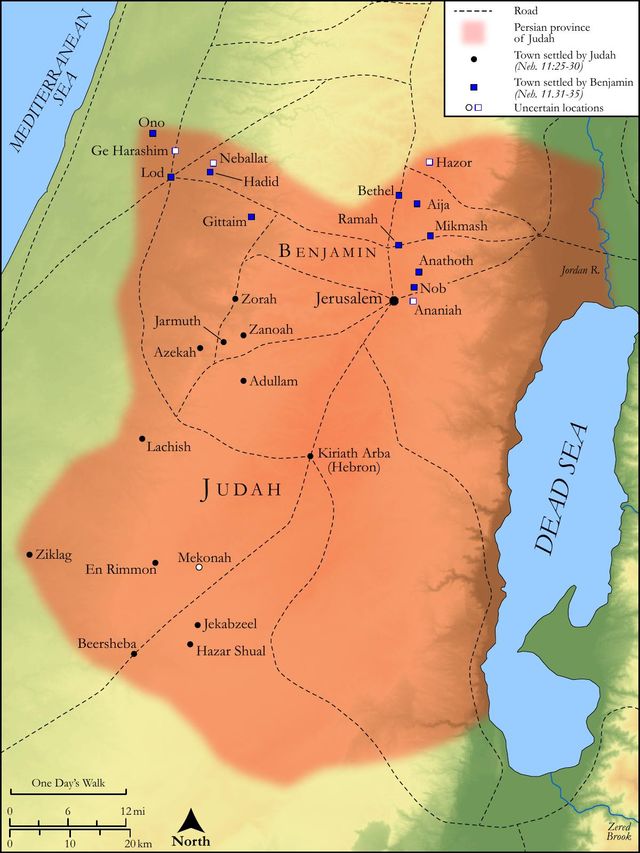
See on the biblical-era map
Study this verse
Public-domain commentary
Matthew Henry
From his Commentary on the Whole Bible. Henry comments on passages, not single verses — this entry covers Nehemiah 11:20–36.
Having given an account of the principal persons that dwelt in Jerusalem (a larger account of whom he had before, Ch1 9:2, etc.), Nehemiah, in these verses, gives us some account of the other cities, in which dwelt the residue of Israel, Neh 11:20. It was requisite that Jerusalem should be replenished, yet not so as to drain the country. The king himself is served of the field, which will do little service if there be not hands to manage it. Let there therefore be no strife, no envy, no contempt, no ill will, between the inhabitants of the cities and those of the villages; both are needful, both useful, and neither can be spared. 1. The Nethinims, the posterity of the Gibeonites, dwelt in Ophel, which was upon the wall of Jerusalem (Neh 3:26), because they were to do the servile work of the temple, which therefore they must be posted near to, that they might be ready to attend, Neh 11:21. 2. Though the Levites were dispersed through the cities of Judah, yet they had an overseer who resided in Jerusalem, superior of their order and their provincial, to whom they applied for direction, who took care of their affairs and took cognizance of their conduct, whether they did their duty, Neh 11:22. 3. Some of the singers were appointed to look after the necessary repairs of the temple, being ingenious men, and having leisure between their hours of service; they were over the business of the house of God, Neh 11:22. And, it seems, the king of Persia had such a kindness for their office that he allotted a particular maintenance for them, besides what belonged to them as Levites, Neh 11:23. 4. Here is one that was the king's commissioner at Jerusalem. He was of the posterity of Zerah (Neh 11:24); for of that family of Judah there were some new settled in Jerusalem, and not all of Pharez, as appears by that other catalogue, Ch1 9:6. He is said to be at the king's hand, or on the king's part, in all matters concerning the people, to determine controversies that arose between the king's officers and his subjects, to see that what was due to the king from the people was duly paid in and what was allowed by the king for the temple service was duly paid out, and happy it was for the Jews that one of themselves was in this post. 5. Here is an account of the villages, or country towns, which were inhabited by the residue of Israel - the towns in which the children of Judah dwelt (Neh 11:25-30), those that were inhabited by the children of Benjamin (Neh 11:31-35), and divisions for the Levites among both, Neh 11:36. We will now suppose them safe and easy, though few and poor, but by the blessing of God they were likely to increase in wealth and power, and they would have been more likely if there had not been that general profaneness among them, and lukewarmness in religion, with which they were charged in God's name by the prophet Malachi, who, it is supposed, prophesied about this time, and in whom prophecy ceased for some ages, till it revived in the great prophet and his forerunner.
Continue studying Nehemiah 11:30 across the web’s major study libraries — every link below opens this exact verse, chapter, or book on the destination site.
Read & Compare
 BibleGatewayThis verse in more than 200 translations and 70 languages.
 Bible.comThe YouVersion reader — hundreds of translations, reading plans, and highlights.
 ESV.orgCrossway's official English Standard Version reader.
 NET BibleThe NET translation with 60,000+ translators' notes on every rendering decision.
 STEP BibleTyndale House's free study tool — original text, vocabulary, and scholarly resources.
 BibliaLogos Bible Software's free web reader.
 USCCBThe New American Bible (Revised Edition) with the U.S. bishops' study notes.
Commentaries
 BibleHub CommentariesDozens of classic commentaries on this verse, gathered on one page.
 StudyLightMore than 100 commentary sets — the largest collection on the web.
 BibleRefPlain-English commentary on what this verse means, verse by verse.
 Enduring WordDavid Guzik's free commentary on this chapter, widely used by Bible teachers.
 Bible Study ToolsVerse commentary alongside Greek and Hebrew study aids.
Original Language & Research
- BibleHub InterlinearThe verse word by word — original language, transliteration, and English.
- BibleHub LexiconEvery word's original-language definition and Strong's entry.
 Blue Letter BibleDeep-study tools — Strong's numbers, concordance, and word studies.
 SefariaThe Hebrew text with Rashi and centuries of Jewish commentary.
Sermons, Hymns & Audio


TrulyRandomVerse is not affiliated with these sites and doesn’t control their content. They’re linked because they’re genuinely useful.
Summary
Nehemiah 11:30 offers a precise geographical enumeration of the towns and their surrounding areas in the southern Shephelah and southern Judah that were reoccupied by the returned exiles. This verse, embedded within a larger census in Nehemiah 11, vividly illustrates the meticulous and comprehensive efforts undertaken to repopulate the ancestral lands after the Babylonian captivity. It signifies the tangible re-establishment of the Jewish community across historically significant territories, from the traditional southern boundary of Beersheba to the immediate vicinity of Jerusalem, thereby underscoring the faithful fulfillment of God's covenant promises regarding the land and His people's return.
Context
ShowHideLiterary Context
Nehemiah 11 meticulously chronicles the crucial repopulation efforts for Jerusalem and the surrounding Judean towns following the completion and dedication of the city walls. After the profound spiritual renewal and covenant reaffirmation detailed in Nehemiah 8-10, a practical necessity arose: securing and sustaining Jerusalem by ensuring a sufficient population within its newly fortified boundaries. The chapter commences by describing the method for selecting Jerusalem's residents—a combination of casting lots and voluntary commitment (Nehemiah 11:1-2). Subsequently, verses Nehemiah 11:3-24 provide a detailed roster of the families and leaders who settled in the capital, organized by tribal affiliation and priestly/Levitical roles. The focus then shifts in Nehemiah 11:25-36 to enumerate the other towns and villages throughout Judah and Benjamin where the remaining Israelites settled. Verse 30 is an integral part of this latter section, specifically identifying key settlements in the southern part of Judah, thereby emphasizing the widespread and systematic nature of the post-exilic return and re-establishment across the land.
Historical & Cultural Context
The events depicted in Nehemiah unfold during the mid-5th century BCE, a period when Judea was a province within the vast Persian Empire. Following the initial wave of returnees under Zerubbabel and Jeshua, as documented in Ezra 2, and the subsequent rebuilding of the Second Temple, Jerusalem and its surrounding territories remained sparsely populated, vulnerable to external threats, and economically fragile. Nehemiah's divinely appointed mission, sanctioned by Artaxerxes I, was to rebuild Jerusalem's defensive walls and revitalize its civic and spiritual life. The repopulation of the land was paramount not only for strategic defense but also for economic stability, the reassertion of Jewish identity, and the reclaiming of their ancestral inheritance. The towns listed in Nehemiah 11:30—Zanoah, Adullam, Lachish, and Azekah—were historically significant locations situated in the Shephelah, the vital lowlands bridging the Judean mountains and the coastal plain. These areas were strategically crucial, often serving as border strongholds and agricultural hubs. Their reoccupation symbolized a profound act of reclaiming vital territory that had been desolate or under foreign dominion since the Babylonian conquest, powerfully demonstrating the community's resilience and God's sovereign hand in their restoration.
Key Themes
ShowHideNehemiah 11:30 profoundly contributes to several overarching themes central to the book of Nehemiah and the broader post-exilic prophetic and historical literature. Firstly, it vividly illustrates the theme of Restoration and Repopulation, showcasing the tangible re-establishment of the Jewish people in their promised land after the devastating trauma of exile. This meticulous listing of towns underscores the faithful fulfillment of prophetic promises concerning the return of the exiles, as articulated in passages like Jeremiah 32:44. Secondly, the verse's Geographical Specificity, from the named towns to the sweeping description "from Beersheba unto the valley of Hinnom," powerfully emphasizes the concrete reality of the return and the re-establishment of the community across historical Judah. This precise detail highlights God's unwavering faithfulness to His covenant land promises, ensuring His people would once again dwell securely in their inheritance. Lastly, the entire process, including the formidable challenges of resettlement and the eventual success, points unequivocally to Divine Providence. Despite immense opposition, logistical complexities, and human frailty, the ability of the exiles to return, rebuild, and resettle their land stands as a profound testament to God's enduring faithfulness in preserving His people and orchestrating their future, as promised in Deuteronomy 30:3-5.
Exposition and Analysis
ShowHideKey Word Analysis
ShowHideThis primitive root means "to incline; by implication, to decline (of the slanting rays of evening); specifically, to pitch a tent; gen. to encamp (for abode or siege)." In this context, it signifies more than mere temporary residence; it denotes a settled, established presence, indicating that the returned exiles were not just passing through but were actively re-establishing their homes, communities, and livelihoods in these areas, rooting themselves once again in the land.
Meaning "well of an oath" or "well of seven." Beersheba was a pivotal and frequently cited landmark in the Old Testament, particularly prominent in the patriarchal narratives (e.g., Genesis 21:31). It consistently served as the traditional southernmost boundary of Israelite territory, often used in the merismic expression "from Dan to Beersheba" to denote the entire breadth of the land. Its inclusion here signifies the comprehensive extent of the reoccupied southern territory of Judah, indicating a full and complete re-establishment of Jewish presence.
And H2011, meaning "gorge" or "valley" of "Hinnom." This valley, located immediately south and southwest of Jerusalem, carried dark historical associations. It was infamous as a site where idolatrous child sacrifices were offered to Molech during the periods of the monarchy (2 Kings 23:10). In later Jewish tradition, due to its association with pagan abominations and subsequent use as a refuse dump where fires burned continually, it became a potent symbol of judgment and eternal punishment, giving rise to the New Testament term "Gehenna." In Nehemiah 11:30, however, it serves purely as a geographical marker, indicating the northern/eastern extent of the resettled area relative to Jerusalem, thereby defining the boundaries of the revived Jewish presence.
Verse Breakdown
ShowHide"Zanoah, Adullam, and [in] their villages,"
This clause initiates the precise enumeration of specific towns in the Shephelah that were reoccupied. Zanoah (modern Khirbet Zanu') and Adullam (modern Tell Sheikh Madhkur) were ancient cities with deep historical roots, the latter famously serving as a refuge for King David (1 Samuel 22:1). The phrase "and [in] their villages" (from H2691, châtsêr, meaning "hamlet" or "village," and H1323, bath, meaning "village") indicates that the resettlement extended beyond the main urban centers to encompass the smaller, dependent settlements in the surrounding agricultural areas. This signifies a broader re-establishment of not only communal life but also the vital agricultural infrastructure necessary for sustaining the returned community.
"at Lachish, and the fields thereof,"
Lachish (modern Tell ed-Duweir) was one of the most strategically important and heavily fortified cities in ancient Judah, second only to Jerusalem in its defensive significance. Its mention here underscores the re-establishment of control over a crucial defensive and administrative hub. "And the fields thereof" (from H7704, sâdeh, meaning "field" or "countryside") further emphasizes the agricultural reclamation of the land. This indicates that the returned exiles were not merely occupying urban centers but were actively restoring the productive capacity of the surrounding countryside, which was absolutely essential for the economic viability and self-sufficiency of the re-established community.
"at Azekah, and [in] the villages thereof."
Azekah (modern Tell Zakariya) was another strategically vital fortified city in the Shephelah, renowned for its proximity to the Valley of Elah, the site of David's legendary encounter with Goliath (1 Samuel 17:1). Similar to the preceding mentions of Zanoah and Adullam, the inclusion of "and [in] the villages thereof" (again, H1323, bath, "village") underscores the comprehensive nature of the resettlement. It highlights that the reoccupation encompassed both the main towns and their satellite communities, indicative of a full re-inhabitation and re-cultivation of the entire region, ensuring a robust and widespread Jewish presence.
"And they dwelt from Beersheba unto the valley of Hinnom."
This concluding clause provides a sweeping and powerful summary of the geographical scope of the resettlement. Beersheba, as the traditional southernmost boundary of Judah, and the Valley of Hinnom, bordering Jerusalem to the south, together form a merism. This potent literary device signifies the entire territory between these two extreme points, effectively stating that the returned exiles had re-established their presence across the full historical breadth of Judah, from its southern frontier up to the immediate vicinity of the capital city. It profoundly encapsulates the comprehensive extent and success of the restoration efforts.
Literary Devices
ShowHideNehemiah 11:30 primarily employs Enumeration and Geographical Specificity to convey its message. The verse meticulously lists specific towns (Zanoah, Adullam, Lachish, Azekah) and their associated areas ("villages," "fields"), which serves to provide precise, verifiable details about the extent of the post-exilic resettlement. This detailed listing is not merely a dry record but a powerful testament to the tangible reality of the return and the re-establishment of the Jewish people in their ancestral land. Furthermore, the concluding phrase, "from Beersheba unto the valley of Hinnom," utilizes Merism, a rhetorical device where two contrasting or extreme parts are used to represent the whole. By naming the southernmost point (Beersheba) and a significant landmark near Jerusalem (Valley of Hinnom), the text effectively encompasses the entire reoccupied territory of Judah, emphasizing the comprehensive nature of the restoration. The Repetition of "villages" (using two different Hebrew words, H2691 and H1323) further reinforces the thoroughness of the resettlement, extending beyond urban centers to the surrounding agricultural and satellite communities. This precise use of specific places grounds the narrative in historical and geographical reality, powerfully affirming the fulfillment of God's promises concerning the land.
Theological and Thematic Connections
ShowHideNehemiah 11:30, though appearing as a mere list of place names, carries profound theological weight, serving as a tangible testament to God's unwavering faithfulness to His covenant promises, particularly concerning the land and the restoration of His people after exile. The reoccupation of these specific, historically significant towns in Judah demonstrates that God was actively working to reverse the desolation brought by judgment, literally putting His people back on the map of their inheritance. This meticulous detail underscores that God's plans are precise and comprehensive, extending even to the geographical particulars of His people's dwelling. It highlights the divine orchestration behind the return, transforming a scattered remnant into a re-established community rooted once more in the land promised to Abraham. This verse stands as a powerful reminder that God's promises are not abstract but find concrete, historical fulfillment, demonstrating His sovereign control over history and His enduring commitment to His covenant people.
Reflection and Application
ShowHideThe detailed geographical list in Nehemiah 11:30, far from being irrelevant, offers profound and practical lessons for contemporary believers. It reminds us that God's faithfulness is not merely an abstract theological concept but is deeply practical, meticulous, and specific. Just as He painstakingly orchestrated the physical return and resettlement of His people in their land, He is equally attentive to the minute details of our lives and the broader unfolding of His redemptive plan. This verse encourages us to cultivate a deep trust in God's comprehensive and often incremental plan, even when the steps seem mundane, the progress slow, or the task overwhelming. It highlights the profound importance of re-establishing foundations—whether in our personal lives, our families, or our communities—after periods of desolation, spiritual wandering, or significant upheaval. The return to these specific towns, many of which had been desolate, symbolizes the reclaiming of heritage, the rebuilding of a future, and the restoration of purpose from the ashes of destruction. It calls us to actively participate in God's ongoing work of restoration in our spheres of influence, recognizing that every "place" we inhabit and every "person" we encounter has a vital role in the flourishing of His kingdom. It also powerfully underscores the resilience of faith, demonstrating that even after severe judgment and prolonged exile, God's people can be brought back to a place of blessing, fruitfulness, and renewed purpose.
Questions for Reflection
ShowHideFAQ
ShowHideWhat is the significance of listing specific towns and villages in Nehemiah 11:30?
ShowHideThe listing of specific towns and villages in Nehemiah 11:30 is profoundly significant for several reasons. Firstly, it provides concrete and verifiable evidence of the tangible re-establishment of the Jewish community in their ancestral land after the Babylonian exile. This was not a mere general return but a precise re-occupation of historically important strategic and agricultural centers in the Shephelah and southern Judah. Secondly, it underscores the meticulous nature of God's fulfillment of His covenant promises regarding the land. The detailed enumeration demonstrates that God's plan for His people's return was comprehensive, extending to the specific places they would inhabit and cultivate. Thirdly, it highlights both the challenges and the successes of the repopulation efforts, showing that the returned exiles were not only rebuilding Jerusalem but also re-establishing a vital and widespread presence across the broader territory, which was crucial for the nation's economic viability, defensive strength, and cultural identity. This geographical specificity grounds the narrative in historical reality, powerfully affirming the divine hand in their restoration and the faithfulness of God's word.
Why are Beersheba and the Valley of Hinnom mentioned together in this verse?
ShowHideBeersheba and the Valley of Hinnom are mentioned together in Nehemiah 11:30 to define the comprehensive geographical scope of the re-settlement in Judah. This is a classic literary device known as a merism, where two extreme points are used to represent the entire area in between. Beersheba was traditionally recognized as the southernmost boundary of Israelite territory (e.g., the phrase "from Dan to Beersheba" encompassed the entire land), while the Valley of Hinnom, located just south and southwest of Jerusalem, marked a significant northern/eastern boundary of the immediate Judean heartland. By stating that the people "dwelt from Beersheba unto the valley of Hinnom," the text comprehensively describes the full extent of the reoccupied territory in Judah, from its southern frontier up to the very vicinity of the capital city. This emphasizes the broad and successful re-establishment of the Jewish presence across their ancestral inheritance, signifying a complete reclaiming of their promised land.
Christ-Centered Fulfillment
ShowHideWhile Nehemiah 11:30 describes a physical return to a literal land, its deeper theological currents find profound Christ-centered fulfillment. The Old Testament narrative of Israel's exile and return, and the meticulous re-establishment in the land, foreshadows a greater spiritual restoration accomplished through Jesus Christ. Just as the exiles were brought back to their inheritance, believers in Christ are brought from spiritual exile—from being "strangers and aliens"—into the very household of God, built on the foundation of the apostles and prophets, with Christ Jesus Himself as the chief cornerstone (Ephesians 2:19-22). The emphasis on re-inhabiting specific towns and fields points to the comprehensive nature of God's redemptive work, which restores not just a general relationship but establishes a new dwelling place, a spiritual "land" where His people can flourish. Christ Himself is the ultimate "place" of our dwelling and security, the true Lamb of God who takes away the sin of the world. The New Testament speaks of believers as citizens of a heavenly Jerusalem (Hebrews 12:22-24), longing for a "better country—a heavenly one" (Hebrews 11:16). Ultimately, this earthly restoration points to the glorious future when the New Jerusalem descends from heaven, where God will dwell with His people in a new heaven and a new earth, and there will be no more death, mourning, crying, or pain (Revelation 21:1-4). Thus, the physical re-establishment in Nehemiah 11:30 serves as a powerful type of the spiritual re-creation and re-habitation that Christ accomplishes, providing His people with an eternal, secure, and flourishing inheritance in Him, far surpassing any earthly territory.