


Joshua 19:3
Bible text: King James Version (1769 Blayney text) · Public domain
Bible text: King James Version with Strong's numbers · Public domain
Bible text: Berean Standard Bible · Public domain
Bible text: American Standard Version (1901) · Public domain
Bible text: World English Bible, Messianic edition · Public domain
Bible text: Geneva Bible (1599) · Public domain
Bible text: Young's Literal Translation · Public domain
- וַחֲצַרva·cha·Tzarand HazarH2705Conj-w ¦ N-properNoun Proper LocationוַandחֲצַרHazar
- שׁוּעָלshu·'AlShualH2705N-properNoun Proper Location
- וּבָלָהu·va·Lahand BalahH1088Conj-w ¦ N-properNoun Proper LocationוּandבָלָהBalah
- וָעָצֶםva·'A·tzemand EzemH6107Conj-w ¦ N-properNoun Proper LocationוָandעָצֶםEzem
English is a literal word-by-word gloss of the Hebrew, not the KJV's wording. Why?
This is the original text the KJV's translators worked from — each Hebrew word with its own literal English meaning in this verse, prepared by scholars at Tyndale House, Cambridge. The KJV translates whole sentences, not word by word, so its wording differs: one Hebrew word can become several English words, and the KJV may choose “the LORD” where the gloss reads “Yahweh”. Both are faithful — they answer different questions. For the KJV's own rendering, switch to the KJV text.
Details
See on the biblical-era maps
Study this verse
Public-domain commentary
Matthew Henry
From his Commentary on the Whole Bible. Henry comments on passages, not single verses — this entry covers Joshua 19:1–9. His two-level outline is real structure in the source text, so it is rendered as structure.
Simeon's lot was drawn after Judah's, Joseph's, and Benjamin's, because Jacob had put that tribe under disgrace; yet it is put before the two younger sons of Leah and the three sons of the handmaids. Not one person of note, neither judge nor prophet, was of this tribe, that we know of.
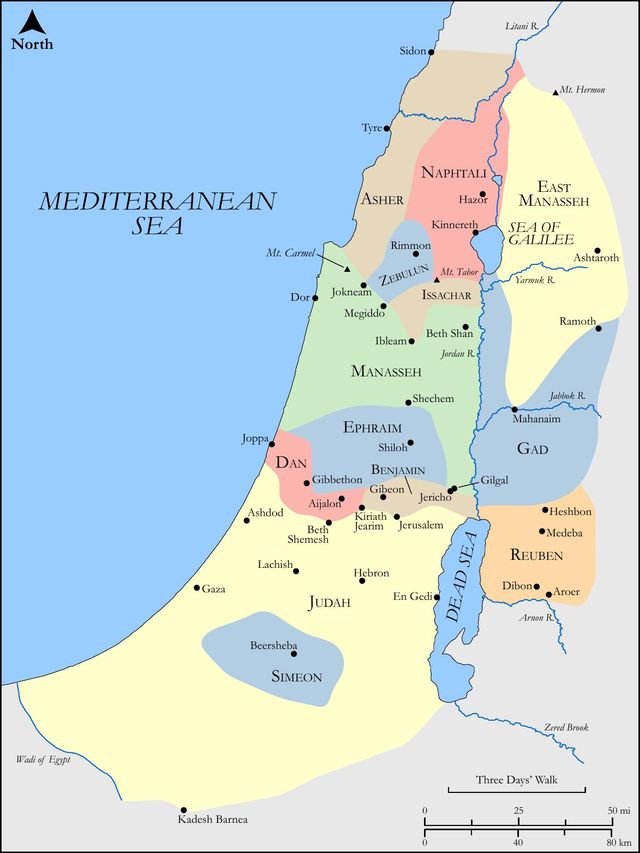
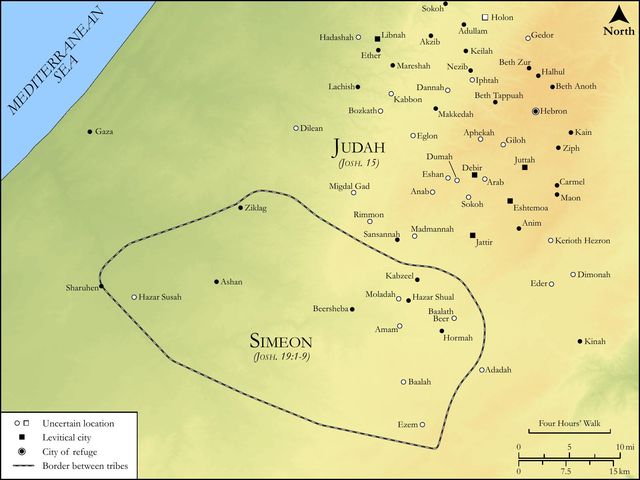
I.The situation of their lot was within that of Judah (Jos 19:1) and was taken from it, Jos 19:9.
It seems, those that first surveyed the land thought it larger than it was, and that it would have held out to give every tribe in proportion as large a share as they had carved out for Judah; but, upon a more strict enquiry, it was found that it would not reach (Jos 19:9): The part of the children of Judah was too much for them, more than they needed, and more, as it proved, than fell to their share. Yet God did not by the lot lessen it, but left it to their prudence and care afterwards to discover and rectify the mistake, which when they did,
1.The men of Judah did not oppose the taking away of the cities again, which by the first distribution fell within their border, when they were convinced that they had more than their proportion. In all such cases errors must be excepted and a review admitted if there be occasion. Though, in strictness, what fell to their lot was their right against all the world, yet they would not insist upon it when it appeared that another tribe would want what they had to spare. Note, We must look on the things of others, and not on our own only. The abundance of some must supply the wants of others, that there may be somewhat of an equality, for which there may be equity where there is not law.
2.That which was thus taken off from Judah to be put into a new lot Providence directed to the tribe of Simeon, that Jacob's prophecy concerning this tribe might be fulfilled, I will divide them in Jacob. The cities of Simeon were scattered in Judah, with which tribe they were surrounded, except on that side towards the sea. This brought them into a confederacy with the tribe of Judah (Jdg 1:3), and afterwards was a happy occasion of the adherence of many of this tribe to the house of David, at the time of the revolt of the ten tribes to Jeroboam. Ch2 15:9, out of Simeon they fell to Asa in abundance. It is good being in a good neighbourhood.
II.The cities within their lot are here named.
Beersheba, or Sheba, for these names seem to refer to the same place, is put first. Ziklag, which we read of in David's story, is one of them. What course they took to enlarge their borders and make room for themselves we find Ch1 4:39, etc.
Continue studying Joshua 19:3 across the web’s major study libraries — every link below opens this exact verse, chapter, or book on the destination site.
Read & Compare
 BibleGatewayThis verse in more than 200 translations and 70 languages.
 Bible.comThe YouVersion reader — hundreds of translations, reading plans, and highlights.
 ESV.orgCrossway's official English Standard Version reader.
 NET BibleThe NET translation with 60,000+ translators' notes on every rendering decision.
 STEP BibleTyndale House's free study tool — original text, vocabulary, and scholarly resources.
 BibliaLogos Bible Software's free web reader.
 USCCBThe New American Bible (Revised Edition) with the U.S. bishops' study notes.
Commentaries
 BibleHub CommentariesDozens of classic commentaries on this verse, gathered on one page.
 StudyLightMore than 100 commentary sets — the largest collection on the web.
 BibleRefPlain-English commentary on what this verse means, verse by verse.
 Enduring WordDavid Guzik's free commentary on this chapter, widely used by Bible teachers.
 Bible Study ToolsVerse commentary alongside Greek and Hebrew study aids.
Original Language & Research
- BibleHub InterlinearThe verse word by word — original language, transliteration, and English.
- BibleHub LexiconEvery word's original-language definition and Strong's entry.
 Blue Letter BibleDeep-study tools — Strong's numbers, concordance, and word studies.
 SefariaThe Hebrew text with Rashi and centuries of Jewish commentary.
Sermons, Hymns & Audio


TrulyRandomVerse is not affiliated with these sites and doesn’t control their content. They’re linked because they’re genuinely useful.
Summary
Joshua 19:3 is a succinct yet profoundly significant verse, listing three specific towns—Hazarshual, Balah, and Azem—that formed part of the divinely ordained inheritance for the tribe of Simeon. This seemingly minor detail is crucial within the broader narrative of Israel's meticulous settlement in the Promised Land, underscoring God's precise fulfillment of His ancient covenant promises and the orderly distribution of territory to each tribe, ensuring their identity and security within the nascent nation.
Context
ShowHideLiterary Context
Joshua 19 is part of the larger section Joshua 13-19 detailing the division of the land among the Israelite tribes. Following the initial major allocations to Judah and the houses of Joseph (Ephraim and Manasseh), chapter 19 focuses on the remaining seven tribes. Specifically, Joshua 19:1-9 meticulously outlines the territory assigned to Simeon. This verse, Joshua 19:3, is embedded within a comprehensive list of towns and villages that constituted Simeon's portion, emphasizing the precise and detailed nature of the land distribution process overseen by Joshua and Eleazar, the priest, at Shiloh. The listing of specific towns, even obscure ones, highlights the meticulous fulfillment of God's promises regarding the land.
Historical & Cultural Context
The period described in Joshua is the immediate aftermath of the conquest of Canaan, marking Israel's transition from nomadic wanderers to a settled nation. The division of land was not merely an historical administrative task but a foundational act for Israel's socio-political and religious identity. Land inheritance was paramount in ancient Israelite culture, signifying divine blessing, security, and the perpetuation of family lines. The specific arrangement for Simeon, whose inheritance was located within the larger territory of Judah (as noted in Joshua 19:9), reflects a unique historical and tribal dynamic. This arrangement also points to the fulfillment of Jacob's prophetic words concerning Simeon and Levi in Genesis 49:7, where he declared they would be "divided in Jacob and scattered in Israel," suggesting a less concentrated or independent tribal territory. The naming of specific towns like Hazarshual, Balah, and Azem provides tangible geographical markers of this historical reality.
Key Themes
ShowHideJoshua 19:3, though brief, contributes to several overarching themes in the book of Joshua. Firstly, it powerfully illustrates Divine Faithfulness and Fulfillment, demonstrating God's unwavering commitment to His covenant promises made to Abraham regarding the land of Canaan (Genesis 15:18). Every town listed, no matter how small, represents a tangible piece of that fulfilled promise. Secondly, the meticulous detailing of boundaries and towns underscores Order and Precision in God's divine administration. The land was not haphazardly distributed but was a divinely guided, precise allocation, ensuring each tribe received its rightful and specific portion. Finally, these verses reinforce the critical importance of Tribal Identity and Inheritance. For each tribe, possessing a secure, divinely appointed inheritance of specific towns and territories was central to their identity, their socio-economic stability, and their place within the unified nation of Israel, laying the groundwork for their future.
Exposition and Analysis
ShowHideKey Word Analysis
ShowHideFrom the Hebrew words for "village" and "fox," this name literally means "village of (the) fox." This suggests a location characterized by the presence of these animals, perhaps indicating a rural or wild area, or a settlement that served as a refuge or den. Its inclusion signifies a specific, identifiable place within Simeon's territory, grounding the divine promise in concrete geography.
Derived from a root meaning "failure" or "to wear out." While the exact implication for the town is speculative, it could suggest an older settlement, one that had seen decline, or perhaps a place associated with a specific type of wear or decay. Its presence in the list, regardless of its etymological nuance, confirms its existence and inclusion in the tribal allotment.
The same as the Hebrew word for "bone" or "strength." It might indicate a place of resilience, a strong or fortified location, or perhaps a significant landmark that served as a "backbone" or central point in the region. The inclusion of such a name further emphasizes the tangible and specific nature of the land being distributed.
Verse Breakdown
ShowHide"And Hazarshual"
This phrase introduces the first of three towns explicitly named in this verse as part of Simeon's inheritance. The conjunction "And" connects it seamlessly to the preceding verses which list other towns, indicating a continuous and comprehensive enumeration of the cities allotted to the tribe. The inclusion of Hazarshual, with its descriptive name, highlights the specificity of God's land grants, ensuring that every designated area, even those with humble or descriptive names, was accounted for.
"and Balah"
Following Hazarshual, Balah is presented as another distinct town within Simeon's portion. Its simple inclusion in this list, without further elaboration, speaks to the administrative precision of the land division. Each name represents a tangible piece of the Promised Land, confirming the fulfillment of God's covenant with Israel to provide them with a secure dwelling place.
"and Azem"
The final town listed in this verse, Azem, completes this particular triplet of named locations. Like the others, its presence is a testament to the meticulous nature of the land distribution. The repetition of the conjunction "and" emphasizes the additive nature of the list, building a comprehensive picture of the geographical extent of Simeon's inheritance, demonstrating divine order and the tangible reality of the fulfilled promise.
Literary Devices
ShowHideThe primary literary device at play in Joshua 19:3, and indeed throughout the extensive lists of towns and boundaries in Joshua 13-19, is Enumeration (or Cataloging). This technique involves the systematic listing of items, in this case, specific geographical locations. While seemingly dry, its purpose is profound: it serves as irrefutable evidence of the meticulous fulfillment of God's promises. The sheer volume and detail of these lists underscore the divine Precision and Order in the land's distribution, leaving no doubt that the inheritance was not haphazard but divinely ordained and executed. Furthermore, the naming of these towns, often with descriptive Hebrew meanings (e.g., Hazarshual, "village of a fox"), can be seen as a form of subtle Symbolism or Etymological Significance, grounding the abstract concept of "inheritance" in concrete, identifiable places. The repetitive structure of "And [name], and [name], and [name]" also creates a sense of Rhythm and Completeness, reinforcing the idea that every piece of the promised land was accounted for and given to its rightful heir.
Theological and Thematic Connections
ShowHideJoshua 19:3, though a simple list of names, resonates with profound theological implications. It serves as a powerful testament to God's unwavering faithfulness and the precision with which He fulfills His covenant promises. The meticulous division of the land, down to individual towns, demonstrates that God is a God of detail, who remembers His word and brings it to pass in tangible ways. This divine fidelity is not limited to ancient Israel but speaks to the reliability of God's promises for all generations. Just as He provided a physical inheritance for His people then, He provides a spiritual inheritance for believers today, assuring them of their place in His kingdom and the fulfillment of His redemptive plan. This verse encourages a deeper trust in God's sovereignty and His meticulous care over every aspect of His creation and His people's lives.
Reflection and Application
ShowHideThe seemingly mundane list of towns in Joshua 19:3 offers a profound invitation to reflect on the nature of God and His relationship with humanity. It reminds us that God is not a God of vague generalities but of precise details. He is meticulously involved in the fulfillment of His promises, down to the specific geographical locations for a particular tribe. This level of divine attention should inspire immense confidence and trust in His character. If God was so faithful to fulfill ancient land covenants, how much more can we trust Him with the intricate details of our own lives, our provisions, and our spiritual inheritance? This verse encourages us to look for God's faithfulness not only in grand, miraculous events but also in the seemingly small, everyday fulfillments of His word. It challenges us to recognize that every part of His plan, even a list of names, contributes to the grand narrative of His redemptive purposes and His unwavering commitment to His people.
Questions for Reflection
ShowHideFAQ
ShowHideWhy are these specific towns listed, and what is their significance?
ShowHideThe listing of specific towns like Hazarshual, Balah, and Azem serves several crucial purposes. Firstly, it provides irrefutable evidence of the precise fulfillment of God's covenant promises to Israel regarding the land of Canaan. It demonstrates that the inheritance was not a vague concept but a tangible, geographically defined reality. Secondly, these lists established clear boundaries and identities for each tribe, preventing future disputes and ensuring an orderly settlement. For the modern reader, these names, though obscure, underscore God's meticulous attention to detail and His unwavering faithfulness in bringing His plans to fruition. They remind us that even the seemingly minor details in Scripture contribute to the grand narrative of God's redemptive work, as seen throughout the historical accounts in books like Joshua.
How does Simeon's inheritance within Judah's territory relate to biblical prophecy?
ShowHideSimeon's unique inheritance, situated entirely within the larger territory of Judah, directly relates to the prophetic words of Jacob in Genesis 49:7. In this prophecy, Jacob declared that Simeon and Levi would be "divided in Jacob and scattered in Israel" due to their violent actions (referencing the incident in Genesis 34). While Levi was scattered through the priestly service without a concentrated land inheritance, Simeon's "scattering" manifested as a territory that was not independent but rather an enclave within another tribe's domain. This arrangement limited Simeon's distinct tribal power and influence, fulfilling Jacob's prophetic curse and demonstrating God's sovereign oversight even in the consequences of human sin, as detailed in the tribal allocations of Joshua 19.
Christ-Centered Fulfillment
ShowHideWhile Joshua 19:3 details a physical land inheritance for an ancient tribe, its deeper theological resonance points powerfully to Christ. The meticulous precision with which God fulfilled His promise of land to Israel foreshadows the even greater precision and faithfulness with which He fulfills His ultimate promise of salvation and spiritual inheritance in Jesus Christ. Just as the land provided rest and security for Israel, Christ is our true rest and secure dwelling place (Matthew 11:28). The detailed allocation of earthly territory prefigures the spiritual inheritance that believers receive in Christ—an inheritance that is "imperishable, undefiled, and unfading, kept in heaven" (1 Peter 1:4). Through His atoning work, Jesus, the true Lamb of God, has secured for His people not merely a plot of land, but eternal life and citizenship in a heavenly kingdom (Philippians 3:20). Thus, the seemingly mundane list of towns in Joshua 19:3 ultimately directs our gaze to the comprehensive and perfectly fulfilled promises of God found in the person and work of our Lord Jesus Christ, who is the ultimate fulfillment of all God's covenants and the guarantor of our eternal inheritance (Hebrews 9:15).