


Genesis 26:33
Bible text: King James Version (1769 Blayney text) · Public domain
Bible text: Berean Standard Bible · Public domain
Bible text: American Standard Version (1901) · Public domain
Bible text: World English Bible, Messianic edition · Public domain
Bible text: Geneva Bible (1599) · Public domain
Bible text: Young's Literal Translation · Public domain
- וַיִּקְרָאvai·yik·Ra'and he calledH7121Conj-w ¦ V-Qal-ConsecImperf-3msVerb Qal Consecutive Imperfect 3rd Singular Masculineוַandיִּקְרָאhe called
- אֹתָהּ'o·Tah<obj.> itH853DirObjM ¦ 3fsParticle Object Indicatorאֹתָ<obj.>הּit
- שִׁבְעָהshiv·'AhShibahH7656N-properNoun Proper Location
- עַל'althere-H5921PrepPreposition
- כֵּןken-foreH3651AdvAdverb
- שֵׁםshem[the] name ofH8034N-mscNoun Singular Masculine Construct
- הָעִירha·'Irthe cityH5892Art ¦ N-fsNoun Singular Feminine Absoluteהָtheעִירcity
- בְּאֵרbe·'Er[is] BeerH884N-properNoun Proper Location
- שֶׁבַעShe·va'ShebaH884N-properNoun Proper Location
- עַד'aduntilH5704PrepPreposition
- הַיּוֹםhai·Yomthe dayH3117Art ¦ N-msNoun Singular Masculine Absoluteהַtheיּוֹםday
- הַזֶּהha·Zeh<the> thisH2088Art ¦ PrtParticle Demonstrativeהַ<the>זֶּהthis
English is a literal word-by-word gloss of the Hebrew, not the KJV's wording. Why?
This is the original text the KJV's translators worked from — each Hebrew word with its own literal English meaning in this verse, prepared by scholars at Tyndale House, Cambridge. The KJV translates whole sentences, not word by word, so its wording differs: one Hebrew word can become several English words, and the KJV may choose “the LORD” where the gloss reads “Yahweh”. Both are faithful — they answer different questions. For the KJV's own rendering, switch to the KJV text.
Details
See on the biblical-era maps


Study this verse
Public-domain commentary
Matthew Henry
From his Commentary on the Whole Bible. Henry comments on passages, not single verses — this entry covers Genesis 26:26–33. His two-level outline is real structure in the source text, so it is rendered as structure.
We have here the contests that had been between Isaac and the Philistines issuing in a happy peace and reconciliation.
I.Abimelech pays a friendly visit to Isaac, in token of the respect he had for him, Gen 26:26.
Note, When a man's ways please the Lord he makes even his enemies to be at peace with him, Pro 16:7. King's hearts are in his hands, and when he pleases he can turn them to favour his people.
II.Isaac prudently and cautiously questions his sincerity in this visit, Gen 26:27.
Note, In settling friendships and correspondences, there is need of the wisdom of the serpent, as well as the innocence of the dove; nor is it any transgression of the law of meekness and love plainly to signify our strong perception of injuries received, and to stand upon our guard in dealing with those that have acted unfairly.
III.Abimelech professes his sincerity, in this address to Isaac, and earnestly courts his friendship, Gen 26:28, Gen 26:29.
Some suggest that Abimelech pressed for this league with him because he feared lest Isaac, growing rich, should, some time or other, avenge himself upon them for the injuries he had received. However, he professes to do it rather from a principle of love.
1.He makes the best of their behaviour towards him. Isaac complained they had hated him, and sent him away. No, said Abimelech, we sent thee away in peace. They turned him off from the land he held of them; but they suffered him to take away his stock, and all his effects, with him. Note, The lessening of injuries is necessary to the preserving of friendship; for the aggravating of them exasperates and widens breaches. The unkindness done to us might have been worse.
2.He acknowledges the token of God's favour to him, and makes this the ground of their desire to be in league with him: The Lord is with thee, and thou art the blessed of the Lord. As if he had said, "Be persuaded to overlook and pass by the injuries offered thee; for God had abundantly made up to thee the damage thou receivedst." Note, Those whom God blesses and favours have reason enough to forgive those who hate them, since the worst enemy they have cannot do them any real hurt. Or, "For this reason we desire thy friendship, because God is with thee." Note, It is good to be in covenant and communion with those who are in covenant and communion with God, Jo1 1:3; present address to him was the result of mature deliberation: We said, Let there be an oath between us. Whatever some of his peevish envious subjects might mean otherwise, he and his prime-ministers of state, whom he had now brought with him, designed no other than a cordial friendship. Perhaps Abimelech had received, by tradition, the warning God gave to his predecessor not to hurt Abraham (Gen 20:7), and this made him stand in such awe of Isaac, who appeared to be as much the favourite of Heaven as Abraham was.
IV.Isaac entertains him and his company, and enters into a league of friendship with him, Gen 26:30, Gen 26:31.
Here see how generous the good man was, 1. In giving: He made them a feast, and bade them welcome. (2.) In forgiving. He did not insist upon the unkindnesses they had done him, but freely entered into a covenant of friendship with them, and bound himself never to do them any injury. Note, Religion teaches us to be neighbourly, and, as much as in us lies, to live peaceably with all men.
V.Providence smiled upon what Isaac did; for the same day that he made this covenant with Abimelech his servants brought him the tidings of a well of water they had found, Gen 26:32, Gen 26:33. He did not insist upon the restitution of the wells which the Philistines had unjustly taken from him, lest this should break off the treaty, but sat down silent under the injury; and, to recompense him for this, immediately he is enriched with a new well, which, because it suited so well to the occurrence of the day, he called by an old name, Beer-sheba, The well of the oath.
Historical interpretation
Historical reception
1 surviving comment on this verse from the historical church.
(Verse 32 and 33.) And the servants of Isaac came and told him about the well that they had dug, and they said to him, 'We have found water.' So he called it Shebah. I don't know how it is translated in the Septuagint: 'And the servants of Isaac came and told him about the well that they had dug, and they said to him, 'We have not found water.' So he called it Oath.' What is the etymology behind calling it Oath just because they did not find water? On the contrary, in Hebrew, which Aquila and Symmachus agree with in interpretation, this signifies that they found water, and therefore the well itself was called Saturation, and the city was called Beersheba, which means well of saturation (Gen. XXI): for although above we asserted that Beersheba was called so from the word of the oath, or from the number seven of the sheep, which is called Sabee, now because water was found, Isaac turned slightly the letter to the name of the city, which was thus called alluding, and instead of the harsh sound of the Hebrews Sin, from which Sabee begins, he placed the Greek sigma, which is the Hebrew Samech: otherwise, according to the law of allegory, after so many wells at the end of virtues, it does not at all agree that Isaac did not find water.
Continue studying Genesis 26:33 across the web’s major study libraries — every link below opens this exact verse, chapter, or book on the destination site.
Read & Compare
 BibleGatewayThis verse in more than 200 translations and 70 languages.
 Bible.comThe YouVersion reader — hundreds of translations, reading plans, and highlights.
 ESV.orgCrossway's official English Standard Version reader.
 NET BibleThe NET translation with 60,000+ translators' notes on every rendering decision.
 STEP BibleTyndale House's free study tool — original text, vocabulary, and scholarly resources.
 BibliaLogos Bible Software's free web reader.
 USCCBThe New American Bible (Revised Edition) with the U.S. bishops' study notes.
Commentaries
 BibleHub CommentariesDozens of classic commentaries on this verse, gathered on one page.
 StudyLightMore than 100 commentary sets — the largest collection on the web.
 BibleRefPlain-English commentary on what this verse means, verse by verse.
 Enduring WordDavid Guzik's free commentary on this chapter, widely used by Bible teachers.
 Bible Study ToolsVerse commentary alongside Greek and Hebrew study aids.
Original Language & Research
- BibleHub InterlinearThe verse word by word — original language, transliteration, and English.
- BibleHub LexiconEvery word's original-language definition and Strong's entry.
 Blue Letter BibleDeep-study tools — Strong's numbers, concordance, and word studies.
 SefariaThe Hebrew text with Rashi and centuries of Jewish commentary.
Sermons, Hymns & Audio


TrulyRandomVerse is not affiliated with these sites and doesn’t control their content. They’re linked because they’re genuinely useful.
Summary
Genesis 26:33 concludes the narrative of Isaac's peaceful resolution with Abimelech, the Philistine king, by formally establishing the name of the city as Beersheba, the "Well of the Oath." This verse encapsulates themes of divine provision, the establishment of peace through covenant, and the continuity of patriarchal legacy, as Isaac re-establishes a significant site first named by his father, Abraham, solidifying its identity as a place of divine encounter and covenant faithfulness.
Context
ShowHideLiterary Context
Genesis 26 details Isaac's sojourn in Gerar during a famine, his deception regarding Rebekah, and the subsequent conflicts with the Philistines over wells. The immediate context leading to Genesis 26:33 begins with Isaac's relocation to Beersheba after repeated disputes over wells (verses 18-22). There, the Lord appears to him, reaffirming the Abrahamic covenant and promising His presence and blessing (verses 23-24). This divine assurance prompts Abimelech, the Philistine king, along with his chief captain Phichol and his friend Ahuzzath, to journey to Isaac, acknowledging God's favor upon him and seeking a covenant of peace (verses 26-29). Isaac hosts them, and they swear an oath of non-aggression (verses 30-31). Crucially, on the very day this oath is sworn, Isaac's servants report finding fresh water in a newly dug well (verse 32), directly preceding Isaac's naming of this well "Shebah," which then gives the city its enduring name, Beersheba.
Historical & Cultural Context
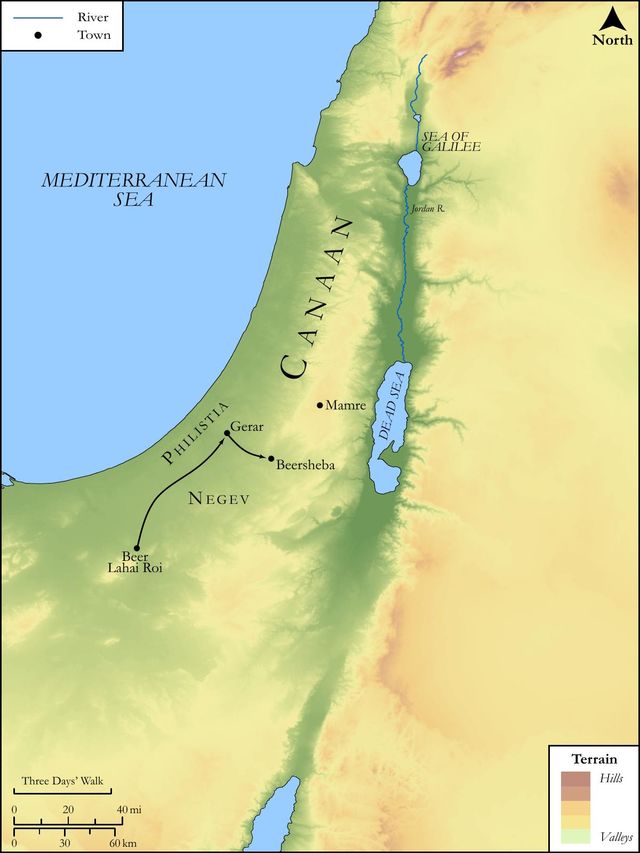
In semi-arid regions like the Negeb where Beersheba is located, water sources were vital for survival and often a cause of intense conflict. Wells represented wealth, sustenance, and territorial rights. The practice of digging and owning wells was a significant aspect of land tenure and economic stability. Covenants, or treaties, were formal agreements, often accompanied by oaths and sacrifices, establishing peace and defining relationships between individuals or groups. The presence of witnesses and the naming of a place to commemorate the oath were common cultural practices, lending permanence and legal weight to the agreement. The interaction between Isaac and Abimelech reflects the complex diplomatic and resource-driven dynamics between nomadic pastoralists (like Isaac) and settled agricultural/urban populations (like the Philistines).
Key Themes
ShowHideGenesis 26 is rich with themes that culminate in this verse. Divine Provision and Faithfulness are central, as God repeatedly blesses Isaac with prosperity and water, even amidst Philistine opposition. The Lord's direct appearance to Isaac at Beersheba (Genesis 26:24) underscores God's active involvement. Covenant and Peacemaking are prominent, demonstrated by Isaac's willingness to seek peace and Abimelech's recognition of God's blessing on Isaac, leading to a solemn oath. The naming of Beersheba as the "Well of the Oath" highlights the significance of this covenant. Furthermore, the chapter emphasizes the Continuity of the Patriarchal Covenant, as God reaffirms His promises to Isaac, mirroring those made to Abraham, and Isaac re-establishes a significant site previously associated with his father (Genesis 21:31).
Exposition and Analysis
ShowHideGenesis 26:33 succinctly records Isaac's act of naming the newly discovered well "Shebah," which in turn solidified the name of the patriarchal city as Beersheba. This act is not merely a geographical designation but a profound theological statement, marking the culmination of a period of strife and the establishment of peace and divine blessing.
Key Word Analysis
ShowHideThis primitive root means "to call out to," "address by name," or "to name." In this context, Isaac's act of "calling" the well "Shebah" is a deliberate act of naming, imbuing the place with meaning and memorializing the event. It signifies an authoritative act of designation, linking the well's identity directly to the preceding oath.
This word is derived from the Hebrew for "seven." While "seven" often denotes completeness or perfection, in this specific context, the narrative explicitly links it to the preceding "oath" (Hebrew, shevu'ah). The phonetic similarity between Shibʻâh (seven) and shevu'ah (oath) creates a wordplay that reinforces the meaning of Beersheba as the "Well of the Oath," rather than solely the "Well of Seven." Isaac's choice of this name directly references the covenant sworn with Abimelech.
This compound word literally means "well of an oath." It is formed from beʼer (well) and shebaʻ (oath/seven). The name solidifies the identity of the location as a place where a solemn covenant was made. Its enduring nature "unto this day" emphasizes its historical and theological significance as a site of divine encounter and covenant faithfulness for generations.
This term refers to a literal day, a period of time, or even an age. In the phrase "unto this day," it serves as an editorial note, indicating that the name "Beersheba" persisted from Isaac's time up to the time the Genesis account was written or compiled. It underscores the historical continuity and the lasting impact of the events described.
Verse Breakdown
ShowHide"And he called it Shebah"
This clause describes Isaac's direct action of naming the well. The naming is not arbitrary but deeply significant, occurring immediately after the discovery of water and the swearing of the oath with Abimelech. Isaac's choice of "Shebah" (related to "seven" and "oath") intentionally connects the well to the covenant of peace just established, marking it as a memorial of divine provision and human reconciliation.
"therefore the name of the city [is] Beersheba"
This phrase explains the consequence of Isaac's naming of the well. The well's name, "Shebah," combined with "Be'er" (well), becomes the enduring name for the entire settlement that grew around it. This highlights how significant events, particularly those involving divine intervention and covenant, shaped the identity and nomenclature of places in ancient Israel. The city's name thus serves as a perpetual reminder of the oath sworn there.
"unto this day"
This is a common editorial phrase in the Pentateuch, indicating the continued existence or relevance of a place, custom, or name from the time of the narrated events up to the time of the narrator/audience. It authenticates the historical account and emphasizes the lasting legacy of Isaac's actions and God's faithfulness at this specific location. It suggests that Beersheba remained a significant and recognized place with this name for centuries.
Literary Devices
ShowHideThe verse employs several literary devices. Etiology is central, as the verse explains the origin of the name "Beersheba," linking it directly to the historical event of Isaac's oath and the discovery of the well. This etiological naming provides a theological justification for the place's significance. There is also a subtle Wordplay between "Shebah" (seven) and "shevu'ah" (oath), which enriches the meaning of Beersheba as the "Well of the Oath," emphasizing the covenantal aspect over a numerical one. The phrase "unto this day" functions as an Anachronism or Editorial Gloss, a common feature in historical narratives that connects the ancient past to the contemporary reality of the audience, lending credibility and continuity to the account. This device underscores the enduring legacy of the patriarchal narratives.
Theological and Thematic Connections
ShowHideGenesis 26:33 stands as a powerful testament to God's unwavering faithfulness and sovereign provision, even in the face of human conflict and uncertainty. It demonstrates how God orchestrates circumstances—from the timely discovery of water to the recognition of His favor by an outsider king—to bring about peace and fulfill His covenant promises. The naming of Beersheba, the "Well of the Oath," transforms a physical location into a theological marker, signifying a place where God's presence was affirmed, covenants were established, and His people were blessed. It reinforces the biblical principle that God blesses those who walk in His ways and seek peace, providing for their needs in tangible and miraculous ways.
Reflection and Application
ShowHideThe narrative culminating in Genesis 26:33 offers profound lessons for contemporary believers. Isaac's journey from contention over vital resources to the establishment of covenant peace, marked by God's evident provision, encourages us to prioritize reconciliation and trust in God's perfect timing for our blessings. In a world often characterized by strife and competition, Isaac's example reminds us that pursuing peace, even with those who may have wronged us, is a divine calling. It demonstrates a profound reliance on God's ultimate vindication and supply, rather than resorting to endless conflict. The immediate discovery of water after the oath serves as a powerful reminder that God not only provides for our physical needs but also affirms our righteous actions and blesses our peacemaking efforts. We are called to embody this spirit of peace, trusting that God will provide for us as we seek to live in harmony, echoing the New Testament call to live peaceably with all people (Romans 12:18).
Questions for Reflection
ShowHideFAQ
ShowHideWhy is the name Beersheba significant in the Bible?
ShowHideBeersheba, meaning "Well of the Oath," is profoundly significant as a recurring patriarchal site where pivotal covenants were made and God repeatedly appeared to Abraham and Isaac, reaffirming His promises. It represents a place of divine provision, peace established through solemn agreements, and the enduring continuity of the Abrahamic covenant across generations. It served as a spiritual and geographical anchor for the patriarchs.
Did Abraham and Isaac name Beersheba for the same reason?
ShowHideWhile both Abraham (Genesis 21:31) and Isaac named or reaffirmed Beersheba after an oath with an Abimelech concerning a well, the specific circumstances differed. Abraham's oath was primarily about the ownership and rights to a specific well, while Isaac's oath was a broader covenant of peace and non-aggression after a period of significant conflict over multiple wells. However, both instances underscore the meaning "Well of the Oath," solidifying the site's identity as a place of covenant and divine faithfulness.
What does the discovery of water immediately after the oath symbolize?
ShowHideThe immediate discovery of fresh water after the oath in Genesis 26:32 symbolizes God's divine affirmation and abundant provision. In a land where water was scarce and a source of conflict, this miraculous timing demonstrates God's blessing upon Isaac, validating the covenant of peace and assuring Isaac of His presence and faithfulness in a tangible, life-sustaining way. It signifies that God honors righteous peacemaking and provides for those who trust in Him.
Christ-Centered Fulfillment
ShowHideThe themes of covenant, peace, and divine provision inherent in Genesis 26:33 find their ultimate and perfect fulfillment in Jesus Christ. Just as Isaac established peace through a covenant at the "Well of the Oath" and found physical provision, Christ is the ultimate source of true peace and the Mediator of a new and better covenant (Hebrews 8:6). He is the "living water" (John 4:10-14) who provides eternal satisfaction and reconciliation with God, far surpassing the physical provision of water at Beersheba. Through His sacrificial death, Christ became our peace (Ephesians 2:14), breaking down the wall of hostility and bringing us into an everlasting covenant relationship with God (Hebrews 9:15). Believers, through faith in Him, enter into this covenant of peace and receive abundant spiritual provision, finding their ultimate "Well of the Oath" in the finished work of Christ.