


Genesis 26:32
- וַיְהִיvay·Hiand it wasH1961Conj-w ¦ V-Qal-ConsecImperf-3msVerb Qal Consecutive Imperfect 3rd Singular Masculineוַandיְהִיit was
- בַּיּוֹםbai·Yomon the dayH3117Prep-b ¦ N-msNoun Singular Masculine Absoluteבַּon theיּוֹםday
- הַהוּאha·Hu'<the> thatH1931Art ¦ Pro-3msPronoun Personal 3rd Singular Masculineהַ<the>הוּאthat
- וַיָּבֹאוּvai·ya·Vo·'uand they cameH935Conj-w ¦ V-Qal-ConsecImperf-3mpVerb Qal Consecutive Imperfect 3rd Plural Masculineוַandיָּבֹאוּthey came
- עַבְדֵי'av·Dei[the] servants ofH5650N-mpcNoun Plural Masculine Construct
- יִצְחָקyitz·ChakIsaacH3327N-proper-mNoun Proper Masculine
- וַיַּגִּדוּvai·ya·Gi·duand they toldH5046Conj-w ¦ V-Hiphil-ConsecImperf-3mpVerb Hiphil Consecutive Imperfect 3rd Plural Masculineוַandיַּגִּדוּthey told
- לוֹloto <the> himPrep-l ¦ 3msSuffix Personal 3rd Singular Masculineלto <the>וֹhim
- עַל'alonH5921PrepPreposition
- אֹדוֹת'o·Dot[the] causes ofH182N-fpcNoun Plural Feminine Construct
- הַבְּאֵרha·be·'Erthe wellH875Art ¦ N-fsNoun Singular Feminine Absoluteהַtheבְּאֵרwell
- אֲשֶׁר'a·SherwhichH834RelParticle Relative
- חָפָרוּcha·Fa·ruthey had dugH2658V-Qal-Perf-3cpVerb Qal Perfect 3rd Plural common gender
- וַיֹּאמְרוּvai·Yo·me·ruand they saidH559Conj-w ¦ V-Qal-ConsecImperf-3mpVerb Qal Consecutive Imperfect 3rd Plural Masculineוַandיֹּאמְרוּthey said
- לוֹloto <the> himPrep-l ¦ 3msSuffix Personal 3rd Singular Masculineלto <the>וֹhim
- מָצָאנוּma·Tza·nuwe have foundH4672V-Qal-Perf-1cpVerb Qal Perfect 1st Plural common gender
- מָיִםMa·yimwaterH4325N-mpNoun Plural Masculine Absolute
English is a literal word-by-word gloss of the Hebrew, not the KJV's wording. Why?
This is the original text the KJV's translators worked from — each Hebrew word with its own literal English meaning in this verse, prepared by scholars at Tyndale House, Cambridge. The KJV translates whole sentences, not word by word, so its wording differs: one Hebrew word can become several English words, and the KJV may choose “the LORD” where the gloss reads “Yahweh”. Both are faithful — they answer different questions. For the KJV's own rendering, switch to the KJV text.
Details
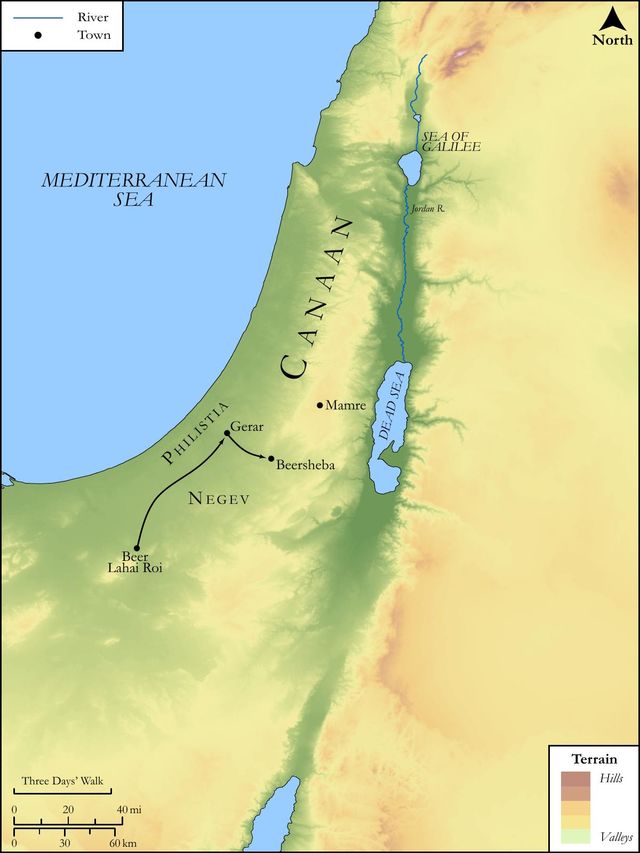
See on the biblical-era map


Study this verse
Public-domain commentary
Matthew Henry
From his Commentary on the Whole Bible. Henry comments on passages, not single verses — this entry covers Genesis 26:26–33. His two-level outline is real structure in the source text, so it is rendered as structure.
We have here the contests that had been between Isaac and the Philistines issuing in a happy peace and reconciliation.
I.Abimelech pays a friendly visit to Isaac, in token of the respect he had for him, Gen 26:26.
Note, When a man's ways please the Lord he makes even his enemies to be at peace with him, Pro 16:7. King's hearts are in his hands, and when he pleases he can turn them to favour his people.
II.Isaac prudently and cautiously questions his sincerity in this visit, Gen 26:27.
Note, In settling friendships and correspondences, there is need of the wisdom of the serpent, as well as the innocence of the dove; nor is it any transgression of the law of meekness and love plainly to signify our strong perception of injuries received, and to stand upon our guard in dealing with those that have acted unfairly.
III.Abimelech professes his sincerity, in this address to Isaac, and earnestly courts his friendship, Gen 26:28, Gen 26:29.
Some suggest that Abimelech pressed for this league with him because he feared lest Isaac, growing rich, should, some time or other, avenge himself upon them for the injuries he had received. However, he professes to do it rather from a principle of love.
1.He makes the best of their behaviour towards him. Isaac complained they had hated him, and sent him away. No, said Abimelech, we sent thee away in peace. They turned him off from the land he held of them; but they suffered him to take away his stock, and all his effects, with him. Note, The lessening of injuries is necessary to the preserving of friendship; for the aggravating of them exasperates and widens breaches. The unkindness done to us might have been worse.
2.He acknowledges the token of God's favour to him, and makes this the ground of their desire to be in league with him: The Lord is with thee, and thou art the blessed of the Lord. As if he had said, "Be persuaded to overlook and pass by the injuries offered thee; for God had abundantly made up to thee the damage thou receivedst." Note, Those whom God blesses and favours have reason enough to forgive those who hate them, since the worst enemy they have cannot do them any real hurt. Or, "For this reason we desire thy friendship, because God is with thee." Note, It is good to be in covenant and communion with those who are in covenant and communion with God, Jo1 1:3; present address to him was the result of mature deliberation: We said, Let there be an oath between us. Whatever some of his peevish envious subjects might mean otherwise, he and his prime-ministers of state, whom he had now brought with him, designed no other than a cordial friendship. Perhaps Abimelech had received, by tradition, the warning God gave to his predecessor not to hurt Abraham (Gen 20:7), and this made him stand in such awe of Isaac, who appeared to be as much the favourite of Heaven as Abraham was.
IV.Isaac entertains him and his company, and enters into a league of friendship with him, Gen 26:30, Gen 26:31.
Here see how generous the good man was, 1. In giving: He made them a feast, and bade them welcome. (2.) In forgiving. He did not insist upon the unkindnesses they had done him, but freely entered into a covenant of friendship with them, and bound himself never to do them any injury. Note, Religion teaches us to be neighbourly, and, as much as in us lies, to live peaceably with all men.
V.Providence smiled upon what Isaac did; for the same day that he made this covenant with Abimelech his servants brought him the tidings of a well of water they had found, Gen 26:32, Gen 26:33. He did not insist upon the restitution of the wells which the Philistines had unjustly taken from him, lest this should break off the treaty, but sat down silent under the injury; and, to recompense him for this, immediately he is enriched with a new well, which, because it suited so well to the occurrence of the day, he called by an old name, Beer-sheba, The well of the oath.
Historical interpretation
Historical reception
1 surviving comment on this verse from the historical church.
(Verse 32 and 33.) And the servants of Isaac came and told him about the well that they had dug, and they said to him, 'We have found water.' So he called it Shebah. I don't know how it is translated in the Septuagint: 'And the servants of Isaac came and told him about the well that they had dug, and they said to him, 'We have not found water.' So he called it Oath.' What is the etymology behind calling it Oath just because they did not find water? On the contrary, in Hebrew, which Aquila and Symmachus agree with in interpretation, this signifies that they found water, and therefore the well itself was called Saturation, and the city was called Beersheba, which means well of saturation (Gen. XXI): for although above we asserted that Beersheba was called so from the word of the oath, or from the number seven of the sheep, which is called Sabee, now because water was found, Isaac turned slightly the letter to the name of the city, which was thus called alluding, and instead of the harsh sound of the Hebrews Sin, from which Sabee begins, he placed the Greek sigma, which is the Hebrew Samech: otherwise, according to the law of allegory, after so many wells at the end of virtues, it does not at all agree that Isaac did not find water.
Continue studying Genesis 26:32 across the web’s major study libraries — every link below opens this exact verse, chapter, or book on the destination site.
Read & Compare
 BibleGatewayThis verse in more than 200 translations and 70 languages.
 Bible.comThe YouVersion reader — hundreds of translations, reading plans, and highlights.
 ESV.orgCrossway's official English Standard Version reader.
 NET BibleThe NET translation with 60,000+ translators' notes on every rendering decision.
 STEP BibleTyndale House's free study tool — original text, vocabulary, and scholarly resources.
 BibliaLogos Bible Software's free web reader.
 USCCBThe New American Bible (Revised Edition) with the U.S. bishops' study notes.
Commentaries
 BibleHub CommentariesDozens of classic commentaries on this verse, gathered on one page.
 StudyLightMore than 100 commentary sets — the largest collection on the web.
 BibleRefPlain-English commentary on what this verse means, verse by verse.
 Enduring WordDavid Guzik's free commentary on this chapter, widely used by Bible teachers.
 Bible Study ToolsVerse commentary alongside Greek and Hebrew study aids.
Original Language & Research
- BibleHub InterlinearThe verse word by word — original language, transliteration, and English.
- BibleHub LexiconEvery word's original-language definition and Strong's entry.
 Blue Letter BibleDeep-study tools — Strong's numbers, concordance, and word studies.
 SefariaThe Hebrew text with Rashi and centuries of Jewish commentary.
Sermons, Hymns & Audio


TrulyRandomVerse is not affiliated with these sites and doesn’t control their content. They’re linked because they’re genuinely useful.
Summary
Genesis 26:32 records the pivotal moment when Isaac's servants announced the discovery of water in a newly dug well, an event that providentially coincided with King Abimelech's visit to establish a peace treaty with Isaac. This timely finding not only underscores God's faithful and comprehensive provision but also marks a significant culmination of Isaac's journey through conflict and migration, powerfully reaffirming the divine covenant promises made to him and his descendants.
Context
ShowHideLiterary Context
This verse serves as a climactic resolution within the narrative of Isaac's sojourn in Gerar and Beersheba, specifically following a period of intense conflict over wells. Prior to this, Isaac had been forced to relocate from Gerar due to the Philistines' envy over his prosperity, re-digging wells that his father Abraham had previously dug but which the Philistines had maliciously stopped up (Genesis 26:18). He faced repeated disputes, naming wells "Esek" (Contention) and "Sitnah" (Enmity), reflecting the ongoing strife. His move to Rehoboth ("room" or "broad places") marked a temporary reprieve, signifying a place where the Lord had "made room" for them (Genesis 26:22). The narrative then shifts to Isaac's arrival at Beersheba, where the Lord appeared to him, reiterating the Abrahamic covenant promises of blessing and numerous descendants (Genesis 26:24). The discovery of water in verse 32, immediately after the peace treaty with Abimelech, powerfully demonstrates God's holistic blessing, providing both relational harmony and essential sustenance.
Historical & Cultural Context
In the ancient Near East, particularly in the semi-arid regions of Canaan, water was an absolute necessity for survival, livestock, and agriculture. Control over water sources was paramount, often leading to disputes and conflicts, as seen in Isaac's interactions with the Philistines. Digging a well was a significant undertaking, requiring considerable labor and resources, and its successful completion was a testament to perseverance and, often, divine favor. Beersheba itself was a historically significant site, known for its wells and its association with Abraham, who had made a covenant there with Abimelech previously (Genesis 21:31). The presence of a well not only provided life-sustaining water but also signified the right to settle and claim territory, making the discovery in this verse a tangible sign of God's fulfillment of His promise of land and blessing.
Key Themes
ShowHideGenesis 26:32 encapsulates several major themes woven throughout the book of Genesis and particularly Isaac's narrative. Foremost is the theme of Divine Provision and Faithfulness, as God consistently provides for Isaac's needs, often in challenging circumstances, fulfilling the covenant promises made to Abraham and reiterated to Isaac. The discovery of water in an arid land, precisely at a moment of reconciliation, highlights God's ability to provide both material sustenance and peace. Another key theme is Covenant Continuity, demonstrating how God's promises are faithfully passed down and affirmed across generations, from Abraham to Isaac and beyond. Isaac's patient Perseverance in Faith, despite repeated opposition over water rights, is also a prominent theme, showing that his steadfastness is ultimately rewarded by God's blessing. This verse also contributes to the theme of Holistic Blessing (Shalom), where God's favor extends beyond mere physical needs to encompass relational harmony and security, as evidenced by the concurrent peace treaty with Abimelech (Genesis 26:28-31).
Exposition and Analysis
ShowHideGenesis 26:32 presents a concise yet profoundly significant event: the announcement by Isaac's servants that they had "found water" in a newly dug well. The phrase "the same day" is crucial, highlighting the divine orchestration that brought together the resolution of relational conflict with Abimelech and the provision of essential resources. This synchronicity underscores God's holistic care for Isaac, providing both peace with his neighbors and sustenance for his household and livestock. The discovery of water in an arid region like Beersheba was not merely fortunate; it was a clear sign of divine favor and blessing.
Key Word Analysis
ShowHideThis word (H3117) refers to a specific period, often the warm hours from sunrise to sunset, but can also denote a defined space of time. In this context, "the same day" emphasizes the precise and immediate timing of the well's discovery in relation to Abimelech's visit and the oath-taking. It highlights the divine synchronicity and the providential nature of the event, suggesting God's deliberate orchestration of circumstances.
This primitive root (H2658) means "to pry into," "to delve," or "to explore." It signifies the laborious and persistent effort involved in excavating the well. The use of this word underscores Isaac's servants' diligent work and Isaac's perseverance in seeking water sources, despite previous opposition and the filling of wells by the Philistines. It sets the stage for the reward of their persistent labor.
This primitive root (H4672) means "to come forth to," "appear," "exist," or transitively, "to attain," "find," or "acquire." In this verse, "We have found water" signifies not merely a fortunate discovery but the successful attainment of a vital resource after diligent search and labor. It implies the successful conclusion of their efforts, culminating in a tangible and life-sustaining result, which is ultimately attributed to divine favor.
Verse Breakdown
ShowHide"And it came to pass the same day,"
This opening clause immediately establishes a precise temporal connection, linking the discovery of water to the very day that King Abimelech and his retinue arrived to make a covenant with Isaac. This synchronicity is not accidental but points to divine orchestration, highlighting God's meticulous timing in providing both relational peace and essential physical sustenance for Isaac.
"that Isaac's servants came, and told him concerning the well which they had digged,"
This part identifies the agents of discovery (Isaac's servants) and the object of their report (the well they had been digging). It emphasizes the human effort involved in the process of seeking water, a task that had been central to Isaac's struggles and perseverance throughout the preceding narrative. The act of "telling" Isaac signifies the importance of the news and its direct relevance to his household's well-being and future settlement.
"and said unto him, We have found water."
This is the climactic declaration, the simple yet profound announcement of success. "Water" (H4325, mayim) in an arid land was synonymous with life, blessing, and the ability to thrive. The phrase "We have found water" signifies the culmination of their efforts and, more importantly, a tangible manifestation of God's direct provision and blessing for Isaac, confirming His covenant faithfulness in a practical and vital way.
Literary Devices
ShowHideThe narrative of Genesis 26:32 employs several significant literary devices. Synchronicity is paramount, as the discovery of water occurs on "the same day" that Abimelech arrives to make a peace treaty. This precise timing highlights divine orchestration, suggesting that God is actively working behind the scenes to bring about comprehensive blessing—both relational harmony and material provision. Symbolism is also central, with water serving as a potent symbol of life, blessing, and divine favor in the arid ancient Near East. The finding of water signifies prosperity, security, and the ability to settle and thrive in the land God had promised. Furthermore, there is a subtle Contrast between Isaac's previous struggles and conflicts over wells (Esek and Sitnah) and this final, successful discovery, which leads to peace and abundance. This contrast underscores God's ultimate triumph over adversity and His faithful provision despite human opposition.
Theological and Thematic Connections
ShowHideThe discovery of water in Genesis 26:32 is a powerful testament to God's sovereign providence and His unwavering faithfulness to His covenant people. It illustrates that God's blessing is holistic, encompassing not only material provision but also relational peace and security. This event reinforces the enduring nature of God's promises, demonstrating how they are passed down and affirmed across generations, from Abraham to Isaac. Isaac's perseverance in digging wells, despite facing opposition, also highlights the theological principle that faithful endurance, even through trials, ultimately leads to divine breakthrough and tangible blessings.
Reflection and Application
ShowHideGenesis 26:32 offers a profound and encouraging message for believers today: God is a faithful, timely, and comprehensive provider. Just as Isaac found essential water after a period of dispute and precisely at the moment of reconciliation with his neighbors, we are reminded that God often reveals His blessings in unexpected ways and at opportune moments, even amidst our own challenges or in seemingly barren seasons of life. This verse encourages us to cultivate patient perseverance in faith, trusting that our diligent efforts, coupled with our reliance on God, will ultimately be met with His abundant provision. It teaches us that God's care extends to every facet of our existence—our physical needs, our relationships, and our overall sense of security and well-being. Therefore, we can rest in the assurance that God's timing is perfect, and His provision is sure, leading to a holistic sense of peace and prosperity that transcends mere material gain.
Questions for Reflection
ShowHideFAQ
ShowHideWhy is the discovery of water so significant in this narrative?
ShowHideThe discovery of water is profoundly significant because it represents divine provision and blessing in an arid land where water was essential for survival, livestock, and settlement. It confirms God's faithfulness to His covenant promises to Isaac, allowing him to thrive and settle in the land God had promised. Furthermore, its timing, coinciding with the peace treaty with Abimelech, underscores God's holistic care, providing both material sustenance and relational harmony. The well, later named "Shebah" or "oath," also solidifies the identity of Beersheba as a place of covenant and divine blessing, echoing Abraham's earlier covenant there (Genesis 21:31).
Christ-Centered Fulfillment
ShowHideThe timely and life-giving provision of water for Isaac in Genesis 26:32, bringing both sustenance and a solidified place of peace, powerfully foreshadows the ultimate and eternal provision found in Jesus Christ. Just as the well of Shebah was a source of physical life in a barren land, Christ is the "living water" (John 4:10) who quenches spiritual thirst and offers eternal life to all who believe. His sacrificial death on the cross establishes a new and better covenant (Hebrews 8:6), bringing true and lasting peace between God and humanity (Ephesians 2:14). The well's discovery, marking the culmination of Isaac's trials and the establishment of peace with his neighbors, points to Christ as the ultimate fulfillment of God's covenant promises, providing not just temporary relief but eternal reconciliation and abundant life for all who come to Him (John 10:10).