


Genesis 26:16
- וַיֹּאמֶרvai·Yo·merand he saidH559Conj-w ¦ V-Qal-ConsecImperf-3msVerb Qal Consecutive Imperfect 3rd Singular Masculineוַandיֹּאמֶרhe said
- אֲבִימֶלֶךְ'a·vi·Me·lekhAbimelechH40N-proper-mNoun Proper Masculine
- אֶל'eltoH413PrepPreposition
- יִצְחָקyitz·ChakIsaacH3327N-proper-mNoun Proper Masculine
- לֵךְlekhgoH1980V-Qal-Imp-2msVerb Qal Imperative 2nd Singular Masculine
- מֵעִמָּנוּme·'i·Ma·nufrom with <the> usH5973Prep-m ¦ Prep ¦ 1cpPreposition Definiteמֵfromעִמָּwith <the>נוּus
- כִּיkiforH3588PrtParticle Conditional
- עָצַמְתָּ'a·tzam·tayou have become [too] powerfulH6105V-Qal-Perf-2msVerb Qal Perfect 2nd Singular Masculine
- מִמֶּנּוּmi·Me·nufor usH4480Prep ¦ 1cpPreposition Definiteמִמֶּforנּוּus
- מְאֹדme·'OdmuchH3966Adj-msAdjective Numerical Singular Masculine Absolute
English is a literal word-by-word gloss of the Hebrew, not the KJV's wording. Why?
This is the original text the KJV's translators worked from — each Hebrew word with its own literal English meaning in this verse, prepared by scholars at Tyndale House, Cambridge. The KJV translates whole sentences, not word by word, so its wording differs: one Hebrew word can become several English words, and the KJV may choose “the LORD” where the gloss reads “Yahweh”. Both are faithful — they answer different questions. For the KJV's own rendering, switch to the KJV text.
Àwọn àlàyé
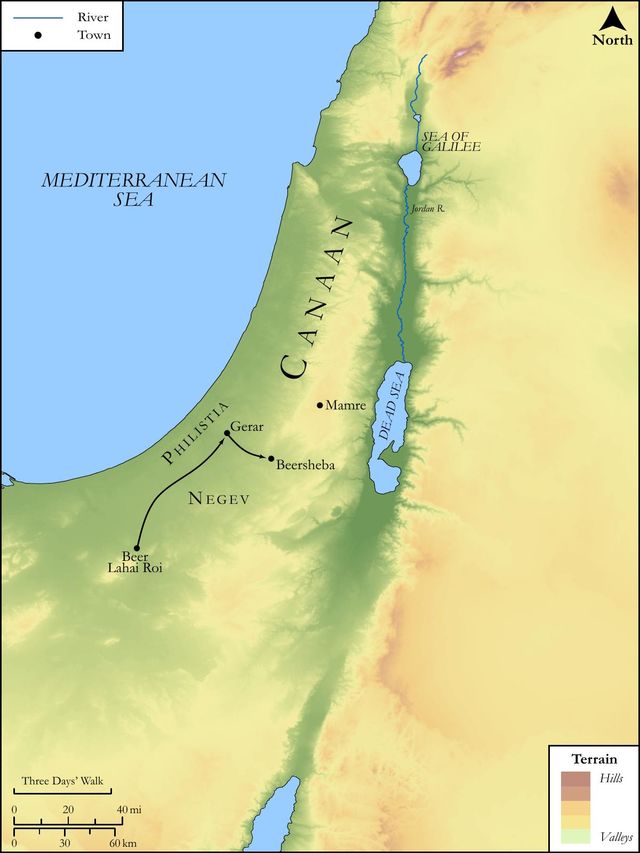
See on the biblical-era map


Kẹ́kọ̀ọ́ ẹsẹ yìí
Àlàyé tí kò sí lábẹ́ ẹ̀tọ́ àdàkọ
Matthew Henry
Láti inú Commentary on the Whole Bible rẹ̀. Henry ń ṣàlàyé àwọn àyọkà, kì í ṣe ẹsẹ kọ̀ọ̀kan — àlàyé yìí bo Genesis 26:12–25. Ìlànà rẹ̀ ní ìpele 4, ó sì jẹ́ ìtòlẹ́sẹẹsẹ gidi nínú ọ̀rọ̀ ìpilẹ̀ṣẹ̀, nítorí náà a fi hàn gẹ́gẹ́ bí ìtòlẹ́sẹẹsẹ.
Here we have,
I.The tokens of God's good-will to Isaac.
He blessed him, and prospered him, and made all that he had to thrive under his hands.
1.His corn multiplied strangely, Gen 26:12. He had no land of his own, but took land of the Philistines, and sowed it; and (be it observed for the encouragement of poor tenants, that occupy other people's lands, and are honest and industrious) God blessed him with a great increase. He reaped a hundred fold; and there seems to be an emphasis laid upon the time: it was that same year when there was a famine in the land; while others scarcely reaped at all, he reaped thus plentifully. See Isa 65:13, My servants shall eat, but you shall be hungry, Psa 37:19, In the days of famine they shall be satisfied.
2.His cattle also increased, Gen 26:14. And then,
3.He had great store of servants, whom he employed and maintained. Note, As goods are increased those are increased that eat them, Ecc 5:11.
II.The tokens of the Philistines' ill-will to him. They envied him, Gen 26:14. It is an instance,
1.Of the vanity of the world that the more men have of it the more they are envied, and exposed to censure and injury. Who can stand before envy? Pro 27:4. See Ecc 4:4.
2.Of the corruption of nature; for that is a bad principle indeed which makes men grieve at the good of others, as if it must needs be ill with me because it is well with my neighbor.
(1.)They had already shown their ill-will to his family, by stopping up the wells which his father had digged, Gen 26:15. This was spitefully done. Because they had not flocks of their own to water at these wells, they would not leave them for the use of others; so absurd a thing is malice. And it was perfidiously done, contrary to the covenant of friendship they had made with Abraham, Gen 21:31, Gen 21:32. No bonds will hold ill-nature.
(2.)They expelled him out of their country, Gen 26:16, Gen 26:17. The king of Gerar began to look upon him with a jealous eye. Isaac's house was like a court, and his riches and retinue eclipsed Abimelech's; and therefore he must go further off. They were weary of his neighborhood, because they saw that the Lord blessed him; whereas, for that reason, they should the rather have courted his stay, that they also might be blessed for his sake. Isaac does not insist upon the bargain he had made with them for the lands he held, nor upon his occupying and improving them, nor does he offer to contest with them by force, though he had become very great, but very peaceably departs thence further from the royal city, and perhaps to a part of the country less fruitful. Note, We should deny ourselves both in our rights and in our conveniences, rather than quarrel: a wise and a good man will rather retire into obscurity, like Isaac here into a valley, than sit high to be the butt of envy and ill-will.
III.His constancy and continuance in his business still.
1.He kept up his husbandry, and continued industrious to find wells of water, and to fit them for his use, Gen 26:18, etc. Though he had grown very rich, yet he was as solicitous as ever about the state of his flocks, and still looked well to his herds; when men grow great, they must take heed of thinking themselves too big and too high for their business. Though he was driven from the conveniences he had had, and could not follow his husbandry with the same ease and advantage as before, yet he set himself to make the best of the country he had come into, which it is every man's prudence to do. Observe,
(1.)He opened the wells that his father had digged (Gen 26:18), and out of respect to his father called them by the same names that he had given them. Note, In our searches after truth, that fountain of living water, it is good to make use of the discoveries of former ages, which have been clouded by the corruptions of later times. Enquire for the old way, the wells which our fathers digged, which the adversaries of truth have stopped up: Ask thy elders, and they shall teach thee.
(2.)His servants dug new wells, Gen 26:19. Note, Though we must use the light of former ages, it does not therefore follow that we must rest in it, and make no advances. We must still be building upon their foundation, running to and fro, that knowledge may be increased, Dan 12:4.
(3.)In digging his wells he met with much opposition, Gen 26:20, Gen 26:21. Those that open the fountains of truth must expect contradiction. The first two wells which they dug were called Esek and Sitnah, contention and hatred. See here,
[1.]What is the nature of worldly things; they are make-bates and occasions of strife.
[2.]What is often the lot even of the most quiet and peaceable men in this world; those that avoid striving yet cannot avoid being striven with, Psa 120:7. In this sense, Jeremiah was a man of contention (Jer 15:10), and Christ himself, though he is the prince of peace.
[3.]What a mercy it is to have plenty of water, to have it without striving for it. The more common this mercy is the more reason we have to be thankful for it.
(4.)At length he removed to a quiet settlement, cleaving to his peaceable principle, rather to fly than fight, and unwilling to dwell with those that hated peace, Psa 120:6. He preferred quietness to victory. He dug a well, and for this they strove not, Gen 26:22. Note, Those that follow peace, sooner or later, shall find peace; those that study to be quiet seldom fail of being so. How unlike was Isaac to his brother Ishmael, who, right or wrong, would hold what he had, against all the world! Gen 16:12. And which of these would we be found the followers of? This well they called Rehoboth, enlargements, room enough: in the two former wells we may see what the earth is, straitness and strife; men cannot thrive, for the throng of their neighbours. This well shows us what heaven is; it is enlargement and peace, room enough there, for there are many mansions.
2.He continued firm to his religion, and kept up his communion with God.
(1.)God graciously appeared to him, Gen 26:24. When the Philistines expelled him, forced him to remove from place to place, and gave him continual molestation, then God visited him, and gave him fresh assurances of his favour. Note, When men are found false and unkind, we may comfort ourselves that God is faithful and gracious; and his time to show himself so is when we are most disappointed in our expectations from men. When Isaac had come to Beer-sheba (Gen 26:23) it is probable that it troubled him to think of his unsettled condition, and that he could not be suffered to stay long in a place; and, in the multitude of these thoughts within him, that same night that he came weary and uneasy to Beer-sheba God brought him his comforts to delight his soul. Probably he was apprehensive that the Philistines would not let him rest there: Fear not, says God to him, I am with thee, and will bless thee. Those may remove with comfort that are sure of God's presence with them wherever they go.
(2.)He was not wanting in his returns of duty to God; for there he built an altar, and called upon the name of the Lord, Gen 26:25. Note,
[1.]Wherever we go, we must take our religion along with us. Probably Isaac's altars and his religious worship gave offence to the Philistines, and provoked them to be the more troublesome to him; yet he kept up his duty, whatever ill-will he might be exposed to by it.
[2.]The comforts and encouragements God gives us by his word should excite and quicken us to every exercise of devotion by which God may be honoured and our intercourse with heaven maintained.
Òye nínú ìtàn
Ìtẹ́wọ́gbà Nínú Ìtàn
Àlàyé 1 ni ó ṣẹ́kù nípa ẹsẹ yìí láti ọ̀dọ̀ ìjọ ìgbàanì.
Consider the degree of evil of those inhabitants such as even to begrudge the good man water. Not even the king, despite his having so much wealth, could withstand the impulse of envy but said, “Depart from us, because you have become far too powerful for us.” What terrible malice; why, in fact, are you driving the good man off? Surely Isaac caused your subjects no harm? Surely he did no wrong? But that is what envy is like: It does nothing out of calm reason. I mean, on seeing the good man enjoying such favor from the God of all, Abimelech should rather have respected him, should rather have shown him honor so as himself to win favor from on high because of the honor shown him. But instead of doing that, he even tried to drive him off, saying, “Depart from us, because you have become far too powerful for us.”That is what envy is like, after all: It cannot simply accept others’ success but instead regards the neighbor’s prosperity as a disaster for itself and is devastated by the neighbor’s good fortune. That is precisely what happened here: having authority over the whole city and holding everyone in his thrall, the king said to this nomad, this vagrant, wandering hither and yon, “Depart from us, because you have become far too powerful for us.” Isaac really was more powerful, with help from above in every circumstance and protected by God’s right hand.
Continue studying Genesis 26:16 across the web’s major study libraries — every link below opens this exact verse, chapter, or book on the destination site.
Read & Compare
 BibleGatewayThis verse in more than 200 translations and 70 languages.
 Bible.comThe YouVersion reader — hundreds of translations, reading plans, and highlights.
 ESV.orgCrossway's official English Standard Version reader.
 NET BibleThe NET translation with 60,000+ translators' notes on every rendering decision.
 STEP BibleTyndale House's free study tool — original text, vocabulary, and scholarly resources.
 BibliaLogos Bible Software's free web reader.
 USCCBThe New American Bible (Revised Edition) with the U.S. bishops' study notes.
Commentaries
 BibleHub CommentariesDozens of classic commentaries on this verse, gathered on one page.
 StudyLightMore than 100 commentary sets — the largest collection on the web.
 BibleRefPlain-English commentary on what this verse means, verse by verse.
 Enduring WordDavid Guzik's free commentary on this chapter, widely used by Bible teachers.
 Bible Study ToolsVerse commentary alongside Greek and Hebrew study aids.
Original Language & Research
- BibleHub InterlinearThe verse word by word — original language, transliteration, and English.
- BibleHub LexiconEvery word's original-language definition and Strong's entry.
 Blue Letter BibleDeep-study tools — Strong's numbers, concordance, and word studies.
 SefariaThe Hebrew text with Rashi and centuries of Jewish commentary.
Sermons, Hymns & Audio


TrulyRandomVerse is not affiliated with these sites and doesn’t control their content. They’re linked because they’re genuinely useful.
Summary
Genesis 26:16 records the Philistine King Abimelech's explicit command for Isaac to depart from Gerar, driven by the king's acknowledgment of Isaac's extraordinary prosperity and influence. Abimelech's declaration, "Go from us; for thou art much mightier than we," highlights the undeniable and visible impact of God's covenant blessing upon Isaac, which, instead of fostering cooperation, provoked profound envy and fear among the Philistines, culminating in this direct expulsion.
Context
FihànFi pamọ́Literary Context
This verse marks a pivotal moment in the narrative of Isaac's sojourn in Gerar, following a severe famine that prompted his relocation. The preceding verses detail God's specific command to Isaac to remain in Gerar, reiterating the Abrahamic covenant promises of blessing, land, and numerous offspring (Genesis 26:2-4). Isaac's obedience is immediately followed by an astonishing hundredfold harvest in the same year, alongside immense growth in his flocks, herds, and servants (Genesis 26:12-13). This burgeoning wealth, a direct manifestation of divine favor, incited intense envy among the Philistines, who retaliated by filling up the wells Abraham had dug (Genesis 26:14-15). Genesis 26:16 serves as the climax of this escalating tension, where the Philistine king, Abimelech, directly confronts Isaac, articulating the collective fear and demanding his departure, thereby forcing Isaac to relocate despite God's initial command to stay.
Historical & Cultural Context
In the ancient Near East, prosperity in livestock, agricultural yield, and the number of servants directly equated to power, influence, and military potential. The control of water sources, especially wells, was critical for survival and a common point of contention, as seen in the Philistines' hostile act of filling Abraham's wells. The title "Abimelech" was likely a dynastic name for Philistine kings in Gerar, much like "Pharaoh" in Egypt, indicating a succession of rulers rather than a single individual over generations. The Philistines, a powerful seafaring people who settled in the coastal plain of Canaan, would have viewed any significant increase in the wealth and numbers of a foreign group like Isaac's as a direct challenge to their sovereignty and a potential threat to their regional dominance. Kings often made treaties to manage such relationships, as Abraham had done with an earlier Abimelech (Genesis 21:22-32), but Isaac's unchecked growth was perceived as destabilizing.
Key Themes
FihànFi pamọ́This passage powerfully illustrates several key themes. Firstly, it underscores the Manifestation of Divine Blessing, demonstrating God's faithfulness to His covenant promises through Isaac's extraordinary prosperity, which becomes so evident it cannot be ignored by outsiders. Secondly, it highlights the Destructive Nature of Human Envy and Hostility, showing how the Philistines' jealousy over Isaac's success leads to aggressive actions and ultimately expulsion. Thirdly, the narrative emphasizes God's Sovereignty Amidst Adversity, revealing that even unjust human actions, like Abimelech's command, can be divinely orchestrated to guide God's chosen ones to new places of provision and blessing, as Isaac's subsequent journey demonstrates in Genesis 26:17-22. Lastly, it touches upon the theme of the Sojourner's Experience, as Isaac, an heir to the promised land, remains a resident alien, facing challenges and displacement in the very land promised to his descendants.
Exposition and Analysis
FihànFi pamọ́Genesis 26:16 captures a moment of direct confrontation, where Abimelech's fear of Isaac's burgeoning power culminates in a decisive command. This verse is not merely a statement but an act of political expulsion, revealing the Philistine king's deep-seated insecurity and the undeniable impact of God's blessing on Isaac.
Key Word Analysis
FihànFi pamọ́From the Hebrew words for "father" (אָב) and "king" (מֶלֶךְ), meaning "father of (the) king." This name signifies a dynastic title rather than a personal name, indicating the Philistine king of Gerar. His role here is to represent the collective fear and political will of his people, acting as the official voice of expulsion. The name itself, "father of the king," might ironically highlight the perceived threat Isaac posed to the Philistine king's own "fatherhood" or authority over his domain.
A primitive root meaning "to walk" (literally or figuratively), but here used as a direct command to "depart" or "go away." This imperative verb signifies an order of expulsion, not a polite request. It reflects Abimelech's authority and his determination to remove Isaac, indicating that Isaac's presence had become an intolerable threat to the Philistine kingdom, necessitating his immediate removal from their territory.
A primitive root meaning "to bind fast," "to close" (eyes), but more commonly, "to be powerful or numerous," "to be great," "to be increased," or "to be strong." When used in conjunction with "much" (H3966, mᵉʼôd), it conveys an overwhelming degree of power, strength, and numerical superiority. Abimelech's use of this term indicates a comprehensive recognition of Isaac's immense influence, not just in terms of physical strength, but his economic, social, and demographic ascendancy, making him a formidable and perceived geopolitical force.
Verse Breakdown
FihànFi pamọ́"And Abimelech said unto Isaac"
This opening clause establishes the speaker and the recipient of the command, highlighting the direct and official nature of the confrontation. Abimelech, as the king, exercises his authority to address Isaac, underscoring the seriousness of the situation. It's not a casual conversation but a formal declaration of intent.
"Go from us;"
This is the immediate and unequivocal command of expulsion. The phrase "from us" implies a collective decision by the Philistines, represented by their king, to remove Isaac from their territory. It signifies a desire to distance themselves from Isaac's growing influence, which they perceived as a threat to their stability and sovereignty.
"for thou art much mightier than we."
This explanatory clause provides the explicit justification for the expulsion. Abimelech acknowledges Isaac's overwhelming power, prosperity, and numerical strength. The use of "much mightier" (Hebrew: mᵉʼôd ʻâtsam) emphasizes the degree to which Isaac's blessing had manifested, surpassing the Philistines' own strength and resources. This admission reveals the Philistines' fear, envy, and sense of vulnerability in the face of Isaac's divinely-granted abundance.
Literary Devices
FihànFi pamọ́The passage employs several literary devices to convey its powerful message. Hyperbole is evident in Abimelech's declaration that Isaac is "much mightier than we," which, while rooted in truth, likely exaggerates the immediate military threat to justify the expulsion, reflecting the Philistine king's deep-seated fear and insecurity. There is also a strong element of Dramatic Irony: Abimelech believes he is removing a threat to his kingdom, yet from a divine perspective, his command inadvertently serves God's larger purpose of guiding Isaac to new lands where God's blessing can continue to unfold, as seen in Isaac's subsequent discovery of new wells. The narrative also uses Conflict, both internal (the Philistines' envy) and external (the confrontation and expulsion), to drive the plot forward and highlight the tension between God's chosen people and the surrounding nations. Finally, Symbolism is present in Isaac's prosperity, which stands as a tangible sign of God's covenant faithfulness and blessing, a visible testimony that even a pagan king cannot deny.
Theological and Thematic Connections
FihànFi pamọ́Isaac's experience in Genesis 26:16 vividly illustrates the dynamic interplay between divine blessing, human response, and God's sovereign plan. His extraordinary prosperity serves as a tangible demonstration of God's faithfulness to His covenant promises, a blessing so profound that it compels recognition and fear even from those outside the covenant community. This passage reminds us that God's favor can be undeniably visible, yet this very visibility can provoke envy and hostility from a world that often resents divine blessing. Despite the injustice of his expulsion, Isaac's narrative underscores God's ability to use adverse circumstances to further His purposes, guiding His people to new opportunities for provision and growth, ultimately demonstrating His unwavering commitment to His promises.
Reflection and Application
FihànFi pamọ́Genesis 26:16 offers profound lessons for believers navigating a world that often misunderstands or resents divine favor. When God blesses us, whether spiritually, materially, or relationally, His favor can be undeniably evident to those around us, serving as a powerful, albeit sometimes challenging, testimony to His goodness and faithfulness. This visibility, however, may not always be met with admiration; it can, as in Isaac's case, provoke envy, suspicion, or even outright opposition from others. Like Isaac, we are called to respond with grace, wisdom, and a deep trust in God's sovereign leading, even when facing unfair treatment, forced displacement, or unexpected changes in our circumstances. This narrative reassures us that even when we are compelled to move from places of comfort or perceived security, God remains sovereign, guiding us to new opportunities for provision, growth, and the continued unfolding of His purposes, just as He faithfully did for Isaac. Our ultimate security is not in our location or possessions, but in the unwavering presence and guidance of God.
Questions for Reflection
FihànFi pamọ́FAQ
FihànFi pamọ́Why was Abimelech so afraid of Isaac's "might"?
FihànFi pamọ́Abimelech's fear stemmed from Isaac's rapidly increasing wealth, resources, and influence, which he perceived as a direct geopolitical threat to his kingdom. Isaac's "might" (Hebrew: ʻâtsam) encompassed not just personal strength but also significant economic power (flocks, herds) and numerical superiority in terms of servants and dependents. In the ancient Near East, such burgeoning power in a foreign entity within one's territory was seen as a potential challenge to the king's own authority and the stability of his realm. This perceived threat, fueled by the Philistines' intense envy, prompted a preemptive expulsion to mitigate the perceived risk to Abimelech's sovereignty and the security of his people.
Does Isaac's prosperity imply a "prosperity gospel" message?
FihànFi pamọ́No, Isaac's prosperity in Genesis 26 does not support a "prosperity gospel" message, which often suggests that material wealth is an automatic sign of God's favor or a guaranteed outcome for all believers. Instead, Isaac's immense blessing highlights God's specific and unique covenant faithfulness to Abraham and his descendants, demonstrating His power to bless and fulfill promises even in challenging circumstances like famine and hostility. Isaac's prosperity was a sign of God's unique favor and a means to establish the promised nation, not a universal formula for automatic personal wealth for all who believe. The focus of the narrative is on God's character and His unwavering commitment to His covenant, not on human entitlement to riches. The narrative also shows that even with blessing, there can be adversity and displacement, reinforcing that God's plan is deeper than mere material comfort.
Christ-Centered Fulfillment
FihànFi pamọ́Isaac's experience in Genesis 26:16, where his divinely-blessed "might" leads to his rejection and expulsion by the world, powerfully foreshadows aspects of Christ's life and the nature of His kingdom. Just as Isaac, the heir of the promise, was so abundantly blessed by God that he became "mightier" than the surrounding Philistines, provoking their envy and leading to his expulsion, so too was Jesus Christ, the ultimate heir of all things and the embodiment of God's blessing, rejected by His own people and expelled from the world through crucifixion. His "might" was not earthly power or material wealth, but divine authority, spiritual abundance, and the transformative power of His kingdom, which the world could not comprehend or tolerate (John 1:10-11). Yet, through His rejection, suffering, and subsequent resurrection, Christ established a spiritual kingdom that continues to grow and flourish, demonstrating a power far exceeding any worldly might (Daniel 2:44). Believers, as heirs with Christ, participate in this divine blessing and may also face worldly envy, misunderstanding, and rejection for their faith (John 15:18-19). However, just as Isaac's blessing continued beyond his expulsion, leading him to new springs of provision, so too are followers of Christ assured of God's continued provision, protection, and the ultimate triumph of His kingdom, even amidst opposition, as they are led by the Spirit to new places of spiritual fruitfulness and blessing in Him (Ephesians 1:3).