


Genesis 26:19
- וַיַּחְפְּרוּvai·yach·pe·Ruand they dugH2658Conj-w ¦ V-Qal-ConsecImperf-3mpVerb Qal Consecutive Imperfect 3rd Plural Masculineוַandיַּחְפְּרוּthey dug
- עַבְדֵי'av·dei[the] servants ofH5650N-mpcNoun Plural Masculine Construct
- יִצְחָקyitz·ChakIsaacH3327N-proper-mNoun Proper Masculine
- בַּנָּחַלba·Na·chalin the wadiH5158Prep-b ¦ N-msNoun Singular Masculine Absoluteבַּin theנָּחַלwadi
- וַיִּמְצְאוּvai·Yim·tze·'uand they foundH4672Conj-w ¦ V-Qal-ConsecImperf-3mpVerb Qal Consecutive Imperfect 3rd Plural Masculineוַandיִּמְצְאוּthey found
- שָׁםShamthereH8033AdvAdverb
- בְּאֵרbe·'Era well ofH875N-fscNoun Singular Feminine Construct
- מַיִםMa·yimwaterH4325N-mpNoun Plural Masculine Absolute
- חַיִּיםchai·YimlivingH2416Adj-mpAdjective Plural Masculine Absolute
English is a literal word-by-word gloss of the Hebrew, not the KJV's wording. Why?
This is the original text the KJV's translators worked from — each Hebrew word with its own literal English meaning in this verse, prepared by scholars at Tyndale House, Cambridge. The KJV translates whole sentences, not word by word, so its wording differs: one Hebrew word can become several English words, and the KJV may choose “the LORD” where the gloss reads “Yahweh”. Both are faithful — they answer different questions. For the KJV's own rendering, switch to the KJV text.
Details
See on the biblical-era maps


Study this verse
Public-domain commentary
Matthew Henry
From his Commentary on the Whole Bible. Henry comments on passages, not single verses — this entry covers Genesis 26:12–25. His four-level outline is real structure in the source text, so it is rendered as structure.
Here we have,
I.The tokens of God's good-will to Isaac.
He blessed him, and prospered him, and made all that he had to thrive under his hands.
1.His corn multiplied strangely, Gen 26:12. He had no land of his own, but took land of the Philistines, and sowed it; and (be it observed for the encouragement of poor tenants, that occupy other people's lands, and are honest and industrious) God blessed him with a great increase. He reaped a hundred fold; and there seems to be an emphasis laid upon the time: it was that same year when there was a famine in the land; while others scarcely reaped at all, he reaped thus plentifully. See Isa 65:13, My servants shall eat, but you shall be hungry, Psa 37:19, In the days of famine they shall be satisfied.
2.His cattle also increased, Gen 26:14. And then,
3.He had great store of servants, whom he employed and maintained. Note, As goods are increased those are increased that eat them, Ecc 5:11.
II.The tokens of the Philistines' ill-will to him. They envied him, Gen 26:14. It is an instance,
1.Of the vanity of the world that the more men have of it the more they are envied, and exposed to censure and injury. Who can stand before envy? Pro 27:4. See Ecc 4:4.
2.Of the corruption of nature; for that is a bad principle indeed which makes men grieve at the good of others, as if it must needs be ill with me because it is well with my neighbor.
(1.)They had already shown their ill-will to his family, by stopping up the wells which his father had digged, Gen 26:15. This was spitefully done. Because they had not flocks of their own to water at these wells, they would not leave them for the use of others; so absurd a thing is malice. And it was perfidiously done, contrary to the covenant of friendship they had made with Abraham, Gen 21:31, Gen 21:32. No bonds will hold ill-nature.
(2.)They expelled him out of their country, Gen 26:16, Gen 26:17. The king of Gerar began to look upon him with a jealous eye. Isaac's house was like a court, and his riches and retinue eclipsed Abimelech's; and therefore he must go further off. They were weary of his neighborhood, because they saw that the Lord blessed him; whereas, for that reason, they should the rather have courted his stay, that they also might be blessed for his sake. Isaac does not insist upon the bargain he had made with them for the lands he held, nor upon his occupying and improving them, nor does he offer to contest with them by force, though he had become very great, but very peaceably departs thence further from the royal city, and perhaps to a part of the country less fruitful. Note, We should deny ourselves both in our rights and in our conveniences, rather than quarrel: a wise and a good man will rather retire into obscurity, like Isaac here into a valley, than sit high to be the butt of envy and ill-will.
III.His constancy and continuance in his business still.
1.He kept up his husbandry, and continued industrious to find wells of water, and to fit them for his use, Gen 26:18, etc. Though he had grown very rich, yet he was as solicitous as ever about the state of his flocks, and still looked well to his herds; when men grow great, they must take heed of thinking themselves too big and too high for their business. Though he was driven from the conveniences he had had, and could not follow his husbandry with the same ease and advantage as before, yet he set himself to make the best of the country he had come into, which it is every man's prudence to do. Observe,
(1.)He opened the wells that his father had digged (Gen 26:18), and out of respect to his father called them by the same names that he had given them. Note, In our searches after truth, that fountain of living water, it is good to make use of the discoveries of former ages, which have been clouded by the corruptions of later times. Enquire for the old way, the wells which our fathers digged, which the adversaries of truth have stopped up: Ask thy elders, and they shall teach thee.
(2.)His servants dug new wells, Gen 26:19. Note, Though we must use the light of former ages, it does not therefore follow that we must rest in it, and make no advances. We must still be building upon their foundation, running to and fro, that knowledge may be increased, Dan 12:4.
(3.)In digging his wells he met with much opposition, Gen 26:20, Gen 26:21. Those that open the fountains of truth must expect contradiction. The first two wells which they dug were called Esek and Sitnah, contention and hatred. See here,
[1.]What is the nature of worldly things; they are make-bates and occasions of strife.
[2.]What is often the lot even of the most quiet and peaceable men in this world; those that avoid striving yet cannot avoid being striven with, Psa 120:7. In this sense, Jeremiah was a man of contention (Jer 15:10), and Christ himself, though he is the prince of peace.
[3.]What a mercy it is to have plenty of water, to have it without striving for it. The more common this mercy is the more reason we have to be thankful for it.
(4.)At length he removed to a quiet settlement, cleaving to his peaceable principle, rather to fly than fight, and unwilling to dwell with those that hated peace, Psa 120:6. He preferred quietness to victory. He dug a well, and for this they strove not, Gen 26:22. Note, Those that follow peace, sooner or later, shall find peace; those that study to be quiet seldom fail of being so. How unlike was Isaac to his brother Ishmael, who, right or wrong, would hold what he had, against all the world! Gen 16:12. And which of these would we be found the followers of? This well they called Rehoboth, enlargements, room enough: in the two former wells we may see what the earth is, straitness and strife; men cannot thrive, for the throng of their neighbours. This well shows us what heaven is; it is enlargement and peace, room enough there, for there are many mansions.
2.He continued firm to his religion, and kept up his communion with God.
(1.)God graciously appeared to him, Gen 26:24. When the Philistines expelled him, forced him to remove from place to place, and gave him continual molestation, then God visited him, and gave him fresh assurances of his favour. Note, When men are found false and unkind, we may comfort ourselves that God is faithful and gracious; and his time to show himself so is when we are most disappointed in our expectations from men. When Isaac had come to Beer-sheba (Gen 26:23) it is probable that it troubled him to think of his unsettled condition, and that he could not be suffered to stay long in a place; and, in the multitude of these thoughts within him, that same night that he came weary and uneasy to Beer-sheba God brought him his comforts to delight his soul. Probably he was apprehensive that the Philistines would not let him rest there: Fear not, says God to him, I am with thee, and will bless thee. Those may remove with comfort that are sure of God's presence with them wherever they go.
(2.)He was not wanting in his returns of duty to God; for there he built an altar, and called upon the name of the Lord, Gen 26:25. Note,
[1.]Wherever we go, we must take our religion along with us. Probably Isaac's altars and his religious worship gave offence to the Philistines, and provoked them to be the more troublesome to him; yet he kept up his duty, whatever ill-will he might be exposed to by it.
[2.]The comforts and encouragements God gives us by his word should excite and quicken us to every exercise of devotion by which God may be honoured and our intercourse with heaven maintained.
Historical interpretation
Two Centuries of Reception
3 surviving comments on this verse. Each one is dated, so this reads as a timeline rather than a list.
Select a marker to jump to its quote. Markers stagger vertically where authors wrote within a few decades of each other.
For who is able worthily to explain either the mysteries of such great wells or of those things that are related to have been done for the wells, unless we invoke the Father of the living Word and he should deign to put the word in our mouth so that we may be able to draw a little “living water” for you who thirst from those wells which are so copious and numerous?There are, therefore, wells that the servants of Abraham dug, but the Philistines had filled these with earth. Isaac therefore undertakes first to clear these wells. The Philistines hate water; they love earth. Isaac loves water; he is always seeking wells; he cleans old wells, he opens new ones.
Consider our Isaac, who “has been offered as a sacrifice for us,” coming into the valley of Gerar, which means “wall” or “hedge.” [He is] coming, I say, that “he might destroy the middle wall of hedge, the enmities, in his flesh.” [He is] coming to remove the wall that is between us and the heavenly virtues, that he might make “both one” and carry back to the mountains "on his shoulder" the lamb which had strayed and restore it to the other “ninety-nine which had not strayed.”
For Abraham dug wells and Isaac too—that is, the mighty patriarchs—and Jacob also, as we find in the Gospel, as if they were fountains of the human race, and specifically fountains of faith and devotion. For what is a well of living water but a depth of profound instruction? On this account Hagar saw the angel by a well and Jacob found his wife Rachel by a well; Moses too earned the first rewards of his future marriage beside a well. Therefore Isaac undertook to open wells out of a depth of vision and in good order, so that the water of his well might first wash and strengthen the reasoning faculty of the soul and its eye, to make its sight clearer.
(Verse 19) And the servants of Isaac dug in the valley of Gerar and found there a well of living water. And for this valley, a stream was written; for never is a well of living water found in the valley.
Continue studying Genesis 26:19 across the web’s major study libraries — every link below opens this exact verse, chapter, or book on the destination site.
Read & Compare
 BibleGatewayThis verse in more than 200 translations and 70 languages.
 Bible.comThe YouVersion reader — hundreds of translations, reading plans, and highlights.
 ESV.orgCrossway's official English Standard Version reader.
 NET BibleThe NET translation with 60,000+ translators' notes on every rendering decision.
 STEP BibleTyndale House's free study tool — original text, vocabulary, and scholarly resources.
 BibliaLogos Bible Software's free web reader.
 USCCBThe New American Bible (Revised Edition) with the U.S. bishops' study notes.
Commentaries
 BibleHub CommentariesDozens of classic commentaries on this verse, gathered on one page.
 StudyLightMore than 100 commentary sets — the largest collection on the web.
 BibleRefPlain-English commentary on what this verse means, verse by verse.
 Enduring WordDavid Guzik's free commentary on this chapter, widely used by Bible teachers.
 Bible Study ToolsVerse commentary alongside Greek and Hebrew study aids.
Original Language & Research
- BibleHub InterlinearThe verse word by word — original language, transliteration, and English.
- BibleHub LexiconEvery word's original-language definition and Strong's entry.
 Blue Letter BibleDeep-study tools — Strong's numbers, concordance, and word studies.
 SefariaThe Hebrew text with Rashi and centuries of Jewish commentary.
Sermons, Hymns & Audio


TrulyRandomVerse is not affiliated with these sites and doesn’t control their content. They’re linked because they’re genuinely useful.
Summary
Genesis 26:19 recounts a pivotal moment in Isaac's sojourn in the valley of Gerar: the discovery by his servants of a new well of "springing water." This event transcends a mere physical finding, serving as a powerful testament to God's faithful, abundant, and often unexpected provision for Isaac amidst Philistine hostility and resource scarcity, signifying not just restoration but a fresh outpouring of divine blessing and favor.
Context
ShowHideLiterary Context
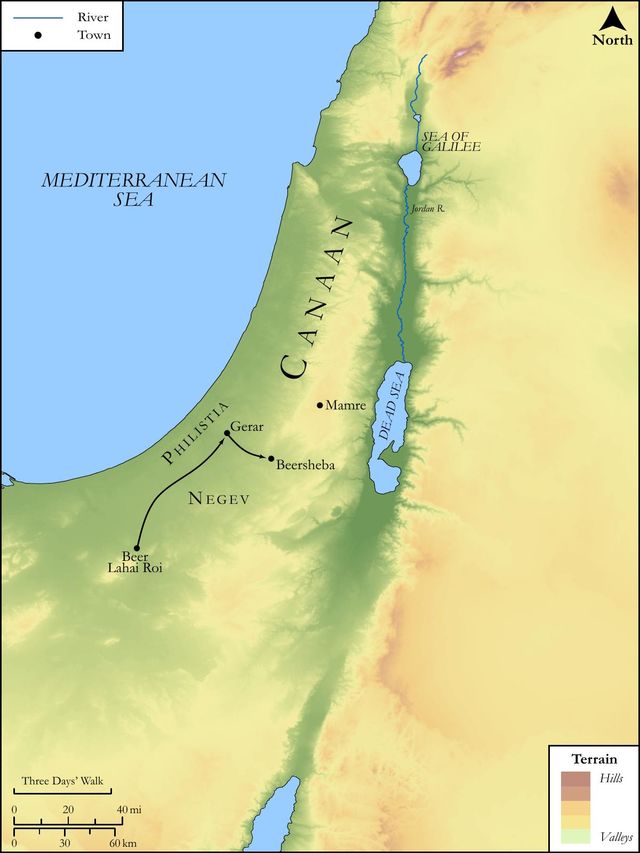
This verse is situated within a crucial narrative arc in Genesis 26, detailing Isaac's experiences during a severe famine. Having been commanded by God to remain in the land of Canaan rather than going down to Egypt (echoing his father Abraham's earlier journey), Isaac settled in Gerar, a Philistine territory. God renewed His covenant promises to Isaac, pledging to bless him, multiply his offspring, and grant him the land (Genesis 26:2-4). Isaac's subsequent prosperity, however, ignited intense envy among the Philistines, who maliciously stopped up the wells that Abraham's servants had dug (Genesis 26:15). Isaac's response was not confrontation but strategic relocation to the valley of Gerar, where he diligently redigged and renamed those ancient wells of his father (Genesis 26:18). The discovery in verse 19, however, marks a distinct moment: the finding of a new, previously unknown source of water, signifying a fresh act of divine favor and abundant provision beyond the restoration of old resources.
Historical & Cultural Context
In the semi-arid climate of the ancient Near East, water was the most vital resource, directly correlating with life, survival, and prosperity for nomadic pastoralists like Isaac. Access to water determined the viability of flocks, the sustenance of families, and the very possibility of settlement. Wells were not merely sources of drinking water but strategic assets, often leading to disputes and conflicts, as evidenced by the subsequent contention over wells like Esek and Sitnah (Genesis 26:20-21). The act of digging a well was a significant investment of labor and resources, and finding a "springing" or "living" well (one with a continuous, natural flow) was an exceptionally valuable discovery, far superior to stagnant cisterns or collected rainwater. This context underscores the immense practical and symbolic significance of the discovery in Genesis 26:19.
Key Themes
ShowHideThe narrative surrounding Isaac's wells in Genesis 26 powerfully illustrates several key themes. Foremost is Divine Provision, showcasing God's unwavering commitment to sustain His covenant people even in hostile environments and through unexpected means. This ties into Covenant Faithfulness, as God's blessings to Isaac directly fulfill the promises made to Abraham and reiterated to Isaac himself (Genesis 26:3-4). The narrative also highlights Perseverance and Diligence on Isaac's part, as he and his servants persistently dug despite opposition, demonstrating that human effort, coupled with faith, often precedes divine breakthrough. Furthermore, the constant conflict over wells emphasizes the theme of Contention over Resources and the challenges faced by God's people in a fallen world. Finally, the "springing water" introduces the profound Symbolism of Living Water, which foreshadows deeper spiritual truths about life and refreshment that culminate in the New Testament.
Exposition and Analysis
ShowHideKey Word Analysis
ShowHideFrom a primitive root meaning "to pry into; by implication, to delve, to explore." This word emphasizes the deliberate, persistent, and laborious effort involved in the servants' actions. It suggests a thorough and investigative search, not a casual discovery, highlighting the diligence of Isaac's household in seeking out this vital resource.
Derived from a root meaning "to make clear," this term refers to a pit, specifically one dug to access water. It signifies a constructed source, distinguishing it from a natural spring that might simply emerge from the ground. The discovery of a bᵉʼêr implies successful engineering and access to an underground water table.
From the root châyâh (to live), this adjective means "alive; hence, fresh (plant, water, year)." When applied to water, it denotes "living water" (Hebrew: mayim chayyim), referring to fresh, flowing water from a natural spring or underground source, as opposed to stagnant water collected in a cistern or rainwater. This quality makes the water highly prized for its purity, coolness, and continuous supply, signifying superior and abundant provision.
This is the dual form of a primitive noun, used in a singular sense, referring to "water." It is the fundamental element, but when combined with chay (springing/living), it takes on a special significance, denoting the highest quality and most desirable form of water in the ancient world.
Verse Breakdown
ShowHide"And Isaac's servants digged in the valley"
This clause sets the scene, identifying the agents (Isaac's servants, acting under his direction) and their location (the valley). The act of "digging" (Hebrew: châphar) denotes deliberate, laborious, and persistent effort. Isaac had previously moved to the valley of Gerar after being driven out by the Philistines, and he had already redigged Abraham's wells there (Genesis 26:18). This particular digging, however, leads to a new discovery, suggesting a continued search for resources beyond merely reclaiming what was lost.
"and found there a well of springing water."
This is the climactic discovery. The verb "found" (Hebrew: mâtsâʼ) implies a successful outcome to their diligent search. The object found is not just any well, but specifically a "well of springing water" (Hebrew: bᵉʼêr mayim chayyim). This phrase is crucial: "springing water" (mayim chayyim, literally "living water") refers to fresh, flowing water from a natural spring or underground source, which was highly valued for its continuous supply, purity, and coolness compared to stagnant well water or cisterns. This signifies an abundant, natural, and superior source of water, representing a profound blessing and a clear indication of divine favor and provision for Isaac and his household.
Literary Devices
ShowHideThe verse employs several significant literary devices. Symbolism is prominent, as the "well of springing water" (or "living water") represents far more than just a physical resource. It symbolizes divine blessing, abundant provision, life, and refreshment in a hostile and arid environment. Its discovery underscores God's ability to provide beyond human expectation or effort, even when existing resources are contested or withheld. Furthermore, there is an element of Contrast between the Philistines' hostile act of stopping up Abraham's wells (Genesis 26:15) and Isaac's diligent, peaceful pursuit of new water sources, which God ultimately blesses. This highlights Isaac's patient trust in God's provision versus the Philistines' envy and aggression. Finally, the phrase "living water" serves as Foreshadowing, subtly introducing a concept that will later gain profound spiritual significance throughout Scripture, culminating in its metaphorical use by Jesus in the New Testament.
Theological and Thematic Connections
ShowHideThe discovery of the well of "springing water" in Genesis 26:19 is a profound theological statement about God's character and His relationship with His covenant people. It powerfully demonstrates God's unwavering faithfulness to His promises of blessing and provision, even when His people face adversity, opposition, and scarcity. This event underscores His sovereign ability to provide abundantly, often in unexpected ways, exceeding human expectations or efforts. It highlights that God's blessings are not contingent on ideal circumstances but can manifest powerfully even in the face of hostility and lack, affirming His sustaining presence and care for those who trust in Him.
Reflection and Application
ShowHideGenesis 26:19 offers timeless lessons for believers today, encouraging unwavering trust in God's faithful and abundant provision. Just as Isaac's servants diligently sought water in a challenging and contested environment, we are called to persist in our faith, prayer, and efforts, knowing that God is capable of providing abundantly, often in unexpected ways, even when faced with adversity, opposition, or scarcity. This narrative reminds us that God's blessings can extend beyond merely restoring what was lost; He can bring forth new sources of refreshment, life, and breakthrough that surpass our expectations. It challenges us to look beyond immediate circumstances and trust in the sovereign hand of God to meet our needs, both physical and spiritual, and to remember that our deepest thirst can ultimately only be quenched by the true "living water" that flows from God through Christ, offering eternal sustenance and spiritual renewal.
Questions for Reflection
ShowHideFAQ
ShowHideDoes "living water" in Genesis 26:19 have a spiritual meaning beyond physical water?
ShowHideWhile primarily referring to fresh, flowing spring water (Hebrew: mayim chayyim) in its immediate context, the term "living water" carries a profound spiritual resonance that develops throughout Scripture. In the Old Testament, it symbolizes purity, life, and divine blessing, often associated with God's provision in the wilderness (e.g., Exodus 17:6 or Numbers 20:11). In the New Testament, particularly through Jesus's teachings, "living water" becomes a direct and powerful metaphor for the Holy Spirit, eternal life, and the spiritual refreshment and satisfaction that only Christ can provide to those who believe in Him. For instance, Jesus tells the Samaritan woman at the well, "If you knew the gift of God, and who it is that says to you, 'Give me a drink,' you would have asked him, and he would have given you living water" (John 4:10). Later, He declares, "Whoever believes in me, as the Scripture has said, 'Out of his heart will flow rivers of living water'" (John 7:38). Thus, while Genesis 26:19 describes a physical blessing, it subtly foreshadows a deeper, spiritual reality that finds its ultimate fulfillment in Christ.
Christ-Centered Fulfillment
ShowHideThe discovery of "springing water" for Isaac in Genesis 26:19 serves as a beautiful and poignant type of Christ, the ultimate and inexhaustible source of "living water." Just as this physical well sustained Isaac's life and prosperity in a barren and hostile land, providing essential refreshment and enabling flourishing, Christ offers spiritual living water that sustains eternal life and satisfies the deepest thirst of the human soul. Isaac's experience of finding a new, abundant source of water amidst contention and scarcity powerfully foreshadows Jesus's promise to give "rivers of living water" to those who believe in Him, a provision that transcends earthly needs and offers eternal spiritual refreshment and fulfillment. He is the one who declares, "If anyone thirsts, let him come to me and drink" (John 7:37). The earthly well for Isaac points to the heavenly wellspring of grace and truth found in Jesus, who alone can truly quench our spiritual longing and provide life everlasting, just as He offered the Samaritan woman living water that would forever satisfy her soul.