


Genesis 26:7
- וַיִּשְׁאֲלוּvai·yish·'a·Luand they askedH7592Conj-w ¦ V-Qal-ConsecImperf-3mpVerb Qal Consecutive Imperfect 3rd Plural Masculineוַandיִּשְׁאֲלוּthey asked
- אַנְשֵׁי'an·Shei[the] men ofH582N-mpcNoun Plural Masculine Construct
- הַמָּקוֹםha·ma·kOmthe placeH4725Art ¦ N-msNoun Singular Masculine Absoluteהַtheמָּקוֹםplace
- לְאִשְׁתּוֹle·'ish·Toof his wifeH802Prep-l ¦ N-fsc ¦ 3msNoun Singular Feminine Constructלְofאִשְׁתּwifeוֹhis
- וַיֹּאמֶרvai·Yo·merand he saidH559Conj-w ¦ V-Qal-ConsecImperf-3msVerb Qal Consecutive Imperfect 3rd Singular Masculineוַandיֹּאמֶרhe said
- אֲחֹתִי'a·Cho·ti[is] my sisterH269N-fsc ¦ 1csNoun Singular Feminine Constructאֲחֹתִ[is] sisterיmy
- הִואhi'sheH1931Pro-3fsPronoun Personal 3rd Singular Feminine
- כִּיkiforH3588PrtParticle Conditional
- יָרֵאya·Re'he was afraidH3372V-Qal-Perf-3msVerb Qal Perfect 3rd Singular Masculine
- לֵאמֹרle·Morto sayH559Prep-l ¦ V-Qal-InfVerb Qal Infinitive Constructלֵtoאמֹרsay
- אִשְׁתִּי'ish·Timy wifeH802N-fsc ¦ 1csNoun Singular Feminine Constructאִשְׁתִּwifeיmy
- פֶּןpenlestH6435PrtParticle Conditional
- יַהַרְגֻנִיya·har·Gu·nithey should kill meH2026V-Qal-Imperf-3mp ¦ 1csVerb Qal Imperfect 3rd Plural Masculineיַהַרְגֻthey should killנִיme
- אַנְשֵׁי'an·Shei[the] men ofH582N-mpcNoun Plural Masculine Construct
- הַמָּקוֹםha·ma·kOmthe placeH4725Art ¦ N-msNoun Singular Masculine Absoluteהַtheמָּקוֹםplace
- עַל'alonH5921PrepPreposition
- רִבְקָהriv·KahRebekahH7259N-proper-fNoun Proper Feminine
- כִּיkiforH3588PrtParticle Conditional
- טוֹבַתto·Vat[was] good ofH2896Adj-fscAdjective Singular Feminine Construct
- מַרְאֶהmar·'EhappearanceH4758N-msNoun Singular Masculine Absolute
- הִיאHi'sheH1931Pro-3fsPronoun Personal 3rd Singular Feminine
English is a literal word-by-word gloss of the Hebrew, not the KJV's wording. Why?
This is the original text the KJV's translators worked from — each Hebrew word with its own literal English meaning in this verse, prepared by scholars at Tyndale House, Cambridge. The KJV translates whole sentences, not word by word, so its wording differs: one Hebrew word can become several English words, and the KJV may choose “the LORD” where the gloss reads “Yahweh”. Both are faithful — they answer different questions. For the KJV's own rendering, switch to the KJV text.
Details
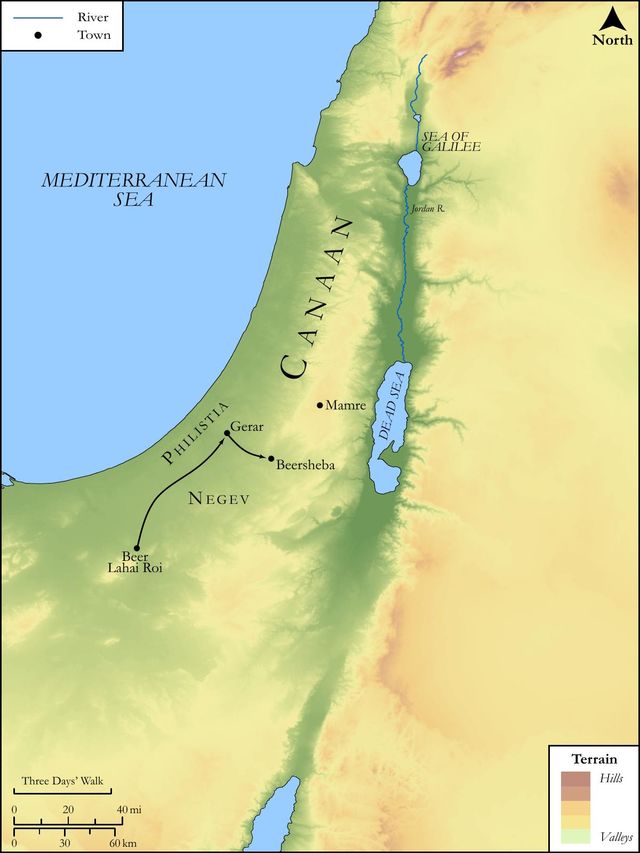
See on the biblical-era maps


Study this verse
Public-domain commentary
Matthew Henry
From his Commentary on the Whole Bible. Henry comments on passages, not single verses — this entry covers Genesis 26:6–11. His two-level outline is real structure in the source text, so it is rendered as structure.
Isaac had now laid aside all thoughts of going to Egypt, and, in obedience to the heavenly vision, sets up his staff in Gerar, the country in which he was born (Gen 26:6), yet there he enters into temptation, the same temptation that his good father had been once and again surprised and overcome by, namely, to deny his wife, and to give out that she was his sister. Observe,
I.How he sinned, Gen 26:7.
Because his wife was handsome, he fancied the Philistines would find some way or other to take him off, that some of them might marry her; and therefore she must pass for his sister. It is an unaccountable thing that both these great and good men should be guilty of so strange a piece of dissimulation, by which they so much exposed both their own and their wives' reputation. But we see,
1.That very good men have sometimes been guilty of very great faults and follies. Let those therefore that stand take heed lest they fall, and those that have fallen not despair of being helped up again.
2.That there is an aptness in us to imitate even the weaknesses and infirmities of those we have a value for. We have need therefore to keep our foot, lest, while we aim to tread in the steps of good men, we sometimes tread in their by-steps.
II.How he was detected, and the cheat discovered, by the king himself.
Abimelech (not the same that was in Abraham's days, ch. 20, for this was nearly 100 years after that, but this was the common name of the Philistine kings, as Caesar of the Roman emperors) saw Isaac more familiar and pleasant with Rebekah than he knew he would be with his sister (Gen 26:8): he saw him sporting with her, or laughing; it is the same word with that from which Isaac has his name. He was rejoicing with the wife of his youth, Pro 5:18. It becomes those in that relation to be pleasant with one another, as those that are pleased with one another. Nowhere may a man more allow himself to be innocently merry than with his own wife and children. Abimelech charged him with the fraud (Gen 26:9), showed him how frivolous his excuse was and what might have been the bad consequences of it (Gen 26:10), and then, to convince him how groundless and unjust his jealousy of them was, took him and his family under his particular protection, forbidding any injury to be done to him or his wife upon pain of death, Gen 26:11. Note,
1.A lying tongue is but for a moment. Truth is the daughter of time; and, in time, it will out.
2.One sin is often the inlet to many, and therefore the beginnings of sin ought to be avoided.
3.The sins of professors shame them before those that are without.
4.God can make those that are incensed against his people, though there may be some colour of cause for it, to know that it is at their peril if they do them any hurt. See Psa 105:14, Psa 105:15.
Historical interpretation
Historical reception
1 surviving comment on this verse from the historical church.
Those who assert that sometimes we must lie make inappropriate mention of Abraham as having lied about Sarah whom he called his sister. For he did not say “She is not my wife” but “She is my sister,” because Sarah was in fact of a family so closely related that without lying she could be called his sister. This fact Abraham confirmed afterward when Sarah was returned by him who had led her away. Abraham replied to him, saying, “Also she is truly my sister, the daughter of my father, and not the daughter of my mother,” that is to say, belonging to his father’s family but not to his mother’s. Thus he concealed something of the truth but did not say anything false in concealing the fact that she was his wife and in saying that she was his sister. His son Isaac also did this, for we know that he too chose a relative of his as wife. Hence it is not a lie when truth is passed over in silence but when falsehood is brought forth in speech.
Continue studying Genesis 26:7 across the web’s major study libraries — every link below opens this exact verse, chapter, or book on the destination site.
Read & Compare
 BibleGatewayThis verse in more than 200 translations and 70 languages.
 Bible.comThe YouVersion reader — hundreds of translations, reading plans, and highlights.
 ESV.orgCrossway's official English Standard Version reader.
 NET BibleThe NET translation with 60,000+ translators' notes on every rendering decision.
 STEP BibleTyndale House's free study tool — original text, vocabulary, and scholarly resources.
 BibliaLogos Bible Software's free web reader.
 USCCBThe New American Bible (Revised Edition) with the U.S. bishops' study notes.
Commentaries
 BibleHub CommentariesDozens of classic commentaries on this verse, gathered on one page.
 StudyLightMore than 100 commentary sets — the largest collection on the web.
 BibleRefPlain-English commentary on what this verse means, verse by verse.
 Enduring WordDavid Guzik's free commentary on this chapter, widely used by Bible teachers.
 Bible Study ToolsVerse commentary alongside Greek and Hebrew study aids.
Original Language & Research
- BibleHub InterlinearThe verse word by word — original language, transliteration, and English.
- BibleHub LexiconEvery word's original-language definition and Strong's entry.
 Blue Letter BibleDeep-study tools — Strong's numbers, concordance, and word studies.
 SefariaThe Hebrew text with Rashi and centuries of Jewish commentary.
Sermons, Hymns & Audio


TrulyRandomVerse is not affiliated with these sites and doesn’t control their content. They’re linked because they’re genuinely useful.
Summary
Genesis 26:7 recounts Isaac's deceptive act in Gerar, where, out of fear for his life, he claims his beautiful wife Rebekah is his sister. This incident strikingly mirrors his father Abraham's similar deceptions, revealing a recurring pattern of human fear, a lack of trust in God's protection, and a failure to fully embrace the implications of divine covenant promises, even among those chosen by God.
Context
ShowHideLiterary Context
Genesis 26:7 is situated within a narrative block (Genesis 26:1-33) that details Isaac's sojourn in Gerar during a famine. Immediately preceding this verse, God appears to Isaac, explicitly commanding him not to go to Egypt but to remain in the land God would show him, reiterating the Abrahamic covenant promises of land, numerous descendants, and universal blessing through his offspring (Genesis 26:2-5). This divine assurance sets a crucial backdrop for Isaac's subsequent actions, highlighting his immediate failure to fully trust God's protection despite a fresh, direct revelation of His faithfulness. The verse then directly parallels Abraham's deceptions concerning Sarah in Genesis 12:10-20 and Genesis 20:1-18, establishing a thematic link across generations of patriarchs.
Historical & Cultural Context
The patriarchal period was often characterized by a precarious existence where personal safety and the protection of one's family, especially women, were constant concerns. Powerful men or rulers could assert their will, sometimes violently, to acquire beautiful women. The fear of being killed to take a wife was a genuine threat, as evidenced by similar narratives and legal codes from the period. Furthermore, the practice of claiming a wife as a sister might have offered a degree of protection or legal advantage in certain cultural contexts, though in these biblical narratives, it primarily serves as a deceptive means of self-preservation. Gerar, a Philistine city, was a foreign land for Isaac, adding to the sense of vulnerability and the perceived need for cunning rather than outright trust.
Key Themes
ShowHideThis verse contributes significantly to several overarching themes in Genesis. It powerfully illustrates the theme of human fallibility and sin, even among God's chosen patriarchs, demonstrating that faith is often a struggle against fear and self-preservation instincts. It underscores the sovereignty and faithfulness of God, who preserves His covenant people and purposes despite their failures, as seen when Abimelech discovers the truth and protects Isaac (Genesis 26:8-11). The striking parallel with Abraham's earlier deceptions also introduces the theme of generational patterns, suggesting that both blessings and weaknesses can be passed down within families. Finally, it highlights the danger of fear overriding trust in God's explicit promises, a recurring lesson throughout the biblical narrative.
Exposition and Analysis
ShowHideKey Word Analysis
ShowHideThis primitive root signifies not merely being afraid, but often a profound dread or reverence. Here, it denotes Isaac's deep-seated apprehension for his life, causing him to prioritize self-preservation over truth. While the word can also mean "to revere" (as in "fear of the Lord"), its usage here clearly points to a paralyzing human fear that leads to moral compromise.
An irregular feminine form meaning "sister," used broadly. In this context, it is the deliberate falsehood Isaac employs to conceal his true relationship with Rebekah. His claim transforms his wife into a relative who might be taken into another's household without directly endangering his life, as a husband would be.
A primitive root meaning "to smite with deadly intent," "destroy," or "murder." This word directly expresses the extreme consequence Isaac fears. It reveals the perceived high stakes of the situation and the violent potential of the "men of the place" if they were to discover Rebekah was his wife.
Verse Breakdown
ShowHide"And the men of the place asked [him] of his wife;"
This opening clause sets the scene, indicating that the local inhabitants of Gerar observed Isaac and Rebekah and, perhaps noticing her beauty or their unusual relationship, inquired about her identity. This inquiry presented Isaac with a direct challenge to his integrity and trust in God.
"and he said, She [is] my sister:"
Isaac's immediate response is a deliberate lie. Instead of affirming his marital bond, he misrepresents Rebekah's relationship to him, choosing deception as a perceived means of protection. This statement is the core of his moral compromise.
"for he feared to say, [She is] my wife;"
This clause explicitly states Isaac's motivation. His fear of the potential consequences of revealing the truth was so profound that it prevented him from acknowledging Rebekah as his wife. This fear reveals a momentary lapse in his trust in God's protective power, despite recent divine promises.
"lest, [said he], the men of the place should kill me for Rebekah;"
Isaac's specific fear is articulated: he believed that the men of Gerar would murder him in order to take Rebekah for themselves. This highlights the harsh realities of that day, where a beautiful woman could be a source of extreme danger to her male protector.
"because she [was] fair to look upon."
This final clause provides the direct catalyst for Isaac's fear and deception. Rebekah's exceptional beauty is presented as the primary reason for the perceived threat. The phrase "fair to look upon" (Hebrew: ṭôwb_ _marʼeh) emphasizes her striking physical attractiveness, which, in that cultural context, could incite covetousness and violence.
Literary Devices
ShowHideThe narrative in Genesis 26:7 employs several significant literary devices. Repetition is prominently featured, as Isaac's deception directly echoes Abraham's identical actions in earlier chapters of Genesis. This thematic repetition underscores a generational pattern of human weakness and a struggle with faith, even among God's chosen. There is also a strong element of Irony: immediately after God renews His covenant promises of protection and blessing to Isaac in Genesis 26:2-5, Isaac responds not with trust, but with fear and deceit. This highlights the stark contrast between divine faithfulness and human fallibility. The narrative also serves as Characterization, revealing Isaac as a complex and flawed patriarch, susceptible to the same fears and moral compromises as his father, despite his unique covenantal position. Finally, the explicit statement of Rebekah's beauty as the cause of Isaac's fear functions as Cause and Effect, directly linking her physical attractiveness to the dangerous situation and Isaac's subsequent lie.
Theological and Thematic Connections
ShowHideGenesis 26:7 vividly illustrates the persistent tension between human fear and divine faithfulness. Despite God's fresh and explicit promises of protection and blessing to Isaac, his immediate response to perceived danger is a resort to self-preservation through deception. This narrative powerfully demonstrates that even those in covenant relationship with God can succumb to fear and compromise their integrity. Yet, it also implicitly highlights God's unwavering commitment to His covenant. Even when His people falter, His purposes are not thwarted, and He often intervenes to protect them and His promises, as seen later in the chapter when Abimelech discovers the truth and safeguards Isaac and Rebekah. This passage serves as a sobering reminder of human weakness and the constant need for faith, while simultaneously affirming God's steadfast grace.
Reflection and Application
ShowHideGenesis 26:7 offers a profound mirror for self-reflection, challenging us to confront the pervasive power of fear in our own lives. Isaac, a patriarch blessed by God with direct promises, still chose to rely on a lie rather than fully trust in divine protection. This compels us to ask: In what areas of our lives do we succumb to fear, choosing our own deceptive schemes or self-protective measures over radical trust in God's sovereignty and provision? Do we believe God's promises are true only when circumstances are favorable, or do we cling to them even when faced with perceived threats to our safety, reputation, or livelihood? The narrative calls us to cultivate a deeper, more robust faith that stands firm amidst uncertainty, reminding us that true security is found not in our cleverness or deception, but in unwavering reliance on the One who is faithful to His every word. Our integrity, rooted in trust, is a more valuable possession than any fleeting sense of safety gained through compromise.
Questions for Reflection
ShowHideFAQ
ShowHideWhy did Isaac lie about Rebekah being his sister, given God's recent promises?
ShowHideIsaac lied out of intense fear for his life. He believed that the "men of the place" in Gerar would kill him to take Rebekah because of her exceptional beauty. Despite God's very recent and direct renewal of covenant promises, including protection and blessing, in Genesis 26:2-5, Isaac's immediate, human instinct for self-preservation temporarily overshadowed his faith in divine providence. This highlights the common human struggle between intellectual assent to God's promises and the practical application of trust in moments of perceived danger.
How does Isaac's deception compare to Abraham's similar acts?
ShowHideIsaac's deception in Genesis 26:7 is remarkably similar to his father Abraham's two previous instances of claiming Sarah was his sister (Genesis 12:11-13 and Genesis 20:2). Both patriarchs acted out of fear for their lives due to their wives' beauty, and both incidents occurred in foreign lands. This striking repetition suggests a generational pattern of weakness and a shared struggle with fully trusting God's protection. It underscores the fallibility of even God's chosen servants, demonstrating that even great men of faith are prone to human fear and moral compromise.
Christ-Centered Fulfillment
ShowHideIsaac's fearful deception in Genesis 26:7 starkly illuminates the profound human need for a perfect deliverer and a perfect trust. The patriarchs, though recipients of God's covenant promises, were deeply flawed individuals, unable to perfectly uphold truth or fully trust God's protection. This recurring pattern of human sin and weakness throughout the Old Testament narrative points forward to the absolute necessity of Jesus Christ. Unlike Isaac, Jesus, the true and faithful Son, never succumbed to fear or deception. He perfectly trusted His Father, even in the face of death, declaring, "I am the way, the truth, and the life". His life of perfect obedience and spotless integrity fulfills the righteousness that the patriarchs lacked, providing the ultimate and unfailing covenant promise. Through His atoning sacrifice and resurrection, Christ secures God's blessing and protection for all who believe, demonstrating that true security is found not in human schemes, but in the perfect work of the Lamb of God, who takes away the sin of the world. He is the one who, "for the joy that was set before him endured the cross, despising the shame," perfectly trusting the Father's plan.