


Genesis 20:2
Bible text: King James Version (1769 Blayney text) · Public domain
Bible text: Berean Standard Bible · Public domain
Bible text: American Standard Version (1901) · Public domain
Bible text: World English Bible, Messianic edition · Public domain
Bible text: Geneva Bible (1599) · Public domain
Bible text: Young's Literal Translation · Public domain
- וַיֹּאמֶרvai·Yo·merand he saidH559Conj-w ¦ V-Qal-ConsecImperf-3msVerb Qal Consecutive Imperfect 3rd Singular Masculineוַandיֹּאמֶרhe said
- אַבְרָהָם'av·ra·HamAbrahamH85N-proper-mNoun Proper Masculine
- אֶל'elconcerningH413PrepPreposition
- שָׂרָהsa·RahSarahH8283N-proper-fNoun Proper Feminine
- אִשְׁתּוֹ'ish·Tohis wifeH802N-fsc ¦ 3msNoun Singular Feminine Constructאִשְׁתּwifeוֹhis
- אֲחֹתִי'a·Cho·ti[is] my sisterH269N-fsc ¦ 1csNoun Singular Feminine Constructאֲחֹתִ[is] sisterיmy
- הִואhi'sheH1931Pro-3fsPronoun Personal 3rd Singular Feminine
- וַיִּשְׁלַחvai·yish·Lachand he sentH7971Conj-w ¦ V-Qal-ConsecImperf-3msVerb Qal Consecutive Imperfect 3rd Singular Masculineוַandיִּשְׁלַחhe sent
- אֲבִימֶלֶךְ'a·vi·Me·lekhAbimelechH40N-proper-mNoun Proper Masculine
- מֶלֶךְMe·lekh[the] king ofH4428N-mscNoun Singular Masculine Construct
- גְּרָרge·RarGerarH1642N-properNoun Proper Location
- וַיִּקַּחvai·yi·Kachand he tookH3947Conj-w ¦ V-Qal-ConsecImperf-3msVerb Qal Consecutive Imperfect 3rd Singular Masculineוַandיִּקַּחhe took
- אֶת'et<obj.>H853DirObjMParticle Object Indicator
- שָׂרָהsa·RahSarahH8283N-proper-fNoun Proper Feminine
English is a literal word-by-word gloss of the Hebrew, not the KJV's wording. Why?
This is the original text the KJV's translators worked from — each Hebrew word with its own literal English meaning in this verse, prepared by scholars at Tyndale House, Cambridge. The KJV translates whole sentences, not word by word, so its wording differs: one Hebrew word can become several English words, and the KJV may choose “the LORD” where the gloss reads “Yahweh”. Both are faithful — they answer different questions. For the KJV's own rendering, switch to the KJV text.
Details
See on the biblical-era maps


Study this verse
Public-domain commentary
Matthew Henry
From his Commentary on the Whole Bible. Henry comments on passages, not single verses — this entry covers Genesis 20:1–2.
Here is, 1. Abraham's removal from Mamre, where he had lived nearly twenty years, into the country of the Philistines: He sojourned in Gerar, Gen 20:1. We are not told upon what occasion he removed, whether terrified by the destruction of Sodom, or because the country round was for the present prejudiced by it, or, as some of the Jewish writers say, because he was grieved at Lot's incest with his daughters, and the reproach which the Canaanites cast upon him and his religion, for his kinsman's sake: doubtless there was some good cause for his removal. Note, In a world where we are strangers and pilgrims we cannot expect to be always in the same place. Again, Wherever we are, we must look upon ourselves but as sojourners. 2. His sin in denying his wife, as before (Gen 12:13), which was not only in itself such an equivocation as bordered upon a lie, and which, if admitted as lawful, would be the ruin of human converse and an inlet to all falsehood, but was also an exposing of the chastity and honour of his wife, of which he ought to have been the protector. But, besides this, it had here a two-fold aggravation: - (1.) He had been guilty of this same sin before, and had been reproved for it, and convinced of the folly of the suggestion which induced him to it; yet he returns to it. Note, It is possible that a good man may, not only fall into sin, but relapse into the same sin, through the surprise and strength of temptation and the infirmity of the flesh. Let backsliders repent then, but not despair, Jer 3:22. (2.) Sarah, as it should seem, was now with child of the promised seed, or, at least, in expectation of being so quickly, according to the word of God; he ought therefore to have taken particular care of her now, as Jdg 13:4. 3. The peril that Sarah was brought into by this means: The king of Gerar sent, and took her to his house, in order to the taking of her to his bed. Note, The sin of one often occasions the sin of others; he that breaks the hedge of God's commandments opens a gap to he knows not how many; the beginning of sin is as the letting forth of water.
Historical interpretation
Five Centuries of Reception
3 surviving comments on this verse. Each one is dated, so this reads as a timeline rather than a list.
Select a marker to jump to its quote. Markers stagger vertically where authors wrote within a few decades of each other.
I think, therefore, that Sarah, which means “princess” or “one who governs empires,” represents aretē, which is the virtue of the soul. This virtue then is joined to and clings to a wise and faithful man, even as that wise man who said of wisdom, “I have desired to take her for my spouse.” For this reason therefore God says to Abraham, “In all that Sarah has said to you, listen to her voice.” This saying, at any rate, is not appropriate to physical marriage, since that well known statement was revealed from heaven which says to the woman concerning the man, “In him shall be your refuge, and he shall have dominion over you.” If therefore the husband is said to be lord of his wife, how is it said again to the man, “In all that Sarah has said to you, pay attention to her voice”? If anyone therefore has married virtue, let him listen to her voice in all which she shall counsel him.Abraham therefore does not now wish that virtue be called his wife. For as long as virtue is called his wife, she belongs to him and can be shared with no one. And it is proper that until we reach perfection, virtue of the soul be within us and personal. But when we reach perfection so that we are capable also of teaching others, let us then no longer enclose virtue within our bosom as a wife but as a sister; let us unite her also with others who desire her. For to those who are perfect the divine Word says, “Say that wisdom is your sister.” In this way therefore Abraham too said Sarah was his sister.…
Nevertheless Pharaoh too once wished to receive Sarah, but he did not wish with a pure heart; and virtue cannot unite except with purity of heart. For this reason, therefore, Scripture relates that “the Lord afflicted Pharaoh with afflictions which were grievous and most severe.” For virtue could not dwell with a destroyer—for this is what Pharaoh means in our language.
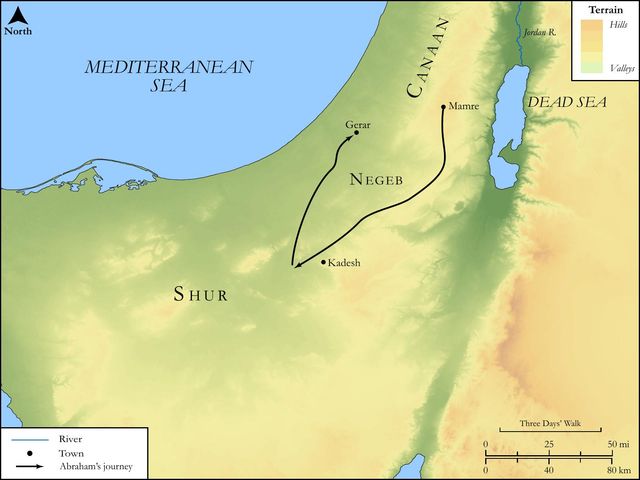
“Abraham moved from there to the southern land,” the text goes on, “and dwelt between Kadesh and Shur, sojourning at Gerar.” Moved on from where? From the place where he was camped, where he was given the privilege of hosting the Lord of all with the angels. Moving from there, the text says, “he sojourned in Gerar.” Notice the life of these good people, how restrained and austere it was, how they shifted place with ease and conducted their life like pilgrims or nomads, pitching their tent at one time in this place, at another in that, as though living in a strange land. They are unlike us, who live in a strange land as though in our home country, erecting extravagant mansions, porches and covered walks, possessing land, building baths and countless other luxuries.By contrast see the good man holding all his possessions in his household and flocks alone. [He is] never staying in one place but at one time pitching his tent in Bethel, at another by the oak of Mamre, at another going down to Egypt and now camping at Gerar, submitting to all this with ease and giving clear evidence in every way of gratitude to his own Lord. Despite such wonderful promises and guarantees given him by God, he saw himself beset by such imposing difficulties and encountering such varied and differing trials. Yet he stood unshaken like some piece of steel, showing his godly attitude and proving no less resolute in any of the problems surrounding him. See in the present instance too, dearly beloved, the kind of trial that befell him at Gerar and the wonderful caliber of the just man’s virtue. What everyone else found unbearable and could not bring themselves to accept he put up with without complaint and without demanding from the Lord explanation of what happened, as many people do, even though weighed down with countless burdens of sin. When they encounter some difficulties, they become meddlesome and inquisitive, saying, “Why has this or that happened?” The just man, on the contrary, didn’t behave like that; hence he enjoyed greater favor from on high. This, after all, is truly the mark of a dutiful servant, not to pry into reasons for what is done by the master but to accept everything in silence and with deep thanks.
And he said of Sarah his wife, She is my sister. So Abimelech king of Gerar sent, and took her. Why Abraham said this about Sarah, and whence it should be believed that she, although taken into the king's house, was by no means touched by the king's embrace, has already been said above, where in a similar manner she was taken by Pharaoh but returned to her husband at the command of the Lord. It follows.
Continue studying Genesis 20:2 across the web’s major study libraries — every link below opens this exact verse, chapter, or book on the destination site.
Read & Compare
 BibleGatewayThis verse in more than 200 translations and 70 languages.
 Bible.comThe YouVersion reader — hundreds of translations, reading plans, and highlights.
 ESV.orgCrossway's official English Standard Version reader.
 NET BibleThe NET translation with 60,000+ translators' notes on every rendering decision.
 STEP BibleTyndale House's free study tool — original text, vocabulary, and scholarly resources.
 BibliaLogos Bible Software's free web reader.
 USCCBThe New American Bible (Revised Edition) with the U.S. bishops' study notes.
Commentaries
 BibleHub CommentariesDozens of classic commentaries on this verse, gathered on one page.
 StudyLightMore than 100 commentary sets — the largest collection on the web.
 BibleRefPlain-English commentary on what this verse means, verse by verse.
 Enduring WordDavid Guzik's free commentary on this chapter, widely used by Bible teachers.
 Bible Study ToolsVerse commentary alongside Greek and Hebrew study aids.
Original Language & Research
- BibleHub InterlinearThe verse word by word — original language, transliteration, and English.
- BibleHub LexiconEvery word's original-language definition and Strong's entry.
 Blue Letter BibleDeep-study tools — Strong's numbers, concordance, and word studies.
 SefariaThe Hebrew text with Rashi and centuries of Jewish commentary.
Sermons, Hymns & Audio


TrulyRandomVerse is not affiliated with these sites and doesn’t control their content. They’re linked because they’re genuinely useful.
Summary
Abraham's troubling repetition of a past deception, where he presents his wife, Sarah, as his sister to Abimelech, the king of Gerar. This act of fear-driven self-preservation, despite God's prior covenant promises, leads Abimelech to take Sarah into his royal household. The verse sets the stage for divine intervention, highlighting God's unwavering faithfulness to protect His covenant and the integrity of the lineage through which the promised heir would come, even in the face of human frailty.
Context
ShowHideLiterary Context
Genesis 20:2 immediately follows Abraham's relocation from Mamre to Gerar, a Philistine city (Genesis 20:1). This verse advances a narrative sequence that strikingly mirrors an earlier incident in Abraham's life, detailed in Genesis 12:10-20. The repetition of this "sister-wife" deception underscores a persistent character flaw in Abraham, even after significant spiritual growth and the establishment of the Abrahamic covenant in Genesis 17. The narrative tension arises from the threat this deception poses to Sarah's purity and, by extension, to the promised lineage through which Isaac, the heir, is to be born (Genesis 18:10). The subsequent verses (Genesis 20:3-7) reveal God's direct intervention to protect Sarah and confront Abimelech, demonstrating divine oversight of the covenant plan.
Historical & Cultural Context
The setting is Gerar, a Philistine city-state in the Negev region, ruled by King Abimelech. Among the kings of that day, a king's household often included a harem, and taking a woman into it was a common practice, though typically with proper marital arrangements. The concern for a woman's beauty leading to the murder of her male relative (husband or father) was a real fear in a society where powerful rulers could act with impunity. Abraham's rationale, while morally questionable, was rooted in a pragmatic (though faithless) assessment of the dangers of his transient existence in foreign lands. The fact that Sarah was indeed Abraham's half-sister (Genesis 20:12) complicates the ethical dimension, turning it into a "half-truth" rather than a complete lie, a common form of deception.
Key Themes
ShowHideThis verse contributes to several overarching themes in Genesis. Firstly, it highlights the theme of human fallibility and imperfection, even among God's chosen patriarchs. Abraham, despite being a man of great faith and recipient of divine promises (e.g., Genesis 15:6), repeatedly struggles with fear and resorts to self-preservation tactics. Secondly, it powerfully illustrates God's unwavering faithfulness and sovereign protection of His covenant promises. Despite Abraham's failure, God actively intervenes to safeguard Sarah and the promised lineage, demonstrating that His plan is not contingent on human perfection but on His own steadfast character. Thirdly, the narrative implicitly reinforces the sanctity of marriage and the importance of sexual purity, as God intervenes to prevent an unwitting violation of the marital bond.
Exposition and Analysis
ShowHideKey Word Analysis
ShowHideThis primitive root (H559) signifies "to say (used with great latitude)," encompassing declaration, command, and communication. In this context, Abraham's "saying" is a deliberate, calculated utterance intended to deceive. It's not a mere statement of fact but a strategic half-truth designed to manipulate Abimelech's perception and protect Abraham's own life, revealing a profound lapse in trust in God's protective power.
This term (H269) refers to a female sibling, used broadly. While Sarah was indeed Abraham's half-sister (Genesis 20:12), Abraham's use of this term here is deceptive. It conceals the crucial fact of her marital status, allowing Abimelech to assume she was available for marriage without consequence. This highlights the dangerous nature of partial truths used with malicious or self-serving intent.
Meaning "father of (the) king" (H40), this name denotes the reigning monarch of Gerar. His role in the narrative is crucial, as he becomes the unwitting recipient of Abraham's deception and the object of God's direct intervention. His actions, though problematic in outcome, are portrayed as being based on the information provided, contrasting with Abraham's deceptive intent.
This primitive root (H3947) means "to take (in the widest variety of applications)," including to accept, seize, or acquire. Here, it describes Abimelech's action of taking Sarah into his household. This "taking" is a direct consequence of Abraham's deception and sets in motion the divine intervention that follows, demonstrating the immediate and serious repercussions of Abraham's faithless act.
Verse Breakdown
ShowHide"And Abraham said of Sarah his wife, She [is] my sister"
This opening clause reveals Abraham's deliberate act of deception. Despite Sarah being his wife, Abraham explicitly states she is his sister. This is a calculated half-truth, as Sarah was indeed his half-sister (Genesis 20:12), but the statement was intended to conceal her marital status and protect Abraham from potential harm, showcasing a profound moment of fear overriding faith.
"and Abimelech king of Gerar sent, and took Sarah."
This second clause details the immediate consequence of Abraham's deception. Abimelech, acting on the false premise that Sarah was an unmarried woman, dispatched his servants to bring her into his royal household. This action, while seemingly innocent from Abimelech's perspective, places Sarah in a perilous situation and directly threatens the divine promise of an heir through her, necessitating God's swift and powerful intervention.
Literary Devices
ShowHideThe narrative of Genesis 20:2 employs several literary devices to convey its profound message. Repetition is a prominent feature, as this incident strikingly mirrors Abraham's earlier deception in Egypt (Genesis 12), highlighting a persistent character flaw and underscoring the enduring challenge of trusting God amidst fear. There is a strong element of Irony present: Abraham, the patriarch of faith, acts out of fear and deception, while Abimelech, a pagan king, is portrayed as acting with a measure of integrity, albeit based on false information, and later demonstrates a surprising receptiveness to God's revelation. This creates a moral inversion that serves to magnify God's faithfulness in contrast to human frailty. The verse also serves as a form of Foreshadowing, setting the stage for God's direct intervention (Genesis 20:3-7), which demonstrates His unwavering commitment to His covenant promises and His protective care over the lineage through which the Messiah would eventually come.
Theological and Thematic Connections
ShowHideGenesis 20:2 offers a stark reminder of the persistent struggle between faith and fear, even for those deeply committed to God. Abraham, despite having received incredible promises and experienced God's faithfulness firsthand, succumbs to fear for his life, choosing self-preservation over full trust in divine protection. This act, a repetition of a past failure, underscores the reality of human imperfection and the ongoing need for reliance on God's grace. Yet, the ensuing narrative powerfully demonstrates God's unwavering commitment to His covenant. Even when His chosen instruments falter, God's sovereign plan prevails, ensuring the protection of His people and the fulfillment of His promises. This passage ultimately points to God's faithfulness as the ultimate guarantor of His redemptive purposes, not human perfection.
Reflection and Application
ShowHideThe account in Genesis 20:2 serves as a powerful mirror for believers today, revealing the insidious nature of fear and its capacity to compromise our integrity and trust in God. Abraham's repeated failure reminds us that spiritual maturity is a journey, not a destination, and that even seasoned believers can fall prey to old habits of distrust when faced with perceived threats. Instead of devising our own schemes for security, we are called to a radical dependence on God's sovereign care, remembering that His faithfulness is not contingent upon our perfection. This passage encourages us to examine areas where fear might be driving our decisions, prompting us to surrender those anxieties to God and to walk in the truth, even when it feels risky. Ultimately, it reassures us that God's purposes will prevail, not because of our unwavering strength, but because of His unchanging character and power, inviting us to rest in His unfailing love.
Questions for Reflection
ShowHideFAQ
ShowHideWhy did Abraham repeat this deception?
ShowHideAbraham's repeated deception, first in Genesis 12:10-20 and again in Genesis 20:2, stemmed primarily from a deep-seated fear for his own life. He genuinely believed that his beautiful wife, Sarah, would put him in mortal danger in foreign lands, as powerful rulers might kill him to take her. This recurring pattern highlights a persistent struggle with fear and a lack of complete trust in God's protection, despite God's previous promises and interventions. It underscores that even great figures of faith can exhibit recurring weaknesses and that spiritual growth is a continuous process.
Was Sarah truly Abraham's sister?
ShowHideYes, Sarah was indeed Abraham's half-sister, sharing the same father (Terah) but not the same mother, as Abraham later clarifies in Genesis 20:12. Therefore, Abraham's statement was a factual half-truth, not a complete fabrication. However, he used this partial truth with deceptive intent, allowing Abimelech to assume a relationship that would permit him to take Sarah without perceived wrongdoing, thus protecting Abraham's life at Sarah's expense. The ethical problem lies in the deliberate intent to mislead.
How does God intervene to protect Sarah and Abraham in this situation?
ShowHideWhile Genesis 20:2 only describes Abimelech taking Sarah, the subsequent verses (Genesis 20:3-7) detail God's direct and sovereign intervention. God appeared to Abimelech in a dream, warning him that he would die if he touched Sarah, as she was a married woman. God also revealed Abraham's prophetic status and instructed Abimelech to return Sarah to him. This divine intervention protected Sarah's purity, prevented Abimelech from sinning unknowingly, and preserved the integrity of the covenant line through which the promised heir, Isaac, would come, demonstrating God's unwavering faithfulness to His promises.
Christ-Centered Fulfillment
ShowHideThe narrative of Genesis 20:2, while exposing Abraham's human frailty and fear-driven deception, ultimately serves as a profound backdrop for understanding the perfect faithfulness of Jesus Christ. Abraham's failure to fully trust God's protection, leading him to compromise his integrity and jeopardize the promised lineage, stands in stark contrast to Christ's unwavering obedience and perfect trust in His Father. Unlike Abraham, who acted out of self-preservation, Jesus, the true Son of Abraham, willingly laid down His life, not for His own safety, but for the salvation of humanity, demonstrating perfect love and obedience (Philippians 2:8). The divine intervention to protect Sarah and the covenant line in Genesis 20 foreshadows God's ultimate act of preservation through Christ. It is through Christ, the promised Seed (Galatians 3:16), that God's covenant with Abraham finds its ultimate and secure fulfillment. He is the one who perfectly secures His people, not through human cunning or half-truths, but through His perfect life, atoning death, and glorious resurrection, ensuring that all the families of the earth are blessed in Him (Genesis 12:3; Acts 3:25-26). In Christ, God's faithfulness is fully revealed, guaranteeing His covenant promises despite human sin and weakness.