


Genesis 20:1
Bible text: King James Version (1769 Blayney text) · Public domain
Bible text: Berean Standard Bible · Public domain
Bible text: American Standard Version (1901) · Public domain
Bible text: World English Bible, Messianic edition · Public domain
Bible text: Geneva Bible (1599) · Public domain
Bible text: Young's Literal Translation · Public domain
- וַיִּסַּעvai·yi·Sa'and he set outH5265Conj-w ¦ V-Qal-ConsecImperf-3msVerb Qal Consecutive Imperfect 3rd Singular Masculineוַandיִּסַּעhe set out
- מִשָּׁםmi·Shamfrom thereH8033Prep-m ¦ AdvAdverbמִfromשָּׁםthere
- אַבְרָהָם'av·ra·HamAbrahamH85N-proper-mNoun Proper Masculine
- אַרְצָה'Ar·tzah[the] land of towardsH776N-fsc ¦ SfxNoun Singular Feminine Constructאַרְצָ[the] land ofהtowards
- הַנֶּגֶבha·Ne·gevthe NegevH5045Art ¦ N-properNoun Proper LocationהַtheנֶּגֶבNegev
- וַיֵּשֶׁבvai·Ye·shevand he dweltH3427Conj-w ¦ V-Qal-ConsecImperf-3msVerb Qal Consecutive Imperfect 3rd Singular Masculineוַandיֵּשֶׁבhe dwelt
- בֵּיןbeinbetweenH996Adj-mscAdjective Numerical Singular Masculine Construct
- קָדֵשׁka·DeshKadeshH6946N-properNoun Proper Location
- וּבֵיןu·Veinand betweenH996Conj-w ¦ Adj-mscAdjective Numerical Singular Masculine Constructוּandבֵיןbetween
- שׁוּרShurShurH7793N-properNoun Proper Location
- וַיָּגָרvai·Ya·gorand he sojournedH1481Conj-w ¦ V-Qal-ConsecImperf-3msVerb Qal Consecutive Imperfect 3rd Singular Masculineוַandיָּגָרhe sojourned
- בִּגְרָרbig·Rarin GerarH1642Prep-b ¦ N-properNoun Proper LocationבִּinגְרָרGerar
English is a literal word-by-word gloss of the Hebrew, not the KJV's wording. Why?
This is the original text the KJV's translators worked from — each Hebrew word with its own literal English meaning in this verse, prepared by scholars at Tyndale House, Cambridge. The KJV translates whole sentences, not word by word, so its wording differs: one Hebrew word can become several English words, and the KJV may choose “the LORD” where the gloss reads “Yahweh”. Both are faithful — they answer different questions. For the KJV's own rendering, switch to the KJV text.
Details
See on the biblical-era maps


Study this verse
Public-domain commentary
Matthew Henry
From his Commentary on the Whole Bible. Henry comments on passages, not single verses — this entry covers Genesis 20:1–2.
Here is, 1. Abraham's removal from Mamre, where he had lived nearly twenty years, into the country of the Philistines: He sojourned in Gerar, Gen 20:1. We are not told upon what occasion he removed, whether terrified by the destruction of Sodom, or because the country round was for the present prejudiced by it, or, as some of the Jewish writers say, because he was grieved at Lot's incest with his daughters, and the reproach which the Canaanites cast upon him and his religion, for his kinsman's sake: doubtless there was some good cause for his removal. Note, In a world where we are strangers and pilgrims we cannot expect to be always in the same place. Again, Wherever we are, we must look upon ourselves but as sojourners. 2. His sin in denying his wife, as before (Gen 12:13), which was not only in itself such an equivocation as bordered upon a lie, and which, if admitted as lawful, would be the ruin of human converse and an inlet to all falsehood, but was also an exposing of the chastity and honour of his wife, of which he ought to have been the protector. But, besides this, it had here a two-fold aggravation: - (1.) He had been guilty of this same sin before, and had been reproved for it, and convinced of the folly of the suggestion which induced him to it; yet he returns to it. Note, It is possible that a good man may, not only fall into sin, but relapse into the same sin, through the surprise and strength of temptation and the infirmity of the flesh. Let backsliders repent then, but not despair, Jer 3:22. (2.) Sarah, as it should seem, was now with child of the promised seed, or, at least, in expectation of being so quickly, according to the word of God; he ought therefore to have taken particular care of her now, as Jdg 13:4. 3. The peril that Sarah was brought into by this means: The king of Gerar sent, and took her to his house, in order to the taking of her to his bed. Note, The sin of one often occasions the sin of others; he that breaks the hedge of God's commandments opens a gap to he knows not how many; the beginning of sin is as the letting forth of water.
Historical interpretation
Five Centuries of Reception
3 surviving comments on this verse. Each one is dated, so this reads as a timeline rather than a list.
Select a marker to jump to its quote. Markers stagger vertically where authors wrote within a few decades of each other.
We have read from the book of Genesis the story where it is related that after the appearance of the three men, after the destruction of Sodom and the salvation of Lot, either due to his hospitality or because of his kinship to Abraham, “Abraham departed thence,” the text says, “to the south” and came to the king of the Philistines. It is related also that he made an agreement with Sarah his wife that she should not say that she was Abraham’s wife but his sister. It is also said that King Abimelech took her, but God went in to Abim-elech at night and said to him, “You have not touched this woman, and I have not permitted you to touch her, etc.” But after this Abimelech gave Sarah back to her husband and at the same time rebuked Abraham for not having told him the truth. It is also related that, as a prophet, Abraham prayed for Abimelech, “and the Lord healed Abimelech and his wife and his handmaids.” And the omnipotent God was concerned to heal even the handmaids of Abimelech, “since he had closed up their wombs that they might not bear.” But they began to bear because of Abraham’s prayer.If anyone wishes to hear and understand these words literally, he ought to gather with the Jews rather than with the Christians. But if he wishes to be a Christian and a disciple of Paul, let him hear Paul saying that “the law is spiritual,” declaring that these words are “allegorical” when the law speaks of Abraham and his wife and sons. And although no one of us can by any means easily discover what kind of allegories these words should contain, nevertheless one ought to pray that “the veil might be removed” from the heart. “If there is anyone who tries to turn to the Lord”—“for the Lord is Spirit”9—the Lord might remove the veil of the letter and uncover the light of the Spirit. [Then] we might be able to say that “beholding the glory of the Lord with open face we are transformed into the same image from glory to glory, as by the Spirit of the Lord.”
And he sojourned in Gerar. For by both the word of sojourning and the name of Gerar, that is, of lodging, the life of the holy ones is aptly depicted, which, as much as it is devoted to divine commands, so much it is alienated from temporal joys; whence also the Apostle, glorifying the life of the same patriarchs, said: By faith, Abraham sojourned in the land of promise as in a foreign land, dwelling in tents with Isaac and Jacob, co-heirs of the same promise; for he was looking for a city with foundations, whose architect and builder is God (Heb. XI, 9). And a little later: According to faith, all these died, not having received the promises, but having seen them from afar and greeted them, and confessing that they were strangers and pilgrims on the earth (Ibid., 13). For those who say such things signify that they are seeking a homeland; but Gerar was formerly the border of the Canaanites to the south, and a metropolis city of Palestine, situated between Kadesh and Shur, that is, between two deserts, one of which is joined to Egypt, to which the people arrived after crossing the Red Sea, and the other extends from Kadesh to the desert of the Saracens. It follows:
Abraham departed from there to the southern land, lived between Kadesh and Shur, and sojourned in Gerar. That Abraham came to the southern land suggests a celestial progress of the mind through his earthly journey, by which he always used to ascend to more perfect works of virtues, as did the other saints. The southern land, being nearer to the light and heat of the sun, often indicates that life of the faithful which, shedding the stupor of worldly desire, used to be renewed more and more daily by the inner light of heavenly love. And Abraham, having destroyed Sodom, sought the southern land, since each chosen person, witnessing the destruction of the wicked, more devotedly girds himself in the service of his Creator so that having been inwardly granted to transcend the perdition of the wicked, he might merit to partake eternally in the joys of the good. "When the scourge is inflicted, the little one will become more prudent." The following words, too, which state that Abraham lived between Kadesh and Shur and sojourned in Gerar, aptly suit the spiritual progress of the elect. For Kadesh means Holy, or Changed, Shur means Strong, and Gerar means Sojourning. Therefore, Abraham having journeyed to the southern land, dwelt between Kadesh and Shur, hence, surely, all the chosen, being inwardly enlightened by the recognition of truth and inflamed with love for the divine vision, strive together to exercise works of holiness; they endeavor to lead a life changed among men, that is, heavenly for earthly, angelic for human, and continually adhere to Him who is uniquely strong with the invincible strength of faith, saying individually, saying together: "But as for me, it is good to be close to God" (Ps. 73:28). Notably, Shur among the Hebrews is one of the ten names for God, by which the power of the Almighty is commonly signified. Therefore, he dwells between Kadesh and Shur, who, through works of virtues, daily yearns for the vision of his Creator; and since this vision is usually to come in the future, but in the present age they confess themselves to be sojourners who have learned to hope for an eternal homeland in the heavens, it rightly follows:
Continue studying Genesis 20:1 across the web’s major study libraries — every link below opens this exact verse, chapter, or book on the destination site.
Read & Compare
 BibleGatewayThis verse in more than 200 translations and 70 languages.
 Bible.comThe YouVersion reader — hundreds of translations, reading plans, and highlights.
 ESV.orgCrossway's official English Standard Version reader.
 NET BibleThe NET translation with 60,000+ translators' notes on every rendering decision.
 STEP BibleTyndale House's free study tool — original text, vocabulary, and scholarly resources.
 BibliaLogos Bible Software's free web reader.
 USCCBThe New American Bible (Revised Edition) with the U.S. bishops' study notes.
Commentaries
 BibleHub CommentariesDozens of classic commentaries on this verse, gathered on one page.
 StudyLightMore than 100 commentary sets — the largest collection on the web.
 BibleRefPlain-English commentary on what this verse means, verse by verse.
 Enduring WordDavid Guzik's free commentary on this chapter, widely used by Bible teachers.
 Bible Study ToolsVerse commentary alongside Greek and Hebrew study aids.
Original Language & Research
- BibleHub InterlinearThe verse word by word — original language, transliteration, and English.
- BibleHub LexiconEvery word's original-language definition and Strong's entry.
 Blue Letter BibleDeep-study tools — Strong's numbers, concordance, and word studies.
 SefariaThe Hebrew text with Rashi and centuries of Jewish commentary.
Sermons, Hymns & Audio


TrulyRandomVerse is not affiliated with these sites and doesn’t control their content. They’re linked because they’re genuinely useful.
Summary
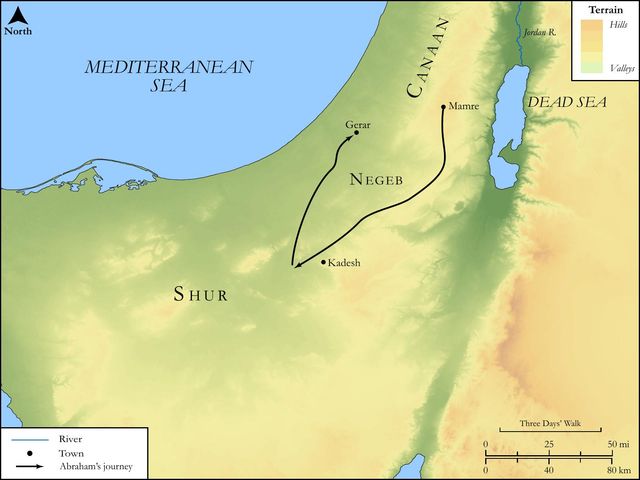
Following the profound judgment on Sodom and Gomorrah, Abraham embarks on a significant geographical transition, moving from his encampment near Mamre southward through the arid Negeb region. This journey leads him to temporary dwellings between the wilderness landmarks of Kadesh and Shur, ultimately culminating in his sojourn within the Philistine city-state of Gerar. This relocation serves as a crucial narrative pivot, setting the stage for a renewed test of Abraham's faith, integrity, and the enduring nature of God's covenantal promises amidst human frailty.
Context
ShowHideLiterary Context
Genesis 20:1 immediately follows the dramatic events of Genesis 19, where God's righteous judgment fell upon Sodom and Gomorrah, and Lot was miraculously delivered. Abraham, having interceded for the cities and witnessed their destruction from a distance (Genesis 19:27-28), now departs from his familiar dwelling place near the oaks of Mamre in Hebron (Genesis 18:1). This movement marks a new phase in his nomadic life, shifting the geographical focus from the fertile plains of Jordan to the southern desert fringes. The verse serves as a narrative bridge, transitioning from the previous divine intervention to a new challenge that will test Abraham's character and God's faithfulness, particularly concerning the promise of a son, Isaac, which was recently reiterated (Genesis 18:10). The events in Gerar, detailed in Genesis 20:2-18, echo Abraham's earlier deception in Egypt (Genesis 12:10-20), highlighting a recurring pattern of fear and a lack of full trust in God's protection.
Historical & Cultural Context
Abraham's journey takes him through the "south country" or Negeb (H5045), a semi-arid region stretching from the Judean hills towards the Sinai peninsula. This area was characterized by sparse vegetation, seasonal wadis, and limited water sources, making nomadic pastoralism challenging but feasible. Kadesh (H6946) and Shur (H7793) were significant geographical markers in the wilderness bordering Egypt. Kadesh (later Kadesh-barnea) was a crucial oasis and future encampment for Israel. Shur was a desert region forming part of the frontier with Egypt, often traversed by travelers and traders. Gerar (H1642) was a prominent Philistine city-state, located southwest of Hebron, near the coastal plain. At this time, the Philistines were likely a distinct, non-Semitic people who had settled in the region, establishing organized city-states. Abraham's decision to "sojourn" (H1481) in such a city indicates a temporary residence as a foreigner, dependent on the goodwill of the local ruler, King Abimelech. This cultural context underscores Abraham's vulnerability and his ongoing reliance on God's protection while living among foreign peoples.
Key Themes
ShowHideThis verse contributes to several overarching themes in Genesis and the Abrahamic narrative. Firstly, it reinforces the theme of Abraham's nomadic, pilgrim identity, emphasizing that he is a sojourner in the land promised to him, not yet its possessor (Hebrews 11:9-10). Secondly, it highlights the theme of divine providence, as Abraham's movements, though seemingly driven by practical needs, are implicitly guided by God to position him for future interactions and tests, demonstrating God's sovereign hand over the details of His covenant people's lives. Thirdly, it sets the stage for the theme of human frailty and God's faithfulness, as Abraham's subsequent actions in Gerar reveal a recurring moral weakness, yet God's covenant promises remain steadfast despite human imperfection. This foreshadows the ongoing process of sanctification and the need for continual trust in God's protective care, even for mature believers. The journey to Gerar also introduces the Philistines into Abraham's narrative, marking the beginning of interactions with this significant people group.
Exposition and Analysis
ShowHideKey Word Analysis
ShowHideA primitive root meaning "to pull up, especially the tent-pins, i.e. start on a journey." This word vividly portrays the nomadic lifestyle of Abraham, emphasizing the act of breaking camp and setting out. It signifies a deliberate and often divinely-guided movement, not merely a casual stroll. In this context, it marks a significant relocation after the traumatic events of Sodom.
A primitive root meaning "properly, to sit down... by implication, to dwell, to remain; causatively, to settle, to marry." While "journeyed" denotes movement, "dwelled" indicates a period of settling or remaining in a place, even if temporarily. It suggests establishing a camp or residence for a duration, implying a degree of stability before the final destination of Gerar.
A primitive root meaning "properly, to turn aside from the road (for a lodging or any other purpose), i.e. sojourn (as a guest); also to shrink, fear (as in a strange place)." This word is crucial for understanding Abraham's status in Gerar. It explicitly defines him as a temporary resident, a foreigner, or a guest, not a permanent inhabitant. This term consistently underscores Abraham's identity as a pilgrim in the land, never fully possessing it, and highlights his vulnerability and dependence on the local authorities and, ultimately, on God's protection.
Verse Breakdown
ShowHide"¶ And Abraham journeyed from thence toward the south country,"
This clause establishes Abraham's departure and direction. "From thence" refers to his previous encampment near Mamre, indicating a deliberate break from the site associated with the recent divine judgment on Sodom. His movement "toward the south country" (the Negeb) signifies a geographical shift into a more arid, less populated region, characteristic of nomadic pastoralism and potentially seeking new pastures or avoiding the aftermath of the catastrophe.
"and dwelled between Kadesh and Shur,"
This describes an intermediate, temporary stop. Kadesh and Shur were well-known desert landmarks, marking the fringes of settled land and the gateway to the wilderness and Egypt. Dwelling "between" them suggests an encampment in the vast, open desert, emphasizing a transitional phase of his journey. This location places Abraham on the edge of civilization, a strategic but potentially vulnerable position.
"and sojourned in Gerar."
This final phrase specifies Abraham's ultimate destination in this leg of his journey. Gerar was a Philistine city-state, indicating Abraham's entry into a more organized, foreign society. The use of "sojourned" (H1481, gûwr) is highly significant, explicitly defining Abraham's status as a temporary resident, a foreigner, or a guest, rather than a permanent settler. This highlights his ongoing identity as a pilgrim in the land God promised him, yet which he does not yet possess, setting the stage for the challenges of living among foreign peoples.
Literary Devices
ShowHideGenesis 20:1 effectively employs Transition and Foreshadowing. The verse serves as a narrative transition, smoothly moving the story from the dramatic events of Sodom and Gomorrah into a new geographical and relational context for Abraham. This shift is not merely geographical but also thematic, preparing the reader for a fresh set of challenges. Furthermore, the verse utilizes foreshadowing through the choice of the word "sojourned" (H1481, gûwr). This term, implying a temporary and often vulnerable status as a foreigner, subtly hints at the precarious situation Abraham will soon face in Gerar, where he again fears for his life and resorts to deception regarding Sarah, echoing a past failure. This linguistic choice sets a tone of potential conflict and dependence, preparing the reader for the subsequent narrative of Abraham's interaction with Abimelech.
Theological and Thematic Connections
ShowHideGenesis 20:1, while seemingly a simple geographical notation, is rich with theological and thematic implications. It underscores the ongoing nature of Abraham's journey of faith, a life characterized by movement and dependence on God's leading, even when the specific reasons for relocation are not explicitly stated as divine commands. Abraham's status as a "sojourner" consistently reinforces the theme of his pilgrim identity, a man living by faith in the promises of a land and descendants he does not yet fully possess. This constant movement and temporary dwelling highlight the transient nature of earthly life for God's people, pointing them to an ultimate, eternal inheritance. The verse also subtly introduces the theme of God's sovereign providence, orchestrating Abraham's steps to position him for future encounters and tests, demonstrating that even in seemingly mundane relocations, God is at work shaping His servants and advancing His redemptive plan.
Reflection and Application
ShowHideAbraham's journey in Genesis 20:1 serves as a profound reminder that the life of faith is often characterized by movement, transition, and a sense of being a sojourner. Just as Abraham broke camp and moved from a place of past experiences, we too are called to embrace transitions in our lives, trusting that God's sovereign hand guides our steps, even when the path ahead is uncertain. This verse encourages us to live with an eternal perspective, recognizing our temporary status on earth as "sojourners" and "pilgrims" (1 Peter 2:11). Our true citizenship is in heaven, and our ultimate hope rests not in earthly security or possessions, but in the fulfillment of God's promises in Christ. This perspective liberates us from clinging too tightly to the transient comforts of this world and compels us to fix our gaze on the "city which has foundations, whose builder and maker is God" (Hebrews 11:10). Like Abraham, we are called to live by faith, trusting God's provision and protection in every new season and location, knowing that He is faithfully leading us towards our eternal home.
Questions for Reflection
ShowHideFAQ
ShowHideWhy did Abraham move again after Sodom's destruction?
ShowHideWhile the text does not explicitly state a divine command for this specific move, Abraham's nomadic lifestyle was inherent to his calling as a sojourner in the promised land. His departure from Mamre after the traumatic events of Sodom's destruction may have been prompted by a desire for fresh pastures, a need to distance himself from the recent judgment, or an implicit divine leading. God often guides His servants through circumstances and internal promptings, positioning them for the next phase of His plan and the ongoing refinement of their faith, as seen throughout Abraham's journey.
What is the significance of Abraham "sojourning" in Gerar?
ShowHideThe Hebrew word for "sojourned" (H1481, gûwr) is crucial. It emphasizes Abraham's status as a temporary resident or foreigner, not a permanent inhabitant or land-owner. This highlights his identity as a pilgrim living by faith in the land God promised to his descendants, but which he did not yet possess (Hebrews 11:9). It also sets the stage for the recurring theme of his vulnerability and reliance on God while living among foreign peoples, foreshadowing the future experience of Israel as sojourners in various lands, and ultimately, the transient nature of all believers on earth awaiting their heavenly home.
Does Abraham's repeated deception with Sarah indicate a lack of faith?
ShowHideAbraham's repeated deception, where he misrepresented Sarah as his sister, previously seen in Egypt, reveals a persistent area of weakness and fear in his character, despite his overall strong faith. It demonstrates that even mature believers can struggle with recurring sins or fears, and that spiritual growth is a lifelong process, not a linear progression without setbacks. However, it also highlights God's incredible grace and faithfulness, as He continues to work with His servants despite their imperfections, often using such trials to deepen their trust in Him alone and to demonstrate His unwavering commitment to His covenant promises.
Christ-Centered Fulfillment
ShowHideAbraham's life as a sojourner, constantly moving in faith toward a promised land he did not yet fully possess, profoundly prefigures the ultimate "sojourner" and "pilgrim," Jesus Christ. While Abraham lived as a temporary resident in an earthly land, Christ, though fully God, "emptied himself, by taking the form of a servant, being born in the likeness of men" (Philippians 2:7). He entered a world that was not His true home, a world that "knew him not" and "received him not" (John 1:10-11). Jesus lived a life of intentional itinerancy, often having "nowhere to lay his head" (Matthew 8:20), embodying the ultimate pilgrim. His journey culminated not in an earthly city, but in His sacrificial death and resurrection, through which He established the new covenant and prepared a heavenly city for all who, like Abraham, live by faith as sojourners awaiting their eternal home (Hebrews 11:10, Hebrews 13:14). Abraham's temporary dwelling in the land points to the temporary nature of this earthly life and the eternal dwelling found only in Christ, who is the true fulfillment of all God's promises and the one who leads His people to their everlasting inheritance.