


2 Chronicles 14:14
Bible text: King James Version (1769 Blayney text) · Public domain
Bible text: King James Version with Strong's numbers · Public domain
Bible text: Berean Standard Bible · Public domain
Bible text: American Standard Version (1901) · Public domain
Bible text: World English Bible, Messianic edition · Public domain
Bible text: Geneva Bible (1599) · Public domain
Bible text: Young's Literal Translation · Public domain
- וַיַּכּוּvai·ya·Kuand they struck downH5221Conj-w ¦ V-Hiphil-ConsecImperf-3mpVerb Hiphil Consecutive Imperfect 3rd Plural Masculineוַandיַּכּוּthey struck down
- אֵת'et<obj.>H853DirObjMParticle Object Indicator
- כָּלkolallH3605N-mscNoun Singular Masculine Construct
- הֶעָרִיםhe·'a·Rimthe citiesH5892Art ¦ N-mpNoun Plural Masculine Absoluteהֶtheעָרִיםcities
- סְבִיבוֹתse·vi·VotaroundH5439N-cpcNoun Plural common gender Construct
- גְּרָרge·RarGerarH1642N-properNoun Proper Location
- כִּיkiforH3588PrtParticle Conditional
- הָיָהha·Yahit wasH1961V-Qal-Perf-3msVerb Qal Perfect 3rd Singular Masculine
- פַחַדfa·chad[the] dread ofH6343N-mscNoun Singular Masculine Construct
- יְהוָהYah·wehYahwehH3068N-properNoun Proper Title
- עֲלֵיהֶם'a·lei·Hemon themH5921Prep ¦ 3mpPrepositionעֲלֵיonהֶםthem
- וַיָּבֹזּוּvai·ya·Vo·zuand they plunderedH962Conj-w ¦ V-Qal-ConsecImperf-3mpVerb Qal Consecutive Imperfect 3rd Plural Masculineוַandיָּבֹזּוּthey plundered
- אֶת'et<obj.>H853DirObjMParticle Object Indicator
- כָּלkolallH3605N-mscNoun Singular Masculine Construct
- הֶעָרִיםhe·'a·Rimthe citiesH5892Art ¦ N-mpNoun Plural Masculine Absoluteהֶtheעָרִיםcities
- כִּיkiforH3588PrtParticle Conditional
- בִזָּהvi·ZahplunderH961N-fsNoun Singular Feminine Absolute
- רַבָּהra·BahmuchH7227Adj-fsAdjective Singular Feminine Absolute
- הָיְתָהha·ye·Tahit wasH1961V-Qal-Perf-3fsVerb Qal Perfect 3rd Singular Feminine
- בָהֶםva·Hemin themPrep-b ¦ 3mpSuffix Personal 3rd Plural Masculineבָinהֶםthem
English is a literal word-by-word gloss of the Hebrew, not the KJV's wording. Why?
This is the original text the KJV's translators worked from — each Hebrew word with its own literal English meaning in this verse, prepared by scholars at Tyndale House, Cambridge. The KJV translates whole sentences, not word by word, so its wording differs: one Hebrew word can become several English words, and the KJV may choose “the LORD” where the gloss reads “Yahweh”. Both are faithful — they answer different questions. For the KJV's own rendering, switch to the KJV text.
Details
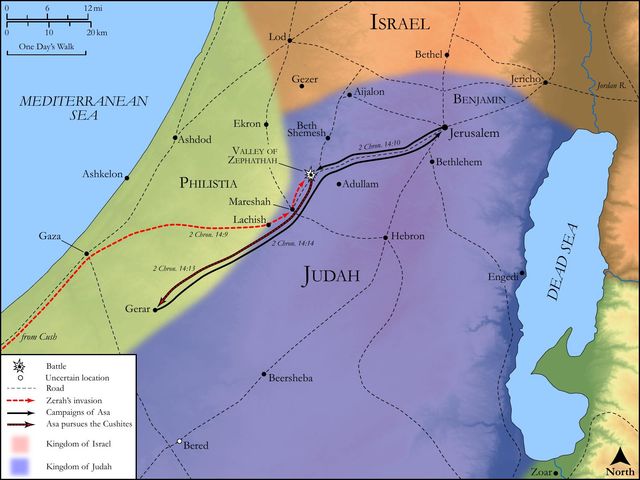
See on the biblical-era map
Study this verse
Public-domain commentary
Matthew Henry
From his Commentary on the Whole Bible. Henry comments on passages, not single verses — this entry covers 2 Chronicles 14:9–15. His three-level outline is real structure in the source text, so it is rendered as structure.
Here is, I. Disturbance given to the peace of Asa's kingdom by a formidable army of Ethiopians that invaded them, Ch2 14:9, Ch2 14:10. Though still they sought God, yet this fear came upon them, that their faith in God might be tried, and that God might have an opportunity of doing great things for them. It was a vast number that the Ethiopians brought against him: 1,000,000 men; and now he found the benefit of having an army ready raised against such a time of need. That provision which we thought needless may soon appear to be of great advantage.
II.The application Asa made to God on occasion of the threatening cloud which now hung over his head, Ch2 14:11.
He that sought God in the day of his peace and prosperity could with holy boldness cry to God in the day of his trouble, and call him his God. His prayer is short, but has much in it. 1. He gives to God the glory of his infinite power and sovereignty: It is nothing with thee to help and save by many or few, by those that are mighty or by those that have no power. See Sa1 14:6. God works in his own strength, not in the strength of instruments (Psa 21:13), nay, it is his glory to help the weakest and to perfect strength out of the mouth of babes and sucklings. "We do not say, Lord, take our part, for we have a good army for thee to work by; but, take our part, for without thee we have no power." 2. He takes hold of their covenant-relation to God as theirs. O Lord, our God! and again, "Thou art our God, whom we have chosen and cleave to as ours, and who hast promised to be ours." 3. He pleads their dependence upon God, and the eye they had to him in this expedition. he was well prepared for it, yet trusted not to his preparations; but, "Lord, we rest on thee, and in thy name we go against this multitude, by warrant from thee, aiming at thy glory, and trusting to thy strength." 4. He interests God in their cause: "Let not man" (mortal man, so the word is) "prevail against thee. If he prevail against us, it will be said that he prevails against thee, because thou art our God, and we rest on thee and go forth in thy name, which thou hast encouraged us to do. The enemy is a mortal man; make it to appear what an unequal match he is for an immortal God. Lord, maintain thy own honour; hallowed by thy name."
III.The glorious victory God gave him over his enemies.
1.God defeated the enemy, and put their forces into disorder (Ch2 14:12): The Lord smote the Ethiopians, smote them with terror, and an unaccountable consternation, so that they fled, and knew neither why nor whither.
2.Asa and his soldiers took the advantage God gave them against the enemy.
(1.)They destroyed them. They fell before the Lord (for who can stand before him?) and before his host, either an invisible host of angels that were employed to destroy them or the host of Israel, called God's host because owned by him.
(2.)They took the plunder of their camp, carried away very much spoil from the slain and from the baggage.
(3.)They smote the cities that were in league with them, to which they fled for shelter, and carried off the spoil of them (Ch2 14:14); and they were not able to make any resistance, for the fear of the Lord came upon them, that is, a fear which God struck them with to such a degree that they had no heart to withstand the conquerors.
(4.)They fetched away the cattle out of the enemy's country, in vast numbers, Ch2 14:15. Thus the wealth of the sinner is laid up for the just.
Historical interpretation
Historical reception
1 surviving comment on this verse from the historical church.
Asa prayed, and his prayer manifested great power: when Zerah the Indian [Ethiopian] went out against him with an army of one million with him, Asa then prayed, saying, “By this shall your power be known, O our God, when you finish off a vast people by means of a small people.” God heard his prayer and sent his angel to rout them. Thus the vast army was defeated by the power of Asa’s prayer.
Continue studying 2 Chronicles 14:14 across the web’s major study libraries — every link below opens this exact verse, chapter, or book on the destination site.
Read & Compare
 BibleGatewayThis verse in more than 200 translations and 70 languages.
 Bible.comThe YouVersion reader — hundreds of translations, reading plans, and highlights.
 ESV.orgCrossway's official English Standard Version reader.
 NET BibleThe NET translation with 60,000+ translators' notes on every rendering decision.
 STEP BibleTyndale House's free study tool — original text, vocabulary, and scholarly resources.
 BibliaLogos Bible Software's free web reader.
 USCCBThe New American Bible (Revised Edition) with the U.S. bishops' study notes.
Commentaries
 BibleHub CommentariesDozens of classic commentaries on this verse, gathered on one page.
 StudyLightMore than 100 commentary sets — the largest collection on the web.
 BibleRefPlain-English commentary on what this verse means, verse by verse.
 Enduring WordDavid Guzik's free commentary on this chapter, widely used by Bible teachers.
 Bible Study ToolsVerse commentary alongside Greek and Hebrew study aids.
Original Language & Research
- BibleHub InterlinearThe verse word by word — original language, transliteration, and English.
- BibleHub LexiconEvery word's original-language definition and Strong's entry.
 Blue Letter BibleDeep-study tools — Strong's numbers, concordance, and word studies.
 SefariaThe Hebrew text with Rashi and centuries of Jewish commentary.
Sermons, Hymns & Audio


TrulyRandomVerse is not affiliated with these sites and doesn’t control their content. They’re linked because they’re genuinely useful.
Summary
Following King Asa's decisive victory over the massive Ethiopian army, 2 Chronicles 14:14 details Judah's subsequent military campaign and the abundant spoils they acquired. This verse highlights the comprehensive nature of God's deliverance, attributing the ease of conquest not merely to Judah's strength but to a divinely instilled terror that paralyzed the inhabitants of the surrounding cities. It underscores the tangible blessings and provisions that accompanied Judah's faith and obedience, demonstrating God's faithfulness to His covenant people and His commitment to reward those who trust Him.
Context
ShowHideLiterary Context
This verse immediately follows the miraculous victory of King Asa and the Judean army over Zerah the Ethiopian's million-man force, an event initiated by Asa's fervent prayer and trust in the Lord, as detailed in 2 Chronicles 14:11. The preceding verses describe the battle itself, where God struck the Ethiopians, causing them to flee in disarray (2 Chronicles 14:12). Verse 13 details the extensive pursuit and slaughter of the fleeing enemy, ensuring no one escaped, demonstrating the totality of God's deliverance. Therefore, 2 Chronicles 14:14 serves as the climax of this post-battle action, describing the subsequent campaign against the Philistine cities around Gerar, which were likely allied with or vulnerable to the defeated Ethiopians. It completes the narrative arc of God's comprehensive deliverance and blessing upon Judah's faith, showcasing the full scope of the victory.
Historical & Cultural Context
The events unfold during the early reign of King Asa, a period marked by his initial commitment to religious reform and steadfast trust in Yahweh. Gerar was an ancient city located in the Negev region, historically associated with Philistine territory, situated southwest of Judah's borders. In the wars of that day, it was common practice for victorious armies to pursue fleeing enemies, plunder their camps, and then conquer and spoil surrounding territories that might have supported the defeated foe or posed a future threat. The mention of "the fear of the LORD" coming upon the cities is a recurring motif in biblical narratives (e.g., Exodus 15:16, Joshua 2:9), indicating divine intervention that supernaturally demoralized adversaries, rendering them incapable of effective resistance and making conquest easier. The "exceeding much spoil" was not just a practical resource for the nation but also a tangible sign of divine favor and a reward for obedience and victory, reinforcing the covenant blessings.
Key Themes
ShowHide2 Chronicles 14:14 powerfully articulates several key themes central to the book of Chronicles and the broader biblical narrative. Foremost is the theme of Divine Sovereignty and Intervention, where God actively works on behalf of His obedient people, instilling fear in their enemies and ensuring victory beyond human capability. This directly flows from the theme of Reward for Faithfulness, as Asa's trust in God (2 Chronicles 14:11) is met with overwhelming success and abundant provision. The "exceeding much spoil" highlights God's Generosity and Provision, demonstrating that His blessings are not merely defensive but also expansive and materially beneficial, providing for His people's needs and prosperity. Finally, the conquest of the surrounding cities reinforces the theme of Comprehensive Deliverance and Dominion, showing that God's salvation extends beyond the immediate threat to secure broader peace and influence for His people, solidifying their borders and demonstrating His covenant faithfulness throughout the reign of Asa.
Exposition and Analysis
ShowHideKey Word Analysis
ShowHideThis word denotes a sudden alarm, terror, or dread. In this context, it signifies a supernatural, paralyzing fear instilled by God upon the inhabitants of the cities, rather than a natural military apprehension. It implies a divine psychological warfare that rendered the adversaries incapable of effective resistance, directly contributing to Judah's easy conquest. This "fear of the LORD" is distinct from the reverential awe often associated with the phrase, here serving as an instrument of divine judgment and demoralization against Judah's adversaries.
This is the personal, covenantal name of God, often translated as "Jehovah" or "the Lord." Its presence here emphasizes that the "fear" was not a random occurrence but originated directly from the sovereign, self-existent God of Israel. It underscores His active involvement and power in the historical events, asserting that the victory and the subsequent ease of conquest were entirely His doing, a demonstration of His faithfulness to His people and His might against their enemies.
This feminine noun refers to booty, plunder, or goods taken from a defeated enemy. In ancient warfare, the acquisition of spoil was a significant aspect of victory, often symbolizing divine favor and providing material resources for the victorious nation. The phrase "exceeding much spoil" emphasizes the vast quantity and value of the plunder, highlighting the magnitude of God's blessing and abundant provision to Judah, serving as a tangible reward for their faith and obedience.
Verse Breakdown
ShowHide"And they smote all the cities round about Gerar;"
Following their pursuit of the Ethiopians, Asa's army turned their attention to the cities in the vicinity of Gerar, a strategic area in Philistine territory. The verb "smote" (Hebrew, nakah) indicates a decisive military strike, implying conquest and destruction. The phrase "all the cities" suggests a thorough and comprehensive campaign, leaving no pockets of resistance and ensuring the complete subjugation of the region.
"for the fear of the LORD came upon them:"
This clause provides the crucial divine explanation for the ease of Judah's conquest. The inhabitants of these cities were not defeated by Judah's superior numbers or military prowess, but by a supernatural terror instilled by God Himself. This divine intervention broke their will to resist, making them vulnerable and ensuring Judah's swift and effortless victory. It underscores that the battle's success was ultimately God's doing, not merely human strength.
"and they spoiled all the cities;"
As a direct consequence of the conquest, Judah plundered these cities. The verb "spoiled" (Hebrew, bazaz) refers to taking all valuable possessions, livestock, and goods. This act was a customary part of ancient warfare and served as a tangible benefit of victory, enriching the conquering army and nation. It signifies the practical outcome of God's intervention on their behalf.
"for there was exceeding much spoil in them."
This final clause emphasizes the immense quantity and value of the plunder. The "exceeding much spoil" signifies a vast accumulation of wealth, livestock, and resources, serving as a powerful testament to God's abundant provision and reward for Judah's faith and obedience. It highlights the generosity of God's blessing, demonstrating that His favor leads to overflowing material benefits.
Literary Devices
ShowHideThe verse effectively employs several literary devices to convey its powerful message. Divine Causation is paramount, explicitly stating that "the fear of the LORD came upon them," directly attributing the ease of conquest to God's supernatural intervention rather than solely to Judah's military might. This highlights God's active and decisive role in the historical events. Hyperbole is evident in the phrase "exceeding much spoil," emphasizing the extraordinary abundance of the plunder and underscoring the magnitude of God's blessing and provision. While not strictly hyperbole, the repetition of "all the cities" in both "smote all the cities" and "spoiled all the cities" creates a sense of Completeness and Thoroughness, reinforcing the comprehensive nature of Judah's victory and God's deliverance, ensuring no enemy stronghold was left untouched.
Theological and Thematic Connections
ShowHideThis verse profoundly illustrates the principle that when God's people walk in faith and obedience, God Himself fights their battles, often in ways that transcend natural capabilities. The "fear of the LORD" coming upon the enemy is a powerful theological statement about divine intervention, demonstrating that God can supernaturally demoralize adversaries and prepare the way for His people's triumph. The abundance of spoil received is a tangible sign of God's generous provision and reward for faithfulness, underscoring His commitment to bless those who trust Him. This narrative reinforces the Chronicler's overarching message: seeking God leads to blessing, while forsaking Him leads to judgment. It paints a vivid picture of God's active involvement in the affairs of His people, not just in defense but in securing their prosperity and dominion.
Reflection and Application
ShowHide2 Chronicles 14:14 offers a timeless lesson on the nature of divine assistance and the blessings that follow trust in God. It reminds us that our greatest victories are often those where God intervenes supernaturally, removing obstacles and breaking the will of opposition in ways we cannot humanly orchestrate. Just as God instilled fear in Judah's enemies, He can soften hearts, open doors, and clear paths for us today, whether in spiritual warfare, evangelism, overcoming personal challenges, or navigating complex societal issues. The "exceeding much spoil" serves as a powerful metaphor for the abundant spiritual and sometimes material blessings that God pours out when we prioritize His will and rely on His strength. It encourages us to pray boldly, trust completely, and expect God to not only deliver us from threats but also to provide generously for our needs and purposes, often beyond our imagination. Our obedience is not a means to earn favor, but a posture that positions us to receive the overflow of God's grace and provision, demonstrating His faithfulness to His covenant promises in our lives.
Questions for Reflection
ShowHideFAQ
ShowHideWhat does "the fear of the LORD came upon them" mean in this context?
ShowHideIn this specific context, "the fear of the LORD came upon them" refers to a supernatural, paralyzing terror or dread that God instilled in the inhabitants of the cities around Gerar. It was not a reverential awe, but a divine intervention that broke their will to resist, making them vulnerable and ensuring Judah's easy conquest. This demonstrates God's direct involvement in the battle, fighting on behalf of His people by supernaturally demoralizing their enemies, similar to how He caused a great panic among the Philistines in 1 Samuel 14:15 or instilled dread in the Canaanites before Israel's entry into the Promised Land (Joshua 2:9-11).
Christ-Centered Fulfillment
ShowHideWhile 2 Chronicles 14:14 describes a physical victory and material spoil for ancient Judah, it powerfully foreshadows the ultimate, comprehensive victory achieved by Jesus Christ. Just as the "fear of the LORD" paralyzed Judah's enemies, Christ's death and resurrection unleashed a divine power that conquered sin, death, and the devil, stripping principalities and powers of their authority and making a public spectacle of them (Colossians 2:15). The "exceeding much spoil" taken by Judah points to the immeasurable spiritual riches and blessings that believers receive through Christ's triumph. We are not merely delivered from our enemies, but we receive the "spoils" of salvation: forgiveness of sins, imputed righteousness, eternal life, the indwelling Holy Spirit, and every spiritual blessing in the heavenly places (Ephesians 1:3). Christ's victory on the cross, like Asa's, was not achieved through human might but through divine power and perfect obedience, leading to a far greater and eternal "spoil" for all who trust in Him, securing not just a temporal kingdom but an everlasting one (Hebrews 9:12). His triumph ensures that all who are in Him share in His victory and inherit His glorious kingdom (Romans 8:17).