


Joshua 2:24
Bible text: King James Version (1769 Blayney text) · Public domain
Bible text: King James Version with Strong's numbers · Public domain
Bible text: Berean Standard Bible · Public domain
Bible text: American Standard Version (1901) · Public domain
Bible text: World English Bible, Messianic edition · Public domain
Bible text: Geneva Bible (1599) · Public domain
Bible text: Young's Literal Translation · Public domain
- וַיֹּאמְרוּvai·yo·me·Ruand they saidH559Conj-w ¦ V-Qal-ConsecImperf-3mpVerb Qal Consecutive Imperfect 3rd Plural Masculineוַandיֹּאמְרוּthey said
- אֶל'eltoH413PrepPreposition
- יְהוֹשֻׁעַye·ho·Shu·a'JoshuaH3091N-proper-mNoun Proper Masculine
- כִּיkithatH3588PrtParticle Conditional
- נָתַןna·Tanhe has givenH5414V-Qal-Perf-3msVerb Qal Perfect 3rd Singular Masculine
- יְהוָהYah·wehYahwehH3068N-properNoun Proper Title
- בְּיָדֵנוּbe·ya·De·nuin our handH3027Prep-b ¦ N-csc ¦ 1cpNoun Singular common gender Constructבְּinיָדֵhandנוּour
- אֶת'et<obj.>H853DirObjMParticle Object Indicator
- כָּלkolallH3605N-mscNoun Singular Masculine Construct
- הָאָרֶץha·'A·retzthe landH776Art ¦ N-fsNoun Singular Feminine Absoluteהָtheאָרֶץland
- וְגַםve·gamand alsoH1571Conj-w ¦ AdvAdverbוְandגַםalso
- נָמֹגוּna·Mo·guthey have melted awayH4127V-Niphal-Perf-3cpVerb Niphal Perfect 3rd Plural common gender
- כָּלkolallH3605N-mscNoun Singular Masculine Construct
- יֹשְׁבֵיyo·she·Vei[the] inhabitants ofH3427V-Qal-Prtcpl-mpVerb Qal Participle Plural Masculine Construct
- הָאָרֶץha·'A·retzthe landH776Art ¦ N-fsNoun Singular Feminine Absoluteהָtheאָרֶץland
- מִפָּנֵינוּmi·pa·Nei·nu<from> because of usH6440Prep-m ¦ N-mpc ¦ 1cpNoun Plural Masculine Constructמִ<from>פָּנֵיbecause ofנוּus
English is a literal word-by-word gloss of the Hebrew, not the KJV's wording. Why?
This is the original text the KJV's translators worked from — each Hebrew word with its own literal English meaning in this verse, prepared by scholars at Tyndale House, Cambridge. The KJV translates whole sentences, not word by word, so its wording differs: one Hebrew word can become several English words, and the KJV may choose “the LORD” where the gloss reads “Yahweh”. Both are faithful — they answer different questions. For the KJV's own rendering, switch to the KJV text.
Details
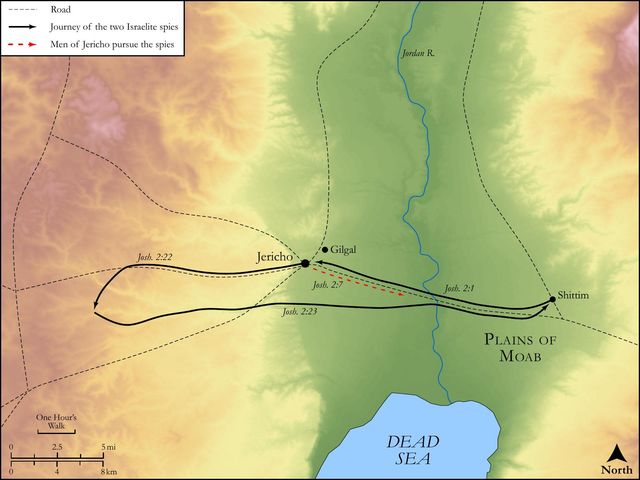
See on the biblical-era map
Study this verse
Public-domain commentary
Matthew Henry
From his Commentary on the Whole Bible. Henry comments on passages, not single verses — this entry covers Joshua 2:22–24.
We have here the safe return of the spies Joshua had sent, and the great encouragement they brought with them to Israel to proceed in their descent upon Canaan. Had they been disposed to discourage the people, as the evil spies did that Moses sent, they might have told them what they had observed of the height and strength of the walls of Jericho, and the extraordinary vigilance of the king of Jericho, and how narrowly they escaped out of his hands; but they were of another spirit, and, depending themselves upon the divine promise, they animated Joshua likewise. 1. Their return in safety was itself an encouragement to Joshua, and a token for good. that God provided for them so good a friend as Rahab was in an enemy's country, and that notwithstanding the rage of the king of Jericho and the eagerness of the pursuers they had come back in peace, was such an instance of God's great care concerning them for Israel's sake as might assure the people of the divine guidance and care they were under, which should undoubtedly make the progress of their arms glorious. He that so wonderfully protected their scouts would preserve their men of war, and cover their heads in the day of battle. 2. The report they brought was much more encouraging (v. 24): "All the inhabitants of the country, though resolved to stand it out, yet do faint because of us, they have neither wisdom to yield nor courage to fight," whence they conclude, "Truly the Lord has delivered into our hands all the land, it is all our own; we have nothing to do, in effect, but to take possession." Sinners' frights are sometimes sure presages of their fall. If we resist our spiritual enemies they will flee before us, which will encourage us to hope that in due time we shall be more than conquerors.
Historical interpretation
Historical reception
1 surviving comment on this verse from the historical church.
On account of her faith and hospitality, Rahab the harlot was saved. For when spies were sent by Joshua, the son of Nun, to Jericho, the king of the country ascertained that they had come to spy out their land, and sent men to seize them, in order that, when taken, they might be put to death. But the hospitable Rahab receiving them, concealed them on the roof of her house under some stalks of flax. And when the men sent by the king arrived and said, "There came men unto you who are to spy out our land; bring them forth, for so the king commands," she answered them, "The two men whom you seek came unto me, but quickly departed again and are gone," thus not discovering the spies to them. Then she said to the men, "I know assuredly that the Lord your God has given you this city, for the fear and dread of you have fallen on its inhabitants. When therefore you shall have taken it, keep ye me and the house of my father in safety." And they said to her, "It shall be as you have spoken to us. As soon, therefore, as you know that we are at hand, you shall gather all your family under your roof, and they shall be preserved, but all that are found outside of your dwelling shall perish." Moreover, they gave her a sign to this effect, that she should hang forth from her house a scarlet thread. And thus they made it manifest that redemption should flow through the blood of the Lord to all them that believe and hope in God. You see, beloved, that there was not only faith, but prophecy, in this woman.
Continue studying Joshua 2:24 across the web’s major study libraries — every link below opens this exact verse, chapter, or book on the destination site.
Read & Compare
 BibleGatewayThis verse in more than 200 translations and 70 languages.
 Bible.comThe YouVersion reader — hundreds of translations, reading plans, and highlights.
 ESV.orgCrossway's official English Standard Version reader.
 NET BibleThe NET translation with 60,000+ translators' notes on every rendering decision.
 STEP BibleTyndale House's free study tool — original text, vocabulary, and scholarly resources.
 BibliaLogos Bible Software's free web reader.
 USCCBThe New American Bible (Revised Edition) with the U.S. bishops' study notes.
Commentaries
 BibleHub CommentariesDozens of classic commentaries on this verse, gathered on one page.
 StudyLightMore than 100 commentary sets — the largest collection on the web.
 BibleRefPlain-English commentary on what this verse means, verse by verse.
 Enduring WordDavid Guzik's free commentary on this chapter, widely used by Bible teachers.
 Bible Study ToolsVerse commentary alongside Greek and Hebrew study aids.
Original Language & Research
- BibleHub InterlinearThe verse word by word — original language, transliteration, and English.
- BibleHub LexiconEvery word's original-language definition and Strong's entry.
 Blue Letter BibleDeep-study tools — Strong's numbers, concordance, and word studies.
 SefariaThe Hebrew text with Rashi and centuries of Jewish commentary.
Sermons, Hymns & Audio


TrulyRandomVerse is not affiliated with these sites and doesn’t control their content. They’re linked because they’re genuinely useful.
Summary
The two spies, having successfully completed their perilous mission into Jericho, return to Joshua with a definitive and faith-affirming report. Their declaration asserts that the LORD, by His sovereign hand, has already secured the entire land of Canaan for Israel. This profound conviction is substantiated by their observation that all the inhabitants of the country are gripped by a paralyzing fear, a divinely orchestrated dread that signals their demoralization and inability to resist. This intelligence serves as a powerful confirmation of God's covenant promises and provides the essential encouragement for Joshua and the Israelite nation to proceed with the imminent conquest.
Context
ShowHideLiterary Context
This pivotal verse concludes the reconnaissance mission detailed in Joshua 2, immediately following the spies' safe return to the Israelite camp after their escape from Jericho (Joshua 2:23). Their report directly corroborates Rahab's earlier confession of widespread terror among the Canaanites (Joshua 2:9-11), reinforcing the supernatural element of the impending conquest. The spies' confident affirmation of God's active involvement in delivering the land serves as a crucial bridge, setting the stage for Joshua's immediate preparations for the crossing of the Jordan River and the invasion of Jericho, as detailed in Joshua 3. This divine assurance is particularly vital for Joshua, who has recently assumed leadership from Moses and faces the monumental task of leading Israel into the Promised Land.
Historical & Cultural Context
The historical backdrop is the plains of Moab, where the Israelites are encamped, poised to cross the Jordan River into Canaan. Canaan itself was a patchwork of fortified city-states, inhabited by diverse peoples known for their polytheistic religious practices, which often included idolatry, cultic prostitution, and even child sacrifice—practices anathema to the worship of Yahweh. The "fainting" described in the verse was not merely natural apprehension but a profound, divinely orchestrated dread that had spread throughout the land. This fear was amplified by reports of Yahweh's mighty acts, such as the miraculous crossing of the Red Sea and the recent decisive victories over the Amorite kings Sihon and Og (Numbers 21:21-35). This psychological warfare was a key component of God's strategy for conquest, as promised in Deuteronomy 2:25, and the spies' report confirms that this divine terror had already begun to paralyze the enemy.
Key Themes
ShowHideJoshua 2:24 powerfully articulates several core themes central to the book of Joshua and the broader biblical narrative. Firstly, it underscores Divine Faithfulness and Fulfillment of Promise, demonstrating that God's commitment to give Israel the land, initially made to Abraham and reiterated to Joshua himself, is actively unfolding. Secondly, it highlights the Sovereignty and Power of Yahweh, showing that the conquest is not merely a human military endeavor but a divinely orchestrated victory, where God Himself fights for Israel by instilling fear in their enemies. This pervasive fear is a manifestation of God's formidable reputation, built on His past mighty acts (e.g., Exodus 15:14-16). Finally, the verse serves as a crucial moment of Encouragement and Validation for Leadership, specifically for Joshua, who had recently assumed the daunting mantle of leadership from Moses. The spies' report provides tangible, eyewitness evidence that God is indeed with him, strengthening his resolve for the immense task ahead.
Exposition and Analysis
ShowHideKey Word Analysis
ShowHideThis refers to the covenant name of God, Jehovah, signifying "the self-Existent or Eternal." The spies' use of this name emphasizes that the deliverance of the land is not a random occurrence or a result of Israelite strength, but the direct, intentional, and sovereign act of the covenant-keeping God. It highlights His unique power and unwavering commitment to His promises.
This versatile verb, meaning "to give," "to place," or "to put," is used here in the perfect tense, indicating a completed action with ongoing results. The spies are not expressing a future hope but a present reality from God's perspective. It emphasizes that God has already acted decisively to ensure the outcome, highlighting His divine sovereignty and the certainty of Israel's victory. The land is not merely about to be given; it has already been placed into their hands by divine decree.
This word literally means "to melt," "to dissolve," or "to liquefy." It vividly describes a state of utter terror, a loss of courage, and the complete dissolution of the will to resist. It implies a psychological and spiritual paralysis, where their hearts have turned to water, rendering them incapable of standing firm against the impending invasion. This strong imagery underscores the profound psychological impact of God's presence and reputation on the enemy, a divinely orchestrated demoralization that precedes physical defeat.
Verse Breakdown
ShowHide"And they said unto Joshua, Truly the LORD hath delivered into our hands all the land"
The spies' opening declaration is a statement of profound faith and confident assurance, not a mere observation. The emphatic "Truly" (Hebrew, kî, "for, indeed") underscores the certainty of their conviction. They unequivocally attribute the success not to their own cunning or strength, but to "the LORD," recognizing His sovereign hand in the unfolding events. The phrase "delivered into our hands" is a common biblical idiom signifying complete victory and possession, confirming the fulfillment of God's promise to Israel.
"for even all the inhabitants of the country do faint because of us"
This clause provides the empirical evidence and the divine rationale for their bold declaration. The "fainting" or "melting" of the inhabitants is the observable sign that God has indeed acted. This widespread terror, affecting "all the inhabitants," signifies a comprehensive psychological defeat, orchestrated by God, which precedes the physical conquest. It highlights that the battle was already won in the spiritual realm before the first sword was drawn, due to the terrifying reputation of Yahweh that had preceded Israel.
Literary Devices
ShowHideThe verse employs Hyperbole to emphasize the pervasive and overwhelming fear among the Canaanites, stating that "all the inhabitants... do faint." While not every single individual might literally be paralyzed, this exaggeration conveys the absolute and widespread demoralization of the collective. A powerful Metaphor is subtly present in the Hebrew word for "faint" (mûwg), which literally means "to melt" or "dissolve," creating a vivid image of their courage and resolve liquefying under the weight of divine terror. The narrative also uses Foreshadowing, as the spies' report of the inhabitants' fear anticipates the subsequent, seemingly impossible, victory at Jericho, where the walls fall not by military might but by divine intervention. The entire scene functions as a Confirmation Narrative, validating Rahab's earlier testimony and God's prior promises to Joshua, thereby building suspense and confidence for the coming events.
Theological and Thematic Connections
ShowHideJoshua 2:24 stands as a powerful testament to God's unwavering faithfulness and His active, sovereign involvement in the lives of His people. It demonstrates that divine promises are not abstract concepts but tangible realities that God brings to pass through His immense power. The fear instilled in the Canaanites serves as a visible and undeniable sign of God's preceding work, preparing the way for Israel's victory. This principle extends beyond military conquest, affirming that God often goes before His people, softening hearts or removing obstacles, enabling them to accomplish His will. It encourages believers to look for God's hand at work in seemingly insurmountable situations, recognizing that His reputation precedes them and that ultimate victory belongs to Him, not to human strength or strategy.
Reflection and Application
ShowHideThis verse offers profound and enduring encouragement for believers facing daunting challenges in any era. Just as the spies returned with tangible confirmation of God's prior work, we are called to trust implicitly in the promises of God, knowing that He is utterly faithful to fulfill His word. When we embark on tasks that seem too big for our own capabilities, whether in our personal lives, vocational callings, or ministry endeavors, we can take immense courage from the fact that God often prepares the way and weakens the opposition, not through our strength or ingenuity, but through His sovereign power and reputation. Our primary role is to step out in obedient faith, recognizing His hand at work, and attributing all success and glory to Him alone. This perspective radically shifts our focus from our limitations and anxieties to God's limitless power and unwavering faithfulness, transforming our fears into opportunities to witness His mighty acts and to give Him the praise He deserves. It reminds us that our most significant battles are often won in the spiritual realm before they are ever manifested physically, and that God's formidable reputation precedes us, opening doors and softening hearts in ways we could never orchestrate.
Questions for Reflection
ShowHideFAQ
ShowHideWhy was the fear of the Canaanites so significant in this context?
ShowHideThe fear of the Canaanites was profoundly significant because it served as tangible, undeniable evidence of God's active involvement in the conquest, directly fulfilling His earlier promises to Israel (e.g., Deuteronomy 2:25). This was not merely natural apprehension; it was a divinely orchestrated psychological warfare that strategically demoralized the enemy before any physical battle commenced. Rahab's confession in Joshua 2:9-11 confirms this widespread dread, which was deeply rooted in the Canaanites' knowledge of Yahweh's mighty acts, particularly the miraculous Red Sea crossing and the recent decisive defeat of the Amorite kings. This pre-battle demoralization demonstrated unequivocally that the ultimate victory was God's, not Israel's, and provided immense encouragement and validation to Joshua and the entire Israelite nation.
How does this verse relate to God's broader promise to give Israel the land?
ShowHideThis verse functions as a direct confirmation and a crucial, initial fulfillment of God's covenant promise to give Israel the land of Canaan, a promise reiterated to Joshua in Joshua 1:3. The spies' bold declaration, "Truly the LORD hath delivered into our hands all the land," is a statement of profound faith grounded in the observable reality of the Canaanites' terror. This fear, divinely instilled, was the spiritual "delivery" of the land into Israel's hands, signaling that the spiritual battle had already been won. It served as a powerful assurance to Joshua and the people that God was actively working to bring His covenant promises to fruition, thereby setting the stage and building confidence for the physical conquest that would inevitably follow.
Christ-Centered Fulfillment
ShowHideJoshua 2:24, with its powerful declaration that God has "delivered into our hands all the land" due to the enemy's "fainting," profoundly foreshadows the ultimate and decisive victory secured by Jesus Christ. Just as the Canaanites' fear was a palpable sign of God's preceding work to prepare the way for Israel, so too did Christ's death and resurrection decisively defeat the spiritual powers of darkness, rendering them "faint" and utterly powerless. The "land" of promise for believers is not a geographical territory but the spiritual inheritance of redemption, reconciliation, and new life in Christ. Through His cross, Jesus disarmed principalities and powers, triumphing over them publicly (Colossians 2:15). The profound fear that gripped the Canaanites is paralleled by the spiritual paralysis of sin and death, which the Lamb of God, by His atoning sacrifice, completely overcame. Our assurance of victory in the spiritual battle is not based on our own strength, strategies, or merits, but solely on the finished work of Christ, who has already "delivered us from the domain of darkness and transferred us to the kingdom of his beloved Son" (Colossians 1:13). Just as Joshua was greatly encouraged by the spies' report, we are profoundly encouraged and emboldened by the New Testament witness of Christ's triumph, knowing with certainty that "greater is he who is in you than he who is in the world" (1 John 4:4). The ultimate "fainting" of the enemy, sin, and death occurred at Calvary, securing our eternal inheritance and making way for our spiritual conquest and flourishing in Christ.