


Joshua 2:23
Bible text: King James Version (1769 Blayney text) · Public domain
Bible text: King James Version with Strong's numbers · Public domain
Bible text: Berean Standard Bible · Public domain
Bible text: American Standard Version (1901) · Public domain
Bible text: World English Bible, Messianic edition · Public domain
Bible text: Geneva Bible (1599) · Public domain
Bible text: Young's Literal Translation · Public domain
- וַיָּשֻׁבוּvai·ya·Shu·vuand they returnedH7725Conj-w ¦ V-Qal-ConsecImperf-3mpVerb Qal Consecutive Imperfect 3rd Plural Masculineוַandיָּשֻׁבוּthey returned
- שְׁנֵיshe·Nei[the] twoH8147Adj-cdcAdjective Numerical Dual common gender Construct
- הָאֲנָשִׁיםha·'a·na·Shimthe menH582Art ¦ N-mpNoun Plural Masculine Absoluteהָtheאֲנָשִׁיםmen
- וַיֵּרְדוּvai·ye·re·Duand they went downH3381Conj-w ¦ V-Qal-ConsecImperf-3mpVerb Qal Consecutive Imperfect 3rd Plural Masculineוַandיֵּרְדוּthey went down
- מֵהָהָרme·ha·Harfrom the hill countryH2022Prep-m ¦ Art ¦ N-msNoun Singular Masculine Absoluteמֵfromהָtheהָרhill country
- וַיַּעַבְרוּvai·ya·'av·Ruand they passed overH5674Conj-w ¦ V-Qal-ConsecImperf-3mpVerb Qal Consecutive Imperfect 3rd Plural Masculineוַandיַּעַבְרוּthey passed over
- וַיָּבֹאוּvai·ya·Vo·'uand they cameH935Conj-w ¦ V-Qal-ConsecImperf-3mpVerb Qal Consecutive Imperfect 3rd Plural Masculineוַandיָּבֹאוּthey came
- אֶל'eltoH413PrepPreposition
- יְהוֹשֻׁעַye·ho·Shu·a'JoshuaH3091N-proper-mNoun Proper Masculine
- בִּןbin[the] son ofH1121N-mscNoun Singular Masculine Construct
- נוּןNunNunH5126N-proper-mNoun Proper Masculine
- וַיְסַפְּרוּvay·Sa·pe·ruand they recountedH5608Conj-w ¦ V-Piel-ConsecImperf-3mpVerb Piel Consecutive Imperfect 3rd Plural Masculineוַandיְסַפְּרוּthey recounted
- לוֹloto <the> himPrep-l ¦ 3msSuffix Personal 3rd Singular Masculineלto <the>וֹhim
- אֵת'et<obj.>H853DirObjMParticle Object Indicator
- כָּלkolallH3605N-msNoun Singular Masculine Absolute
- הַמֹּצְאוֹתha·mo·tze·'otthe [things that] had foundH4672Art ¦ V-Qal-Prtcpl-fpVerb Qal Participle Plural Feminine Absoluteהַtheמֹּצְאוֹת[things that] had found
- אוֹתָם'o·Tamwith themH854Prep ¦ 3mpPreposition Definiteאוֹתָwithםthem
English is a literal word-by-word gloss of the Hebrew, not the KJV's wording. Why?
This is the original text the KJV's translators worked from — each Hebrew word with its own literal English meaning in this verse, prepared by scholars at Tyndale House, Cambridge. The KJV translates whole sentences, not word by word, so its wording differs: one Hebrew word can become several English words, and the KJV may choose “the LORD” where the gloss reads “Yahweh”. Both are faithful — they answer different questions. For the KJV's own rendering, switch to the KJV text.
Details
See on the biblical-era map
Study this verse
Public-domain commentary
Matthew Henry
From his Commentary on the Whole Bible. Henry comments on passages, not single verses — this entry covers Joshua 2:22–24.
We have here the safe return of the spies Joshua had sent, and the great encouragement they brought with them to Israel to proceed in their descent upon Canaan. Had they been disposed to discourage the people, as the evil spies did that Moses sent, they might have told them what they had observed of the height and strength of the walls of Jericho, and the extraordinary vigilance of the king of Jericho, and how narrowly they escaped out of his hands; but they were of another spirit, and, depending themselves upon the divine promise, they animated Joshua likewise. 1. Their return in safety was itself an encouragement to Joshua, and a token for good. that God provided for them so good a friend as Rahab was in an enemy's country, and that notwithstanding the rage of the king of Jericho and the eagerness of the pursuers they had come back in peace, was such an instance of God's great care concerning them for Israel's sake as might assure the people of the divine guidance and care they were under, which should undoubtedly make the progress of their arms glorious. He that so wonderfully protected their scouts would preserve their men of war, and cover their heads in the day of battle. 2. The report they brought was much more encouraging (v. 24): "All the inhabitants of the country, though resolved to stand it out, yet do faint because of us, they have neither wisdom to yield nor courage to fight," whence they conclude, "Truly the Lord has delivered into our hands all the land, it is all our own; we have nothing to do, in effect, but to take possession." Sinners' frights are sometimes sure presages of their fall. If we resist our spiritual enemies they will flee before us, which will encourage us to hope that in due time we shall be more than conquerors.
Historical interpretation
Historical reception
1 surviving comment on this verse from the historical church.
On account of her faith and hospitality, Rahab the harlot was saved. For when spies were sent by Joshua, the son of Nun, to Jericho, the king of the country ascertained that they had come to spy out their land, and sent men to seize them, in order that, when taken, they might be put to death. But the hospitable Rahab receiving them, concealed them on the roof of her house under some stalks of flax. And when the men sent by the king arrived and said, "There came men unto you who are to spy out our land; bring them forth, for so the king commands," she answered them, "The two men whom you seek came unto me, but quickly departed again and are gone," thus not discovering the spies to them. Then she said to the men, "I know assuredly that the Lord your God has given you this city, for the fear and dread of you have fallen on its inhabitants. When therefore you shall have taken it, keep ye me and the house of my father in safety." And they said to her, "It shall be as you have spoken to us. As soon, therefore, as you know that we are at hand, you shall gather all your family under your roof, and they shall be preserved, but all that are found outside of your dwelling shall perish." Moreover, they gave her a sign to this effect, that she should hang forth from her house a scarlet thread. And thus they made it manifest that redemption should flow through the blood of the Lord to all them that believe and hope in God. You see, beloved, that there was not only faith, but prophecy, in this woman.
Continue studying Joshua 2:23 across the web’s major study libraries — every link below opens this exact verse, chapter, or book on the destination site.
Read & Compare
 BibleGatewayThis verse in more than 200 translations and 70 languages.
 Bible.comThe YouVersion reader — hundreds of translations, reading plans, and highlights.
 ESV.orgCrossway's official English Standard Version reader.
 NET BibleThe NET translation with 60,000+ translators' notes on every rendering decision.
 STEP BibleTyndale House's free study tool — original text, vocabulary, and scholarly resources.
 BibliaLogos Bible Software's free web reader.
 USCCBThe New American Bible (Revised Edition) with the U.S. bishops' study notes.
Commentaries
 BibleHub CommentariesDozens of classic commentaries on this verse, gathered on one page.
 StudyLightMore than 100 commentary sets — the largest collection on the web.
 BibleRefPlain-English commentary on what this verse means, verse by verse.
 Enduring WordDavid Guzik's free commentary on this chapter, widely used by Bible teachers.
 Bible Study ToolsVerse commentary alongside Greek and Hebrew study aids.
Original Language & Research
- BibleHub InterlinearThe verse word by word — original language, transliteration, and English.
- BibleHub LexiconEvery word's original-language definition and Strong's entry.
 Blue Letter BibleDeep-study tools — Strong's numbers, concordance, and word studies.
 SefariaThe Hebrew text with Rashi and centuries of Jewish commentary.
Sermons, Hymns & Audio


TrulyRandomVerse is not affiliated with these sites and doesn’t control their content. They’re linked because they’re genuinely useful.
Summary
Joshua 2:23 meticulously records the successful and critical conclusion of the reconnaissance mission undertaken by the two Israelite spies. After their perilous escape from Jericho, a strategic three-day hiding period in the mountainous terrain, and their safe passage back across the Jordan River, they returned directly to Joshua, the divinely appointed leader of Israel. This verse marks the pivotal moment when the vital intelligence gathered from within Jericho, encompassing their encounter with Rahab and their assessment of the Canaanites' morale, was comprehensively delivered to Joshua, providing the essential information needed for the impending conquest of the Promised Land.
Context
ShowHideLiterary Context
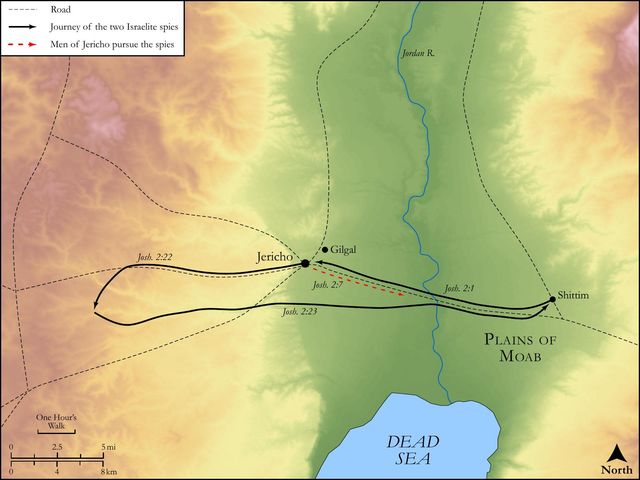
This verse serves as the narrative culmination and formal conclusion of the spy mission that Joshua initiated at the beginning of the chapter, as detailed in Joshua 2:1. It immediately follows the spies' dramatic escape from Jericho, their strategic three-day concealment in the mountains as advised by Rahab (Joshua 2:16), and their safe return across the Jordan River. The comprehensive report they deliver to Joshua, which is summarized here and expanded upon in Joshua 2:24, directly sets the stage for Israel's miraculous crossing of the Jordan in Joshua chapter 3 and the subsequent, divinely orchestrated conquest of Jericho in Joshua chapter 6. The successful completion of this mission not only validates Joshua's leadership but also powerfully demonstrates God's protective hand and providential guidance over His people as they prepare to inherit the Promised Land.
Historical & Cultural Context
At this juncture in the biblical narrative, the Israelite nation is encamped in the plains of Moab, positioned on the eastern bank of the Jordan River, poised to enter the land of Canaan. Jericho, a heavily fortified city, stood as the initial and strategically crucial obstacle near the primary Jordan crossing. In the wars of Israel, reconnaissance missions, as in Moses' sending of twelve men into Canaan, were indispensable for military planning, offering vital intelligence regarding enemy fortifications, troop morale, and logistical challenges. The description of the spies "descending from the mountain" and "passing over" (undoubtedly referring to the Jordan) vividly portrays the arduous physical journey and the inherent dangers involved in traversing hostile or contested territories. Their immediate and direct reporting to Joshua reflects the established and respected chain of command within Israel, underscoring the critical importance of timely and accurate first-hand intelligence for a leader preparing for a major military campaign, especially one understood to be divinely ordained.
Key Themes
ShowHideJoshua 2:23 powerfully underscores several significant theological and narrative themes. Firstly, it highlights Divine Providence and Protection, as the spies' safe and successful return, despite the immense perils of their mission within a hostile city, implicitly but strongly points to God's guiding and preserving hand. This divine safeguarding echoes the protection extended through Rahab's actions and foreshadows God's unwavering faithfulness throughout the subsequent conquest. Secondly, the verse emphasizes Human Agency and Obedience, as the spies diligently executed Joshua's command and reported back faithfully, illustrating the essential role of human action and cooperation within God's overarching divine plans. Thirdly, this passage contributes significantly to the overarching theme of Preparation for Conquest, showcasing the meticulous and strategic steps undertaken by Joshua and the Israelite community before engaging in battle. The intelligence garnered, particularly the detailed account of the Canaanites' demoralized state as confessed by Rahab in Joshua 2:9-11, served as a tangible divine sign that the Lord was indeed delivering the land into Israel's hand, thereby building crucial confidence for the formidable task that lay ahead.
Exposition and Analysis
ShowHideKey Word Analysis
ShowHideThis Hebrew verb, derived from a primitive root, signifies a turning back, often implying a restoration, a completion of a cycle, or a successful conclusion. In the context of Joshua 2:23, it emphasizes that the spies' perilous mission has been brought to a successful and safe end, enabling them to deliver their vital intelligence. It denotes not just physical movement but the fulfillment of their assigned task.
This primitive root means "to score with a mark as a tally or record," and by implication, "to inscribe" or "to enumerate." Intensively, it means "to recount" or "to celebrate." Here, it suggests a comprehensive and detailed report, not merely a brief summary. The spies were expected to give a full account of "all things that befell them," indicating that every observation, every encounter (especially with Rahab), and every perceived detail of Jericho's defenses and the inhabitants' morale was to be meticulously recounted to Joshua.
This primitive root properly means "to come forth to," "to appear or exist," and transitively, "to attain," "to find or acquire." Figuratively, it means "to occur," "meet," or "be present." The phrase "all things that befell them" indicates a full disclosure of their experiences, encompassing both the planned aspects of their mission (spying out the land) and the unexpected, providential encounters, most notably their interaction with Rahab. It signifies a complete and unreserved sharing of their entire ordeal.
Verse Breakdown
ShowHide"So the two men returned, and descended from the mountain, and passed over"
This opening clause succinctly describes the successful completion of the spies' arduous journey back to the Israelite camp. "Returned" signifies the triumphant conclusion of their mission, fraught with peril. "Descended from the mountain" refers to their departure from the strategic hiding place Rahab had advised, a crucial maneuver that allowed them to evade pursuit for three days. "Passed over" most certainly refers to their crossing back over the Jordan River, the natural barrier separating Jericho from the Israelite encampment, thereby completing their perilous journey from enemy territory to the safety of their own people.
"and came to Joshua the son of Nun"
This phrase highlights the direct accountability of the spies to their supreme leader. Joshua, as the divinely appointed successor to Moses and the military commander of Israel, was the central figure for receiving critical intelligence and making strategic decisions for the nation. Their immediate and direct return to him underscores the established hierarchical structure within Israel and the paramount importance of reporting directly to the highest authority, especially concerning matters of national security and divine mandate.
"and told him all [things] that befell them"
This final and crucial phrase emphasizes the comprehensive and unreserved nature of their report. It was not merely a tactical overview of Jericho's defenses or a brief summary; it encompassed every significant event, observation, and encounter they experienced. Crucially, this would have included Rahab's courageous confession of faith in the God of Israel and the widespread fear and demoralization among the Canaanites—intelligence that was perhaps the most significant piece of information, serving as a divine confirmation that God's hand was indeed delivering the land into Israel's possession.
Literary Devices
ShowHideJoshua 2:23 primarily employs Narrative Closure, bringing the suspenseful and perilous account of the spy mission to a definitive and successful end. This verse acts as a crucial pivot point in the narrative, concluding the reconnaissance phase and setting the immediate stage for the active conquest of Canaan. There is also a subtle but powerful element of Understatement in the phrase "all [things] that befell them," which, in its concise simplicity, encompasses a dramatic and perilous three-day ordeal involving a narrow escape from capture, divine protection facilitated by Rahab, and the gathering of crucial intelligence. Furthermore, the successful return of the spies and their comprehensive report Foreshadow the impending success of the conquest, as the intelligence they bring back—particularly the demoralized state of the Canaanites—serves as a divine confirmation of God's promise that the inhabitants of the land are already overcome with fear and ready to fall before Israel.
Theological and Thematic Connections
ShowHideJoshua 2:23 transcends a mere logistical update; it stands as a profound testament to God's unwavering faithfulness and the indispensable role of human obedience in the unfolding of divine plans. The safe return of the spies, despite the inherent dangers and immense odds of their mission, powerfully underscores God's protective providence over His people as they step out in faith and courage. Their diligent and comprehensive reporting to Joshua highlights the biblical principle of accountability within leadership and the intrinsic value of accurate, first-hand information for wise and strategic decision-making. This pivotal event demonstrates that while God orchestrates grand and sovereign plans, He frequently chooses to work through human agents who exercise courage, wisdom, and faithful obedience. The intelligence gathered, particularly the confirmed fear of the Canaanites, serves as a tangible divine confirmation that the Lord is indeed fighting on behalf of Israel, thereby bolstering their faith and confidence for the daunting and divinely mandated task of conquest that lies ahead.
Reflection and Application
ShowHideThe successful return of the spies in Joshua 2:23 offers profound and actionable lessons for contemporary believers. It serves as a powerful reminder of the importance of diligent preparation, thorough reconnaissance, and faithful reporting in our spiritual journeys and practical endeavors. Just as Joshua relied on accurate intelligence for the strategic conquest of Jericho, we are similarly called to seek wisdom, gather information, and prayerfully discern God's will before embarking on significant actions, rather than rushing impulsively or presumptuously. The spies' safe return, against immense odds and through divine intervention, stands as a powerful testament to God's unwavering faithfulness and protective care for those who trust in Him, even when facing seemingly insurmountable challenges or venturing into unfamiliar territory. This narrative encourages us to step out in faith, knowing that God actively guides and protects us as we pursue His purposes. Moreover, their direct accountability to Joshua highlights the enduring value of reporting back to spiritual leaders, mentors, or trusted community members, sharing our experiences, insights, and challenges. This practice fosters a vibrant community of shared wisdom, mutual support, and collective discernment, ensuring that our individual journeys are integrated into the larger body of Christ.
Questions for Reflection
ShowHideFAQ
ShowHideWhat was the significance of the spies' report to Joshua?
ShowHideThe spies' report, delivered upon their return in Joshua 2:23 and elaborated upon in Joshua 2:24, was of paramount significance for several crucial reasons. Firstly, it provided indispensable tactical intelligence regarding Jericho's formidable defenses and the surrounding terrain, which was absolutely essential for Joshua's military strategy. Secondly, and arguably more importantly, the report definitively confirmed the demoralized and terrified state of the Canaanite inhabitants. Rahab's confession, "For we have heard how the Lord dried up the water of the Red Sea before you... and as soon as we heard these things, our hearts melted" (Joshua 2:10-11), served as a tangible divine sign. It powerfully affirmed God's promise that the fear of Israel had indeed fallen upon the land, thereby bolstering the Israelites' faith and confidence that the Lord was actively delivering Canaan into their hands, fulfilling His sacred covenant.
How does Rahab's role connect to this verse?
ShowHideRahab's pivotal role is intrinsically linked to Joshua 2:23, even though she is not explicitly named within this specific verse. The comprehensive phrase "all [things] that befell them" implicitly but crucially includes their transformative encounter with Rahab. Her courageous actions—hiding the spies from the king's men, advising them on their strategic escape route (Joshua 2:16), and her profound declaration of faith in the God of Israel (Joshua 2:9-11)—were absolutely pivotal to the success of the entire mission. Her confession provided the most vital piece of intelligence: the Canaanites' hearts had melted in fear of the Lord, confirming God's prior assurances. Thus, the spies' safe return and their comprehensive report to Joshua were a direct and miraculous result of Rahab's faithfulness and courage, powerfully highlighting God's ability to use unexpected individuals, even from enemy territory, to accomplish His sovereign purposes and demonstrate His universal dominion.
Christ-Centered Fulfillment
ShowHideThe return of the spies in Joshua 2:23, bringing back a report that confirms God's sovereign hand and strategically prepares the way for Israel's entry into the Promised Land, beautifully foreshadows the ultimate "scout" and "forerunner," Jesus Christ. Just as the spies ventured into hostile territory and returned with a message of victory and assurance, Christ descended from heaven, entering the hostile territory of a fallen world, a realm fraught with sin and the power of death. He lived a perfect, sinless life, confronted the spiritual powers of darkness, and through His sacrificial death and glorious resurrection, secured a definitive and eternal victory over sin, death, and the grave. His ascension to the Father, as recorded in Acts 1:9, is His triumphant "return" from His mission, bringing back the "report" of accomplished salvation and the assurance of His reign. He has gone to prepare a place for us in the Father's house (John 14:2-3), just as the spies' report prepared the way for Israel's physical inheritance. Furthermore, Jesus, the ascended Lord, commissioned His disciples, much like Joshua sent his spies, to go into all the world and make disciples of all nations, proclaiming the good news of His victory and the kingdom of God (Matthew 28:18-20). He is the ultimate Lamb of God who takes away the sin of the world (John 1:29), and His "report" to the Father, sealed by His finished work on the cross, ensures our entrance into the true, eternal Promised Land—the new heavens and new earth where righteousness dwells.