


Joshua 2:22
Bible text: King James Version (1769 Blayney text) · Public domain
Bible text: King James Version with Strong's numbers · Public domain
Bible text: Berean Standard Bible · Public domain
Bible text: American Standard Version (1901) · Public domain
Bible text: World English Bible, Messianic edition · Public domain
Bible text: Geneva Bible (1599) · Public domain
Bible text: Young's Literal Translation · Public domain
- וַיֵּלְכוּvai·ye·le·Khuand they wentH1980Conj-w ¦ V-Qal-ConsecImperf-3mpVerb Qal Consecutive Imperfect 3rd Plural Masculineוַandיֵּלְכוּthey went
- וַיָּבֹאוּvai·ya·Vo·'uand they cameH935Conj-w ¦ V-Qal-ConsecImperf-3mpVerb Qal Consecutive Imperfect 3rd Plural Masculineוַandיָּבֹאוּthey came
- הָהָרָהha·Ha·rahthe hill country towardsH2022Art ¦ N-ms ¦ SfxNoun Singular Masculine Absoluteהָtheהָרָhill countryהtowards
- וַיֵּשְׁבוּvai·Ye·she·vuand they remainedH3427Conj-w ¦ V-Qal-ConsecImperf-3mpVerb Qal Consecutive Imperfect 3rd Plural Masculineוַandיֵּשְׁבוּthey remained
- שָׁםshamthereH8033AdvAdverb
- שְׁלֹשֶׁתshe·Lo·shetthreeH7969Adj-cscAdjective Numerical Singular common gender Construct
- יָמִיםya·MimdaysH3117N-mpNoun Plural Masculine Absolute
- עַד'aduntilH5704PrepPreposition
- שָׁבוּSha·vuthey returnedH7725V-Qal-Perf-3cpVerb Qal Perfect 3rd Plural common gender
- הָרֹדְפִיםha·ro·de·Fimthe pursuersH7291Art ¦ V-Qal-Prtcpl-mpVerb Qal Participle Plural Masculine Absoluteהָtheרֹדְפִיםpursuers
- וַיְבַקְשׁוּvay·vak·Shuand they searchedH1245Conj-w ¦ V-Piel-ConsecImperf-3mpVerb Piel Consecutive Imperfect 3rd Plural Masculineוַandיְבַקְשׁוּthey searched
- הָרֹדְפִיםha·ro·de·Fimthe pursuersH7291Art ¦ V-Qal-Prtcpl-mpVerb Qal Participle Plural Masculine Absoluteהָtheרֹדְפִיםpursuers
- בְּכָלbe·kholin allH3605Prep-b ¦ N-mscNoun Singular Masculine Constructבְּinכָלall
- הַדֶּרֶךְha·De·rekhthe wayH1870Art ¦ N-csNoun Singular common gender Absoluteהַtheדֶּרֶךְway
- וְלֹאve·Lo'and notH3808Conj-w ¦ NegParticle Negativeוְandלֹאnot
- מָצָאוּma·Tza·'uthey found [them]H4672V-Qal-Perf-3cpVerb Qal Perfect 3rd Plural common gender
English is a literal word-by-word gloss of the Hebrew, not the KJV's wording. Why?
This is the original text the KJV's translators worked from — each Hebrew word with its own literal English meaning in this verse, prepared by scholars at Tyndale House, Cambridge. The KJV translates whole sentences, not word by word, so its wording differs: one Hebrew word can become several English words, and the KJV may choose “the LORD” where the gloss reads “Yahweh”. Both are faithful — they answer different questions. For the KJV's own rendering, switch to the KJV text.
Details
See on the biblical-era map
Study this verse
Public-domain commentary
Matthew Henry
From his Commentary on the Whole Bible. Henry comments on passages, not single verses — this entry covers Joshua 2:22–24.
We have here the safe return of the spies Joshua had sent, and the great encouragement they brought with them to Israel to proceed in their descent upon Canaan. Had they been disposed to discourage the people, as the evil spies did that Moses sent, they might have told them what they had observed of the height and strength of the walls of Jericho, and the extraordinary vigilance of the king of Jericho, and how narrowly they escaped out of his hands; but they were of another spirit, and, depending themselves upon the divine promise, they animated Joshua likewise. 1. Their return in safety was itself an encouragement to Joshua, and a token for good. that God provided for them so good a friend as Rahab was in an enemy's country, and that notwithstanding the rage of the king of Jericho and the eagerness of the pursuers they had come back in peace, was such an instance of God's great care concerning them for Israel's sake as might assure the people of the divine guidance and care they were under, which should undoubtedly make the progress of their arms glorious. He that so wonderfully protected their scouts would preserve their men of war, and cover their heads in the day of battle. 2. The report they brought was much more encouraging (v. 24): "All the inhabitants of the country, though resolved to stand it out, yet do faint because of us, they have neither wisdom to yield nor courage to fight," whence they conclude, "Truly the Lord has delivered into our hands all the land, it is all our own; we have nothing to do, in effect, but to take possession." Sinners' frights are sometimes sure presages of their fall. If we resist our spiritual enemies they will flee before us, which will encourage us to hope that in due time we shall be more than conquerors.
Historical interpretation
Historical reception
1 surviving comment on this verse from the historical church.
On account of her faith and hospitality, Rahab the harlot was saved. For when spies were sent by Joshua, the son of Nun, to Jericho, the king of the country ascertained that they had come to spy out their land, and sent men to seize them, in order that, when taken, they might be put to death. But the hospitable Rahab receiving them, concealed them on the roof of her house under some stalks of flax. And when the men sent by the king arrived and said, "There came men unto you who are to spy out our land; bring them forth, for so the king commands," she answered them, "The two men whom you seek came unto me, but quickly departed again and are gone," thus not discovering the spies to them. Then she said to the men, "I know assuredly that the Lord your God has given you this city, for the fear and dread of you have fallen on its inhabitants. When therefore you shall have taken it, keep ye me and the house of my father in safety." And they said to her, "It shall be as you have spoken to us. As soon, therefore, as you know that we are at hand, you shall gather all your family under your roof, and they shall be preserved, but all that are found outside of your dwelling shall perish." Moreover, they gave her a sign to this effect, that she should hang forth from her house a scarlet thread. And thus they made it manifest that redemption should flow through the blood of the Lord to all them that believe and hope in God. You see, beloved, that there was not only faith, but prophecy, in this woman.
Continue studying Joshua 2:22 across the web’s major study libraries — every link below opens this exact verse, chapter, or book on the destination site.
Read & Compare
 BibleGatewayThis verse in more than 200 translations and 70 languages.
 Bible.comThe YouVersion reader — hundreds of translations, reading plans, and highlights.
 ESV.orgCrossway's official English Standard Version reader.
 NET BibleThe NET translation with 60,000+ translators' notes on every rendering decision.
 STEP BibleTyndale House's free study tool — original text, vocabulary, and scholarly resources.
 BibliaLogos Bible Software's free web reader.
 USCCBThe New American Bible (Revised Edition) with the U.S. bishops' study notes.
Commentaries
 BibleHub CommentariesDozens of classic commentaries on this verse, gathered on one page.
 StudyLightMore than 100 commentary sets — the largest collection on the web.
 BibleRefPlain-English commentary on what this verse means, verse by verse.
 Enduring WordDavid Guzik's free commentary on this chapter, widely used by Bible teachers.
 Bible Study ToolsVerse commentary alongside Greek and Hebrew study aids.
Original Language & Research
- BibleHub InterlinearThe verse word by word — original language, transliteration, and English.
- BibleHub LexiconEvery word's original-language definition and Strong's entry.
 Blue Letter BibleDeep-study tools — Strong's numbers, concordance, and word studies.
 SefariaThe Hebrew text with Rashi and centuries of Jewish commentary.
Sermons, Hymns & Audio


TrulyRandomVerse is not affiliated with these sites and doesn’t control their content. They’re linked because they’re genuinely useful.
Summary
Joshua 2:22 narrates the successful evasion of the two Israelite spies, who, following Rahab's strategic counsel, sought refuge in the rugged mountainous terrain west of Jericho. They remained concealed for three days, a crucial period that allowed the intense pursuit by Jericho's soldiers to subside. Despite a comprehensive search by their pursuers along all possible routes, the spies remained undiscovered, powerfully illustrating God's providential protection and the efficacy of wise, obedient action in the face of grave danger.
Context
ShowHideLiterary Context
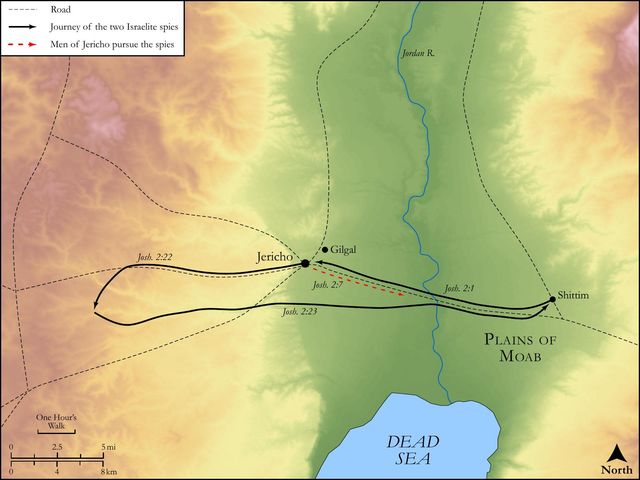
This verse serves as the critical culmination of the spies' escape from Jericho, directly following their perilous encounter with Rahab detailed in Joshua 2:1-21. Joshua had dispatched them to reconnoiter Jericho and its surrounding land (Joshua 2:1), but their presence was quickly discovered, prompting the King of Jericho to send soldiers to apprehend them (Joshua 2:2-3). Rahab, a harlot, courageously hid them on her roof (Joshua 2:4-6) and then provided precise instructions for their escape: to flee to the mountain and remain there for three days until the pursuers returned (Joshua 2:16). Joshua 2:22 confirms their complete obedience to her counsel and the successful execution of this vital phase of their mission, thereby setting the stage for their safe return to Joshua and their subsequent report in Joshua 2:23-24.
Historical & Cultural Context
Jericho, an ancient and formidable city, was strategically positioned at a fertile oasis near the Jordan River, making it a pivotal entry point into Canaan from the east. The "mountain" referenced in this verse refers to the stark, rugged wilderness and hill country immediately west of Jericho. This region is characterized by steep wadis (dry riverbeds), numerous caves, and rocky outcrops, which offered abundant natural hiding places. In ancient warfare, military pursuit was typically intense but finite; soldiers would usually conduct a thorough search for a limited duration before returning to their posts, especially if the trail grew cold. The three-day period mentioned was likely a calculated estimate for how long a diligent but ultimately unsuccessful search would last before the pursuers would concede defeat and return to the city. The Canaanites, including Jericho's inhabitants, were already acutely aware of Israel's God and their miraculous crossing of the Red Sea (Joshua 2:9-11), which would have undoubtedly intensified their fear and their efforts to capture the spies.
Key Themes
ShowHideThis verse powerfully illustrates several foundational themes within the book of Joshua and the broader biblical narrative. Divine Protection is paramount; despite being deep in hostile territory and facing a determined search, the spies were supernaturally shielded, demonstrating God's active providence over His chosen instruments. The utter futility of the pursuers' efforts ("sought them throughout all the way, but found them not") vividly underscores the effectiveness of this divine safeguard. Wisdom and Obedience are also prominently highlighted, as the spies' adherence to Rahab's specific, strategic, and seemingly unconventional advice (coming from a non-Israelite woman) proved absolutely instrumental in their survival. This emphasizes the critical importance of heeding wise counsel, even from unexpected sources, when it aligns with God's overarching plan. Finally, the theme of Patience and Timing is clearly evident in the instruction to wait "three days." This period of patient waiting allowed the immediate threat to dissipate, teaching that God's purposes often unfold according to His perfect timing, requiring human patience and trust rather than impulsive action. This strategic waiting is a recurring motif in God's dealings with His people, seen in various instances of divine deliverance throughout Scripture, for example, in Exodus 14:13-14 or Isaiah 30:15.
Exposition and Analysis
ShowHideKey Word Analysis
ShowHideThe Hebrew word הַר (har, H2022) refers to a mountain, hill, or mountainous region. In this specific context, it denotes the steep, arid, and rugged wilderness terrain directly to the west of Jericho. This area, replete with numerous caves, ravines, and natural crevices, served as an ideal natural hiding place. The selection of this location, advised by Rahab, was strategically sound, offering essential concealment from the open plains and the direct routes back to the Jordan River. It signifies a place of refuge and security providentially provided by God through natural means.
The Hebrew word יוֹם (yôwm, H3117) refers to a day, whether literal (from sunrise to sunset or sunset to sunset) or figuratively a space of time. In the phrase "three days," it specifies a precise period of seventy-two hours. This duration was not arbitrary but a divinely guided, strategic timeframe. It was sufficient for the Jerichoite pursuers to exhaust their search efforts, return to their city, and for the immediate danger to subside. This detail underscores the importance of precise timing in God's plans and the necessity of patient waiting for His deliverance to fully manifest, ultimately ensuring the spies' safe passage back to the Israelite camp.
The Hebrew word מָצָא (mâtsâʼ, H4672) is a primitive root meaning to come forth to, appear, or exist; transitively, to attain, find, or acquire. In the context of "but found [them] not," this word highlights the complete failure of the Jerichoite pursuers. Despite their diligent search, their efforts to "find" the spies were utterly fruitless. This outcome is not merely a testament to the spies' effective hiding skills or Rahab's cleverness, but a clear indication of divine intervention and protection. It signifies that when God chooses to hide or protect His people, no human effort, however thorough or determined, can uncover them against His sovereign will.
Verse Breakdown
ShowHide"And they went, and came unto the mountain"
This initial clause describes the spies' immediate and obedient response to Rahab's crucial counsel. Having been lowered from her window, they did not hesitate but swiftly headed for the designated hiding place. This act of prompt obedience demonstrates their trust in Rahab's wisdom, which was implicitly aligned with God's providential care for them. Their rapid departure from the city walls and strategic movement towards the mountainous refuge was absolutely critical for their survival and the success of their mission.
"and abode there three days, until the pursuers were returned"
This segment specifies both the duration and the strategic purpose of their hiding. Staying for "three days" was a deliberate, calculated waiting period, specifically designed to outlast the active and intense search by the Jerichoite soldiers. This highlights the virtue of patience and the understanding that immediate danger often necessitates a period of withdrawal and waiting for the opportune moment to proceed. The phrase "until the pursuers were returned" marks the successful conclusion of the immediate threat, signifying that the danger had passed and their path was clear for their next move.
"and the pursuers sought [them] throughout all the way, but found [them] not."
This final clause powerfully confirms the utter futility of the enemy's efforts and the complete effectiveness of the spies' concealment. The phrase "throughout all the way" implies a comprehensive and diligent search conducted along all the roads, paths, and likely routes leading from Jericho. However, despite their best and most thorough efforts, the pursuers were utterly unable to locate the spies. This outcome is a profound testament to God's protective hand, ensuring that His servants remain hidden and safe until His divine purposes for them are fully accomplished. It underscores the ultimate inability of human opposition to thwart God's sovereign plans.
Literary Devices
ShowHideJoshua 2:22 employs several literary devices to enhance its narrative impact and theological depth. Foreshadowing is evident, as the successful evasion of the spies, despite intense pursuit, subtly hints at God's greater, miraculous protection over Israel in the impending conquest of Jericho. Their hiddenness and subsequent safe return foreshadow the ultimate security God provides for His people in the face of insurmountable odds. There is also a strong element of Irony, as the powerful King of Jericho, with all his military resources and authority, is utterly frustrated in his search for two individuals, while a seemingly insignificant harlot (Rahab) becomes the divinely appointed instrument of their salvation. This highlights the divine reversal of human expectations and power dynamics. Furthermore, the passage powerfully demonstrates Divine Providence. Though not explicitly a literary device, it is the underlying theological framework that permeates the narrative. The seemingly natural events—Rahab's astute advice, the rugged terrain providing natural cover, and the precise duration of the search—are all orchestrated by God to ensure the success of His plan, making the spies' escape appear not merely fortunate, but miraculous in its precision and outcome.
Theological and Thematic Connections
ShowHideJoshua 2:22 beautifully encapsulates the profound themes of divine protection and strategic timing within God's unfolding redemptive plan. The spies' successful evasion is not merely a stroke of luck or human ingenuity but a clear demonstration of God's active involvement in safeguarding His chosen instruments. This episode powerfully reinforces the biblical truth that when God has a purpose for His servants, He will provide the means for their safety and success, even in the midst of hostile environments and intense opposition. It speaks to the absolute sovereignty of God, who can use unexpected individuals (like Rahab) and seemingly mundane circumstances (a mountain hiding place, a three-day wait) to achieve His extraordinary will. This narrative serves as an encouraging reminder that God's hidden hand is always at work, ensuring the advancement of His kingdom despite human obstacles and the most diligent efforts of adversaries.
Reflection and Application
ShowHideThe narrative of the spies' escape in Joshua 2:22 offers profound and enduring lessons for contemporary believers. It reminds us that there are times in life when God calls us to a season of "hiding"—not necessarily physical concealment, but perhaps a period of patient waiting, quiet trust, strategic withdrawal from conflict, or diligent preparation. In these moments, like the spies, we are called to exercise unwavering obedience to wise counsel, even if it comes from unexpected sources, and to trust implicitly in God's perfect timing rather than rushing ahead in our own strength or impatience. This verse encourages us to believe that even when "pursuers" are "throughout all the way," diligently seeking to thwart us or our God-given mission, God can render their efforts utterly futile. Our safety, our progress, and our ultimate success are deeply rooted in His providential care, which often works through natural means and human cooperation. It fosters a deep and abiding sense of security, knowing that our God is a God who hides His own, making a way where there seems to be no way, and bringing His purposes to fruition in His own perfect time.
Questions for Reflection
ShowHideFAQ
ShowHideWhy was "three days" the specific time period for the spies to hide?
ShowHideThe "three days" was a strategic and divinely guided period. In ancient warfare and pursuit, a three-day window was often considered sufficient for initial, intense searches to subside. After this time, pursuers would typically exhaust their immediate efforts and return to their base, assuming their targets had either escaped far away or successfully hidden beyond immediate reach. For the spies, this duration allowed the immediate danger to pass, ensuring that the roads and surrounding areas were clear of the Jerichoite soldiers before they attempted to return to the Israelite camp. It demonstrates the importance of patience and waiting for God's opportune timing, as seen in other biblical narratives where specific waiting periods precede significant events or deliverances, such as Jonah's three days in the fish (Jonah 1:17) or Esther's three-day fast before approaching the king (Esther 4:16).
What does this verse tell us about Rahab's faith and wisdom?
ShowHideJoshua 2:22, by confirming the spies' obedience to Rahab's instructions and the ultimate success of her plan, powerfully underscores her remarkable faith and practical wisdom. Her counsel to hide in the mountain for three days was not a random suggestion but a shrewd strategic move, demonstrating an acute understanding of the local terrain and the typical duration of military pursuits. This wisdom, coupled with her courageous decision to protect the spies, reveals a deep conviction that the God of Israel was indeed sovereign and that His plans would prevail (Joshua 2:9-11). Her actions were a tangible expression of her burgeoning faith, leading directly to her and her family's salvation during the fall of Jericho (Joshua 6:25). Her example is even celebrated in the New Testament as a model of faith and works (Hebrews 11:31, James 2:25).
How does this event balance God's sovereignty with human responsibility and action?
ShowHideThis verse beautifully illustrates the dynamic and complementary interplay between God's sovereignty and human responsibility. God's providential protection is clearly at work, ensuring the spies are "found not" despite a thorough search, demonstrating His ultimate control. Yet, this divine protection does not negate human action; rather, it works through it. The spies had to actively "go" to the mountain and "abide there three days," demonstrating their obedience, patience, and strategic thinking. Rahab's wise counsel and courageous actions were also absolutely crucial to the outcome. This narrative shows that God often accomplishes His sovereign will not through passive waiting, but by empowering and guiding His people to take specific, strategic actions, ensuring that their efforts align with and are ultimately blessed by His overarching plan. It's a powerful partnership where human obedience becomes the channel for divine intervention and miraculous deliverance.
Christ-Centered Fulfillment
ShowHideJoshua 2:22, with its narrative of hiddenness, divine protection, and a strategic three-day period, finds profound Christ-centered fulfillment. The spies, sent on a mission into hostile enemy territory, faced imminent danger but were supernaturally preserved through a period of concealment, emerging safely to report on the land. This vividly foreshadows the ultimate mission of Christ, the true Spy and Son sent by God into the hostile territory of a fallen world. Jesus, too, experienced periods of hiddenness and evasion from those who sought to destroy Him prematurely (John 7:1, John 8:59). Yet, His ultimate "hiding place" was the tomb, where He lay for "three days and three nights" (Matthew 12:40). Just as the pursuers could not find the spies in their mountain refuge, death and the grave could not hold Christ. On the third day, He emerged victorious, having conquered sin and death, thereby fulfilling the ultimate mission of redemption for all humanity (1 Corinthians 15:3-4). Furthermore, the security found by the spies in their hiddenness speaks to the spiritual security believers find in Christ. We are declared by Paul to be "hidden with Christ in God" (Colossians 3:3), eternally protected from the ultimate pursuers of sin, death, and condemnation, awaiting our full revelation with Him in glory (Romans 8:38-39). The safe return of the spies brought hope and confirmation of God's power to Israel; Christ's resurrection brings eternal hope and the absolute assurance of God's complete victory for all who trust in Him.