


2 Samuel 17:20
- וַיָּבֹאוּvai·ya·Vo·'uand they cameH935Conj-w ¦ V-Qal-ConsecImperf-3mpVerb Qal Consecutive Imperfect 3rd Plural Masculineוַandיָּבֹאוּthey came
- עַבְדֵי'av·Dei[the] servants ofH5650N-mpcNoun Plural Masculine Construct
- אַבְשָׁלוֹם'av·sha·LomAbsalomH53N-proper-mNoun Proper Masculine
- אֶל'eltoH413PrepPreposition
- הָאִשָּׁהha·'i·Shahthe womanH802Art ¦ N-fsNoun Singular Feminine Absoluteהָtheאִשָּׁהwoman
- הַבַּיְתָהha·Bay·tahthe house towardsH1004Art ¦ N-ms ¦ SfxNoun Singular Masculine Absoluteהַtheבַּיְתָhouseהtowards
- וַיֹּאמְרוּvai·yo·me·Ruand they saidH559Conj-w ¦ V-Qal-ConsecImperf-3mpVerb Qal Consecutive Imperfect 3rd Plural Masculineוַandיֹּאמְרוּthey said
- אַיֵּה'ai·Yehwhere?H346InterrogParticle Interrogative
- אֲחִימַעַץ'a·chi·Ma·'atz[are] AhimaazH290N-proper-mNoun Proper Masculine
- וִיהוֹנָתָןvi·Ho·na·Tanand JonathanH3083Conj-w ¦ N-proper-mNoun Proper MasculineוִandיהוֹנָתָןJonathan
- וַתֹּאמֶרva·To·merand she saidH559Conj-w ¦ V-Qal-ConsecImperf-3fsVerb Qal Consecutive Imperfect 3rd Singular Feminineוַandתֹּאמֶרshe said
- לָהֶםla·Hemto <the> themPrep-l ¦ 3mpSuffix Personal 3rd Plural Masculineלָto <the>הֶםthem
- הָאִשָּׁהha·'i·Shahthe womanH802Art ¦ N-fsNoun Singular Feminine Absoluteהָtheאִשָּׁהwoman
- עָבְרוּ'a·ve·Ruthey have passed overH5674V-Qal-Perf-3cpVerb Qal Perfect 3rd Plural common gender
- מִיכַלmi·Khal[the] brook ofH4323N-mscNoun Singular Masculine Construct
- הַמָּיִםha·Ma·yim<the> waterH4325Art ¦ N-mpNoun Plural Masculine Absoluteהַ<the>מָּיִםwater
- וַיְבַקְשׁוּvay·vak·Shuand they sought [them]H1245Conj-w ¦ V-Piel-ConsecImperf-3mpVerb Piel Consecutive Imperfect 3rd Plural Masculineוַandיְבַקְשׁוּthey sought [them]
- וְלֹאve·Lo'and notH3808Conj-w ¦ NegParticle Negativeוְandלֹאnot
- מָצָאוּma·Tza·'uthey found [them]H4672V-Qal-Perf-3cpVerb Qal Perfect 3rd Plural common gender
- וַיָּשֻׁבוּvai·ya·Shu·vuand they returnedH7725Conj-w ¦ V-Qal-ConsecImperf-3mpVerb Qal Consecutive Imperfect 3rd Plural Masculineוַandיָּשֻׁבוּthey returned
- יְרוּשָׁלִָםye·ru·sha·LimJerusalemH3389N-properNoun Proper Location
English is a literal word-by-word gloss of the Hebrew, not the KJV's wording. Why?
This is the original text the KJV's translators worked from — each Hebrew word with its own literal English meaning in this verse, prepared by scholars at Tyndale House, Cambridge. The KJV translates whole sentences, not word by word, so its wording differs: one Hebrew word can become several English words, and the KJV may choose “the LORD” where the gloss reads “Yahweh”. Both are faithful — they answer different questions. For the KJV's own rendering, switch to the KJV text.
Details
See on the biblical-era map

Study this verse
Public-domain commentary
Matthew Henry
From his Commentary on the Whole Bible. Henry comments on passages, not single verses — this entry covers 2 Samuel 17:15–21.
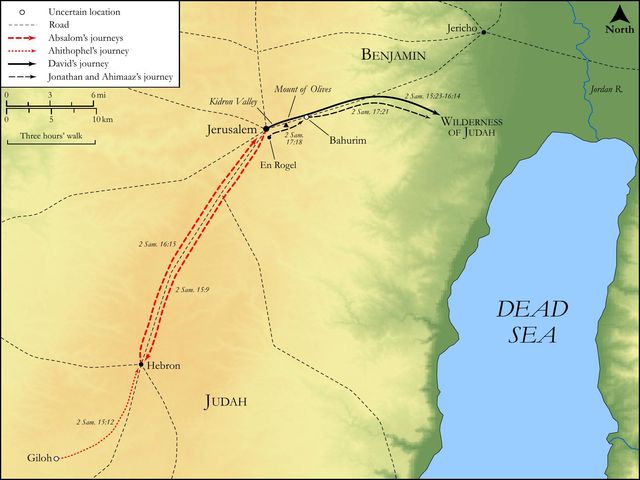
We must now leave David's enemies pleasing themselves with the thoughts of a sure victory by following Hushai's counsel, and sending a summons, no doubt, to all the tribes of Israel, to come to the general rendezvous at a place appointed, pursuant to that counsel; and we next find David's friends consulting how to get him notice of all this, that he might steer his course accordingly. Hushai tells the priests what had passed in council, Sa2 17:15. But, it should seem, he was not sure but that yet Ahithophel's counsel might be followed, and was therefore jealous lest, if he made not the best of his way, the king would be swallowed up, and all the people that were with him, Sa2 17:16. Perhaps, as he was called in to give advice (Sa2 17:5), so he was dismissed before they came to that resolve (Sa2 17:14) in favour of his advice, or he feared they might afterwards change their mind. However, it was good to provide against the worst, and therefore to hasten those valuable lives out of the reach of these destroyers. Such strict guards did Absalom set upon all the avenues to Jerusalem that they had much ado to get this necessary intelligence to David. 1. The young priests that were to be the messengers were forced to retire secretly out of the city, by En-rogel, which signifies, as some say, the fountain of a spy. Surely it went ill with Jerusalem when two such faithful priests as they were might not be seen to come into the city. 2. Instructions were sent to them by a poor simple young woman, who probably went to that well under pretence of fetching water, Sa2 17:17. If she carried the message by word of mouth, there was danger of her making some mistake or blunder in it; but Providence can make an ignorant girl a trusty messenger, and serve its wise counsels by the foolish things of the world. 3. Yet, by the vigilance of Absalom's spies, they were discovered, and information was brought to Absalom of their motions: A lad saw them and told him, Sa2 17:18. 4. They, being aware that they were discovered, sheltered themselves in a friend's house in Bahurim, where David had refreshed himself but just before, Sa2 16:14. There they were happily hidden in a well, which now, in summer time, perhaps was dry, Sa2 17:18. The woman of the house very ingeniously covered the mouth of the well with a cloth, on which she spread corn to dry, so that the pursuers were not aware that there was a well; else they would have searched it, Sa2 17:19. Thus far the woman did well; but we know not how to justify her further concealing them with a lie, Sa2 17:20. We must not do evil that good may come of it. However, hereby the messengers were protected, and the pursuers were defeated and returned to Absalom without their prey. It was well that Absalom did not hereupon fall upon their two fathers, Zadok and Abiathar, as Saul on Ahimelech for his kindness to David: but God restrained him. Being thus preserved, they brought their intelligence very faithfully to David (Sa2 17:21), with this advice of his friends, that he should not delay to pass over Jordan, near to which, it seems, he now was. There, as some think, he penned the 42nd and 43rd Psalms, looking back upon Jerusalem from the land of Jordan, Psa 42:6.
Historical interpretation
Historical reception
1 surviving comment on this verse from the historical church.
And what shall we say about the deed of the woman who received those who had been sent to King David by the aforementioned Hushai and who hid them in a well, spreading a cover over the mouth of it and making believe that she was drying barley? “They went on,” she said, “after having drunk a little water,” and by this trick she saved them from the hands of their pursuers. Tell me, then, I ask you, what you would have done if a similar situation had arisen for you who now live under the gospel. Would you have chosen to conceal them by a similar lie, saying in the same way, “They went on after having drunk a little water,” thus fulfilling what is commanded, “Do not spare [your help] to save those who are being led to death and to redeem those who are being slain” Or by speaking the truth would you have given over those who were hidden to those who were going to kill them? What, then, of the apostle’s words? “Let no one seek what is [to] his own [benefit] but rather [to] what is another’s.” And, “Love does not seek what is its own but rather what belongs to others.” And what he says about himself, “I do not seek what is beneficial to me but what is beneficial to the many, so that they may be saved.” For if we seek what is ours and wish to hold on obstinately to what is beneficial to us, we shall have to speak the truth even in difficulties of this sort, and we shall become guilty of another’s death. But if we fulfill the apostolic command by placing what is helpful to others ahead of our own well-being, without a doubt the necessity of lying will be imposed upon us.
Continue studying 2 Samuel 17:20 across the web’s major study libraries — every link below opens this exact verse, chapter, or book on the destination site.
Read & Compare
 BibleGatewayThis verse in more than 200 translations and 70 languages.
 Bible.comThe YouVersion reader — hundreds of translations, reading plans, and highlights.
 ESV.orgCrossway's official English Standard Version reader.
 NET BibleThe NET translation with 60,000+ translators' notes on every rendering decision.
 STEP BibleTyndale House's free study tool — original text, vocabulary, and scholarly resources.
 BibliaLogos Bible Software's free web reader.
 USCCBThe New American Bible (Revised Edition) with the U.S. bishops' study notes.
Commentaries
 BibleHub CommentariesDozens of classic commentaries on this verse, gathered on one page.
 StudyLightMore than 100 commentary sets — the largest collection on the web.
 BibleRefPlain-English commentary on what this verse means, verse by verse.
 Enduring WordDavid Guzik's free commentary on this chapter, widely used by Bible teachers.
 Bible Study ToolsVerse commentary alongside Greek and Hebrew study aids.
Original Language & Research
- BibleHub InterlinearThe verse word by word — original language, transliteration, and English.
- BibleHub LexiconEvery word's original-language definition and Strong's entry.
 Blue Letter BibleDeep-study tools — Strong's numbers, concordance, and word studies.
 SefariaThe Hebrew text with Rashi and centuries of Jewish commentary.
Sermons, Hymns & Audio


TrulyRandomVerse is not affiliated with these sites and doesn’t control their content. They’re linked because they’re genuinely useful.
Summary
2 Samuel 17:20 vividly portrays a critical moment in Absalom's rebellion, highlighting the quick-witted courage of an unnamed woman in Bahurim. Through strategic deception, she successfully protects King David's vital messengers, Ahimaaz and Jonathan, from Absalom's pursuing servants. This verse details the confrontation, the woman's decisive misdirection, and the subsequent failure of the search, ensuring the messengers' escape and the delivery of crucial intelligence that would ultimately aid David's survival and strategic counter-planning against the usurper.
Context
ShowHideLiterary Context
This verse is deeply embedded within the climactic narrative of Absalom's rebellion against King David, immediately following the pivotal counsel given by Hushai the Archite. Hushai's cunning advice, detailed in 2 Samuel 17:1-14, successfully thwarted Ahithophel's immediate and deadly plan to pursue David. The critical information about Hushai's counter-strategy and the need for David to flee across the Jordan was entrusted to Ahimaaz and Jonathan, sons of the high priests Zadok and Abiathar. These messengers were initially positioned near En-rogel (2 Samuel 17:17), but their presence was discovered by a young boy, forcing them to flee. They sought refuge in Bahurim, where a loyal woman and her husband bravely concealed them in a well, covering it with a grinding stone and grain (2 Samuel 17:18-19). Verse 20 describes Absalom's servants arriving at the house, their direct questioning, and the woman's decisive action to protect the messengers, setting the stage for their eventual escape and the delivery of the life-saving message to David.
Historical & Cultural Context
The backdrop of 2 Samuel 17 is a full-scale civil war, with Absalom having successfully seized Jerusalem and King David in hasty flight. In the ancient Near East, intelligence gathering and swift communication were paramount to military and political success. Messengers, especially those carrying secret or urgent information, faced extreme danger if captured, as their capture could compromise entire campaigns or even lead to the death of leaders. The woman's act of hiding and deceiving Absalom's servants was not merely a personal favor but a high-stakes act of political defiance, risking her own life and the lives of her household. Bahurim, a village situated east of the Mount of Olives on the route towards the Jordan River, was strategically located along David's escape path, making it a logical place for the messengers to seek refuge and for Absalom's forces to pursue. This narrative powerfully illustrates the deep divisions within Israel during this rebellion, where loyalty to David was often expressed through acts of covert resistance and immense personal risk, contrasting with the widespread defection to Absalom.
Key Themes
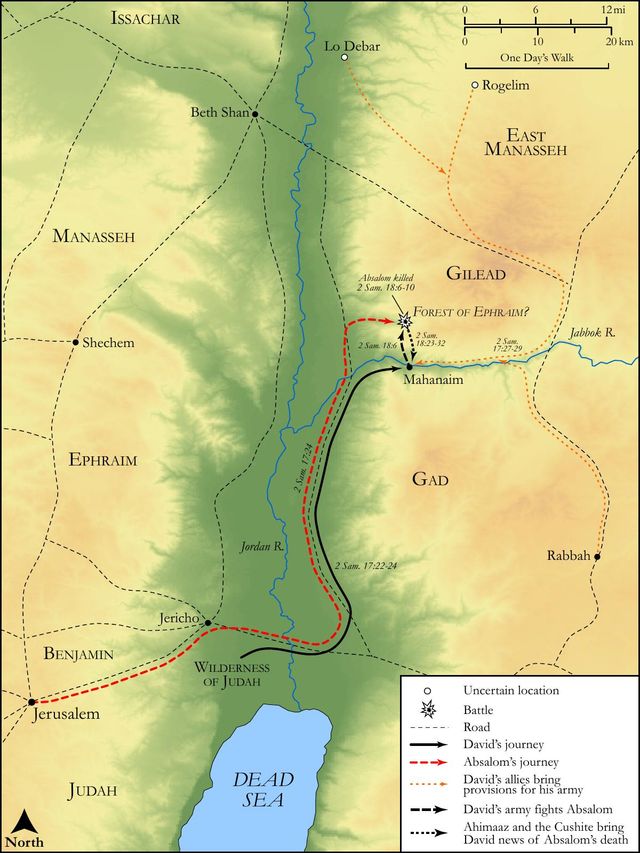
ShowHideThe passage powerfully illustrates the theme of Loyalty Versus Treachery. While Absalom's rebellion represents profound disloyalty to David and God's anointed king, the woman's actions exemplify unwavering faithfulness, placing her own safety at risk to protect David's interests. This contrasts sharply with the widespread defection seen elsewhere in 2 Samuel 15. Another prominent theme is Divine Providence. Although the woman's quick thinking appears to be a purely human act of ingenuity, the successful hiding and escape of Ahimaaz and Jonathan are ultimately presented as part of God's overarching plan to preserve David and ensure the continuation of his dynasty. This aligns with the broader biblical understanding that God works through human agents and seemingly ordinary circumstances to achieve His sovereign purposes, as hinted at in Proverbs 19:21. Finally, the intense search by Absalom's servants underscores The Urgency and Power of Information. The intelligence carried by Ahimaaz and Jonathan was literally a matter of life and death for David, highlighting how critical strategic information was in ancient conflict and how its successful transmission could alter the course of events.
Exposition and Analysis
ShowHideKey Word Analysis
ShowHideThis term (H1004) refers to a dwelling, often encompassing the entire household or family within. The servants' arrival "to the woman to the house" indicates their direct confrontation with the household, implying a search of the premises. The woman's quick thinking within her own domestic sphere is highlighted, turning a place of refuge into a site of strategic deception.
The verb "sought" (H1245) denotes a diligent, earnest, and persistent search. Absalom's servants were not merely glancing around; they were actively looking for the messengers, indicating the high priority and urgency Absalom placed on their capture. The fact that they "could not find" them underscores the effectiveness of the woman's concealment and deception, despite the thoroughness of the search.
This verb (H7725) signifies a turning back or going back to a previous location. Their return to Jerusalem without the messengers confirms the failure of their mission and the success of the woman's protective lie. It marks a critical turning point, as the absence of the messengers meant David would receive the warning, thus gaining precious time and allowing him to escape further.
Verse Breakdown
ShowHide"And when Absalom's servants came to the woman to the house, they said, Where [is] Ahimaaz and Jonathan?"
This clause establishes the direct confrontation and the immediate danger faced by the woman. Absalom's servants were clearly informed that the messengers were in the vicinity, indicating a successful pursuit or intelligence gathering on their part. Their direct, pointed question shows they knew exactly whom they were looking for, placing the woman in a perilous position where a truthful answer would have condemned David's loyalists.
"And the woman said unto them, They be gone over the brook of water."
This is the pivotal moment of deception. The woman's response is swift, confident, and strategically misleading. By directing them "over the brook of water," she provides a plausible but incorrect destination, sending the pursuers on a wild goose chase. This quick thinking under immense pressure demonstrates remarkable courage, loyalty, and ingenuity.
"And when they had sought and could not find [them], they returned to Jerusalem."
This final clause confirms the success of the woman's ruse. The servants' diligent search proved fruitless, leading them to abandon their pursuit and return to Absalom's headquarters in Jerusalem. This outcome was crucial, as it bought the messengers the necessary time to emerge from hiding and continue their journey to warn David, thereby directly impacting the outcome of the rebellion and David's survival.
Literary Devices
ShowHideThe narrative of 2 Samuel 17:20 masterfully employs several Literary Devices to heighten tension and convey meaning. Dramatic Irony is prominent, as the audience knows the messengers are hidden in the well, while Absalom's servants are completely unaware, making their futile search all the more poignant and creating suspense. The woman's quick, deceptive response is an example of Quick Wit or Cleverness, a recurring motif in biblical narratives where seemingly weaker or overlooked characters outmaneuver powerful adversaries. Furthermore, the scene presents a stark Contrast between the treachery of Absalom and his followers, who seek to destroy David, and the steadfast loyalty and courage of ordinary individuals like this woman, who risk everything for the rightful king. The entire sequence also serves as Foreshadowing, subtly hinting at David's ultimate preservation and the eventual failure of Absalom's rebellion, as God's providential hand is clearly at work through these human actions, demonstrating His ability to use unexpected means to achieve His purposes.
Theological and Thematic Connections
ShowHideThe account in 2 Samuel 17:20 raises profound theological questions about the nature of truth, deception, and divine providence. While the Bible generally condemns lying, this narrative, alongside others like Rahab's deception in Jericho, presents instances where a lie, told to protect life or to further God's redemptive purposes, is implicitly or explicitly presented as a righteous act. The woman's lie here is not for personal gain or malice, but for the preservation of God's anointed king and the continuation of His covenantal plan. It highlights God's sovereign ability to work through unconventional means and human agents, even when those means involve moral complexities. The success of her deception underscores that God's purposes cannot be thwarted by human schemes, and He can use the seemingly small and insignificant acts of individuals to achieve His grand designs. This passage reminds us that loyalty to God's chosen path may sometimes demand courage that defies conventional morality in a fallen world, trusting in a higher purpose that transcends immediate ethical dilemmas.
Reflection and Application
ShowHideThe story of the unnamed woman in Bahurim is a powerful reminder that God often uses unexpected people in unexpected ways to accomplish His will. This ordinary householder, not a prophet or a priest, demonstrated extraordinary courage and quick thinking in a moment of national crisis. Her actions, though involving deception, were rooted in deep loyalty and a desire to protect life and the rightful king. This challenges us to consider our own roles in moments of moral or spiritual crisis: Are we willing to act decisively, even when it involves personal risk or difficult ethical choices, to uphold what is right and protect the vulnerable? The passage also underscores the immense value of faithfulness in small, seemingly insignificant acts. Just as the woman's quick wit had far-reaching consequences for David's survival, our daily choices of integrity, courage, and loyalty, however small, can contribute to God's larger purposes in ways we may not immediately perceive. It calls us to cultivate a spirit of discernment and courage, ready to respond faithfully when opportunities arise to serve God's kingdom, even when the path is fraught with danger or ethical complexity.
Questions for Reflection
ShowHideFAQ
ShowHideWas the woman's lie justifiable from a biblical perspective?
ShowHideThe Bible consistently condemns lying as sin (e.g., Proverbs 6:16-19), yet there are specific instances, like this one, or the actions of the Hebrew midwives in Exodus 1:17-20 and Rahab in Joshua 2:4-6, where deception is employed to preserve life or further God's redemptive plan, and the individuals are not condemned for their actions. In these cases, the "lie" is presented as a lesser evil in a dire situation, chosen to protect innocent lives against malicious intent. The woman's lie here was not for selfish gain or to harm, but to protect David's loyal messengers from those seeking to overthrow God's anointed king. While not endorsing lying as a general practice, these narratives suggest that in extreme, life-or-death circumstances where a higher moral good (preserving life, protecting God's covenant purposes) is at stake, God can work through such actions and even commend the courage and faith behind them.
What was the significance of Ahimaaz and Jonathan, and why was their protection so crucial?
ShowHideAhimaaz and Jonathan were the sons of Zadok and Abiathar, the two high priests loyal to King David. Their priestly lineage likely afforded them a degree of trust and access, making them ideal messengers. Their protection was absolutely crucial because they carried the vital intelligence from Hushai that exposed Ahithophel's deadly counsel to Absalom and warned David to cross the Jordan River to safety before Absalom could launch a swift, decisive attack. This message, detailed in 2 Samuel 17:15-16, was literally a matter of life and death for David and his loyal followers. Their successful evasion of Absalom's servants, facilitated by the woman in Bahurim, ensured that David received the warning, allowing him to regroup and prepare for the coming conflict, ultimately preserving his life and the future of his kingdom.
Christ-Centered Fulfillment
ShowHideThe narrative of 2 Samuel 17:20, while seemingly a straightforward account of human courage and deception, finds its ultimate fulfillment and deeper meaning in the person and work of Jesus Christ. David, the anointed king whose life is providentially preserved here, is a profound type of the greater King, Jesus, the Son of David. Just as David's life was protected from the rebellion of Absalom, ensuring the continuation of the royal line, so too was the ultimate King, Jesus, protected from the murderous schemes of Herod in His infancy (Matthew 2:13-15), ensuring the fulfillment of God's redemptive plan. The "brook of water" that the woman deceptively points to can be seen as a faint echo of the "living water" that Jesus offers (John 4:10), contrasting the deceptive, life-preserving water in the Old Testament with the life-giving, truthful water of the New. Ultimately, while human deception was necessary to preserve David's life in a fallen world, Jesus, the embodiment of truth (John 14:6), did not need to employ such means. He overcame rebellion and death not through evasion but through direct confrontation and ultimate sacrifice on the cross, becoming the true Lamb of God who takes away the sin of the world. His kingdom is established not by human cunning but by divine power and the unwavering truth of His resurrection, offering ultimate protection and salvation to all who believe (Romans 8:31-39).