


2 Samuel 17:17
- וִיהוֹנָתָןvi·ho·na·Tanand JonathanH3083Conj-w ¦ N-proper-mNoun Proper MasculineוִandיהוֹנָתָןJonathan
- וַאֲחִימַעַץva·'a·chi·Ma·'atzand AhimaazH290Conj-w ¦ N-proper-mNoun Proper MasculineוַandאֲחִימַעַץAhimaaz
- עֹמְדִים'o·me·Dim[were] stayingH5975V-Qal-Prtcpl-mpVerb Qal Participle Plural Masculine Absolute
- בְּעֵיןbe·'einat EnH5883Prep-b ¦ N-properNoun Proper LocationבְּatעֵיןEn
- רֹגֵלro·GelRogelH5883N-properNoun Proper Location
- וְהָלְכָהve·ha·le·Khahand she wentH1980Conj-w ¦ V-Qal-ConsecPerf-3fsVerb Qal Consecutive Perfect 3rd Singular Feminineוְandהָלְכָהshe went
- הַשִּׁפְחָהha·shif·Chahthe maidservantH8198Art ¦ N-fsNoun Singular Feminine Absoluteהַtheשִּׁפְחָהmaidservant
- וְהִגִּידָהve·hi·Gi·dahand she toldH5046Conj-w ¦ V-Hiphil-ConsecPerf-3fsVerb Hiphil Consecutive Perfect 3rd Singular Feminineוְandהִגִּידָהshe told
- לָהֶםla·Hemto <the> themPrep-l ¦ 3mpSuffix Personal 3rd Plural Masculineלָto <the>הֶםthem
- וְהֵםve·Hemand theyH1992Conj-w ¦ Pro-3mpPronoun Personal 3rd Plural Masculineוְandהֵםthey
- יֵלְכוּye·le·Khuthey wentH1980V-Qal-Imperf-3mpVerb Qal Imperfect 3rd Plural Masculine
- וְהִגִּידוּve·hi·Gi·duand they toldH5046Conj-w ¦ V-Hiphil-ConsecPerf-3cpVerb Hiphil Consecutive Perfect 3rd Plural common genderוְandהִגִּידוּthey told
- לַמֶּלֶךְla·Me·lekhto the kingH4428Prep-l ¦ N-msNoun Singular Masculine Absoluteלַto theמֶּלֶךְking
- דָּוִדda·VidDavidH1732N-proper-mNoun Proper Masculine
- כִּיkiforH3588PrtParticle Conditional
- לֹאlo'notH3808NegParticle Negative
- יוּכְלוּyu·khe·Luthey were ableH3201V-Qal-Imperf-3mpVerb Qal Imperfect 3rd Plural Masculine
- לְהֵרָאוֹתle·he·ra·'otto be seenH7200Prep-l ¦ V-Niphal-InfVerb Niphal Infinitive Constructלְtoהֵרָאוֹתbe seen
- לָבוֹאla·Vo'to goH935Prep-l ¦ V-Qal-InfVerb Qal Infinitive Constructלָtoבוֹאgo
- הָעִירָהha·'I·rahthe city towardsH5892Art ¦ N-fs ¦ SfxNoun Singular Feminine Absoluteהָtheעִירָcityהtowards
English is a literal word-by-word gloss of the Hebrew, not the KJV's wording. Why?
This is the original text the KJV's translators worked from — each Hebrew word with its own literal English meaning in this verse, prepared by scholars at Tyndale House, Cambridge. The KJV translates whole sentences, not word by word, so its wording differs: one Hebrew word can become several English words, and the KJV may choose “the LORD” where the gloss reads “Yahweh”. Both are faithful — they answer different questions. For the KJV's own rendering, switch to the KJV text.
Details
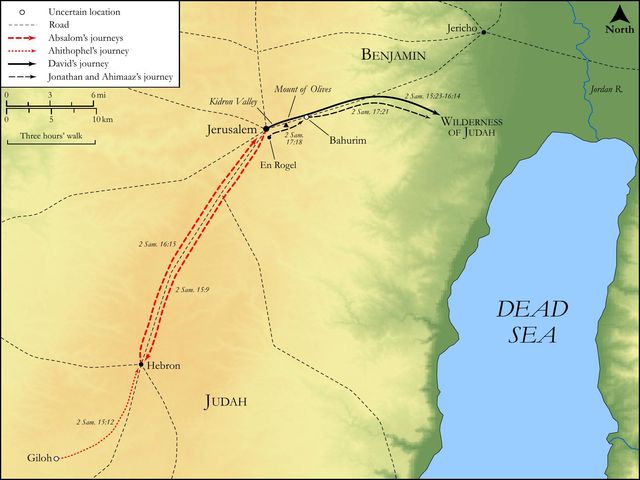
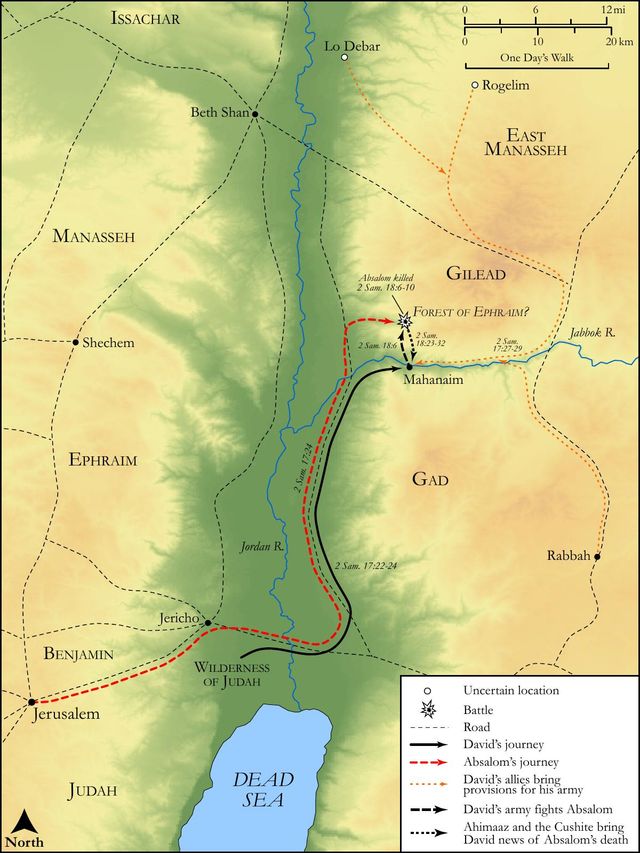
See on the biblical-era map

Study this verse
Public-domain commentary
Matthew Henry
From his Commentary on the Whole Bible. Henry comments on passages, not single verses — this entry covers 2 Samuel 17:15–21.
We must now leave David's enemies pleasing themselves with the thoughts of a sure victory by following Hushai's counsel, and sending a summons, no doubt, to all the tribes of Israel, to come to the general rendezvous at a place appointed, pursuant to that counsel; and we next find David's friends consulting how to get him notice of all this, that he might steer his course accordingly. Hushai tells the priests what had passed in council, Sa2 17:15. But, it should seem, he was not sure but that yet Ahithophel's counsel might be followed, and was therefore jealous lest, if he made not the best of his way, the king would be swallowed up, and all the people that were with him, Sa2 17:16. Perhaps, as he was called in to give advice (Sa2 17:5), so he was dismissed before they came to that resolve (Sa2 17:14) in favour of his advice, or he feared they might afterwards change their mind. However, it was good to provide against the worst, and therefore to hasten those valuable lives out of the reach of these destroyers. Such strict guards did Absalom set upon all the avenues to Jerusalem that they had much ado to get this necessary intelligence to David. 1. The young priests that were to be the messengers were forced to retire secretly out of the city, by En-rogel, which signifies, as some say, the fountain of a spy. Surely it went ill with Jerusalem when two such faithful priests as they were might not be seen to come into the city. 2. Instructions were sent to them by a poor simple young woman, who probably went to that well under pretence of fetching water, Sa2 17:17. If she carried the message by word of mouth, there was danger of her making some mistake or blunder in it; but Providence can make an ignorant girl a trusty messenger, and serve its wise counsels by the foolish things of the world. 3. Yet, by the vigilance of Absalom's spies, they were discovered, and information was brought to Absalom of their motions: A lad saw them and told him, Sa2 17:18. 4. They, being aware that they were discovered, sheltered themselves in a friend's house in Bahurim, where David had refreshed himself but just before, Sa2 16:14. There they were happily hidden in a well, which now, in summer time, perhaps was dry, Sa2 17:18. The woman of the house very ingeniously covered the mouth of the well with a cloth, on which she spread corn to dry, so that the pursuers were not aware that there was a well; else they would have searched it, Sa2 17:19. Thus far the woman did well; but we know not how to justify her further concealing them with a lie, Sa2 17:20. We must not do evil that good may come of it. However, hereby the messengers were protected, and the pursuers were defeated and returned to Absalom without their prey. It was well that Absalom did not hereupon fall upon their two fathers, Zadok and Abiathar, as Saul on Ahimelech for his kindness to David: but God restrained him. Being thus preserved, they brought their intelligence very faithfully to David (Sa2 17:21), with this advice of his friends, that he should not delay to pass over Jordan, near to which, it seems, he now was. There, as some think, he penned the 42nd and 43rd Psalms, looking back upon Jerusalem from the land of Jordan, Psa 42:6.
Continue studying 2 Samuel 17:17 across the web’s major study libraries — every link below opens this exact verse, chapter, or book on the destination site.
Read & Compare
 BibleGatewayThis verse in more than 200 translations and 70 languages.
 Bible.comThe YouVersion reader — hundreds of translations, reading plans, and highlights.
 ESV.orgCrossway's official English Standard Version reader.
 NET BibleThe NET translation with 60,000+ translators' notes on every rendering decision.
 STEP BibleTyndale House's free study tool — original text, vocabulary, and scholarly resources.
 BibliaLogos Bible Software's free web reader.
 USCCBThe New American Bible (Revised Edition) with the U.S. bishops' study notes.
Commentaries
 BibleHub CommentariesDozens of classic commentaries on this verse, gathered on one page.
 StudyLightMore than 100 commentary sets — the largest collection on the web.
 BibleRefPlain-English commentary on what this verse means, verse by verse.
 Enduring WordDavid Guzik's free commentary on this chapter, widely used by Bible teachers.
 Bible Study ToolsVerse commentary alongside Greek and Hebrew study aids.
Original Language & Research
- BibleHub InterlinearThe verse word by word — original language, transliteration, and English.
- BibleHub LexiconEvery word's original-language definition and Strong's entry.
 Blue Letter BibleDeep-study tools — Strong's numbers, concordance, and word studies.
 SefariaThe Hebrew text with Rashi and centuries of Jewish commentary.
Sermons, Hymns & Audio


TrulyRandomVerse is not affiliated with these sites and doesn’t control their content. They’re linked because they’re genuinely useful.
Summary
This verse encapsulates a critical juncture in Absalom's rebellion, detailing the perilous and divinely orchestrated relay of life-saving intelligence to King David. It vividly portrays the courage and strategic actions of David's loyal network—Jonathan, Ahimaaz, and an unnamed maidservant—whose timely and secretive communication ensured the king's escape from immediate capture, underscoring the intricate interplay of human faithfulness and divine providence in preserving David's life and the future of his kingdom.
Context
ShowHideLiterary Context
This verse is strategically positioned at the climax of the intelligence war between David and Absalom, immediately following the crucial counsel given to Absalom. In 2 Samuel 17:1-14, Absalom's trusted advisor, Ahithophel, proposed an immediate and devastating pursuit of David, which would have almost certainly led to David's demise. However, David's loyal spy, Hushai the Archite, successfully countered this deadly advice with a more elaborate and time-consuming plan, a maneuver explicitly stated in 2 Samuel 17:14 to be divinely orchestrated for David's protection. Verse 2 Samuel 17:15 immediately precedes our verse, depicting Hushai sending his urgent message to the priests Zadok and Abiathar, whose sons, Jonathan and Ahimaaz, are the direct recipients of the message in 2 Samuel 17:17. The successful delivery of this intelligence directly precipitates David's urgent flight across the Jordan River, as detailed in 2 Samuel 17:21-22, thereby securing his safety and paving the way for his eventual restoration to the throne.
Historical & Cultural Context
Absalom's rebellion, which began in 2 Samuel 15, had forced King David to flee Jerusalem, leaving the capital under Absalom's control. This created an extraordinarily volatile and dangerous environment for anyone associated with David, making open communication impossible. Enrogel, a prominent spring or well located just southeast of Jerusalem's walls at the confluence of the Kidron and Hinnom Valleys, served as a well-known landmark and a strategic, albeit risky, clandestine meeting point. In ancient Near Eastern warfare and political upheavals, intelligence gathering and swift, secretive communication were paramount for survival. Messengers often faced grave danger, and the use of seemingly inconspicuous individuals, such as women or servants, was a common and effective tactic to avoid detection by enemy forces. The narrative powerfully underscores the high stakes of this period, where David's life and the very future of his divinely appointed kingdom hung precariously in the balance.
Key Themes
ShowHideThis verse profoundly contributes to several overarching themes woven throughout the book of Samuel and the broader biblical narrative. Firstly, it unmistakably highlights Divine Providence and Sovereignty, illustrating how God actively intervenes in human affairs, using seemingly ordinary people and circumstances to achieve His purposes and protect His anointed king. The acceptance of Hushai's counsel over Ahithophel's is explicitly attributed to God's will in 2 Samuel 17:14, setting the stage for the events of our verse. Secondly, the verse powerfully showcases profound Loyalty and Courage in the face of treachery and immense personal risk. Jonathan and Ahimaaz, sons of the high priests, exhibit immense bravery by risking their lives as messengers for David, embodying unwavering commitment to their king even when his cause appeared lost. The unnamed "wench" (maidservant) further exemplifies this theme, acting with remarkable courage and quick thinking in a perilous situation. Thirdly, the passage emphasizes the Critical Role of Intelligence and Communication in times of crisis. David's survival hinges entirely on the efficient, accurate, and secretive transmission of Hushai's intelligence, illustrating how timely and secure information can be a matter of life and death, a theme echoed in other biblical accounts of strategic communication, such as in Joshua 2. Finally, the narrative subtly introduces the theme of Hidden Heroes and Unexpected Instruments, as the maidservant, a person of humble status, plays an absolutely vital and decisive role in the unfolding events, demonstrating God's consistent pattern of using the overlooked to fulfill His grand purposes, a pattern seen throughout the biblical narrative, from Moses's mother to the boy with the loaves and fish.
Exposition and Analysis
ShowHideKey Word Analysis
ShowHideThis verb signifies "to stand," "to remain," or "to abide." In this context, it conveys a deliberate, fixed waiting, implying a pre-arranged and patient posture. Jonathan and Ahimaaz were not merely passing by; they were positioned at Enrogel with a specific purpose, enduring the tension and danger of their hidden vigil. The word emphasizes their commitment to their post and the critical nature of their mission, requiring them to "stand firm" in their assigned role.
Meaning "Fountain of the Fuller" or "Spring of the Foot," Enrogel was a well-known spring and landmark located just southeast of Jerusalem, at the confluence of the Kidron and Hinnom Valleys. Its strategic location outside the city walls made it a suitable, albeit risky, clandestine meeting point for those who wished to avoid detection within the city. For Jonathan and Ahimaaz, it was a necessary hiding place from which they could receive the crucial message without being seen by Absalom's loyalists. The name itself, potentially linked to "foot" or "traveler," subtly hints at its use as a transit point.
The King James Version's translation "wench" might carry a derogatory connotation in modern English, but in 17th-century English, it simply referred to a "young woman" or "maidservant." The original Hebrew word, shiphchâh, is a neutral term for a female slave or servant, often a member of the household. Her role in this narrative is far from insignificant; she is the courageous and quick-thinking individual who, despite the danger, delivers the critical intelligence to David's waiting messengers, highlighting that God often uses the seemingly insignificant to accomplish great things.
Verse Breakdown
ShowHide"Now Jonathan and Ahimaaz stayed by Enrogel;"
Jonathan, the son of Abiathar, and Ahimaaz, the son of Zadok, were the designated couriers for Hushai's urgent message to King David. As sons of the high priests, they were trusted by David and had access to crucial intelligence channels. Their position "by Enrogel" indicates a pre-arranged, discreet waiting location outside the city walls, chosen specifically to avoid being seen entering or leaving Jerusalem, which was now under Absalom's hostile control. Their patient "staying" underscores the tension and anticipation of their critical mission.
"for they might not be seen to come into the city:"
This clause explicitly states the paramount reason for their clandestine location and the method of relay. The danger of being discovered by Absalom's forces was immense; their capture would have jeopardized David's life and the entire counter-intelligence operation. This highlights the high stakes, the necessity of absolute secrecy, and the careful planning involved in this desperate situation to protect the king.
"and a wench went and told them;"
This is the pivotal action of the verse, demonstrating the ingenious and courageous execution of the intelligence relay. Due to the extreme danger for Jonathan and Ahimaaz, a young maidservant from within the city was dispatched to relay the message that Hushai had given to the priests. Her willingness to undertake this perilous task, crossing potentially hostile territory within the city to reach the hidden messengers, demonstrates remarkable courage and loyalty. Her anonymous yet decisive role highlights that crucial contributions can come from unexpected sources, often from those in humble or overlooked positions, serving as a testament to God's ability to use anyone for His purposes.
"and they went and told king David."
This final clause confirms the successful completion of the vital intelligence relay. Upon receiving the urgent message from the maidservant, Jonathan and Ahimaaz immediately proceeded to deliver it to King David. This swift and successful transmission of information was instrumental in allowing David to take the necessary evasive action, ensuring his survival and setting the stage for the eventual turning of the tide against Absalom's rebellion. It represents the culmination of a divinely orchestrated plan to preserve David's life and kingship.
Literary Devices
ShowHideThe narrative of 2 Samuel 17:17 is rich with literary techniques that heighten its impact and underscore its theological significance. Narrative Tension is palpable throughout the passage, as the reader is acutely aware of the life-or-death stakes involved in the delivery of Hushai's message. The very act of Jonathan and Ahimaaz hiding by Enrogel, "for they might not be seen," immediately establishes a sense of imminent danger and the urgent need for secrecy, creating a suspenseful atmosphere. The introduction of the "wench" serves as a powerful example of Understatement or Irony, as a seemingly minor and unnamed character, a humble maidservant, becomes the crucial and decisive link in a chain of events that will determine the fate of a king and an entire kingdom. Her courageous and quick action provides a subtle but profound example of Heroism, demonstrating that significant contributions can come from unexpected and humble sources, a recurring motif in biblical literature. The entire sequence, from Hushai's counter-counsel to the maidservant's relay and David's subsequent escape, also functions as a powerful illustration of Divine Providence woven seamlessly into the human narrative, where seemingly coincidental or human-initiated events are revealed to be part of God's overarching plan to protect His anointed and fulfill His purposes.
Theological and Thematic Connections
ShowHideThis verse powerfully illustrates God's active and intricate involvement in human history, often working through humble and unexpected means to achieve His divine purposes. The entire chain of events, from Hushai's divinely inspired counsel being accepted over Ahithophel's (2 Samuel 17:14) to the timely and courageous actions of the maidservant and the messengers, underscores the profound theme of divine providence. It reminds us that God is sovereign over all circumstances, even in the midst of chaos, rebellion, and seemingly insurmountable odds, and that He can use anyone, regardless of their status or perceived importance, to accomplish His will. The unwavering loyalty and remarkable courage displayed by David's supporters also serve as a powerful testament to faithfulness in adversity, a theme that resonates throughout biblical history and points to the enduring power of steadfast devotion to God's anointed.
Reflection and Application
ShowHideThis passage serves as a profound reminder that God often works through ordinary people and seemingly small acts to accomplish His grand purposes. The maidservant's action, though brief and easily overlooked in the broader narrative, was absolutely instrumental in saving David's life and, by extension, preserving the Davidic line through which the Messiah would eventually come. This encourages believers to embrace faithfulness in their daily tasks, no matter how minor or insignificant they may seem in the grand scheme of things, recognizing that they might be part of a larger, divinely orchestrated plan. It calls us to cultivate a spirit of courage and loyalty in our service to God and others, even when circumstances are challenging or dangerous, trusting that our obedience, however small, can have eternal ramifications. Furthermore, it highlights the enduring value of trustworthy communication and the necessity of relying on God's protection during times of adversity, knowing that He is our ultimate refuge and deliverer, orchestrating events for our good and His glory, even when we cannot perceive His hand.
Questions for Reflection
ShowHideFAQ
ShowHideWho were Jonathan and Ahimaaz, and why were they chosen for this mission?
ShowHideJonathan and Ahimaaz were the sons of the high priests Abiathar and Zadok, respectively. They were chosen for this mission due to their unwavering loyalty to King David and their privileged access to information through their fathers, who remained in Jerusalem as David's trusted agents. As trusted individuals within David's inner circle and with connections to the religious establishment, they were ideal for relaying the critical intelligence from Hushai to David while avoiding suspicion. Their priestly lineage also lent a certain authority and trust to their mission, though their primary qualification here was their steadfast faithfulness to David in a time of great peril.
What was Enrogel, and why was it a significant location in this narrative?
ShowHideEnrogel was a well-known spring or well located just outside the walls of Jerusalem, in the Kidron Valley, a prominent landmark in the area. It was a significant location in this narrative because its position outside the city made it a strategic and relatively discreet hiding spot for Jonathan and Ahimaaz. They could wait there, away from the watchful eyes of Absalom's forces within the city, making it a crucial point for the clandestine transfer of the life-saving message to David. Its function as a meeting point for those who needed to avoid detection within the city walls was key to the success of this vital intelligence operation.
Why is the "wench" (maidservant) so important to this story, despite being unnamed?
ShowHideThe unnamed "wench" or maidservant is critically important because she served as the direct, indispensable link in the chain of communication that ultimately saved King David's life. Jonathan and Ahimaaz could not risk entering the city themselves without being seen, so a trusted individual from within Jerusalem was needed to carry the message to them. Her willingness to undertake this dangerous task, crossing potentially hostile territory to deliver vital intelligence, highlights her remarkable courage, quick thinking, and loyalty. Her anonymous yet decisive role underscores the biblical theme that God often uses the humble, the overlooked, or the seemingly insignificant to accomplish His greatest purposes, demonstrating that every act of faithfulness, no matter how small, can have profound and far-reaching consequences in His divine plan, as seen in 1 Corinthians 1:27-29.
Christ-Centered Fulfillment
ShowHideThe dramatic deliverance of King David in 2 Samuel 17:17 through a network of loyal, courageous, and even unexpected individuals, finds its ultimate and profound fulfillment in the person and redemptive work of Jesus Christ. David, as God's anointed king and a type of the coming Messiah, was providentially protected to ensure the continuation of the messianic line, a lineage that would culminate in the birth of the true King, Jesus. Just as David was preserved from the treachery of Absalom and the immediate threat of death, so too was Christ, the Son of David, preserved through His earthly ministry to accomplish His redemptive work on the cross, ultimately triumphing over sin and death. The "hidden" work of God, orchestrating events through a humble maidservant and loyal messengers to save David, foreshadows the deeper, hidden wisdom of God revealed in Christ's seemingly humble incarnation and sacrificial death, which appeared as weakness to the world but was in fact God's ultimate power for salvation (1 Corinthians 1:25). The loyal messengers, Jonathan and Ahimaaz, risking their lives for their king, prefigure the apostles and all believers who, as messengers of the Gospel, faithfully proclaim the life-saving message of Christ to a world in rebellion against its true King (Romans 10:15). Ultimately, David's escape from death and his eventual restoration to his throne foreshadow the resurrection and glorious reign of Jesus, who, having suffered and died for the sins of humanity, was raised to sit at the right hand of God, securing eternal deliverance and an everlasting kingdom for all who believe (Hebrews 1:3).