


2 Samuel 15:36
- הִנֵּהhi·nehthere!H2009PrtParticle Interjection
- שָׁםshamthereH8033AdvAdverb
- עִמָּם'i·Mam[are] with themH5973Prep ¦ 3mpPreposition Definiteעִמָּ[are] withםthem
- שְׁנֵיshe·Nei[the] twoH8147N-cdcNoun Dual common gender Construct
- בְנֵיהֶםve·nei·Hemtheir sonsH1121N-mpc ¦ 3mpNoun Plural Masculine Constructבְנֵיsonsהֶםtheir
- אֲחִימַעַץ'a·chi·Ma·'atzAhimaazH290N-proper-mNoun Proper Masculine
- לְצָדוֹקle·tza·Dokof ZadokH6659Prep-l ¦ N-proper-mNoun Proper MasculineלְofצָדוֹקZadok
- וִיהוֹנָתָןvi·ho·na·Tanand JonathanH3083Conj-w ¦ N-proper-mNoun Proper MasculineוִandיהוֹנָתָןJonathan
- לְאֶבְיָתָרle·'ev·ya·Tarof AbiatharH54Prep-l ¦ N-proper-mNoun Proper MasculineלְofאֶבְיָתָרAbiathar
- וּשְׁלַחְתֶּםu·she·lach·Temand you will sendH7971Conj-w ¦ V-Qal-ConsecPerf-2mpVerb Qal Consecutive Perfect 2nd Plural Masculineוּandשְׁלַחְתֶּםyou will send
- בְּיָדָםbe·ya·Damby their handH3027Prep-b ¦ N-csc ¦ 3mpNoun Singular common gender Constructבְּbyיָדָhandםtheir
- אֵלַי'e·Laito meH413Prep ¦ 1csPreposition Definiteאֵלַtoיme
- כָּלkoleveryH3605N-mscNoun Singular Masculine Construct
- דָּבָרda·VarwordH1697N-msNoun Singular Masculine Absolute
- אֲשֶׁר'a·SherwhichH834RelParticle Relative
- תִּשְׁמָעוּtish·Ma·'uyou will hearH8085V-Qal-Imperf-2mpVerb Qal Imperfect 2nd Plural Masculine
English is a literal word-by-word gloss of the Hebrew, not the KJV's wording. Why?
This is the original text the KJV's translators worked from — each Hebrew word with its own literal English meaning in this verse, prepared by scholars at Tyndale House, Cambridge. The KJV translates whole sentences, not word by word, so its wording differs: one Hebrew word can become several English words, and the KJV may choose “the LORD” where the gloss reads “Yahweh”. Both are faithful — they answer different questions. For the KJV's own rendering, switch to the KJV text.
Details
See on the biblical-era map

Study this verse
Public-domain commentary
Matthew Henry
From his Commentary on the Whole Bible. Henry comments on passages, not single verses — this entry covers 2 Samuel 15:31–37.
Nothing, it seems, appeared to David more threatening in Absalom's plot than that Ahithophel was in it; for one good head, in such a design, is worth a thousand good hands. Absalom was himself no politician, but he had got one entirely in his interest that was, and would be the more dangerous because he had been all along acquainted with David's counsels and affairs; if therefore he can be baffled, Absalom is as good as routed and the head of the conspiracy cut off. This David endeavours to do.
I.By prayer.
When he heard that Ahithophel was in the plot he lifted up his heart to God in this short prayer: Lord, turn the counsel of Ahithophel into foolishness, Sa2 15:31. He had not opportunity for a long prayer, but he was not one of those that thought he should be heard for his much speaking. It was a fervent prayer: "Lord, I pray thee, do this." God is well pleased with the importunity of those that come to him with their petitions. David is particular in this prayer; he names the person whose counsels he prays against. God gives us leave, in prayer, to be humbly and reverently free with him, and to mention the particular care, and fear, and grief, that lies heavily upon us. David prayed not against Ahithophel's person, but against his counsel, that God would turn it into foolishness, that, though he was a wise man, he might at this time give foolish counsel, or, if he gave wise counsel, that it might be rejected as foolish, or, if it were followed, that by some providence or other it might be defeated, and not attain the end. David prayed this in a firm belief that God has all hearts in his hand, and tongues too, that, when he pleases, he can take away the understanding of the aged and make the judges fools, (Job 12:17; Isa 3:2, Isa 3:3), and in hope that God would own and plead his just and injured cause. Note, We may pray in faith, and should pray with fervency, that God will turn that counsel into foolishness which is taken against his people.
II.By policy.
We must second our prayer with our endeavours, else we tempt God. It is good service to countermine the policy of the church's enemies. When David came to the top of the mount, he worshipped God, Sa2 15:32. Note, Weeping must not hinder worshipping, but quicken it rather. Now he penned the third Psalm, as appears by the title; and some think that his singing this was the worship he now paid to God. Just now Providence brought Hushai to him. While he was yet speaking, God heard, and sent him the person that should be instrumental to befool Ahithophel. He came to condole with David on his present trouble, with his coat rent and earth upon his head; but David, having a great deal of confidence in his conduct and faithfulness, resolved to employ him as a spy upon Absalom. He would not take him with him (Sa2 15:33), for he had now more need of soldiers than counsellors, but sent him back to Jerusalem, to wait for Absalom's arrival, as a deserter from David, and to offer him his service, Sa2 15:34. Thus he might insinuate himself into his counsels, and defeat Ahithophel, either by dissuading Absalom from following his advice or by discovering it to David, that he might know where to stand upon his guard. How this gross dissimulation, which David put Hushai upon, can be justified, as a stratagem in war, I do not see. The best that can be made of it is that Absalom, if he rebel against his father, must stand upon his guard against all mankind, and, if he will be deceived, let him be deceived. David recommended Hushai to Zadok and Abiathar, as persons proper to be consulted with (Sa2 15:35), and to their two sons, as trusty men to be sent on errands to David, Sa2 15:36. Hushai, thus instructed, came to Jerusalem (Sa2 15:37), whither also Absalom soon after came with his forces. How soon do royal palaces and royal cities change their masters! But we look for a kingdom which cannot be thus shaken and in the possession of which we cannot be disturbed.
Continue studying 2 Samuel 15:36 across the web’s major study libraries — every link below opens this exact verse, chapter, or book on the destination site.
Read & Compare
 BibleGatewayThis verse in more than 200 translations and 70 languages.
 Bible.comThe YouVersion reader — hundreds of translations, reading plans, and highlights.
 ESV.orgCrossway's official English Standard Version reader.
 NET BibleThe NET translation with 60,000+ translators' notes on every rendering decision.
 STEP BibleTyndale House's free study tool — original text, vocabulary, and scholarly resources.
 BibliaLogos Bible Software's free web reader.
 USCCBThe New American Bible (Revised Edition) with the U.S. bishops' study notes.
Commentaries
 BibleHub CommentariesDozens of classic commentaries on this verse, gathered on one page.
 StudyLightMore than 100 commentary sets — the largest collection on the web.
 BibleRefPlain-English commentary on what this verse means, verse by verse.
 Enduring WordDavid Guzik's free commentary on this chapter, widely used by Bible teachers.
 Bible Study ToolsVerse commentary alongside Greek and Hebrew study aids.
Original Language & Research
- BibleHub InterlinearThe verse word by word — original language, transliteration, and English.
- BibleHub LexiconEvery word's original-language definition and Strong's entry.
 Blue Letter BibleDeep-study tools — Strong's numbers, concordance, and word studies.
 SefariaThe Hebrew text with Rashi and centuries of Jewish commentary.
Sermons, Hymns & Audio


TrulyRandomVerse is not affiliated with these sites and doesn’t control their content. They’re linked because they’re genuinely useful.
Summary
2 Samuel 15:36 captures a pivotal moment in King David's flight from Absalom, revealing his strategic genius and reliance on a loyal network. As David retreats from Jerusalem, he orchestrates a critical intelligence operation, instructing the faithful priests Zadok and Abiathar to return to the capital. This verse specifically designates their sons, Ahimaaz and Jonathan, as the discreet and trusted conduits for relaying vital information from within Absalom's court back to David, thereby establishing a crucial communication lifeline that underscores David's foresight, his dependence on steadfast allies, and the indispensable role of intelligence in navigating crisis.
Context
ShowHideLiterary Context
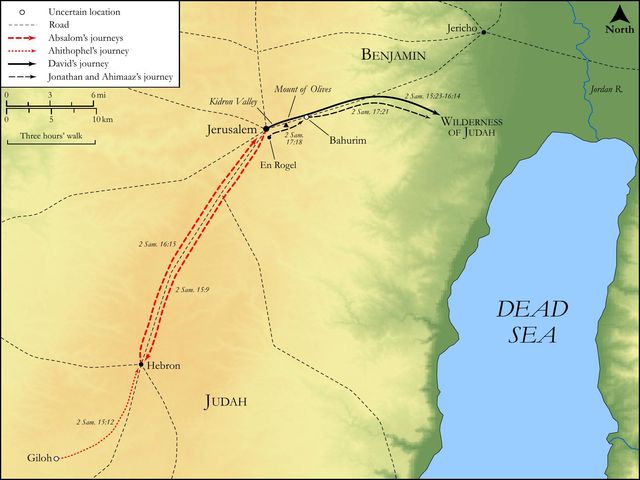
This verse is deeply embedded within the dramatic narrative of Absalom's usurpation of King David's throne, a crisis detailed from 2 Samuel 15 onwards. David has been forced into a humiliating and perilous retreat from Jerusalem, a city now under his rebellious son's control. Immediately preceding this verse, David has made two crucial strategic deployments: first, he sends the priests Zadok and Abiathar, along with the Ark of the Covenant, back to Jerusalem, instructing them to serve as his "eyes and ears" within the capital, trusting in God's will concerning the Ark's presence (2 Samuel 15:27-29). Second, David dispatches his astute advisor, Hushai the Archite, to infiltrate Absalom's inner circle, feign loyalty, and subtly undermine the counsel of Ahithophel, Absalom's chief strategist (2 Samuel 15:32-34). Verse 36 then meticulously specifies the mechanism for this vital intelligence flow, naming Ahimaaz and Jonathan as the indispensable messengers. This setup directly foreshadows their heroic and life-saving actions later in the rebellion, particularly as recounted in 2 Samuel 17.
Historical & Cultural Context
The historical backdrop is a full-blown civil war, where Absalom's swift coup has seized Jerusalem, forcing the legitimate, anointed king into exile. In the ancient Near East, particularly during periods of conflict and political instability, intelligence gathering was not merely advantageous but absolutely critical for survival and strategic advantage. Kings relied heavily on networks of loyalists, scouts, and messengers to stay abreast of enemy movements, internal plots, and public sentiment. The role of priests, such as Zadok and Abiathar, often extended beyond their sacral duties; they frequently served as trusted royal advisors and administrators, possessing unique access to the heart of the city and its populace. Their sons, therefore, were ideal candidates for such a sensitive and dangerous mission, benefiting from their fathers' standing and presumed loyalty. David's decision to send the Ark back to Jerusalem, rather than keep it with him in exile, also reflects a profound theological and cultural understanding: the Ark symbolized God's presence and legitimacy, and its return to the city underscored David's trust in divine sovereignty over Jerusalem, even as he engaged in human strategic planning.
Key Themes
ShowHideThis verse powerfully contributes to several overarching themes woven throughout the book of Samuel and the broader Old Testament narrative. It highlights Strategic Leadership in Adversity, showcasing David's remarkable capacity for proactive planning and the establishment of a robust intelligence network even while in a state of flight and profound personal distress. This demonstrates a leader who, despite facing immense pressure, does not succumb to paralysis but actively seeks to regain control. The passage also strongly emphasizes the theme of Loyalty and Trust, as David places his life and the very fate of his kingdom in the hands of Zadok, Abiathar, and their sons, who remain steadfast amidst widespread defection and betrayal. Their unwavering allegiance becomes a beacon of hope in a time of profound disloyalty. Furthermore, the verse underscores the Crucial Role of Communication in times of crisis, illustrating how timely and accurate information is absolutely vital for survival, strategic advantage, and effective decision-making. This is vividly demonstrated later when the intelligence relayed by these messengers directly saves David's life, as seen in 2 Samuel 17:15-22. Finally, it subtly points to the theme of Divine Providence, demonstrating how God often utilizes human ingenuity, strategic planning, and the faithfulness of individuals to accomplish His sovereign purposes, even in the midst of human conflict, political maneuvering, and personal sin.
Exposition and Analysis
ShowHideKey Word Analysis
ShowHideThe specific mention of "their two sons" (H8147 shᵉnayim "two" and H1121 bên "son") is highly significant. The Hebrew word bên for "son" carries a broad semantic range, often implying a builder or inheritor of the family name and legacy. Here, it emphasizes the hereditary nature of their trusted positions within the esteemed priestly families of Zadok and Abiathar. This lineage implies not only legitimate access to key locations within Jerusalem (such as the temple precincts) but also a presumed loyalty and reliability that David could depend on, setting them apart from many others who had defected to Absalom.
The word dâbâr, translated here as "everything," is rich in meaning, encompassing "a word," "a matter," "a thing," "an affair," or "tidings." Its use here signifies a comprehensive and unreserved intelligence-gathering operation. David is not seeking specific pieces of information but "every thing" that can be heard, implying a need for a full and accurate picture of Absalom's plans, counsel, and movements. This breadth underscores the critical importance of the information flow for David's strategic decisions and survival.
The verb shâlach, meaning "to send away, for, or out," implies a deliberate, organized, and continuous process of communication. It is not a request for a single, isolated message, but rather the establishment of a reliable and ongoing channel for the regular transmission of intelligence. This indicates David's long-term strategic planning for the duration of the rebellion, recognizing that sustained communication would be vital for his ability to react and respond effectively to Absalom's actions.
Verse Breakdown
ShowHide"Behold, [they have] there with them their two sons, Ahimaaz Zadok's [son], and Jonathan Abiathar's [son]"
This initial clause serves to identify the specific individuals designated as the crucial messengers in David's nascent intelligence network. David's prior instruction to the priests Zadok and Abiathar to return to Jerusalem (2 Samuel 15:29) is now made concrete by naming their sons. The familial connection to the high priests ensures their trustworthiness and provides a legitimate, inconspicuous reason for their presence within the city, enabling them to gather and relay sensitive information without immediately arousing suspicion from Absalom's faction. Their identities are key to the success of the mission.
"and by them ye shall send unto me every thing that ye can hear"
This second clause precisely defines the mission of these designated messengers. They are to act as the conduits for "everything" that the priests and Hushai can "hear" or perceive within Absalom's court and the city. This directive implies a comprehensive intelligence-gathering operation, including Absalom's strategic decisions, the advice he receives from his counselors (especially Ahithophel's), and any movements or plans of his forces. The phrase "ye shall send unto me" underscores David's absolute reliance on this network for his strategic decisions, his personal safety, and the eventual restoration of his kingdom, highlighting the critical need for timely and accurate intelligence from within the enemy's camp.
Literary Devices
ShowHideThe verse employs several potent literary devices that amplify its meaning and underscore the gravity of the situation. Foreshadowing is prominently featured, as the explicit naming of Ahimaaz and Jonathan as messengers directly sets the stage for their courageous and life-saving role later in the narrative, particularly in 2 Samuel 17, where they brave significant danger to deliver critical intelligence that saves David's life. There is also an element of Synecdoche, where "their two sons" function as a part representing the whole, symbolizing the entire, albeit clandestine, intelligence network that David is establishing. While only two individuals are named, they embody the broader concept of a vital communication channel. Furthermore, a subtle Irony pervades the scene: the anointed king, David, the rightful ruler of Israel, is reduced to relying on secret, clandestine communication channels and a network of spies to survive and reclaim his throne. This starkly highlights his vulnerable position and the topsy-turvy nature of the rebellion, where legitimate power has been temporarily usurped by a rebellious son.
Theological and Thematic Connections
ShowHideThis verse, while seemingly a tactical instruction, carries profound theological and thematic weight, illustrating God's common grace at work. It demonstrates that even in the midst of profound crisis, personal betrayal, and the consequences of past sin (as David was experiencing), God allows human wisdom, strategic planning, and responsible leadership to operate. David's proactive establishment of an intelligence network is not an act of distrust in God, but rather a responsible exercise of God-given discernment and a reliance on the means available to him, rather than passive resignation. The passage highlights the importance of faithful intermediaries in God's economy, echoing the role of prophets and priests who frequently served as channels of divine communication. Just as David relied on trusted human agents to relay vital truths and information for his earthly kingdom, God often uses human vessels, faithful individuals, and divinely-enabled means to communicate His will, purposes, and saving truth to His people.
Reflection and Application
ShowHideThe account in 2 Samuel 15:36 offers enduring lessons that transcend its ancient historical context, providing profound wisdom for navigating the complex challenges of our contemporary lives. David's remarkable ability to act strategically, even while in the throes of personal humiliation and national catastrophe, serves as a powerful reminder that adversity should not lead to paralysis. Instead, it calls for proactive planning, resourcefulness, and a clear-headed assessment of the situation, trusting that God works through our diligent efforts. This verse profoundly encourages us to identify, cultivate, and cherish genuinely trustworthy relationships, recognizing that in times of crisis, a reliable network of loyal individuals—those who stand with us when others flee—is an invaluable and often life-saving asset. Just as David depended on the integrity and courage of Ahimaaz and Jonathan, we too benefit immensely from surrounding ourselves with people of integrity, discernment, and unwavering loyalty. Furthermore, the emphasis on communication underscores the vital role of accurate and timely information in making wise and effective decisions, urging us to be diligent in seeking understanding, discerning truth, and maintaining open, honest channels of communication in a world often clouded by misinformation and superficiality.
Questions for Reflection
ShowHideFAQ
ShowHideWhy were Ahimaaz and Jonathan chosen for such a critical mission?
ShowHideAhimaaz and Jonathan were chosen primarily due to their unique lineage and the deep, proven trust David placed in their fathers, Zadok and Abiathar, who were loyal high priests. As sons of the high priests, they possessed legitimate and inconspicuous access to various parts of Jerusalem, including the temple precincts, which served as a central hub for information gathering. Their familial connection ensured not only their unwavering loyalty to David but also their discretion, making them ideal, un-suspicious messengers for sensitive intelligence that could determine the fate of David's kingdom. Their ability to move within the city without immediately drawing attention was paramount to the mission's success, as highlighted in 2 Samuel 17:17.
What was the significance of this communication network for David?
ShowHideThis communication network was absolutely vital for David's survival and his eventual restoration to the throne. It provided him with real-time intelligence on Absalom's plans, movements, and the counsel he was receiving, allowing David to anticipate and counter his son's strategies effectively. Most notably, the critical information relayed by Ahimaaz and Jonathan regarding Ahithophel's counsel and Hushai's counter-counsel (as detailed in 2 Samuel 17:15-22) directly saved David's life by giving him the necessary time to cross the Jordan River and regroup his forces, preparing for the decisive battle. Without this network, David would have been operating blind, significantly increasing his vulnerability and likely leading to his capture or death.
Christ-Centered Fulfillment
ShowHideDavid's strategic establishment of a communication network through trusted messengers, Ahimaaz and Jonathan, during his exile from Jerusalem, powerfully foreshadows the ultimate divine communication and mediation found in Jesus Christ. David, the earthly king, relied on loyal sons to bring him vital intelligence from a hostile city; similarly, God, in His infinite wisdom and love, sent His own Son, Jesus Christ, into a world hostile to Him, to deliver the ultimate message of salvation and reconciliation. Jesus is not merely a messenger but the very Word made flesh, the perfect and complete revelation of God's character, will, and redemptive plan. He is the faithful witness who brings the true intelligence from the Father to humanity, bridging the chasm of sin and ignorance that separated us from God. Just as Ahimaaz and Jonathan risked their lives to bring David life-saving information, Christ willingly laid down His life on the cross to bring humanity the life-giving truth of the Gospel, establishing a new and living way for us to draw near to God through His sacrifice. Through Him, we receive not just information, but eternal life, reconciliation, and the very presence of God's Spirit, fulfilling the ultimate divine communication.