


2 Samuel 15:37
Bible text: King James Version (1769 Blayney text) · Public domain
Bible text: Berean Standard Bible · Public domain
Bible text: American Standard Version (1901) · Public domain
Bible text: World English Bible, Messianic edition · Public domain
Bible text: Geneva Bible (1599) · Public domain
Bible text: Young's Literal Translation · Public domain
- וַיָּבֹאvai·ya·Vo'and he cameH935Conj-w ¦ V-Qal-ConsecImperf-3msVerb Qal Consecutive Imperfect 3rd Singular Masculineוַandיָּבֹאhe came
- חוּשַׁיchu·ShaiHushaiH2365N-proper-mNoun Proper Masculine
- רֵעֶהre·'Eh[the] friend ofH7463N-mscNoun Singular Masculine Construct
- דָוִדda·VidDavidH1732N-proper-mNoun Proper Masculine
- הָעִירha·'Irthe cityH5892Art ¦ N-fsNoun Singular Feminine Absoluteהָtheעִירcity
- וְאַבְשָׁלֹםve·'av·sha·Lomand AbsalomH53Conj-w ¦ N-proper-mNoun Proper MasculineוְandאַבְשָׁלֹםAbsalom
- יָבֹאya·Vo'he cameH935V-Qal-Imperf-3msVerb Qal Imperfect 3rd Singular Masculine
- יְרוּשָׁלִָםye·ru·sha·LimJerusalemH3389N-properNoun Proper Location
English is a literal word-by-word gloss of the Hebrew, not the KJV's wording. Why?
This is the original text the KJV's translators worked from — each Hebrew word with its own literal English meaning in this verse, prepared by scholars at Tyndale House, Cambridge. The KJV translates whole sentences, not word by word, so its wording differs: one Hebrew word can become several English words, and the KJV may choose “the LORD” where the gloss reads “Yahweh”. Both are faithful — they answer different questions. For the KJV's own rendering, switch to the KJV text.
Details
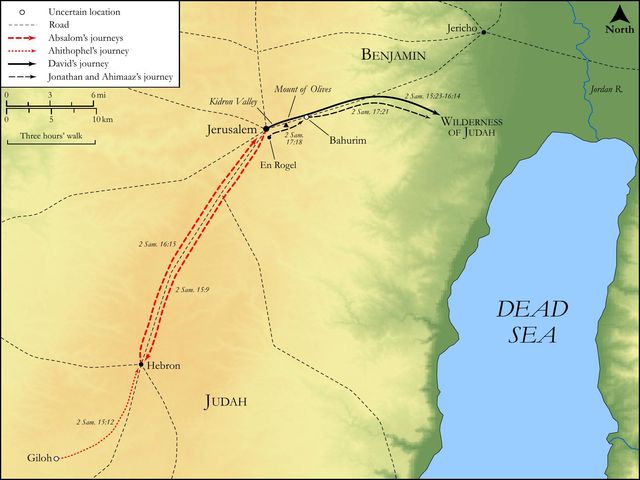
See on the biblical-era maps
Study this verse
Public-domain commentary
Matthew Henry
From his Commentary on the Whole Bible. Henry comments on passages, not single verses — this entry covers 2 Samuel 15:31–37.
Nothing, it seems, appeared to David more threatening in Absalom's plot than that Ahithophel was in it; for one good head, in such a design, is worth a thousand good hands. Absalom was himself no politician, but he had got one entirely in his interest that was, and would be the more dangerous because he had been all along acquainted with David's counsels and affairs; if therefore he can be baffled, Absalom is as good as routed and the head of the conspiracy cut off. This David endeavours to do.
I.By prayer.
When he heard that Ahithophel was in the plot he lifted up his heart to God in this short prayer: Lord, turn the counsel of Ahithophel into foolishness, Sa2 15:31. He had not opportunity for a long prayer, but he was not one of those that thought he should be heard for his much speaking. It was a fervent prayer: "Lord, I pray thee, do this." God is well pleased with the importunity of those that come to him with their petitions. David is particular in this prayer; he names the person whose counsels he prays against. God gives us leave, in prayer, to be humbly and reverently free with him, and to mention the particular care, and fear, and grief, that lies heavily upon us. David prayed not against Ahithophel's person, but against his counsel, that God would turn it into foolishness, that, though he was a wise man, he might at this time give foolish counsel, or, if he gave wise counsel, that it might be rejected as foolish, or, if it were followed, that by some providence or other it might be defeated, and not attain the end. David prayed this in a firm belief that God has all hearts in his hand, and tongues too, that, when he pleases, he can take away the understanding of the aged and make the judges fools, (Job 12:17; Isa 3:2, Isa 3:3), and in hope that God would own and plead his just and injured cause. Note, We may pray in faith, and should pray with fervency, that God will turn that counsel into foolishness which is taken against his people.
II.By policy.
We must second our prayer with our endeavours, else we tempt God. It is good service to countermine the policy of the church's enemies. When David came to the top of the mount, he worshipped God, Sa2 15:32. Note, Weeping must not hinder worshipping, but quicken it rather. Now he penned the third Psalm, as appears by the title; and some think that his singing this was the worship he now paid to God. Just now Providence brought Hushai to him. While he was yet speaking, God heard, and sent him the person that should be instrumental to befool Ahithophel. He came to condole with David on his present trouble, with his coat rent and earth upon his head; but David, having a great deal of confidence in his conduct and faithfulness, resolved to employ him as a spy upon Absalom. He would not take him with him (Sa2 15:33), for he had now more need of soldiers than counsellors, but sent him back to Jerusalem, to wait for Absalom's arrival, as a deserter from David, and to offer him his service, Sa2 15:34. Thus he might insinuate himself into his counsels, and defeat Ahithophel, either by dissuading Absalom from following his advice or by discovering it to David, that he might know where to stand upon his guard. How this gross dissimulation, which David put Hushai upon, can be justified, as a stratagem in war, I do not see. The best that can be made of it is that Absalom, if he rebel against his father, must stand upon his guard against all mankind, and, if he will be deceived, let him be deceived. David recommended Hushai to Zadok and Abiathar, as persons proper to be consulted with (Sa2 15:35), and to their two sons, as trusty men to be sent on errands to David, Sa2 15:36. Hushai, thus instructed, came to Jerusalem (Sa2 15:37), whither also Absalom soon after came with his forces. How soon do royal palaces and royal cities change their masters! But we look for a kingdom which cannot be thus shaken and in the possession of which we cannot be disturbed.
Continue studying 2 Samuel 15:37 across the web’s major study libraries — every link below opens this exact verse, chapter, or book on the destination site.
Read & Compare
 BibleGatewayThis verse in more than 200 translations and 70 languages.
 Bible.comThe YouVersion reader — hundreds of translations, reading plans, and highlights.
 ESV.orgCrossway's official English Standard Version reader.
 NET BibleThe NET translation with 60,000+ translators' notes on every rendering decision.
 STEP BibleTyndale House's free study tool — original text, vocabulary, and scholarly resources.
 BibliaLogos Bible Software's free web reader.
 USCCBThe New American Bible (Revised Edition) with the U.S. bishops' study notes.
Commentaries
 BibleHub CommentariesDozens of classic commentaries on this verse, gathered on one page.
 StudyLightMore than 100 commentary sets — the largest collection on the web.
 BibleRefPlain-English commentary on what this verse means, verse by verse.
 Enduring WordDavid Guzik's free commentary on this chapter, widely used by Bible teachers.
 Bible Study ToolsVerse commentary alongside Greek and Hebrew study aids.
Original Language & Research
- BibleHub InterlinearThe verse word by word — original language, transliteration, and English.
- BibleHub LexiconEvery word's original-language definition and Strong's entry.
 Blue Letter BibleDeep-study tools — Strong's numbers, concordance, and word studies.
 SefariaThe Hebrew text with Rashi and centuries of Jewish commentary.
Sermons, Hymns & Audio


TrulyRandomVerse is not affiliated with these sites and doesn’t control their content. They’re linked because they’re genuinely useful.
Summary
2 Samuel 15:37 marks a critical juncture in Absalom's rebellion, succinctly detailing the simultaneous arrival of two pivotal figures in Jerusalem: Hushai, King David's loyal friend and strategic agent, and Absalom, the rebellious prince. This dual entry into the capital sets the immediate stage for a profound strategic and spiritual contest, where human cunning and divine providence intertwine to shape the unfolding drama of David's kingdom and the trajectory of the revolt.
Context
ShowHideLiterary Context
This verse immediately follows King David's sorrowful yet strategically astute retreat from Jerusalem. Faced with Absalom's rapidly gaining popularity and successful coup, David had just dispatched Hushai the Archite back to the capital. David's explicit instruction to Hushai was to feign loyalty to Absalom and, crucially, to "defeat the counsel of Ahithophel" 2 Samuel 15:34. This command underscores Hushai's entry into the city not as a simple return or surrender, but as a calculated, dangerous maneuver in David's counter-strategy, designed to undermine the rebellion from within. Absalom's concurrent arrival, conversely, signifies his triumphal seizure of the capital, solidifying his apparent victory and the establishment of his rebellious reign. The juxtaposition of these two entries sets up the direct confrontation of opposing strategies and loyalties within the very heart of the kingdom.
Historical & Cultural Context
Jerusalem, as the capital and the "City of David," held immense symbolic, political, and religious importance in ancient Israel. Its capture by Absalom signified the perceived legitimacy of his claim to the throne and a significant blow to David's authority. In the monarchy of David's day, the counsel of trusted advisors was paramount; a king's wisdom and stability were often judged by the quality of his counselors. Ahithophel was renowned for his sagacity, his advice being "as if one consulted the oracle of God" 2 Samuel 16:23. Therefore, the battle for counsel, represented by Hushai's mission to counteract Ahithophel, was not merely a political skirmish but a spiritual and existential struggle for the kingdom itself. The cultural expectation was that a new king would immediately consolidate power and seek wise counsel to legitimize his rule, making the arrival of both Absalom and Hushai in the capital a critical juncture for the future of the Davidic dynasty.
Key Themes
ShowHideThis verse powerfully contributes to several overarching themes in the narrative of David's reign and the broader book of Samuel. Firstly, it underscores the theme of Strategic Deception and Loyalty, as Hushai's outward allegiance to Absalom masks his profound, unwavering loyalty to David, illustrating how God can use unconventional means to achieve His purposes. This highlights the tension between appearance and reality, and the depth of true friendship. Secondly, it sets the stage for the Battle for Counsel, a crucial intellectual and spiritual contest between Ahithophel's shrewd but ultimately destructive advice and Hushai's divinely inspired counter-counsel. This strategic conflict would prove pivotal in the rebellion's defeat, as seen in 2 Samuel 17:14. Finally, and most profoundly, the verse subtly points to Divine Sovereignty. While human actions and strategies are clearly at play, the larger narrative reveals that God is actively orchestrating events behind the scenes to protect His anointed king and preserve the Davidic covenant. Hushai's success is ultimately attributed to the Lord's intervention, turning Ahithophel's wise counsel into foolishness, thereby demonstrating God's ultimate control over human affairs and the destiny of His chosen people, as echoed in Proverbs 21:30.
Exposition and Analysis
ShowHideKey Word Analysis
ShowHideThis name, derived from a root meaning "hasty," belongs to David's loyal friend, Hushai the Archite (H2365). His character is defined by his swift and decisive action in responding to David's plea, demonstrating a readiness to undertake a perilous mission for his king. The text emphasizes his personal identity, setting him apart as a key individual in the unfolding drama, whose actions will have significant, divinely orchestrated consequences.
The term "friend" (H7463, rêʻeh) signifies a close, intimate companion, a trusted confidant, or a beloved associate, implying a deep personal bond and mutual loyalty. By identifying Hushai as "David's friend," the text emphasizes the profound trust David placed in him for such a perilous and vital mission. This designation underscores the personal nature of the conflict and the strength of the relationships that sustained David in his darkest hour, contrasting sharply with the familial betrayal he experienced from Absalom (H53, ʼĂbîyshâlôwm).
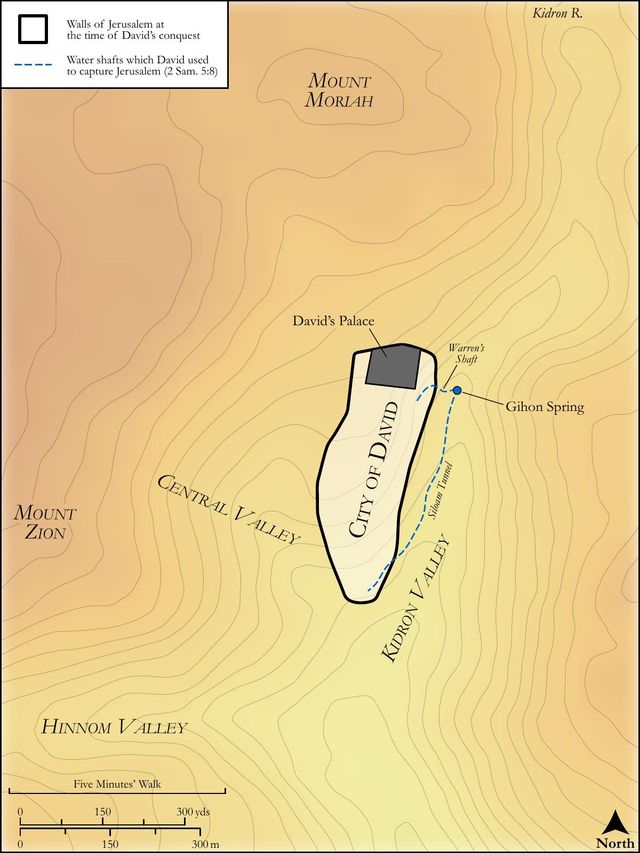
The capital city, chosen by David as the political and religious center of Israel, symbolizes the heart of the kingdom and the seat of divine authority. Its occupation by Absalom represents the temporary usurpation of power and the disruption of God's established order. The simultaneous entry of Hushai and Absalom into Jerusalem is highly symbolic; it is the stage where the fate of the kingdom, and by extension, the Davidic line, will be decided through a clash of wills and strategies. The city itself becomes a silent witness to the unfolding drama of loyalty, betrayal, and divine intervention.
Verse Breakdown
ShowHide"So Hushai David's friend came into the city"
This clause highlights Hushai's arrival, which is presented as a direct consequence of David's strategic command given earlier. The designation "David's friend" immediately informs the reader of Hushai's true allegiance and his deep loyalty, even as he is about to enter a hostile environment under false pretenses. His entry is discreet and purposeful, a calculated move to infiltrate Absalom's inner circle and execute David's counter-strategy. The phrase "into the city" refers to Jerusalem (H5892, ʻîyr), emphasizing the critical location where the strategic battle of wits will commence.
"and Absalom came into Jerusalem"
This clause describes Absalom's arrival, which stands in stark contrast to Hushai's. Absalom's entry is triumphal, public, and indicative of his successful seizure of the capital. He arrives as the perceived victor, ready to consolidate his power and assume the throne. The explicit mention of "Jerusalem" (H3389) underscores the significance of his conquest, symbolizing the apparent culmination of his rebellion and the overthrow of David's authority. The conjunction "and" links these two seemingly disparate arrivals, setting up the dramatic tension of their opposing missions within the same space, unaware of the divine orchestration at play.
Literary Devices
ShowHideThe verse employs several potent literary devices to convey its significance and foreshadow the unfolding narrative. Foremost is Juxtaposition, as the simultaneous arrival of Hushai and Absalom in Jerusalem immediately highlights the stark contrast between their intentions and roles. Hushai enters as a loyal agent of the legitimate king, operating in stealth and deception for a righteous cause, while Absalom enters as the rebellious usurper, publicly asserting his newfound power. This creates a powerful sense of dramatic Irony, as Absalom's apparent triumph is, unbeknownst to him, already being undermined by the very "friend" of his father who has just entered his domain. The verse also utilizes Foreshadowing, signaling the impending conflict of counsel that will determine the outcome of the rebellion. The presence of both figures in the capital sets the stage for the intellectual and strategic battle that will unfold in subsequent chapters. Finally, Symbolism is present in the choice of "Jerusalem" as the setting, representing not just a physical city but the very heart of the kingdom and the destiny of David's lineage, making the dual entry into this sacred space profoundly meaningful for the future of God's chosen people.
Theological and Thematic Connections
ShowHide2 Samuel 15:37, though brief, is rich in theological implications, serving as a powerful illustration of God's sovereign hand at work even amidst human rebellion and political chaos. The narrative demonstrates that while human plans and schemes unfold, the Lord remains ultimately in control, orchestrating events to fulfill His divine purposes. Hushai's mission, seemingly a mere human strategy, becomes an instrument of divine intervention, demonstrating God's ability to "turn wise counsel into foolishness" 2 Samuel 17:14. This highlights a consistent biblical theme: God often uses unexpected means and seemingly ordinary individuals to achieve extraordinary ends, protecting His anointed and preserving His covenantal promises. The verse subtly reinforces the idea that true wisdom and ultimate victory come not from human cunning alone, but from alignment with God's will and reliance on His providential care. It reminds us that even in the darkest moments of betrayal and uncertainty, God is actively working behind the scenes to accomplish His eternal plan.
Reflection and Application
ShowHideThe simultaneous arrival of Hushai and Absalom in Jerusalem, each with a distinct and opposing purpose, offers profound insights into the nature of loyalty, betrayal, and divine providence in our own lives. In moments of personal or communal upheaval, this narrative reminds us that God is not absent, but often works through the quiet, strategic acts of faithful individuals. It challenges us to consider where our true loyalties lie and whether we are willing to act on behalf of what is right, even when it requires personal risk or unconventional methods. The story underscores the invaluable nature of trusted relationships, like that between David and Hushai, which can serve as instruments of God's protection and provision in times of adversity. It encourages us to discern carefully the counsel we receive, recognizing that not all "wise" advice aligns with God's ultimate purposes. Ultimately, it calls us to trust in God's overarching plan, even when circumstances seem chaotic and unpredictable, recognizing that His wisdom can thwart the most cunning of human schemes and bring about His intended outcome, ensuring His faithfulness to His promises.
Questions for Reflection
ShowHideFAQ
ShowHideWhat was Hushai's specific mission in Jerusalem?
ShowHideHushai's mission, given directly by King David, was twofold: first, to feign loyalty to Absalom and gain his trust, thereby becoming his advisor, and second, and most critically, to "defeat the counsel of Ahithophel" 2 Samuel 15:34. Ahithophel was Absalom's chief advisor, renowned for his wise counsel, and David knew that Ahithophel's advice, if followed, could lead to his swift and utter destruction. Hushai was to act as a double agent, providing counter-counsel that would delay Absalom's pursuit of David, thereby giving David time to regroup and prepare for battle. This strategic deception, rooted in unwavering loyalty to David, was crucial for David's survival and eventual restoration to his throne.
What was the significance of both Absalom and Hushai entering Jerusalem simultaneously?
ShowHideThe simultaneous entry of Absalom and Hushai into Jerusalem is highly significant because it immediately sets the stage for the central conflict of the rebellion: a battle of wits and counsel that would ultimately determine the fate of the kingdom. Absalom's entry signifies his apparent triumph and the establishment of his rebellious reign in the capital, symbolizing his successful usurpation of power. Hushai's entry, however, represents David's counter-strategy and the infiltration of the rebellion's inner circle. This dual arrival creates dramatic tension, foreshadowing the clash between Ahithophel's shrewd but ultimately thwarted advice and Hushai's divinely inspired counter-counsel. It highlights that while Absalom believed he was consolidating power, the seeds of his downfall were already being sown by a loyal agent of David within his newly acquired domain, demonstrating God's providential hand at work even in the midst of human rebellion.
Christ-Centered Fulfillment
ShowHideThe narrative of David's flight, Absalom's betrayal, and Hushai's strategic loyalty in 2 Samuel 15:37 finds profound Christ-centered fulfillment in the ultimate King, Jesus Christ. David, though a flawed king, foreshadows the righteous and eternal King, Jesus. Just as David faced betrayal from his own son, Jesus experienced ultimate betrayal from one of His own disciples, Judas Iscariot Luke 22:48. However, unlike David, who fled Jerusalem, Jesus willingly entered Jerusalem, knowing it would lead to His crucifixion, not as a fleeing king but as the Lamb of God who takes away the sin of the world. Hushai's role as a loyal friend who strategically thwarts the counsel of the enemy points to the divine wisdom of God, which ultimately confounds the schemes of Satan and the wisdom of this world 1 Corinthians 1:25. God's providential hand, which preserved David's throne and lineage through Hushai's intervention, ultimately ensured the coming of the Messiah. The temporary usurpation of David's throne by Absalom, though chaotic, was ultimately overruled by God's sovereign plan to establish an eternal kingdom through His Son. Christ's kingdom, unlike David's, is not threatened by human rebellion; it is an everlasting dominion that shall not pass away, secured by His perfect obedience, sacrificial death, and glorious resurrection. Thus, 2 Samuel 15:37, with its themes of betrayal, loyalty, and divine intervention, points forward to the greater narrative of God's unwavering faithfulness in establishing His eternal kingdom through the King of Kings and Lord of Lords, Jesus Christ, whose reign will never end.