


2 Samuel 16:1
Bible text: King James Version (1769 Blayney text) · Public domain
Bible text: King James Version with Strong's numbers · Public domain
Bible text: Berean Standard Bible · Public domain
Bible text: American Standard Version (1901) · Public domain
Bible text: World English Bible, Messianic edition · Public domain
Bible text: Geneva Bible (1599) · Public domain
Bible text: Young's Literal Translation · Public domain
- וְדָוִדve·da·Vidand DavidH1732Conj-w ¦ N-proper-mNoun Proper MasculineוְandדָוִדDavid
- עָבַר'a·Varhe passed onH5674V-Qal-Perf-3msVerb Qal Perfect 3rd Singular Masculine
- מְעַטme·'Ata littleH4592N-msNoun Singular Masculine Absolute
- מֵהָרֹאשׁme·ha·Roshfrom the topH7218Prep-m ¦ Art ¦ N-msNoun Singular Masculine Absoluteמֵfromהָtheרֹאשׁtop
- וְהִנֵּהve·hi·Nehand there!H2009Conj-w ¦ PrtParticle Interjectionוְandהִנֵּהthere!
- צִיבָאtzi·Va'ZibaH6717N-proper-mNoun Proper Masculine
- נַעַרNa·'ar[the] servant ofH5288N-mscNoun Singular Masculine Construct
- מְפִיme·fiMephi-H4648N-proper-mNoun Proper Masculine
- בֹשֶׁתVo·shet-boshethH4648N-proper-mNoun Proper Masculine
- לִקְרָאתוֹlik·ra·Toto meet himH7122Prep-l ¦ V-Qal-Inf ¦ 3msVerb Qal Infinitive Constructלִtoקְרָאתmeetוֹhim
- וְצֶמֶדve·Tze·medand a pair ofH6776Conj-w ¦ N-mscNoun Singular Masculine Constructוְandצֶמֶדa pair of
- חֲמֹרִיםcha·mo·RimdonkeysH2543N-cpNoun Plural common gender Absolute
- חֲבֻשִׁיםcha·vu·Shim[were] saddledH2280V-Qal-PassPrtcpl-mpVerb Qal Participle Passive Plural Masculine Absolute
- וַעֲלֵיהֶםva·'a·lei·Hemand [were] on themH5921Conj-w ¦ Prep ¦ 3mpPreposition Definiteוַandעֲלֵי[were] onהֶםthem
- מָאתַיִםma·Ta·yimtwo hundredH3967N-fdNoun Dual Feminine Absolute
- לֶחֶםLe·chembread[s]H3899N-msNoun Singular Masculine Absolute
- וּמֵאָהu·me·'Ahand one hundredH3967Conj-w ¦ N-fsNoun Singular Feminine Absoluteוּandמֵאָהone hundred
- צִמּוּקִיםtzi·mu·Kimbunches of raisinsH6778N-mpNoun Plural Masculine Absolute
- וּמֵאָהu·Me·'ahand one hundredH3967Conj-w ¦ N-fsNoun Singular Feminine Absoluteוּandמֵאָהone hundred
- קַיִץKa·yitzsummer fruitH7019N-msNoun Singular Masculine Absolute
- וְנֵבֶלve·Ne·veland a skin ofH5035Conj-w ¦ N-mscNoun Singular Masculine Constructוְandנֵבֶלa skin of
- יָיִןYa·yinwineH3196N-msNoun Singular Masculine Absolute
English is a literal word-by-word gloss of the Hebrew, not the KJV's wording. Why?
This is the original text the KJV's translators worked from — each Hebrew word with its own literal English meaning in this verse, prepared by scholars at Tyndale House, Cambridge. The KJV translates whole sentences, not word by word, so its wording differs: one Hebrew word can become several English words, and the KJV may choose “the LORD” where the gloss reads “Yahweh”. Both are faithful — they answer different questions. For the KJV's own rendering, switch to the KJV text.
Details
See on the biblical-era maps

Study this verse
Public-domain commentary
Matthew Henry
From his Commentary on the Whole Bible. Henry comments on passages, not single verses — this entry covers 2 Samuel 16:1–4.
We read before how kind David was to Mephibosheth the son of Jonathan, how he prudently entrusted his servant Ziba with the management of his estate, while he generously entertained him at his own table, Sa2 9:10. This matter was well settled; but, it seems, Ziba is not content to be manager, he longs to be master, of Mephibosheth's estate. Now, he thinks, is his time to make himself so; if he can procure a grant of it from the crown, whether David or Absalom get the better it is all one to him, he hopes he shall secure his prey, which he promises himself by fishing in troubled waters. In order hereunto, 1. He made David a handsome present of provisions, which was the more welcome because it came seasonably (Sa2 16:1), and with this he designed to incline him to himself; for a man's gift maketh room for him, and bringeth him before great men, Pro 18:16. Nay, Whithersoever it turneth, it prospereth, Pro 17:8. David inferred from this that Ziba was a very discreet and generous man, and well affected to him, when, in all, he designed nothing but to make his own market and to get Mephibosheth's estate settled upon himself. Shall the prospect of advantage in this world make men generous to the rich? and shall not the belief of an abundant recompence in the resurrection of the just make us charitable to the poor? Luk 14:14. Ziba was very considerate in the present he brought to David; it was what would do him some good in his present distress, Sa2 16:2. Observe, The wine was intended for those that were faint, not for the king's own drinking, or the courtiers; it seems, they did not commonly use it, but it was for cordials for those that were ready to perish, Pro 31:6. Blessed art thou, O land! when thy princes use wine for strength, as David did, and not for drunkenness, as Absalom did, ch. 13:28. See Ecc 10:17. Whatever Ziba intended in this present, God's providence sent it to David for his support very graciously. God makes use of bad men for good purposes to his people, and sends them meat by ravens. Having by his present insinuated himself into David's affection, and gained credit with him, the next thing he has to do for the compassing of his end is to incense him against Mephibosheth, which he does by a false accusation, representing him as ungratefully designing to raise himself by the present broils, and to recover the crown to his own head, now that David and his son were contending for it. David enquires for him as one of his family, which gives Ziba occasion to tell this false story of him, Sa2 16:3. What immense damages do masters often sustain by the lying tongues of their servants! David knew Mephibosheth not to be an ambitious man, but easy in his place, and well-affected to him and his government; nor could he be so weak as to expect with his lame legs to climb the ladder of preferment; yet David gives credit to the calumny, and, without further enquiry or consideration, convicts Mephibosheth of treason, seizes his lands as forfeited, and grants them to Ziba: Behold, thine are all that pertained to Mephibosheth (Sa2 16:4), a rash judgment, and which afterwards he was ashamed of, when the truth came to light, Sa2 19:29. Princes cannot help it, but they will be sometimes (as our law speaks) deceived in their grants; but they ought to use all means possible to discover the truth and to guard against malicious designing men, who would impose upon them, as Ziba did upon David. Having by his wiles gained his point, Ziba secretly laughed at the king's credulity, congratulated himself on his success, and departed, with a great compliment upon the king, that he valued his favour more than Mephibosheth's estate: "Let me find grace in thy sight, O king! and I have enough." Great men ought always to be jealous of flatterers, and remember that nature has given them two ears, that they may hear both sides.
Historical interpretation
Historical reception
1 surviving comment on this verse from the historical church.
It ought not to excite astonishment that Constantine was so far deceived as to send so many great men into exile: for he believed the assertions of bishops of high fame and reputation, who skillfully concealed their malice. Those who are acquainted with the Sacred Scriptures know that the holy David, although he was a prophet, was deceived; and that too not by a priest, but by one who was a menial, a slave and a rascal. I mean Ziba, who deluded the king by lies against Mephibosheth, and thus obtained his land. It is not to condemn the prophet that I speak in this way; but that I may defend the emperor, by showing the weakness of human nature, and to teach that credit should not be given only to those who advance accusations, even though they may appear worthy of credit; but that the other party ought also to be heard, and that one ear should be left open to the accused.
Continue studying 2 Samuel 16:1 across the web’s major study libraries — every link below opens this exact verse, chapter, or book on the destination site.
Read & Compare
 BibleGatewayThis verse in more than 200 translations and 70 languages.
 Bible.comThe YouVersion reader — hundreds of translations, reading plans, and highlights.
 ESV.orgCrossway's official English Standard Version reader.
 NET BibleThe NET translation with 60,000+ translators' notes on every rendering decision.
 STEP BibleTyndale House's free study tool — original text, vocabulary, and scholarly resources.
 BibliaLogos Bible Software's free web reader.
 USCCBThe New American Bible (Revised Edition) with the U.S. bishops' study notes.
Commentaries
 BibleHub CommentariesDozens of classic commentaries on this verse, gathered on one page.
 StudyLightMore than 100 commentary sets — the largest collection on the web.
 BibleRefPlain-English commentary on what this verse means, verse by verse.
 Enduring WordDavid Guzik's free commentary on this chapter, widely used by Bible teachers.
 Bible Study ToolsVerse commentary alongside Greek and Hebrew study aids.
Original Language & Research
- BibleHub InterlinearThe verse word by word — original language, transliteration, and English.
- BibleHub LexiconEvery word's original-language definition and Strong's entry.
 Blue Letter BibleDeep-study tools — Strong's numbers, concordance, and word studies.
 SefariaThe Hebrew text with Rashi and centuries of Jewish commentary.
Sermons, Hymns & Audio


TrulyRandomVerse is not affiliated with these sites and doesn’t control their content. They’re linked because they’re genuinely useful.
Summary
As King David, in profound distress, flees Jerusalem from his rebellious son Absalom, he encounters Ziba, the servant of Mephibosheth, just beyond the summit of the Mount of Olives. Ziba appears with a significant supply of provisions—asses laden with bread, raisins, summer fruits, and wine—ostensibly as a loyal gesture to the king. This seemingly providential meeting provides immediate relief for David and his weary company, yet it subtly introduces a complex subplot of apparent loyalty, underlying deception, and the king's vulnerability in a time of crisis.
Context
ShowHideLiterary Context
This verse immediately follows the deeply poignant scene of David's sorrowful ascent of the Mount of Olives, weeping and barefoot, as he departs Jerusalem. His chief counselor, Ahithophel, has defected to Absalom, and David has just prayed for Ahithophel's counsel to be turned into foolishness, dispatching Hushai to infiltrate Absalom's camp and thwart his plans (2 Samuel 15:31-37). The appearance of Ziba with substantial provisions offers a stark contrast to David's personal destitution and sets the stage for a critical subplot involving Mephibosheth, which will be resolved only much later in the narrative (2 Samuel 19:24-30). The encounter is strategically placed to highlight David's vulnerable state and the complex web of loyalties and betrayals unfolding around him.
Historical & Cultural Context
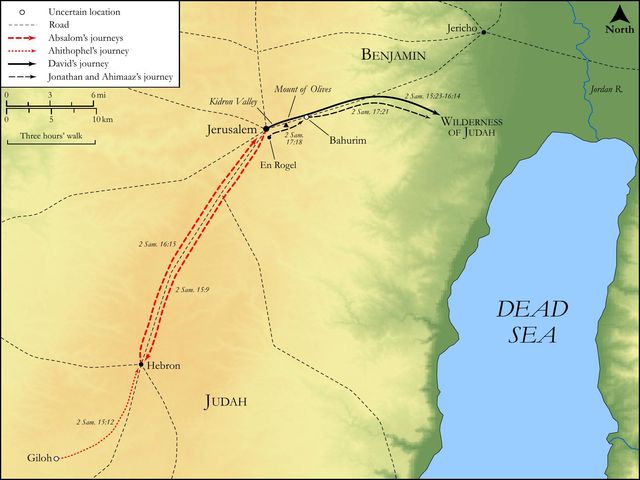
David's flight from Absalom represents a significant political and personal crisis for the king and the nation. The "hill" mentioned is universally understood to be the Mount of Olives, a prominent landmark directly east of Jerusalem, which served as a natural barrier and a gateway to the wilderness and the Jordan Valley. David's journey over this mount signifies his exile from his capital and throne. The provisions brought by Ziba—bread, raisins, summer fruits, and wine—were typical, practical supplies for travel and sustenance in ancient Israel. Their quantity (200 loaves, 100 bunches of raisins, 100 summer fruits, a bottle of wine) indicates a substantial offering, far more than a casual gift, suggesting either a genuine act of devotion or a calculated attempt to gain favor. The role of a servant like Ziba, managing a master's estate and representing his interests, was common, but his actions here reveal the potential for manipulation within such relationships.
Key Themes
ShowHideThis verse contributes to several overarching themes in the book of 2 Samuel. Firstly, it underscores the theme of Divine Providence amidst Human Deception. While the provisions offer timely relief for David, the narrative later reveals Ziba's true, self-serving motives, highlighting how God can provide for His people even through flawed or deceitful human instruments. Secondly, it emphasizes David's Vulnerability and Discernment. In his profound distress and flight, David is susceptible to Ziba's manipulative narrative, illustrating the challenges of leadership and judgment during times of extreme pressure. This episode also deepens the theme of Loyalty and Treachery, contrasting Ziba's feigned allegiance with the later-revealed loyalty of Mephibosheth, and fitting into the broader narrative of Absalom's rebellion, which is itself an act of profound treachery against his father. Finally, it is a moment in David's journey of Exile and Restoration, marking his physical departure from Jerusalem as a prelude to his eventual return and re-establishment of his kingship.
Exposition and Analysis
ShowHideKey Word Analysis
ShowHideThe name "Ziba" (H6717, Tsîybâʼ) means "station" or "standing," which ironically foreshadows his opportunistic positioning in this narrative. As the servant of Mephibosheth, Ziba was entrusted with managing the estate of Jonathan's son. His sudden appearance at this critical juncture, offering substantial provisions, is a calculated move designed to exploit David's vulnerability and gain personal advantage, ultimately leading to a false accusation against his master.
The mention of "asses" (H2543, chămôwr) is significant as these animals were the primary mode of transport for goods and people in ancient Israel. Ziba brings a "couple" (H6776, tsemed, meaning a yoke or pair) of asses, indicating a substantial capacity for carrying the provisions. The term chămôwr specifically refers to a male ass, often known for its strength and reliability, underscoring the practicality and readiness of the aid Ziba presents.
The detail that the asses were "saddled" (H2280, châbash) implies a state of immediate readiness for travel. The root meaning of châbash—"to wrap firmly" or "bind up"—highlights the secure preparation of the animals for their task. This seemingly minor detail reinforces the impression that Ziba's appearance was either meticulously planned or executed with great efficiency, adding to the deceptive facade of his timely and well-prepared act of loyalty.
Verse Breakdown
ShowHide"And when David was a little past the top [of the hill]"
This clause establishes the immediate spatial and temporal context. David has completed the arduous and emotionally draining ascent of the Mount of Olives, a place of significant sorrow for him. Being "past the top" indicates he is moving away from Jerusalem, physically distancing himself from the seat of his power and the source of his current anguish. This moment signifies a transition from the immediate vicinity of his fallen kingdom into the uncertainty of exile.
"behold, Ziba the servant of Mephibosheth met him"
The interjection "behold" (Hebrew, hinnēh) signals a sudden, unexpected, and significant event. The appearance of Ziba, a figure known to David through his connection to Mephibosheth (Jonathan's son, whom David had shown great kindness), immediately introduces a new element into David's desperate flight. His identity as Mephibosheth's servant adds a layer of complexity, as David would naturally associate him with the loyal house of Jonathan.
"with a couple of asses saddled, and upon them two hundred [loaves] of bread, and an hundred bunches of raisins, and an hundred of summer fruits, and a bottle of wine."
This detailed inventory highlights the generosity and practicality of Ziba's offering. The provisions are not merely symbolic; they are substantial and vital for a fleeing company. "Bread" (staple food), "raisins" (concentrated energy), "summer fruits" (seasonal, refreshing), and "wine" (for hydration and morale) collectively represent a comprehensive supply. This impressive display of resources is designed to convey loyalty and support, yet it later proves to be part of Ziba's calculated deception to gain personal advantage.
Literary Devices
ShowHideThe verse effectively employs Juxtaposition by contrasting David's weeping, barefoot, and vulnerable state with Ziba's well-provisioned and seemingly well-intentioned arrival. This creates an immediate sense of relief for the reader, only to be complicated by later revelations. The use of "behold" functions as a Dramatic Marker, drawing immediate attention to Ziba's sudden appearance and signaling its importance in the unfolding narrative. Furthermore, the entire encounter serves as a powerful instance of Foreshadowing. Ziba's appearance and his generous gifts, coupled with his identity as Mephibosheth's servant, subtly hint at the deeper, more complex motivations that will be revealed later in the story, ultimately exposing his Irony as an apparent benefactor who is, in fact, a deceiver. The Mount of Olives itself carries Symbolism as a place of sorrow, transition, and later, for Christ, of agony and betrayal.
Theological and Thematic Connections
ShowHideThis encounter in 2 Samuel 16:1, while seemingly a straightforward act of provision, serves as a profound theological lesson on the complexities of human motivation and the necessity of spiritual discernment, especially in times of crisis. While God often provides for His people, sometimes miraculously and sometimes through human agents, this verse cautions that not every seemingly helpful gesture is born of pure motives. David, in his profound distress and vulnerability, is quick to accept Ziba's narrative, underscoring how emotional duress can impair judgment. This highlights the ongoing tension between divine providence and human deception, reminding believers to "test the spirits" (1 John 4:1) and to look beyond superficial appearances. The narrative implicitly teaches that true loyalty is proven not by outward display but by consistent character and action.
Reflection and Application
ShowHideThe story of Ziba's encounter with David offers a timeless lesson on the critical importance of discernment, particularly when we are at our most vulnerable. David, heartbroken and fleeing for his life, was in no position to thoroughly vet Ziba's claims or motives. His immediate relief at the sight of provisions likely overshadowed any critical questioning. In our own lives, when we face overwhelming challenges, grief, or personal crises, we too can become susceptible to deceptive appearances or manipulative individuals who offer seemingly timely "help." This verse challenges us to cultivate a spirit of wisdom and careful consideration, even when circumstances press us to act quickly. It reminds us that true provision often comes from God, but the channels through which it flows can sometimes be tainted by human sin and self-interest. We are called to pray for discernment, to seek counsel, and to rely on the Holy Spirit to reveal truth, even when it's uncomfortable, so that we do not fall prey to those who would exploit our weakness for their own gain.
Questions for Reflection
ShowHideFAQ
ShowHideWho was Ziba, and what was his relationship to Mephibosheth?
ShowHideZiba was a servant from the house of Saul. After David became king and sought to show kindness to Saul's family for Jonathan's sake, he discovered Mephibosheth, Jonathan's son. David restored all of Saul's land to Mephibosheth and appointed Ziba, along with his sons and servants, to cultivate the land and bring in its produce for Mephibosheth's sustenance (2 Samuel 9:9-10). Ziba was therefore Mephibosheth's chief steward and manager of his estate.
What was the significance of the "hill" David was passing?
ShowHideThe "hill" David was passing is identified as the Mount of Olives, a significant geographical landmark directly east of Jerusalem. David had just ascended it weeping and barefoot, a powerful symbol of his humiliation and grief as he fled his rebellious son. Passing "a little past the top" signifies his complete departure from the city and his entry into the wilderness towards the Jordan River. This location is also symbolically significant, as it would later be a place of profound suffering and betrayal for Jesus Christ (Luke 22:39-44).
Why did Ziba bring these provisions to David?
ShowHideOn the surface, Ziba presented his actions as an act of loyalty and provision for the fleeing king. When David asked where Mephibosheth was, Ziba falsely claimed that Mephibosheth had stayed in Jerusalem, hoping that the house of Israel would restore the kingdom to him (2 Samuel 16:2-3). Ziba's true motive, however, was revealed later in the narrative: he used this opportunity to slander Mephibosheth and gain favor with David, hoping to inherit Mephibosheth's land and wealth for himself (2 Samuel 19:24-30).
Christ-Centered Fulfillment
ShowHideThe poignant scene of David's flight over the Mount of Olives, weeping and betrayed, finds a profound Christ-centered fulfillment in the New Testament. David's experience of apparent abandonment and the deceptive provision from Ziba foreshadows the ultimate betrayal and suffering of Jesus Christ. Just as David ascended the Mount of Olives in sorrow, so too did Jesus go to the Garden of Gethsemane on the same mount, where He faced immense anguish and was ultimately betrayed by one of His own disciples, Judas Iscariot (Luke 22:39-48). While Ziba offered deceptive provision for personal gain, Jesus, the true King, offers Himself as the ultimate, unfailing provision, the Bread of Life and the Living Water, not for His own benefit, but for the eternal sustenance of His people. David's vulnerability to Ziba's lies highlights the fallenness of human nature and the need for perfect discernment, which is found perfectly in Christ, who was never deceived by outward appearances or false loyalty. Ultimately, Christ's journey through suffering and betrayal leads not to a temporary restoration of an earthly kingdom, but to an eternal reign and the true, unadulterated provision of salvation and abundant life for all who trust in Him (John 10:10).