


2 Samuel 16:2
- וַיֹּאמֶרvai·Yo·merand he saidH559Conj-w ¦ V-Qal-ConsecImperf-3msVerb Qal Consecutive Imperfect 3rd Singular Masculineוַandיֹּאמֶרhe said
- הַמֶּלֶךְha·Me·lekhthe kingH4428Art ¦ N-msNoun Singular Masculine Absoluteהַtheמֶּלֶךְking
- אֶל'eltoH413PrepPreposition
- צִיבָאtzi·Va'ZibaH6717N-proper-mNoun Proper Masculine
- מָהmahwhat?H4100InterrogPronoun Interrogative
- אֵלֶּה'E·leh[are] these [things]H428PrtParticle Demonstrative
- לָּךְLakhto <the> youPrep-l ¦ 2msSuffix Personal 2nd Singular Masculineלָּto <the>ךְyou
- וַיֹּאמֶרvai·Yo·merand he saidH559Conj-w ¦ V-Qal-ConsecImperf-3msVerb Qal Consecutive Imperfect 3rd Singular Masculineוַandיֹּאמֶרhe said
- צִיבָאTzi·va'ZibaH6717N-proper-mNoun Proper Masculine
- הַחֲמוֹרִיםha·cha·mo·Rimthe donkeysH2543Art ¦ N-cpNoun Plural common gender Absoluteהַtheחֲמוֹרִיםdonkeys
- לְבֵיתle·veit[are] for [the] household ofH1004Prep-l ¦ N-mscNoun Singular Masculine Constructלְ[are] forבֵית[the] household of
- הַמֶּלֶךְha·Me·lekhthe kingH4428Art ¦ N-msNoun Singular Masculine Absoluteהַtheמֶּלֶךְking
- לִרְכֹּבlir·Koto rideH7392Prep-l ¦ V-Qal-InfVerb Qal Infinitive Constructלִtoרְכֹּבride
- וְהַלֶּחֶםu·ha·le·chemand the breadH3899Conj-w ¦ Art ¦ N-msNoun Singular Masculine Absoluteוְandהַtheלֶּחֶםbread
- וְהַקַּיִץve·ha·Ka·yitzand the summer fruitH7019Conj-w ¦ Art ¦ N-msNoun Singular Masculine Absoluteוְandהַtheקַּיִץsummer fruit
- לֶאֱכוֹלle·'e·Khol[are] to eatH398Prep-l ¦ V-Qal-InfVerb Qal Infinitive Constructלֶ[are] toאֱכוֹלeat
- הַנְּעָרִיםha·ne·'a·Rimthe young menH5288Art ¦ N-mpNoun Plural Masculine Absoluteהַtheנְּעָרִיםyoung men
- וְהַיַּיִןve·hai·Ya·yinand the wineH3196Conj-w ¦ Art ¦ N-msNoun Singular Masculine Absoluteוְandהַtheיַּיִןwine
- לִשְׁתּוֹתlish·Tot[is] to drinkH8354Prep-l ¦ V-Qal-InfVerb Qal Infinitive Constructלִ[is] toשְׁתּוֹתdrink
- הַיָּעֵףhai·ya·'Efthe weary [person]H3287Art ¦ Adj-msAdjective Singular Masculine Absoluteהַtheיָּעֵףweary [person]
- בַּמִּדְבָּרba·mid·Barin the wildernessH4057Prep-b ¦ N-msNoun Singular Masculine Absoluteבַּin theמִּדְבָּרwilderness
English is a literal word-by-word gloss of the Hebrew, not the KJV's wording. Why?
This is the original text the KJV's translators worked from — each Hebrew word with its own literal English meaning in this verse, prepared by scholars at Tyndale House, Cambridge. The KJV translates whole sentences, not word by word, so its wording differs: one Hebrew word can become several English words, and the KJV may choose “the LORD” where the gloss reads “Yahweh”. Both are faithful — they answer different questions. For the KJV's own rendering, switch to the KJV text.
Details
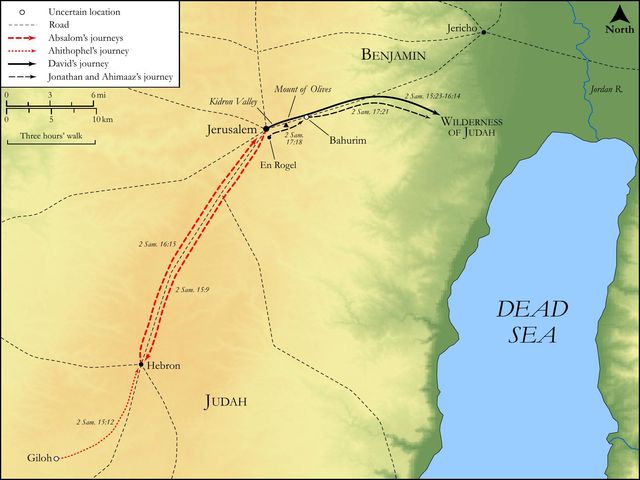
See on the biblical-era map

Study this verse
Public-domain commentary
Matthew Henry
From his Commentary on the Whole Bible. Henry comments on passages, not single verses — this entry covers 2 Samuel 16:1–4.
We read before how kind David was to Mephibosheth the son of Jonathan, how he prudently entrusted his servant Ziba with the management of his estate, while he generously entertained him at his own table, Sa2 9:10. This matter was well settled; but, it seems, Ziba is not content to be manager, he longs to be master, of Mephibosheth's estate. Now, he thinks, is his time to make himself so; if he can procure a grant of it from the crown, whether David or Absalom get the better it is all one to him, he hopes he shall secure his prey, which he promises himself by fishing in troubled waters. In order hereunto, 1. He made David a handsome present of provisions, which was the more welcome because it came seasonably (Sa2 16:1), and with this he designed to incline him to himself; for a man's gift maketh room for him, and bringeth him before great men, Pro 18:16. Nay, Whithersoever it turneth, it prospereth, Pro 17:8. David inferred from this that Ziba was a very discreet and generous man, and well affected to him, when, in all, he designed nothing but to make his own market and to get Mephibosheth's estate settled upon himself. Shall the prospect of advantage in this world make men generous to the rich? and shall not the belief of an abundant recompence in the resurrection of the just make us charitable to the poor? Luk 14:14. Ziba was very considerate in the present he brought to David; it was what would do him some good in his present distress, Sa2 16:2. Observe, The wine was intended for those that were faint, not for the king's own drinking, or the courtiers; it seems, they did not commonly use it, but it was for cordials for those that were ready to perish, Pro 31:6. Blessed art thou, O land! when thy princes use wine for strength, as David did, and not for drunkenness, as Absalom did, ch. 13:28. See Ecc 10:17. Whatever Ziba intended in this present, God's providence sent it to David for his support very graciously. God makes use of bad men for good purposes to his people, and sends them meat by ravens. Having by his present insinuated himself into David's affection, and gained credit with him, the next thing he has to do for the compassing of his end is to incense him against Mephibosheth, which he does by a false accusation, representing him as ungratefully designing to raise himself by the present broils, and to recover the crown to his own head, now that David and his son were contending for it. David enquires for him as one of his family, which gives Ziba occasion to tell this false story of him, Sa2 16:3. What immense damages do masters often sustain by the lying tongues of their servants! David knew Mephibosheth not to be an ambitious man, but easy in his place, and well-affected to him and his government; nor could he be so weak as to expect with his lame legs to climb the ladder of preferment; yet David gives credit to the calumny, and, without further enquiry or consideration, convicts Mephibosheth of treason, seizes his lands as forfeited, and grants them to Ziba: Behold, thine are all that pertained to Mephibosheth (Sa2 16:4), a rash judgment, and which afterwards he was ashamed of, when the truth came to light, Sa2 19:29. Princes cannot help it, but they will be sometimes (as our law speaks) deceived in their grants; but they ought to use all means possible to discover the truth and to guard against malicious designing men, who would impose upon them, as Ziba did upon David. Having by his wiles gained his point, Ziba secretly laughed at the king's credulity, congratulated himself on his success, and departed, with a great compliment upon the king, that he valued his favour more than Mephibosheth's estate: "Let me find grace in thy sight, O king! and I have enough." Great men ought always to be jealous of flatterers, and remember that nature has given them two ears, that they may hear both sides.
Historical interpretation
Historical reception
1 surviving comment on this verse from the historical church.
It ought not to excite astonishment that Constantine was so far deceived as to send so many great men into exile: for he believed the assertions of bishops of high fame and reputation, who skillfully concealed their malice. Those who are acquainted with the Sacred Scriptures know that the holy David, although he was a prophet, was deceived; and that too not by a priest, but by one who was a menial, a slave and a rascal. I mean Ziba, who deluded the king by lies against Mephibosheth, and thus obtained his land. It is not to condemn the prophet that I speak in this way; but that I may defend the emperor, by showing the weakness of human nature, and to teach that credit should not be given only to those who advance accusations, even though they may appear worthy of credit; but that the other party ought also to be heard, and that one ear should be left open to the accused.
Continue studying 2 Samuel 16:2 across the web’s major study libraries — every link below opens this exact verse, chapter, or book on the destination site.
Read & Compare
 BibleGatewayThis verse in more than 200 translations and 70 languages.
 Bible.comThe YouVersion reader — hundreds of translations, reading plans, and highlights.
 ESV.orgCrossway's official English Standard Version reader.
 NET BibleThe NET translation with 60,000+ translators' notes on every rendering decision.
 STEP BibleTyndale House's free study tool — original text, vocabulary, and scholarly resources.
 BibliaLogos Bible Software's free web reader.
 USCCBThe New American Bible (Revised Edition) with the U.S. bishops' study notes.
Commentaries
 BibleHub CommentariesDozens of classic commentaries on this verse, gathered on one page.
 StudyLightMore than 100 commentary sets — the largest collection on the web.
 BibleRefPlain-English commentary on what this verse means, verse by verse.
 Enduring WordDavid Guzik's free commentary on this chapter, widely used by Bible teachers.
 Bible Study ToolsVerse commentary alongside Greek and Hebrew study aids.
Original Language & Research
- BibleHub InterlinearThe verse word by word — original language, transliteration, and English.
- BibleHub LexiconEvery word's original-language definition and Strong's entry.
 Blue Letter BibleDeep-study tools — Strong's numbers, concordance, and word studies.
 SefariaThe Hebrew text with Rashi and centuries of Jewish commentary.
Sermons, Hymns & Audio


TrulyRandomVerse is not affiliated with these sites and doesn’t control their content. They’re linked because they’re genuinely useful.
Summary
In 2 Samuel 16:2, King David, in the throes of a desperate flight from his rebellious son Absalom, interrogates Ziba, the servant of Mephibosheth, regarding the substantial provisions he has unexpectedly presented. Ziba meticulously details the purpose of each item: the asses are for the royal household's transport, the bread and summer fruit are for the sustenance of the young men, and the wine is intended for those weakened by the arduous journey through the wilderness. This seemingly benevolent act by Ziba is, in reality, a calculated and manipulative ploy to curry favor with the vulnerable king and unjustly acquire Mephibosheth's land, thereby setting the stage for David's hasty and regrettable judgment amidst a period of profound national upheaval.
Context
ShowHideLiterary Context
This verse is strategically placed at a pivotal moment in the unfolding drama of Absalom's rebellion, immediately following David's forced departure from Jerusalem. The preceding chapter, 2 Samuel 15, details Absalom's successful usurpation of the throne, compelling David and his loyal followers to flee the capital in haste and distress. The specific encounter with Ziba is introduced in 2 Samuel 16:1, where Ziba appears with a significant retinue and an abundance of provisions, prompting David's direct inquiry in verse 2. Ziba's artful explanation here, coupled with his subsequent malicious slander of Mephibosheth in 2 Samuel 16:3, directly precipitates David's swift and ill-considered decision to transfer Mephibosheth's land to Ziba in 2 Samuel 16:4. This entire episode serves as a powerful illustration of David's extreme vulnerability, the opportunistic nature of individuals during times of political instability, and the complex interplay of loyalty and deception that permeates the narrative of David's later reign.
Historical & Cultural Context
David's flight from Jerusalem would have been an incredibly perilous and physically demanding ordeal for a large household, including women, children, and a contingent of loyal soldiers. Traveling through the Judean wilderness, characterized by its arid and rugged terrain, necessitated reliable transport and ample provisions for survival. Asses were indispensable in the ancient Near East, serving as primary beasts of burden for carrying supplies and providing transport for the infirm or weary. Bread constituted the staple diet, while "summer fruit" – likely dried figs or dates – offered concentrated energy and could be easily preserved for travel. Wine, far from being solely for recreation, was a vital source of hydration, calories, and a mild restorative, particularly crucial for those suffering from exhaustion or illness in harsh conditions. Culturally, the act of offering such substantial provisions was a significant gesture of hospitality and loyalty, making Ziba's presentation appear genuinely supportive on the surface, even as his deeper, self-serving motives were carefully concealed within the volatile political climate of the time.
Key Themes
ShowHideThis verse significantly contributes to several profound themes woven throughout the book of 2 Samuel. Firstly, it highlights the theme of Divine Provision amidst Crisis, demonstrating the immediate and practical needs of David and his followers during a desperate flight. Regardless of Ziba's corrupt intentions, the supplies were a tangible necessity for their survival, echoing how God often provides for His people, even through unexpected or morally compromised channels. Secondly, the passage introduces and develops the pervasive theme of Deception and Opportunism, as Ziba's meticulously crafted explanation of his "generosity" serves as a cunning prelude to his slander of Mephibosheth and his calculated attempt to seize his master's inheritance. This deceptive scheme is later fully exposed and partially rectified in 2 Samuel 19:24-30. Finally, the episode vividly portrays David's Vulnerability and Hasty Judgment. Under immense emotional and physical duress, fleeing for his life, David is tragically susceptible to Ziba's manipulative narrative, leading him to make a swift and unjust decision that he later must confront and partially reverse, illustrating that even wise and righteous leaders can falter under extreme pressure, as seen in his immediate response in 2 Samuel 16:4.
Exposition and Analysis
ShowHideKey Word Analysis
ShowHideMeaning "a male ass (from its dun red); (he) ass." These animals were indispensable for ancient travel and commerce, serving as primary beasts of burden and transport. Their provision here signifies not only a means of carrying essential supplies but also a vital aid for the mobility of David's household, particularly the elderly, women, and children, who would struggle with prolonged walking in the rugged wilderness. The presence of asses underscores the practical and immediate logistical needs of a fleeing royal entourage.
Meaning "a house (in the greatest variation of applications, especially family, etc.); court, daughter, door, [phrase] dungeon, family, [phrase] forth of, [idiom] great as would contain, hangings, home(born), (winter) house(-hold), inside(-ward), palace, place, [phrase] prison, [phrase] steward, [phrase] tablet, temple, web, [phrase] within(-out)." In this context, "household" refers to David's entire extended family, servants, and loyal followers who were accompanying him in his desperate flight. Ziba's specific mention of the asses being for the "king's household" implies a comprehensive provision for the entire group, aiming to convey a deep and broad sense of loyalty and foresight.
Meaning "fatigued; figuratively, exhausted; faint, weary." This word vividly describes a state of severe physical exhaustion, weariness, or faintness, often induced by hunger, thirst, or arduous exertion. The specific provision of wine for "such as be faint in the wilderness" powerfully emphasizes the severe physical toll of their flight. Wine, in this context, served as a crucial restorative, providing calories and a sense of revitalization to those on the brink of collapse, highlighting the desperate and challenging conditions David's group faced.
Verse Breakdown
ShowHide"And the king said unto Ziba, What meanest thou by these?"
David's question is one of genuine surprise and inquiry. He has just encountered Ziba with a significant and unexpected display of resources (asses, food, wine) and is naturally curious about the purpose of these provisions and Ziba's presence, especially given that Mephibosheth, Ziba's master, is conspicuously absent. This direct question sets the stage for Ziba's carefully crafted and ultimately manipulative explanation.
"And Ziba said, The asses [be] for the king's household to ride on;"
Ziba immediately frames his provision as an act of loyal and thoughtful service to the king. By explicitly designating the asses for David's "household," he implies a concern for the entire royal family and retinue, not merely David himself. This statement strategically positions Ziba as a proactive, empathetic, and indispensable supporter of the beleaguered king, aiming to impress David with his foresight.
"and the bread and summer fruit for the young men to eat;"
Here, Ziba further specifies the food items, dedicating them to the "young men," which likely refers to the soldiers and able-bodied loyalists accompanying David. This detail reinforces the impression of practical, well-considered aid, directly addressing the immediate sustenance needs of David's fighting force and his most active followers, enhancing Ziba's image as a diligent provider.
"and the wine, that such as be faint in the wilderness may drink."
This final clause targets the most vulnerable and physically exhausted members of the fleeing group. The explicit mention of those "faint in the wilderness" vividly paints a picture of the harsh realities and physical toll of their arduous journey. By providing a vital restorative like wine for these individuals, Ziba positions himself as someone deeply empathetic to their suffering, thereby completing a comprehensive explanation of the provisions' utility designed to maximize David's perception of Ziba's unwavering loyalty and generosity.
Literary Devices
ShowHideThe passage masterfully employs several literary devices to deepen its meaning and foreshadow the complex events that follow. Irony is profoundly evident, as Ziba's outwardly generous and loyal explanation of the provisions stands in stark contrast to his true, deeply self-serving motives, which involve slandering his master, Mephibosheth, and seizing his property. His detailed account of the provisions' utility is a meticulously crafted performance of devotion, making David's subsequent hasty judgment in 2 Samuel 16:4 deeply pathetic, highlighting the king's extreme vulnerability and susceptibility to manipulation during his time of distress. The very act of providing these necessities, while genuinely meeting David's immediate physical needs, serves as a powerful instance of foreshadowing, hinting at the deeper deception that will unfold and the king's tragic susceptibility to such treachery. Furthermore, there is an element of symbolism in the provisions themselves: while they represent crucial physical sustenance, they also become potent symbols of false loyalty and the treacherous nature of human interactions, particularly when power, property, and personal gain are at stake.
Theological and Thematic Connections
ShowHideThis seemingly straightforward exchange about practical provisions carries significant theological weight, touching upon themes of divine providence, human fallibility, and the stark contrast between true loyalty and opportunistic deception. While Ziba's underlying motives were undeniably corrupt and self-serving, the provisions themselves were a tangible and much-needed blessing to David and his weary company. This illustrates a profound theological truth: God, in His sovereign wisdom, can orchestrate His provision for His people even through the flawed, self-interested, or even malicious actions of individuals. David's swift judgment, based solely on Ziba's deceptive narrative, serves as a poignant cautionary tale about the inherent dangers of making critical decisions under duress and without thorough discernment. It powerfully reminds believers that even the most righteous and divinely appointed leaders are susceptible to human weakness, emotional vulnerability, and cunning manipulation. This episode underscores the constant and urgent need for wisdom, discernment, and a reliance on God's guidance, especially when faced with seemingly helpful gestures that may conceal ulterior motives or involve accusations against others.
Reflection and Application
ShowHideThe narrative of 2 Samuel 16:2 compels us to engage in deep reflection on the intricate complexities of human relationships, particularly when navigating periods of intense personal or communal crisis. David, despite being a man famously described as "after God's own heart," was demonstrably vulnerable to cunning deception when subjected to immense pressure and distress. This serves as a powerful reminder that our spiritual maturity and faith do not automatically exempt us from the critical need for discernment, especially when others offer aid or information that could potentially benefit them at the expense of another's reputation or well-being. The passage challenges us to look beyond the superficial appearance of benevolent acts and to prayerfully consider the character, integrity, and potential hidden motives of those offering assistance, particularly when such assistance involves accusations or negative portrayals of absent parties. Moreover, this episode subtly but profoundly points to God's overarching and unfailing providence: even through Ziba's manipulative and self-serving actions, David's immediate and desperate physical needs were undeniably met. This encourages us, as believers, to cultivate a profound trust that God can and will provide for us in unexpected ways, even amidst treachery, adversity, and human imperfection, reminding us that His faithful care is ultimately dependent not on the purity of human instruments but on His sovereign will and unfailing love.
Questions for Reflection
ShowHideFAQ
ShowHideWhy did David not question Ziba's story more thoroughly, especially given Mephibosheth's previous demonstrated loyalty?
ShowHideDavid was in an extremely vulnerable, desperate, and emotionally compromised state, literally fleeing for his life from his own son, Absalom. His profound emotional and physical duress likely impaired his usual astute judgment. The sudden and timely appearance of vital provisions from Ziba, coupled with Ziba's plausible (though utterly false) explanation that Mephibosheth had deliberately chosen to remain in Jerusalem, hoping to reclaim the throne for the house of Saul (2 Samuel 16:3), would have been highly persuasive to a king under such immense pressure. David's immediate and pressing need for sustenance and transport for his large entourage, combined with the profound shock and betrayal of Absalom's rebellion, made him tragically susceptible to Ziba's manipulative narrative. Consequently, he made a hasty and regrettable decision, granting Mephibosheth's entire land inheritance to Ziba in 2 Samuel 16:4, a decision he later had to revisit and partially reverse when Mephibosheth finally had the opportunity to explain himself upon David's return to Jerusalem in 2 Samuel 19:24-30.
Christ-Centered Fulfillment
ShowHideThe narrative of King David's desperate flight and Ziba's deceptive provision, while deeply rooted in the historical tapestry of the Old Testament, profoundly anticipates the person and redemptive work of Jesus Christ. David, the anointed king of Israel, is forced into ignominious exile by a rebellious son, experiencing profound betrayal and relying on external, often flawed, provision for survival. This mirrors, in a profound way, the experience of Christ, the true and eternal King, who was ultimately betrayed by His own people and faced immense suffering and rejection. While David received physical provisions from a deceptive source, Jesus is the ultimate and perfect spiritual provision for all who are "faint in the wilderness" of sin, despair, and spiritual hunger. He is the Bread of Life, offering spiritual sustenance that never perishes and truly satisfies, unlike the temporary bread and summer fruit Ziba provided. He is the Living Water, quenching the deepest thirst of the human soul, far surpassing the restorative wine given to the physically weary. Furthermore, just as David was slandered, misunderstood, and falsely accused during his time of vulnerability and distress, Jesus endured relentless false accusations, betrayal by His closest disciples, and ultimately, crucifixion. Yet, through His unparalleled suffering and sacrificial death, He became the perfect and spotless sacrifice, the Lamb of God who takes away the sin of the world, providing eternal life, true rest, and complete restoration for all who are spiritually faint and burdened. His kingdom, unlike David's temporarily usurped earthly throne, is an everlasting kingdom, established not by human manipulation or earthly power struggles, but by divine authority, perfect love, and unwavering faithfulness, offering genuine and eternal provision and unwavering loyalty to all who believe and follow Him.