


2 Samuel 17:29
- וּדְבַשׁu·de·Vashand honeyH1706Conj-w ¦ N-msNoun Singular Masculine Absoluteוּandדְבַשׁhoney
- וְחֶמְאָהve·chem·'Ahand curd<s>H2529Conj-w ¦ N-fsNoun Singular Feminine Absoluteוְandחֶמְאָהcurd<s>
- וְצֹאןve·tzoNand sheepH6629Conj-w ¦ N-csNoun Singular common gender Absoluteוְandצֹאןsheep
- וּשְׁפוֹתu·she·Fotand cheese ofH8194Conj-w ¦ N-fpcNoun Plural Feminine Constructוּandשְׁפוֹתcheese of
- בָּקָרba·Kar[the] herdH1241N-csNoun Singular common gender Absolute
- הִגִּישׁוּhi·Gi·shuthey broughtH5066V-Hiphil-Perf-3cpVerb Hiphil Perfect 3rd Plural common gender
- לְדָוִדle·da·Vidfor DavidH1732Prep-l ¦ N-proper-mNoun Proper MasculineלְforדָוִדDavid
- וְלָעָםve·la·'Amand for the peopleH5971Conj-w ¦ Prep-l ¦ N-msNoun Singular Masculine Absoluteוְandלָfor theעָםpeople
- אֲשֶׁר'a·SherwhichH834RelParticle Relative
- אִתּוֹ'i·To[was] with himH854Prep ¦ 3msPreposition Definiteאִתּ[was] withוֹhim
- לֶאֱכוֹלle·'e·Kholto eatH398Prep-l ¦ V-Qal-InfVerb Qal Infinitive Constructלֶtoאֱכוֹלeat
- כִּיkiforH3588PrtParticle Conditional
- אָמְרוּ'a·me·Ruthey saidH559V-Qal-Perf-3cpVerb Qal Perfect 3rd Plural common gender
- הָעָםha·'Amthe peopleH5971Art ¦ N-msNoun Singular Masculine Absoluteהָtheעָםpeople
- רָעֵבra·'Ev[is] hungryH7457Adj-msAdjective Singular Masculine Absolute
- וְעָיֵףve·'a·Yefand wearyH5889Conj-w ¦ Adj-msAdjective Singular Masculine Absoluteוְandעָיֵףweary
- וְצָמֵאve·tza·Me'and thirstyH6771Conj-w ¦ Adj-msAdjective Singular Masculine Absoluteוְandצָמֵאthirsty
- בַּמִּדְבָּרba·mid·Barin the wildernessH4057Prep-b ¦ N-msNoun Singular Masculine Absoluteבַּin theמִּדְבָּרwilderness
English is a literal word-by-word gloss of the Hebrew, not the KJV's wording. Why?
This is the original text the KJV's translators worked from — each Hebrew word with its own literal English meaning in this verse, prepared by scholars at Tyndale House, Cambridge. The KJV translates whole sentences, not word by word, so its wording differs: one Hebrew word can become several English words, and the KJV may choose “the LORD” where the gloss reads “Yahweh”. Both are faithful — they answer different questions. For the KJV's own rendering, switch to the KJV text.
Details
See on the biblical-era map
Study this verse
Public-domain commentary
Matthew Henry
From his Commentary on the Whole Bible. Henry comments on passages, not single verses — this entry covers 2 Samuel 17:22–29. His three-level outline is real structure in the source text, so it is rendered as structure.
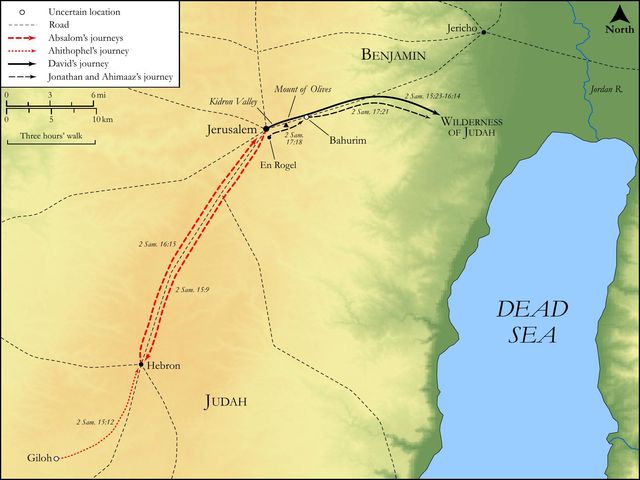
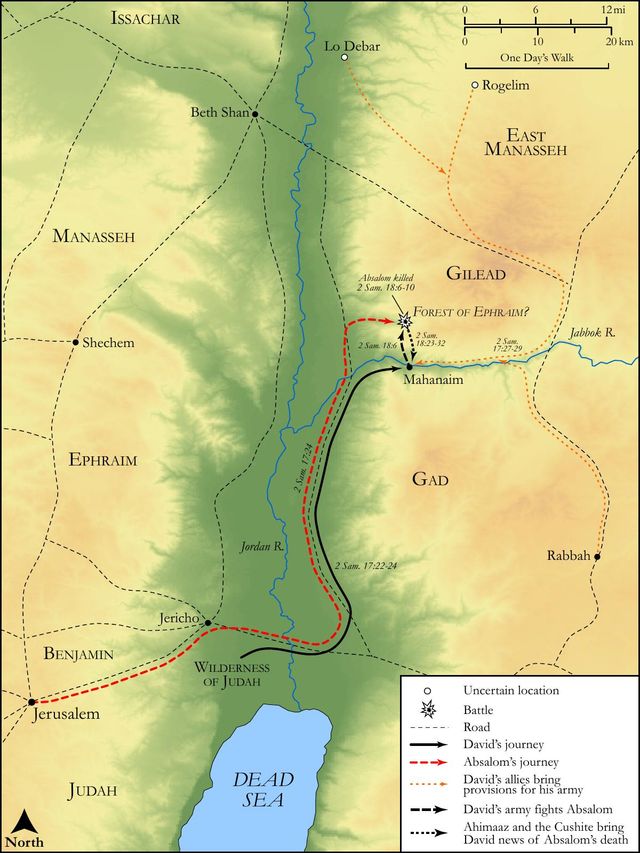
Here is, I. The transporting of David and his forces over Jordan, pursuant to the advice he had received from his friends at Jerusalem, Sa2 17:22. He, and all that were with him, went over in the night, whether in ferryboats, which probably always plied there, or through the fords, does not appear. But special notice is taken of this, that there lacked not one of them: none deserted him, though his distress was great, none staid behind sick or weary, nor were any lost or cast away in passing the river. Herein some make him a type of the Messiah, who said, in a difficult day, Of all that thou hast given me have I lost none. Having got over Jordan, he marched many miles forward to Mahanaim, a Levites' city in the tribe of Gad, in the utmost border of that tribe, and not far from Rabbah, the chief city of the Ammonites. This city, which Ishbosheth had made his royal city (Sa2 2:8), David now made his head-quarters, Sa2 17:24. And now he had time to raise an army wherewith to oppose the rebels and give them a warm reception.
II.The death of Ahithophel, Sa2 17:23.
He died by his own hands, felo de se - a suicide. He hanged himself for vexation that his counsel was not followed; for thereby,
1.He thought himself slighted, and an intolerable slur cast upon his reputation for wisdom. His judgment always used to sway at the counsel-board, but now another's opinion is thought wiser and better than his. His proud heart cannot bear the affront; it rises and swells, and the more he thinks of it the more violent his resentments grow, till they bring him at last to this desperate resolve not to live to see another preferred before him. All men think him a wise man, but he thinks himself the only wise man; and therefore to be avenged upon mankind for not thinking so too, he will die, that wisdom may die with him. The world is not worthy of such an oracle as he is, and therefore he will make them know the want of him. See what real enemies those are to themselves that think too well of themselves, and what mischiefs those run upon that are impatient of contempt. That will break a proud man's heart that will not break a humble man's sleep.
2.He thought himself endangered and his life exposed. He concluded that, because his counsel was not followed, Absalom's cause would certainly miscarry, and then, whoever would find David's mercy, he concluded that he, who was the greatest criminal, and had particularly advised him to lie with his father's concubines, must be sacrificed to justice. To prevent therefore the shame and terror of a public and solemn execution, he does justice upon himself, and, after his reputation for wisdom, by this last act puts a far greater disgrace upon himself than Absalom's privy-council had put upon him, and answers his name Ahithophel, which signifies, the brother of a fool. Nothing indicates so much folly as self-murder. Observe, How deliberately he did it, and of malice prepense against himself; not in a heat, but he went home to his city, to his house, to do it; and, which is strange, took time to consider of it, and yet did it. And, to prove himself compos mentis - in his senses, when he did it, he first put his household in order, made his will as a man of sane memory and understanding, settled his estate, balanced his accounts; yet he that had sense and prudence enough to do this had not consideration enough to revoke the sentence his pride and passion had passed upon his own neck, nor so much as to suspend the execution of it till he saw the event of Absalom's rebellion. Now herein we may see,
(1.)Contempt poured upon the wisdom of man. He that was more renowned for policy than any man played the fool with himself more abundantly. Let not the wise man glory in his wisdom, when he sees him that was so great an oracle dying as a fool dies.
(2.)Honour done to the justice of God. When the wicked are thus snared in the work of their own hands, and sunk in a pit of their own digging, the Lord is known by the judgment which he executeth, and we must say, Higgaion, Selah; it is a thing to be marked and meditated upon, Psa 7:15, Psa 7:16.
(3.)Prayer answered, and an honest cause served even by its enemies. Now, as David had prayed, Ahithophel's counsel was turned into foolishness to himself. Dr. Lightfoot supposes that David penned the 55th Psalm upon occasion of Ahithophel's being in the plot against him, and that he is the man complained of (Sa2 17:13) that had been his equal, his guide, and his acquaintance; and, if so, this was an immediate answer to his prayer there (Sa2 17:15): Let death seize upon them, and let them go down quickly into hell. Ahithophel's death was an advantage to David's interest; for had he digested that affront (as those must resolve often to do that will live in this world), and continued his post at Absalom's elbow, he might have given him counsel afterwards that might have been of pernicious consequence to David. It is well that that breath is stopped and that head laid from which nothing could be expected but mischief. It seems, it was not then usual to disgrace the dead bodies of self-murderers, for Ahithophel was buried, we may suppose honourably buried, in the sepulchre of his father, though he deserved no better than the burial of an ass. See Ecc 8:10.
III.Absalom's pursuit of his father.
He had now got all the men of Israel with him, as Hushai advised, and he himself, at the head of them, passed over Jordan, Sa2 17:24. Not content that he had driven his good father to the utmost corner of his kingdom, he resolved to chase him out of the world. He pitched in the land of Gilead with all his forces, ready to give David battle, Sa2 17:26. Absalom made one Amasa his general (Sa2 17:25), whose father was by birth Jether, an Ishmaelite (Ch1 2:17), but by religion Ithra (as he is here called), an Israelite; probably he was not only proselyted, but, having married a near relation of David's, was, by some act of the state, naturalized, and is therefore called an Israelite. His wife, Amasa's mother, was Abigail, David's sister, whose other sister, Zeruiah, was Joab's mother (Ch1 2:16), so that Amasa was in the same relation to David that Joab was. In honour to his family, even while he was in arms against his father, Absalom made him commander-in-chief of all his forces. Jesse is here called Nahash, for many had two names; or perhaps this was his wife's name.
IV.The friends David met with in this distant country.
Even Shobi, a younger brother of the royal family of the Ammonites, was kind to him, Sa2 17:27. It is probable that he had detested the indignity which his brother Hanun had done to David's ambassadors, and for that had received favours from David, which he now returned. Those that think their prosperity most confirmed know not but, some time or other, they may stand in need of the kindness of those that now lie at their mercy, and may be glad to be beholden to them, which is a reason why we should, as we have opportunity, do good to all men, for he that watereth shall be watered also himself, when there is occasion. Machir, the son of Ammiel, was he that maintained Mephibosheth (Sa2 9:4), till David eased him of that charge, and is now repaid for it by that generous man, who, it seems, was the common patron of distressed princes. Barzillai we shall hear of again. These, compassionating David and his men, now that they were weary with a long march, brought him furniture for his house, beds and basins, and provision for his table, wheat and barley, etc., Sa2 17:28, Sa2 17:29. He did not put them under contribution, did not compel them to supply him, much less plunder them; but in token of their dutiful affection to him, and their sincere concern for him in his present straits, of their own good will they brought in plenty of all that which he had occasion for. Let us learn hence to be generous and open-handed, according as our ability is, to all in distress, especially great men, to whom it is most grievous, and good men, who deserve better treatment; and see how God sometimes makes up to his people that comfort from strangers which they are disappointed of in their own families.
Continue studying 2 Samuel 17:29 across the web’s major study libraries — every link below opens this exact verse, chapter, or book on the destination site.
Read & Compare
 BibleGatewayThis verse in more than 200 translations and 70 languages.
 Bible.comThe YouVersion reader — hundreds of translations, reading plans, and highlights.
 ESV.orgCrossway's official English Standard Version reader.
 NET BibleThe NET translation with 60,000+ translators' notes on every rendering decision.
 STEP BibleTyndale House's free study tool — original text, vocabulary, and scholarly resources.
 BibliaLogos Bible Software's free web reader.
 USCCBThe New American Bible (Revised Edition) with the U.S. bishops' study notes.
Commentaries
 BibleHub CommentariesDozens of classic commentaries on this verse, gathered on one page.
 StudyLightMore than 100 commentary sets — the largest collection on the web.
 BibleRefPlain-English commentary on what this verse means, verse by verse.
 Enduring WordDavid Guzik's free commentary on this chapter, widely used by Bible teachers.
 Bible Study ToolsVerse commentary alongside Greek and Hebrew study aids.
Original Language & Research
- BibleHub InterlinearThe verse word by word — original language, transliteration, and English.
- BibleHub LexiconEvery word's original-language definition and Strong's entry.
 Blue Letter BibleDeep-study tools — Strong's numbers, concordance, and word studies.
 SefariaThe Hebrew text with Rashi and centuries of Jewish commentary.
Sermons, Hymns & Audio


TrulyRandomVerse is not affiliated with these sites and doesn’t control their content. They’re linked because they’re genuinely useful.
Summary
2 Samuel 17:29 powerfully depicts the critical provision of sustenance for King David and his loyal followers during their desperate flight from Absalom's rebellion. In their vulnerable state—hungry, weary, and thirsty in the desolate wilderness—this generous supply of essential provisions, including honey, butter, sheep, and cheese, served as a tangible expression of compassion and unwavering loyalty, enabling David's exhausted company to survive and persevere through an intensely challenging period of crisis and displacement.
Context
ShowHideLiterary Context
This verse serves as the culmination of a pivotal act of support detailed in the immediately preceding verses, where three prominent individuals—Shobi the Ammonite, Machir from Lo-debar, and Barzillai the Gileadite—are introduced as those who brought a comprehensive array of provisions to David. Their actions directly follow David's hasty and desperate flight from Jerusalem, as recorded in 2 Samuel 15:13-17, due to Absalom's swift and overwhelming rebellion. The narrative highlights David's extreme vulnerability and the critical need for sustenance for his large entourage, setting the stage for the profound impact of these provisions. The specific listing of food items underscores the practical nature of their dire circumstances and the immediate relief provided. This act of kindness stands in stark contrast to the betrayal David experienced from his own son and many within his kingdom, emphasizing the loyalty of a faithful remnant.
Historical & Cultural Context
David's flight took him across the Jordan River into the Transjordan region, an area often described as a "wilderness" (midbār). While not entirely barren, this region was less populated and offered fewer immediate resources for a large, fleeing company than the settled lands west of the Jordan. In ancient Near Eastern culture, hospitality was a sacred duty, especially towards those in distress or flight. The act of providing food and shelter to a king in exile, particularly one whose throne was contested, was a significant political and social statement, demonstrating loyalty and risking the wrath of the usurper, Absalom. The provisions listed—honey, butter, sheep, and cheese—were staple foods of the time, providing vital energy, protein, and fat necessary for sustaining a large group of people who were physically exhausted and deprived. "Cheese of kine" specifically refers to cheese made from cow's milk, indicating a common and accessible dairy product, essential for a people on the move.
Key Themes
ShowHideThis verse powerfully contributes to several overarching themes within 2 Samuel and the broader biblical narrative. Firstly, it exemplifies Divine Provision through Human Instruments, showcasing how God, in His faithfulness, provides for His anointed, David, even in his lowest and most vulnerable state, often working through the compassion and loyalty of others. This underscores that God's care is tangible and practical, meeting immediate physical needs, much like His provision for Israel in the desert, as recounted in Exodus 16. Secondly, it highlights the profound Compassion and Loyalty demonstrated by Shobi, Machir, and Barzillai, who risked their own safety and resources to support their king, embodying selfless devotion in a time of political upheaval. Their actions stand in stark contrast to the betrayal David experienced from Absalom and others. Thirdly, the passage underscores the Vulnerability of Leadership, revealing that even a powerful king like David was not immune to severe hardship, hunger, and physical exhaustion, emphasizing his dependence on God and the faithfulness of his subjects during a period of intense crisis, as seen in his lament in Psalm 3:1-2. Lastly, it emphasizes the Practical Needs in Crisis, illustrating that in moments of extreme distress, basic sustenance is paramount. The specific list of provisions—honey, butter, sheep, and cheese—speaks to the immediate, practical necessities for survival and recovery when people are "hungry, and weary, and thirsty" in the wilderness.
Exposition and Analysis
ShowHideKey Word Analysis
ShowHideDerived from a root meaning "to be gummy," this term refers to honey, likely from wild bees, or a syrup made from dates or grapes. In the ancient world, honey was a primary natural sweetener and a valuable source of quick energy, often consumed as a staple food. Its inclusion here signifies a readily available and highly beneficial provision for an exhausted and famished group.
This archaic English term, preserved in the KJV, refers to "beef cattle" or "an animal of the ox family," encompassing both genders but often implying female cattle when used in the plural for dairy products. In the context of "cheese of kine," it specifically means cheese made from cow's milk. This highlights the common, practical nature of the provisions, drawing from readily available agricultural resources in the region.
This word describes a state of intense hunger or being "hunger-bitten." It conveys a deep, physical need for food, emphasizing the severe deprivation experienced by David and his company. Coupled with "weary" and "thirsty," it paints a vivid picture of their dire physical condition, making the provision of food not merely a comfort but an urgent necessity for their very survival.
Verse Breakdown
ShowHide"And honey, and butter, and sheep, and cheese of kine"
This clause provides a precise inventory of the provisions brought. "Honey" would have been a natural sweetener and energy source. "Butter" (likely a fermented milk product or curd, or even clarified butter/ghee) and "cheese of kine" (cow's milk cheese) provided essential fats and proteins. "Sheep" would have been for meat, offering a crucial source of protein for a large, exhausted group. This list speaks to both immediate energy needs and sustained nourishment, demonstrating a comprehensive and thoughtful provision.
"for David, and for the people that [were] with him, to eat"
This specifies the recipients of the provisions. It emphasizes that the aid was not just for David, the king, but for his entire company—his loyal soldiers, household, and all who had followed him in his desperate flight. This underscores the scale of the need and the comprehensive nature of the provision, ensuring that no one in his vulnerable entourage was left without sustenance. It highlights the collective nature of their suffering and the collective benefit of the aid.
"for they said, The people [is] hungry, and weary, and thirsty, in the wilderness."
This final clause reveals the profound motivation behind the benefactors' actions. Their direct statement indicates a deep empathy and acute awareness of David's and his people's dire physical state. "Hungry, and weary, and thirsty" vividly describes the cumulative effects of rapid flight, lack of rest, and exposure in a harsh, unyielding environment. The phrase "in the wilderness" further emphasizes the challenging circumstances, highlighting the isolation and scarcity that made these provisions absolutely vital for survival and recovery.
Literary Devices
ShowHideThe verse employs several effective literary devices to convey its message with vividness and emotional impact. The most prominent is Enumeration, as it meticulously lists the specific items of provision: "honey, and butter, and sheep, and cheese of kine." This detailed catalog not only provides a concrete image of the relief offered but also emphasizes the practical, life-sustaining nature of the gifts, highlighting their immediate utility for a group facing starvation. Furthermore, the verse powerfully uses Pathos by explicitly stating the dire condition of David's people: "hungry, and weary, and thirsty." This direct appeal to the reader's emotions evokes profound sympathy for David's plight and underscores the urgency and compassion of the benefactors. The phrase "for they said" also functions as Reported Speech, giving voice to the benefactors' motivation and emphasizing their empathetic understanding of the dire situation. Finally, there is an implicit Contrast between David's former glory as king in Jerusalem and his current vulnerable state, fleeing in the wilderness, which heightens the significance of this timely and life-saving provision.
Theological and Thematic Connections
ShowHideThis passage beautifully illustrates the providential care of God, often manifested through the compassion and generosity of His people. Even when David, God's anointed king, found himself in the lowest and most vulnerable circumstances, stripped of his throne and fleeing for his life, God did not abandon him. Instead, He moved the hearts of faithful individuals to provide tangible, life-sustaining aid. This demonstrates that God's faithfulness is not merely spiritual but extends to the practical, physical needs of His servants, especially in times of extreme hardship. It underscores a fundamental biblical principle: God often uses human instruments to accomplish His divine purposes and to demonstrate His love and provision for His children. The selfless actions of Shobi, Machir, and Barzillai serve as a powerful example of biblical love in action, responding to immediate and desperate need without expectation of return. Their willingness to risk their own safety and resources for the sake of God's anointed king exemplifies true loyalty and faith.
Reflection and Application
ShowHideThe narrative of 2 Samuel 17:29 offers profound lessons for believers navigating their own "wilderness" seasons—times of great difficulty, exhaustion, uncertainty, or even spiritual dryness. It serves as a powerful reminder that even in our most vulnerable moments, when we feel abandoned or overwhelmed, God remains faithful to provide for our needs. This provision often comes not through miraculous, direct intervention, but through the kindness, generosity, and compassion of others whom God has prepared and moved. This passage challenges us to cultivate a spirit of trust in God's provision, recognizing that He uses the tangible actions of His people to meet real needs. Furthermore, it calls us to embody the same selfless compassion demonstrated by Shobi, Machir, and Barzillai. Are we attentive to the practical needs of those around us—the hungry, the weary, the thirsty, the vulnerable, the displaced? Are we willing to extend ourselves, even at personal risk or inconvenience, to provide tangible support to those in crisis, echoing Christ's call to care for "the least of these"? This verse encourages us to be instruments of God's grace and provision, reflecting His love in practical, life-sustaining ways within our communities and beyond, remembering that acts of kindness, however small, can have profound impact in desperate times.
Questions for Reflection
ShowHideFAQ
ShowHideWho were Shobi, Machir, and Barzillai, and why did they help David?
ShowHideShobi, Machir, and Barzillai were three prominent individuals from the Transjordan region who provided crucial aid to King David and his followers during his flight from Absalom's rebellion. Shobi was the son of Nahash from Rabbah of the Ammonites, possibly indicating a former enemy now allied with David, or a sign of David's widespread support across tribal and national lines. Machir, son of Ammiel, was from Lo-debar and had previously shown kindness by caring for Mephibosheth, Jonathan's son (2 Samuel 9:4-5). Barzillai was a wealthy Gileadite from Rogelim. They helped David out of profound loyalty and compassion, recognizing his desperate plight and the extreme exhaustion, hunger, and thirst of his company. Their actions were a testament to their unwavering support for David's legitimate kingship, even when it seemed to be in jeopardy, demonstrating remarkable courage and selflessness.
What is the significance of the specific provisions listed: "honey, and butter, and sheep, and cheese of kine"?
ShowHideThe specific items listed—honey, butter (likely a form of curd or fermented milk product), sheep (for meat), and cheese of kine (cow's milk cheese)—were not luxuries but vital, practical provisions for a large group of people facing physical exertion and deprivation in a wilderness setting. Honey provided quick energy and was a natural sweetener. Butter and cheese offered essential fats and proteins, crucial for sustained energy and nourishment. Sheep provided meat, a significant source of protein. Together, these items formed a comprehensive and highly nutritious supply, demonstrating a thoughtful and practical response to the immediate, life-threatening needs of David's weary and famished company. This shows that the benefactors understood the specific demands of their situation and provided exactly what was needed for survival and recovery.
How does this event demonstrate God's providence?
ShowHideThis event powerfully demonstrates God's providence by showing His faithful care for David, His anointed king, even in his darkest hour. While David was fleeing, vulnerable and seemingly abandoned, God orchestrated human agents—Shobi, Machir, and Barzillai—to provide exactly what was needed for survival. This is not a direct, miraculous intervention like manna from heaven, but a profound demonstration of God working through the hearts and resources of His people. It illustrates that God's providence often operates through ordinary means and human compassion, ensuring that His purposes are fulfilled and His servants are sustained, even when circumstances seem dire. It underscores the truth that God is always at work, even when His hand is not overtly visible, orchestrating events and moving individuals to accomplish His divine will.
Christ-Centered Fulfillment
ShowHideThe provision for David in 2 Samuel 17:29, while a historical event, resonates deeply with the broader biblical narrative of God's provision and finds its ultimate fulfillment in Jesus Christ. David, the anointed king, finds himself rejected, fleeing, and utterly dependent, a poignant foreshadowing of Christ's own journey. Jesus, the true King, also experienced rejection and vulnerability, famously having "nowhere to lay his head" (Matthew 8:20). He endured His own "wilderness" experiences, facing temptation and hunger after forty days of fasting (Matthew 4:1-11). Yet, just as David was sustained by faithful hands, Christ was ministered to by angels after His temptation (Matthew 4:11) and strengthened by an angel in Gethsemane (Luke 22:43). Ultimately, Christ is the ultimate provision for a humanity that is "hungry, and weary, and thirsty" in the wilderness of sin, separated from God. He declares Himself the "bread of life" (John 6:35), offering spiritual sustenance that truly satisfies, and the "living water" (John 4:10) to quench our deepest thirst. The compassion shown to David by his loyalists also prefigures the call for believers to minister to Christ's body, the Church, and to the "least of these" (Matthew 25:35-40), recognizing that in serving others, we are serving Him. Thus, 2 Samuel 17:29 points to God's unwavering commitment to sustain His chosen ones, a commitment perfectly and eternally fulfilled in the person and work of Jesus Christ, our ultimate Provider and Sustainer, who gave His very self for our eternal nourishment.