


Judges 8:6
Bible text: King James Version (1769 Blayney text) · Public domain
Bible text: Berean Standard Bible · Public domain
Bible text: American Standard Version (1901) · Public domain
Bible text: World English Bible, Messianic edition · Public domain
Bible text: Geneva Bible (1599) · Public domain
Bible text: Young's Literal Translation · Public domain
- וַיֹּאמֶרvai·Yo·merand he saidH559Conj-w ¦ V-Qal-ConsecImperf-3msVerb Qal Consecutive Imperfect 3rd Singular Masculineוַandיֹּאמֶרhe said
- שָׂרֵיsa·Rei[the] officials ofH8269N-mpcNoun Plural Masculine Construct
- סֻכּוֹתsu·KotSuccothH5523N-properNoun Proper Location
- הֲכַףHa·khaf¿ [is] [the] hand ofH3709Interrog ¦ N-fscNoun Singular Feminine Constructהֲ¿כַף[is] [the] hand of
- זֶבַחZe·vachZebahH2078N-proper-mNoun Proper Masculine
- וְצַלְמֻנָּעve·tzal·mu·Na'and ZalmunnaH6759Conj-w ¦ N-proper-mNoun Proper MasculineוְandצַלְמֻנָּעZalmunna
- עַתָּה'a·TahnowH6258AdvAdverb
- בְּיָדֶךָbe·ya·De·khain your handH3027Prep-b ¦ N-csc ¦ 2msNoun Singular common gender Constructבְּinיָדֶhandךָyour
- כִּיkithatH3588PrtParticle Conditional
- נִתֵּןni·Tenwe will giveH5414V-Qal-Imperf-1cpVerb Qal Imperfect 1st Plural common gender
- לִצְבָאֲךָlitz·va·'a·Khato your armyH6635Prep-l ¦ N-msc ¦ 2msNoun Singular Masculine Constructלִtoצְבָאֲarmyךָyour
- לָחֶםLa·chembreadH3899N-msNoun Singular Masculine Absolute
English is a literal word-by-word gloss of the Hebrew, not the KJV's wording. Why?
This is the original text the KJV's translators worked from — each Hebrew word with its own literal English meaning in this verse, prepared by scholars at Tyndale House, Cambridge. The KJV translates whole sentences, not word by word, so its wording differs: one Hebrew word can become several English words, and the KJV may choose “the LORD” where the gloss reads “Yahweh”. Both are faithful — they answer different questions. For the KJV's own rendering, switch to the KJV text.
Details
See on the biblical-era maps
Study this verse
Public-domain commentary
Matthew Henry
From his Commentary on the Whole Bible. Henry comments on passages, not single verses — this entry covers Judges 8:4–17. His four-level outline is real structure in the source text, so it is rendered as structure.
In these verses we have,
I.Gideon, as a valiant general, pursuing the remaining Midianites, and bravely following his blow.
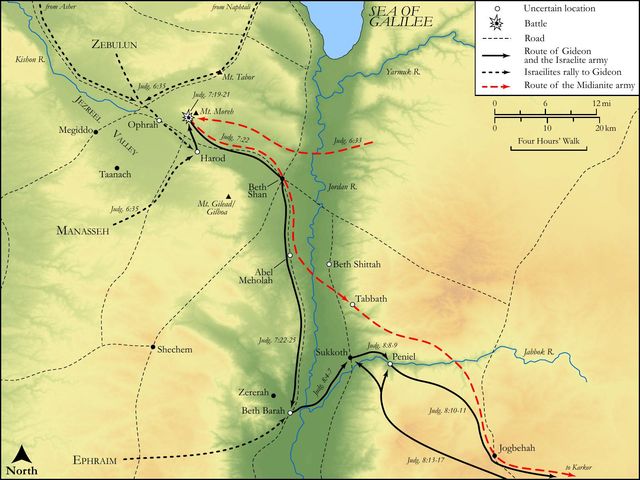
A very great slaughter was made of the enemy at first: 120,000 men that drew the sword, Jdg 8:10. Such a terrible execution did they make among themselves, and so easy a prey were they to Israel. But, it seems, the two kings of Midian, being better provided than the rest for an escape, with 15,000 men got over Jordan before the passes could be secured by the Ephraimites, and made towards their own country. Gideon thinks he does not fully execute his commission to save Israel if he let them escape. He is not content to chase them out of the country, but he will chase them out of the world, Job 18:18. This resolution is here pushed on with great firmness, and crowned with great success.
1.His firmness was very exemplary. He effected his purpose under the greatest disadvantages and discouragements that could be.
(1.)He took none with him but his 300 men, who now laid aside their trumpets and torches, and betook themselves to their swords and spears. God had said, By these 300 men will I save you (Jdg 7:7); and, confiding in that promise, Gideon kept to them only, Jdg 8:4. He expected more from 300 men, supported by a particular promise, than from so many thousands supported only by their own valour.
(2.)They were faint, and yet pursuing, much fatigued with what they had done, and yet eager to do more against the enemies of their country. Our spiritual warfare must thus be prosecuted with what strength we have, though we have but little; it is many a time the true Christina's case, fainting and yet pursuing.
(3.)Though he met with discouragement from those of his own people, was jeered for what he was doing, as going about what he could never accomplish, yet he went on with it. If those that should be our helpers in the way of our duty prove hindrances to us, let not this drive us off from it. Those know not how to value God's acceptance that know not how to despise the reproaches and contempts of men.
(4.)He made a very long march by the way of those that dwelt in tents (Jdg 8:11), either because he hoped to find them kinder to him than the men of Succoth and Penuel, that dwelt in walled towns (sometimes there is more generosity and charity found in country tents than in city palaces), or because that was a road in which he would be least expected, and therefore that way it would be the greater surprise to them. It is evident he spared no pains to complete his victory. Now he found it an advantage to have his 300 men such as could bear hunger, and thirst, and toil. It should seem, he set upon the enemy by night, as he had done before, for the host was secure. The security of sinners often proves their ruin, and dangers are most fatal when least feared.
2.His success was very encouraging to resolution and industry in a good cause. He routed the army (Jdg 8:11), and took the two kings prisoners, Jdg 8:12. Note, The fear of the wicked shall come upon him. Those that think to run from the sword of the Lord and of Gideon do but run upon it. If he flee from the iron weapon, yet the bow of steel shall strike him through; for evil pursueth sinners.
II.Here is Gideon, as a righteous judge, chastising the insolence of the disaffected Israelites, the men of Succoth and the men of Penuel, both in the tribe of Gad, on the other side Jordan.
1.Their crime was great. Gideon, with a handful of feeble folk was pursuing the common enemy, to complete the deliverance of Israel. His way led him through the city of Succoth first and afterwards of Penuel. He expected not that the magistrates should meet him in their formalities, congratulate him upon his victory, present him with the keys of their city, and give him a treat, much less that they should send forces in to his assistance, though he was entitled to all this; but he only begs some necessary food for his soldiers that were ready to faint for want, and he does it very humbly and importunately: Give, I pray you, loaves of bread unto the people that follow me, Jdg 8:5. The request would have been reasonable if they had been but poor travellers in distress; but considering that they were soldiers, called, and chose, and faithful (Rev 17:14), men whom God had greatly honoured and to whom Israel was highly obliged, who had done great service to their country and were now doing more, - that they were conquerors, and had power to put them under contribution, - and that they were fighting God's battles and Israel's, - nothing could be more just than that their brethren should furnish them with the best provisions their city afforded. But the princes of Succoth neither feared God nor regarded man. For,
(1.)In contempt of God, they refused to answer the just demands of him whom God had raised up to save them, affronted him, bantered him, despised the success he had already been honoured with, despaired of the success of his present undertaking, did what they could to discourage him in prosecuting the war, and were very willing to believe that the remaining forces of Midian, which they had now seen march through their country, would be too hard for him: Are the hands of Zebah and Zalmunna now in thy hand? "No, nor ever will be," so they conclude, judging by the disproportion of numbers.
(2.)The bowels of their compassion were shut up against their brethren; they were as destitute of love as they were of faith, would not give morsels of bread (so some read it) to those that were ready to perish. Were these princes? were these Israelites? unworthy either title, base and degenerate men! Surely they were worshippers of Baal, or in the interests of Midian. The men of Penuel gave the same answer to the same request, defying the sword of the Lord and of Gideon, Jdg 8:8.
2.The warning he gave them of the punishment of their crime was very fair.
(1.)He did not punish it immediately, because he would not lose so much time from the pursuit of the enemy that were flying from him, because he would not seem to do it in a neat of passion, and because he would do it more to their shame and confusion when he had completed his undertaking, which they thought impracticable. But,
(2.)He told them how he would punish it (Jdg 8:7, Jdg 8:9), to show the confidence he had of success in the strength of God, and that, if they had the least grain of grace and consideration left, they might upon second thoughts repent of their folly, humble themselves, and contrive how to atone for it, by sending after him succours and supplies, which if they had done, no doubt, Gideon would have pardoned them. God gives notice of danger, and space to repent, that sinners may flee from the wrath to come.
3.The warning being slighted, the punishment, though very severe, was really very just.
(1.)The princes of Succoth were first made examples. Gideon got intelligence of their number, seventy-seven men, their names, and places of abode, which were described in writing to him, Jdg 8:14. And, to their great surprise, when they thought he had scarcely overtaken the Midianites, he returned a conqueror. His 300 men were now the ministers of his justice; they secured all these princes, and brought them before Gideon, who showed them his royal captives in chains. "These are the men you thought me an unequal match for, and would give me no assistance in the pursuit of," Jdg 8:15. And he punished them with thorns and briers, but, it should seem, not unto death. With these,
[1.]He tormented their bodies, either by scourging or by rolling them in the thorns and briers; some way or other he tore their flesh, Jdg 8:7. Those shall have judgment without mercy that have shown no mercy. Perhaps he observed them to be soft and delicate men, who despised him and his company for their roughness and hardiness, and therefore Gideon thus mortified them for their effeminacy.
[2.]He instructed their minds: With these he taught the men of Succoth, Jdg 8:16. The correction he gave them was intended, not for destruction, but wholesome discipline, to make them wiser and better for the future. He made them know (so the word is), made them know themselves and their folly, God and their duty, made them know who Gideon was, since they would not know by the success wherewith God had crowned him. Note, Many are taught with the briers and thorns of affliction that would not learn otherwise. God gives wisdom by the rod and reproof, chastens and teaches, and by correction opens the ear to discipline. Our blessed Saviour, though he was a Son, yet learnt obedience by the things which he suffered, Heb 5:8. Let every pricking brier, and grieving thorn, especially when it becomes a thorn in the flesh, be thus interpreted, thus improved. "By this God designs to teach me; what good lesson shall I learn?"
(2.)The doom of the men of Penuel comes next, and it should seem he used them more severely than the other, for good reason, no doubt, Jdg 8:17.
[1.]He beat down their tower, of which they gloried, in which they trusted, perhaps scornfully advising Gideon and his men rather to secure themselves in that than to pursue the Midianites. What men make their pride is justly by its ruin made their shame.
[2.]He slew the men of the city, not all, perhaps not the elders or princes, but those that had affronted him, and those only. He slew some of the men of the city that were most insolent and abusive, for terror to the rest, and so he taught the men of Penuel.
Continue studying Judges 8:6 across the web’s major study libraries — every link below opens this exact verse, chapter, or book on the destination site.
Read & Compare
 BibleGatewayThis verse in more than 200 translations and 70 languages.
 Bible.comThe YouVersion reader — hundreds of translations, reading plans, and highlights.
 ESV.orgCrossway's official English Standard Version reader.
 NET BibleThe NET translation with 60,000+ translators' notes on every rendering decision.
 STEP BibleTyndale House's free study tool — original text, vocabulary, and scholarly resources.
 BibliaLogos Bible Software's free web reader.
 USCCBThe New American Bible (Revised Edition) with the U.S. bishops' study notes.
Commentaries
 BibleHub CommentariesDozens of classic commentaries on this verse, gathered on one page.
 StudyLightMore than 100 commentary sets — the largest collection on the web.
 BibleRefPlain-English commentary on what this verse means, verse by verse.
 Enduring WordDavid Guzik's free commentary on this chapter, widely used by Bible teachers.
 Bible Study ToolsVerse commentary alongside Greek and Hebrew study aids.
Original Language & Research
- BibleHub InterlinearThe verse word by word — original language, transliteration, and English.
- BibleHub LexiconEvery word's original-language definition and Strong's entry.
 Blue Letter BibleDeep-study tools — Strong's numbers, concordance, and word studies.
 SefariaThe Hebrew text with Rashi and centuries of Jewish commentary.
Sermons, Hymns & Audio


TrulyRandomVerse is not affiliated with these sites and doesn’t control their content. They’re linked because they’re genuinely useful.
Summary
Judges 8:6 vividly portrays the cynical and uncooperative stance of the leaders of Succoth towards Gideon's urgent plea for provisions for his weary army. Despite Gideon's recent, miraculous victory over the Midianites, these princes refuse to provide essential sustenance, demanding tangible proof of the complete capture of the Midianite kings, Zebah and Zalmunna, before they would offer any aid. Their skepticism reveals a profound lack of faith, prioritizing self-preservation and immediate security over national unity and the support of a divinely appointed deliverer.
Context
ShowHideLiterary Context
This verse is situated immediately after Gideon's stunning, God-empowered victory over the Midianite forces with only 300 men, a triumph detailed in Judges 7. Despite the rout, the Midianite kings, Zebah and Zalmunna, and a remnant of their army, have escaped across the Jordan River. Gideon, with his small but determined force, is described as "faint, yet pursuing" in Judges 8:4, demonstrating unwavering resolve to complete the mission. His request for bread from Succoth, a presumably Israelite city, underscores the dire physical state of his men and the ongoing nature of the conflict, even after a decisive battle. The refusal by Succoth's leaders sets up Gideon's stern warning and subsequent judgment upon the city, as detailed in Judges 8:7-9, highlighting a tragic internal division within Israel.
Historical & Cultural Context
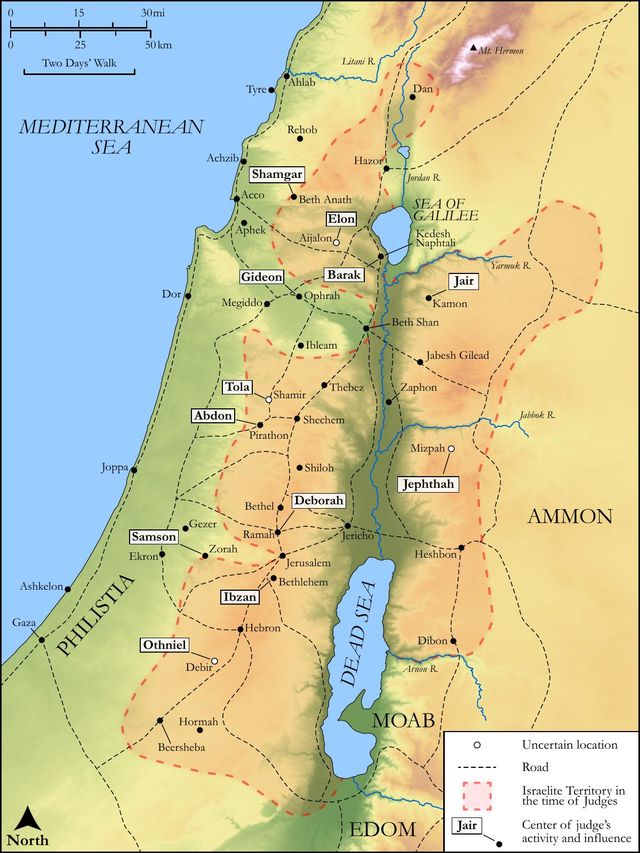
Succoth was a city located in the Jordan Valley, east of the Jordan River, within the tribal territory of Gad (though its exact tribal affiliation is sometimes debated, it was clearly an Israelite settlement). In that day, hospitality, especially to fellow countrymen engaged in a national cause, was a deeply ingrained social expectation and a moral imperative. The princes of Succoth's refusal to provide food to Gideon's army was not merely a lack of generosity but a profound breach of communal solidarity and a direct affront to a divinely commissioned leader. Their fear of reprisal from the still-at-large Midianite kings, Zebah and Zalmunna, reveals a pragmatic, self-serving mindset that prioritized immediate safety over loyalty to their own people and trust in God's ongoing deliverance. This reflects a broader pattern of disunity and wavering faith that plagued Israel during the period of the Judges, where "every man did that which was right in his own eyes" (Judges 21:25).
Key Themes
ShowHideThe verse powerfully illustrates several key themes prevalent in the book of Judges. Firstly, it highlights the lack of faith and short-sightedness prevalent among many Israelites. The princes of Succoth demand tangible proof of victory ("Are the hands of Zebah and Zalmunna now in thine hand?") before they will offer support, demonstrating a reliance on sight rather than trust in God's ongoing work through Gideon, even after the miraculous victory detailed in Judges 7. Secondly, it underscores the theme of self-preservation over national unity. The leaders of Succoth prioritize their own safety and potential repercussions from the Midianites over supporting their own people and a divinely appointed deliverer. This refusal to aid fellow Israelites in a critical national effort points to a fractured unity and a failure to recognize the greater good, a recurring problem in the era of the Judges. Lastly, it foreshadows Gideon's perseverance amidst internal opposition, as he does not give up despite being rejected by his own countrymen, continuing his pursuit of the enemy, demonstrating unwavering resolve and faith in God's ultimate deliverance, as seen in his subsequent actions in Judges 8:10-12.
Exposition and Analysis
ShowHideKey Word Analysis
ShowHideThis term (H3709) refers to the "hollow hand or palm," often implying the physical grasp or literal possession. In the princes' question, "Are the hands of Zebah and Zalmunna," it emphasizes their demand to see the Midianite kings themselves, physically subdued and under Gideon's immediate control, before they would offer any assistance.
Distinct from kaph, this term (H3027) refers to the "open hand," often signifying power, authority, or dominion. The phrase "in thine hand" (using yâd) is an idiomatic expression for complete control, capture, or possession. The princes are questioning if Gideon truly has ultimate power and authority over these formidable enemies, implying a lack of trust in his current standing or God's ongoing work through him.
This term (H3899) broadly refers to "food," specifically "bread" or "grain," representing the most basic and essential provisions for sustenance. The refusal to provide "bread" highlights the severity of Succoth's inhospitality and their complete denial of fundamental support to Gideon's exhausted army, demonstrating a profound lack of compassion and solidarity.
Verse Breakdown
ShowHide"And the princes of Succoth said"
This identifies the speakers as the authoritative leaders or elders of the city of Succoth. Their collective voice represents the city's official stance, indicating a unified decision to deny aid. Their position implies responsibility for the welfare of their people, yet they use it to deny support to their brethren engaged in a national cause.
"[Are] the hands of Zebah and Zalmunna now in thine hand"
This is the core of their cynical and conditional response. It is a rhetorical question, expressing doubt and demanding undeniable proof of Gideon's complete victory. They are essentially saying, "Prove to us that you have entirely subdued these dangerous kings, so we know there's no risk to us if we help you." This reveals their fear, self-interest, and pragmatic mindset, prioritizing their own safety over the needs of their brethren and the completion of God's work.
"that we should give bread unto thine army?"
This clause completes their refusal, making explicit their condition for providing aid. By linking the provision of "bread" directly to the capture of Zebah and Zalmunna, they demonstrate their unwillingness to offer support based on faith, communal obligation, or the clear evidence of God's previous miraculous intervention. Their refusal is not merely passive but an active denial of essential provisions, highlighting their lack of trust in Gideon and, implicitly, in God's ongoing work through him.
Literary Devices
ShowHideThe verse employs several significant literary devices. Irony is prominent, as fellow Israelites, who should be allies in the fight against their common oppressor, refuse aid to their divinely appointed deliverer. This internal opposition is a tragic counterpoint to the external victory Gideon has already achieved. The question posed by the princes is laden with Sarcasm and skepticism, challenging Gideon's authority and the completeness of his mission. It is not a genuine inquiry but a dismissive demand for absolute, risk-free certainty. Furthermore, the verse uses Foreshadowing, setting the stage for Gideon's subsequent, severe judgment upon Succoth (and Penuel) for their disloyalty and lack of support, as detailed in Judges 8:16-17. The imagery of "hands...in thine hand" is an Idiom, conveying complete control and capture, emphasizing the princes' demand for absolute and visible certainty.
Theological and Thematic Connections
ShowHideThe refusal of the princes of Succoth to aid Gideon's weary army is a profound theological statement on the nature of faith, trust, and communal responsibility. Their demand for tangible proof before offering support ("Are the hands of Zebah and Zalmunna now in thine hand?") mirrors a common human tendency to rely on sight rather than trust in God's ongoing process, even when His hand has been clearly evident. This episode serves as a stark reminder that God's work often requires perseverance and faithful support even when the outcome is not yet fully visible or secure. It challenges believers to consider whether their support for God's kingdom initiatives is conditional upon perceived success or rooted in a deeper commitment to His purposes and His people, regardless of immediate risk or comfort. The fear of man and the desire for self-preservation can often hinder our willingness to participate in God's redemptive work, echoing the broader struggle between faith and fear found throughout scripture.
Reflection and Application
ShowHideJudges 8:6 offers a powerful mirror for contemporary believers, challenging our readiness to support God's work and His people, especially when the victory is not yet fully realized or when there is personal risk involved. Like the princes of Succoth, we may be tempted to withhold our resources, time, or encouragement until we see undeniable proof of success, or until we are certain there will be no cost to ourselves. This verse calls us to move beyond a conditional faith, urging us to trust God's ongoing work even when it appears incomplete or when the path is arduous. It reminds us that true solidarity within the body of Christ means supporting one another in the trenches, not just celebrating on the mountaintops. Our fear of potential repercussions or our desire for comfort can cause us to neglect our calling to serve and to participate in the larger kingdom narrative. Gideon's perseverance, despite being rejected by his own countrymen, serves as an enduring example for us to press on in our God-given assignments, even when those who should be allies become obstacles.
Questions for Reflection
ShowHideFAQ
ShowHideWhy were the princes of Succoth so uncooperative and fearful?
ShowHideThe princes of Succoth were primarily motivated by self-preservation and a profound lack of faith in God's ongoing deliverance through Gideon. Despite Gideon's miraculous victory over the Midianites in Judges 7, the Midianite kings, Zebah and Zalmunna, were still at large and posed a significant threat. The princes feared that if they aided Gideon's army and Gideon subsequently failed to capture the kings, Succoth would face severe retaliation from the Midianites. Their question, "Are the hands of Zebah and Zalmunna now in thine hand?" reveals their demand for absolute certainty and security before they would risk anything. This pragmatic, fear-driven mindset overshadowed their duty to support their fellow Israelites and a divinely appointed deliverer, highlighting a common spiritual failing in the period of the Judges where tribal loyalties and personal safety often superseded national unity and trust in God.
What is the significance of the phrase "Are the hands of Zebah and Zalmunna now in thine hand?"
ShowHideThis idiomatic expression signifies complete control, capture, or possession. The princes were not asking if Gideon literally held the kings' hands, but if he had them completely defeated, captured, and under his power. It was a cynical and conditional demand for undeniable proof of Gideon's success. They were essentially saying, "Have you already achieved total victory over these dangerous kings, so that we can be sure there's no risk to us if we help you?" This highlights their skepticism and their unwillingness to offer aid based on faith or communal obligation. It underscores their desire for a risk-free commitment, which is antithetical to the nature of faith and the demands of warfare.
What happened to Succoth after this refusal?
ShowHideGideon, angered by their refusal and lack of support for their own people, vowed to return and punish them. After successfully capturing Zebah and Zalmunna, Gideon indeed returned to Succoth. He took the elders of the city and "taught them a lesson" by punishing them with thorns and briers from the wilderness, as recorded in Judges 8:16. This severe act served as a stark consequence for their disloyalty, fear, and failure to support God's deliverer and their own nation in a time of critical need. It underscores the biblical principle that those who refuse to aid God's work and His people may face divine judgment.
Christ-Centered Fulfillment
ShowHideThe narrative of Gideon's pursuit and the rejection by Succoth finds profound Christ-centered fulfillment in the life and mission of Jesus. Just as Gideon, faint yet pursuing, sought sustenance for his weary men only to be rejected by his own countrymen, so too did Jesus, the ultimate deliverer, come to His own, and His own received Him not (John 1:11). Jesus, the Bread of Life, offered spiritual nourishment and deliverance, yet He was met with skepticism, fear, and outright hostility from those who should have welcomed Him. The princes of Succoth demanded tangible proof of Gideon's victory before offering "bread," mirroring the world's demand for signs and wonders, or a visible, conquering king, before believing in Christ. Yet, Jesus' victory was not to be found in the immediate overthrow of earthly kings, but in His sacrificial death and resurrection, a victory that initially appeared as weakness and defeat to the world (1 Corinthians 1:23). The refusal of bread to Gideon's army foreshadows the world's rejection of Christ's life-giving sustenance. However, unlike Gideon who returned to punish Succoth, Christ's ultimate return will be in glory, not primarily to punish those who refused Him bread, but to judge the living and the dead, and to gather those who, by faith, received Him as the true Lamb of God who takes away the sin of the world. His mission was to provide eternal sustenance and salvation, even when despised and rejected by men (Isaiah 53:3). Thus, Judges 8:6 ultimately points to the greater rejection and the greater, ultimate victory of Christ, who persevered in His mission despite profound human opposition, securing salvation for all who believe.