


Judges 7:7
Bible text: King James Version (1769 Blayney text) · Public domain
Bible text: King James Version with Strong's numbers · Public domain
Bible text: Berean Standard Bible · Public domain
Bible text: American Standard Version (1901) · Public domain
Bible text: World English Bible, Messianic edition · Public domain
Bible text: Geneva Bible (1599) · Public domain
Bible text: Young's Literal Translation · Public domain
- וַיֹּאמֶרvai·Yo·merand he saidH559Conj-w ¦ V-Qal-ConsecImperf-3msVerb Qal Consecutive Imperfect 3rd Singular Masculineוַandיֹּאמֶרhe said
- יְהוָהYah·wehYahwehH3068N-properNoun Proper Title
- אֶל'eltoH413PrepPreposition
- גִּדְעוֹןgid·'onGideonH1439N-proper-mNoun Proper Masculine
- בִּשְׁלֹשׁbish·Loshby threeH7969Prep-b ¦ N-cscNoun Singular common gender Constructבִּbyשְׁלֹשׁthree
- מֵאוֹתme·'othundred<s>H3967N-fpNoun Plural Feminine Absolute
- הָאִישׁha·'Ishthe manH376Art ¦ N-msNoun Singular Masculine Absoluteהָtheאִישׁman
- הַמֲלַקְקִיםha·ma·la·Kimwho lappedH3952Art ¦ V-Piel-Prtcpl-mpVerb Piel Participle Plural Masculine Absoluteהַwhoמֲלַקְקִיםlapped
- אוֹשִׁיעַ'o·Shi·a'I will deliverH3467V-Hiphil-Imperf-1csVerb Hiphil Imperfect 1st Singular common gender
- אֶתְכֶם'et·Khem<obj.> youH853DirObjM ¦ 2mpParticle Object Indicatorאֶתְ<obj.>כֶםyou
- וְנָתַתִּיve·na·ta·Tiand I will giveH5414Conj-w ¦ V-Qal-ConsecPerf-1csVerb Qal Consecutive Perfect 1st Singular common genderוְandנָתַתִּיI will give
- אֶת'et<obj.>H853DirObjMParticle Object Indicator
- מִדְיָןmid·YanMidianH4080N-properNoun Proper Location
- בְּיָדֶךָbe·ya·De·khain your handH3027Prep-b ¦ N-csc ¦ 2msNoun Singular common gender Constructבְּinיָדֶhandךָyour
- וְכָלve·kholand allH3605Conj-w ¦ N-mscNoun Singular Masculine Constructוְandכָלall
- הָעָםha·'Amthe peopleH5971Art ¦ N-msNoun Singular Masculine Absoluteהָtheעָםpeople
- יֵלְכוּye·le·Khulet them goH1980V-Qal-Imperf-3mpVerb Qal Imperfect 3rd Plural Masculine
- אִישׁ'isheachH376N-msNoun Singular Masculine Absolute
- לִמְקֹמוֹlim·ko·Moto his own placeH4725Prep-l ¦ N-msc ¦ 3msNoun Singular Masculine Constructלִtoמְקֹמown placeוֹhis
English is a literal word-by-word gloss of the Hebrew, not the KJV's wording. Why?
This is the original text the KJV's translators worked from — each Hebrew word with its own literal English meaning in this verse, prepared by scholars at Tyndale House, Cambridge. The KJV translates whole sentences, not word by word, so its wording differs: one Hebrew word can become several English words, and the KJV may choose “the LORD” where the gloss reads “Yahweh”. Both are faithful — they answer different questions. For the KJV's own rendering, switch to the KJV text.
Details
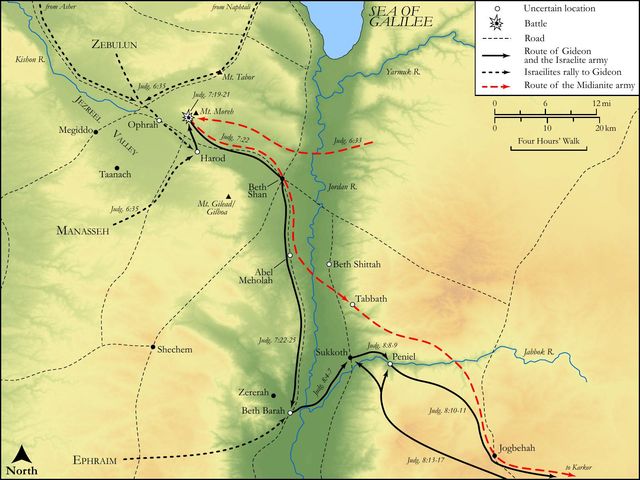
See on the biblical-era maps

Study this verse
Public-domain commentary
Matthew Henry
From his Commentary on the Whole Bible. Henry comments on passages, not single verses — this entry covers Judges 7:1–8. His three-level outline is real structure in the source text, so it is rendered as structure.
Here, I. Gideon applies himself with all possible care and industry to do the part of a good general, in leading on the hosts of Israel against the Midianites (Jdg 7:1): He rose up early, as one whose heart was upon his business, and who was afraid of losing time. Now that he is sure God is with him he is impatient of delay. He pitched near a famous well, that his army might not be distressed for want of water, and gained the higher ground, which possibly might be some advantage to him, for the Midianites were beneath him in the valley. Note, Faith in God's promises must not slacken, but rather quicken, our endeavours. When we are sure God goes before us, then we must bestir ourselves, Sa2 5:24.
II.God provides that the praise of the intended victory may be reserved wholly to himself, by appointing 300 men only to be employed in this service.
1.The army consisted of 32,000 men, a small army in comparison with what the Midianites had now brought into the field; Gideon was ready to think them too few, but God comes to him, and tells him they are too many, Jdg 7:2. Not but that those did well who offered themselves willingly to this expedition, but God saw fit not to make use of all that came. We often find God bringing great things to pass by a few hands, but this was the only time that he purposely made them fewer. Had Deborah lately blamed those who came not to the help of the Lord, and yet in the next great action must those be turned off that do come? Yes;
(1.)God would hereby show that when he employed suitable instruments in his service he did not need them, but could do his work without them, so that he was not indebted to them for their service, but they to him for employing them.
(2.)He would hereby put those to shame for their cowardice who had tamely submitted to the Midianites, and durst not make head against them, because of the disproportion of their numbers. They now saw that, if they had but made sure of the favour of God, one of them might have chased a thousand.
(3.)He would hereby silence and exclude boasting. This is the reason here given by him who knows the pride that is in men's hearts: Lest Israel vaunt themselves against me. Justly were those denied the honour of the success. My own hand hath saved me is a word that must never come out of the mouth of such as shall be saved. He that glories must glory in the Lord, and all flesh must be silent before him.
2.Two ways God took to lessen their numbers: - (1.) He ordered all that would own themselves timorous and faint-hearted to be dismissed, Jdg 7:3. They were now encamped on a mountain close to the enemy, called Mount Gilead, from Gilead, the common ancestor of these families of Manasseh, which were seated on this side Jordan (Num 26:30), and thence they might see perhaps the vast numbers of the enemy; those therefore who were disheartened at the sight were left to their liberty, to go back if they pleased. There was a law for making such a proclamation as this, Deu 20:8. But Gideon perhaps thought that concerned only those wars which were undertaken for the enlarging of their coast, not, as this, for their necessary defence against an invader; therefore Gideon would not have proclaimed this if God, who knew how his forces would hereby be diminished, had not commanded him. Cowards would be as likely as any, after the victory, to take the honour of it from God, and therefore God would not do them the honour to employ them in it. One would have thought there would be scarcely one Israelite to be found that against such an enemy as the Midianites, and under such a leader as Gideon, would own himself fearful; yet above two parts of three took advantage of this proclamation, and filed off, when they saw the strength of the enemy and their own weakness, not considering the assurances of the divine presence which their general had received of the Lord, and, it is likely, delivered unto them. Some think the oppression they had been under so long had broken their spirits, others, more probably, that consciousness of their own guilt had deprived them of their courage. Sin stared them in the face, and therefore they durst not look death in the face. Note, Fearful faint-hearted people are not fit to be employed for God; and, among those that are enlisted under the banner of Christ, there are more such than we think there are. (2.) He directed the cashiering of all that remained except 300 men, and he did it by a sign: The people are yet too many for me to make use off, Jdg 7:4. See how much God's thoughts and ways are above ours. Gideon himself, it is likely, thought they were too few, though they were as many as Barak encountered Sisera with (Jdg 4:14); and, had he not forced his way through the discouragement by dint of faith, he himself would have started back from so hazardous an enterprise, and have made the best of his own way back. But God saith, they are too many, and, when diminished to a third part, they are yet too many, which may help us to understand those providences which sometimes seem to weaken the church and its interests: its friends are too many, too mighty, too wise, for God to work deliverance by; God is taking a course to lessen them, that he may be exalted in his own strength. Gideon is ordered to bring his soldiers to the watering, probably to the well of Harod (Jdg 7:1) and the stream that ran from it; he, or some appointed by him, must observe how they drank. We must suppose they were all thirsty, and were inclined to drink; it is likely he told them they must prepare to enter upon action immediately, and therefore must refresh themselves accordingly, not expecting, after this, to drink any thing else but the blood of their enemies. Now some, and no doubt the most, would kneel down on their knees to drink, and put their mouths to the water as horses do, and so they might get their full draught. Others, it may be, would not make such a formal business of it, but as a dog laps with his tongue, a lap and away, so they would hastily take up a little water in their hands, and cool their mouths with that, and be gone. Three hundred and no more there were of this latter sort, that drank in haste, and by those God tells Gideon he would rout the Midianites, Jdg 7:7. By the former distinction none were retained but hearty men, that were resolved to do their utmost for retrieving the liberties of Israel; but by this further distinction it was provided that none should be made use of but, [1.] Men that were hardy, that could endure long fatigue, without complaining of thirst or weariness, that had not in them any dregs either of sloth or luxury. [2.] Men that were hasty, that thought it long till they were engaged with the enemy, preferring the service of God and their country before their necessary refreshment; such as these God chooses to employ, that are not only well affected, but zealously affected in a good thing. And also because these were the smaller number, and therefore the least likely to effect what they were designed for, God would by them save Israel. It was a great trial to the faith and courage of Gideon, when God bade him let all the rest of the people but these 300 go every man to his place, that is, go where they pleased out of his call, and from under his command; yet we may suppose those that were hearty in the cause, though now set aside, did not go so far out of hearing but that they were ready to follow the blow, when the 300 had broken the ice, though this does not appear. Thus strangely was Gideon's army purged, and modelled, and reduced, instead of being recruited, as one would think in so great an action it both needed and deserved to be. Now,
3.Let us see how this little despicable regiment, on which the stress of the action must lie, was accoutred and fitted out. Had these 300 been double-manned with servants and attendants, and double-armed with swords and spears, we should have thought them the more likely to bring something to pass. But, instead of making them more serviceable by their equipment, they are made less so. For,
(1.)Every soldier turns butler: They took victuals in their hands (Jdg 7:8), left their bag and baggage behind, and every man burdened himself with his own provision, which was a trial of their faith, whether they could trust God when they had no more provisions with them than they could carry, and a trial of their diligence, whether they would carry as much as they had occasion for. This was indeed living from hand to mouth.
(2.)Every soldier turns trumpeter. The regiments that were cashiered left their trumpets behind them for the use of these 300 men, who were furnished with these instead of weapons of war, as if they had been going rather to a game than to a battle.
Historical interpretation
Fourteen Centuries of Reception
7 surviving comments on this verse. Each one is dated, so this reads as a timeline rather than a list.
Select a marker to jump to its quote. Markers stagger vertically where authors wrote within a few decades of each other.
For the same reason was it that when Gideon was about to overcome the Midianites, he commanded three hundred men to take pitchers, and to hold lighted torches inside the pitchers, and trumpets in their right hands. Our predecessors have preserved the explanation received from the apostles, that the pitchers are our bodies, fashioned of clay, which do not know fear if they burn with the fervor of the grace of the Spirit, and bear witness to the passion of the Lord Jesus with a loud confession of the voice. Who, then, can doubt the divinity of the Holy Spirit, since where the grace of the Spirit is, there the manifestation of the divinity appears. By this evidence we infer not a diversity but the unity of the divine power. For how can there be a severance of power, where the effect of the working in all is one? Neither can there be the grace of the sacraments where there is no forgiveness of sins. What, then, is that fire? Not certainly one made up of common twigs or roaring with the burning of the reeds of the woods, but that fire which improves good deeds like gold and consumes sins like stubble. This is undoubtedly the Holy Spirit, who is called both the fire and light of the countenance of God: light as we said above: “The light of your countenance has been sealed upon us, O Lord.” What is, then, the light that is sealed, but that of the seal of the Spirit, believing in whom, “you were sealed,” he says, “with the Holy Spirit of promise.” And as there is a light of the divine countenance, so, too, does fire shine forth from the countenance of God, for it is written: “A fire shall burn in his sight.” For the grace of the day of judgment shines beforehand, that forgiveness may follow to reward the service of the saints. O the great fullness of the Scriptures, which no one can comprehend with human genius! O greatest proof of the divine unity! For how many things are pointed out in these two verses!
Limiting one’s intake of water helps a great deal to obtain temperance. This was well understood by the three hundred Israelites accompanying Gideon just when they were preparing to attack Midian.
Dogs should not always be taken in an evil sense; otherwise the prophet would not blame “dogs not able to bark and loving to dream.” Doubtless they would be praiseworthy dogs if they both knew how to bark and loved to watch. And certainly those three hundred men—a most sacred number according to the letter of the cross10—would not have been chosen to win the victory because they lapped water as dogs do, unless some great mystery were signified. Good dogs watch and bark to protect their house and their master, their flock and their shepherd. Finally, even here in the praises offered by the church, when a selection is made from this prophecy, it is the tongue of dogs that is mentioned, not their teeth.
Dogs are commendable, not abominable. They observe fidelity toward their master, and before his house they bark against enemies. He has not simply said “of dogs” but “of your dog.” Nor are their teeth praised, but their tongue is: for it was not indeed to no purpose, not without a great mystery, that Gideon was bidden to lead those alone who should lap the water of the river like dogs. Of such sort not more than three hundred among so great a multitude were found. In this number is the sign of the cross because of the letter T [tau], which signifies three hundred in the Greek numeral characters.
And they were brought to the river to drink the waters; and whoever drank the waters with bended knees were removed from the struggle of war. For by the waters is designated the doctrine of wisdom, but by the unbended knee righteous conduct. Therefore those who are reported to have bent their knees while drinking the water retired from the strife of battles, having been forbidden because Christ proceeds to battle against the enemies of the faith with those who, when they drink the streams of doctrine, do not distort the uprightness of their actions. For all are said at that time to have drunk the water, but not all [are said] to have stood with unbended knee. And those who bent their knees while they were drinking the waters were rejected because, as the apostle witnesses, “It is not the hearers of the law who are just before God, but the doers of the law will be justified.” For since weakness of conduct is, as we have said, signified by this very bending of the knees, it is rightly said again by Paul: “Lift up the hands that droop and the feeble knees and make straight steps with your feet.” Therefore those who proceed under Christ as their leader to battle, are those who exhibit in their conduct that which they profess with their mouth, who drink spiritually the streams of doctrine and yet are not carnally distorted by wicked works.
Just as the six hundred years of life which Noah completed prior to entering the ark designate the perfection of faith and confession of those who approach the church’s sacraments of heavenly grace and perpetual reward, so also does the three hundred and fifty years that he lived after the great flood typify the perfection of those who, having received the sacraments of life, zealously and faithfully serve the Lord until death. For we say that three hundred, because it is denoted in Greek by the letter tau, which is written in the shape of a cross, most aptly signifies those who resolve not to glory except in the cross of our Lord Jesus Christ. Hence Gideon, at the Lord’s command and with his assistance, conquered the innumerable army of the Midianites with three hundred men, thus teaching figuratively that by faith in the Lord’s cross we will be victorious in the wars waged against us both by this world and by our own vices.
That lapped water: These were preferred that took the water up in their hands, and so lapped it, before them who laid themselves quite down to the waters to drink: which argued a more eager and sensual disposition.
Continue studying Judges 7:7 across the web’s major study libraries — every link below opens this exact verse, chapter, or book on the destination site.
Read & Compare
 BibleGatewayThis verse in more than 200 translations and 70 languages.
 Bible.comThe YouVersion reader — hundreds of translations, reading plans, and highlights.
 ESV.orgCrossway's official English Standard Version reader.
 NET BibleThe NET translation with 60,000+ translators' notes on every rendering decision.
 STEP BibleTyndale House's free study tool — original text, vocabulary, and scholarly resources.
 BibliaLogos Bible Software's free web reader.
 USCCBThe New American Bible (Revised Edition) with the U.S. bishops' study notes.
Commentaries
 BibleHub CommentariesDozens of classic commentaries on this verse, gathered on one page.
 StudyLightMore than 100 commentary sets — the largest collection on the web.
 BibleRefPlain-English commentary on what this verse means, verse by verse.
 Enduring WordDavid Guzik's free commentary on this chapter, widely used by Bible teachers.
 Bible Study ToolsVerse commentary alongside Greek and Hebrew study aids.
Original Language & Research
- BibleHub InterlinearThe verse word by word — original language, transliteration, and English.
- BibleHub LexiconEvery word's original-language definition and Strong's entry.
 Blue Letter BibleDeep-study tools — Strong's numbers, concordance, and word studies.
 SefariaThe Hebrew text with Rashi and centuries of Jewish commentary.
Sermons, Hymns & Audio


TrulyRandomVerse is not affiliated with these sites and doesn’t control their content. They’re linked because they’re genuinely useful.
Summary
Judges 7:7 serves as the divine confirmation of God's audacious strategy for Israel's deliverance from the oppressive Midianite forces. Following a dramatic reduction of Gideon's army from 32,000 to a mere 300 men, the Lord explicitly declares that He will achieve victory through this small, carefully selected contingent. This pivotal verse powerfully underscores God's absolute sovereignty, His ability to save through seemingly inadequate means, and His unwavering intention to ensure that the glory for the impending triumph belongs solely to Him, rather than to human strength, numbers, or strategic brilliance.
Context
ShowHideLiterary Context
Judges 7:7 stands as the conclusive divine declaration following a meticulously orchestrated winnowing process initiated by God Himself. The narrative in Judges 6 introduces Gideon and the initial assembly of a large Israelite force. As the story progresses into Judges 7, God systematically reduces the army's size in two distinct stages. First, in Judges 7:3, 22,000 fearful men are sent home, leaving 10,000. Subsequently, in Judges 7:4-6, God institutes a peculiar test at the water, where only 300 men are chosen based on their vigilant method of drinking. Verse 7, therefore, is God's definitive affirmation to Gideon, declaring that this tiny, seemingly insufficient force is precisely the instrument He will employ. This divine pronouncement sets the stage for the miraculous and decisive victory against the vast Midianite and Amalekite coalition, vividly described in Judges 7:12.
Historical & Cultural Context
The period of the Judges (approximately 1200-1000 BC) was a turbulent era in Israel's history, marked by a recurring cycle of apostasy, oppression by foreign powers, the Israelites' cry for deliverance, and God raising up a "judge" or deliverer. The Midianites, often allied with the Amalekites and other "people of the East," were formidable nomadic raiders who, for seven years, had severely oppressed Israel, devastating their crops and livestock and forcing them to hide in caves (Judges 6:1-6). Their military strength was overwhelming, described as "without number, as the sand by the sea side for multitude" (Judges 7:12). Within this context, an army of 300 men facing such an immense force was not merely a numerical disadvantage but, by any human military standard, an act of suicidal folly. This stark contrast between human capability and divine power profoundly highlights God's counter-cultural methodology, which directly challenged the prevailing cultural expectations of large, strong armies as prerequisites for victory.
Key Themes
ShowHideThis verse profoundly encapsulates several overarching themes prevalent throughout the book of Judges and the broader biblical narrative. It is a powerful demonstration of Divine Sovereignty and Power, unequivocally asserting that God alone is the source of salvation and victory, entirely independent of human strength or numbers. The drastic reduction of the army ensures that "Israel might not vaunt themselves against me, saying, Mine own hand hath saved me" (Judges 7:2), thus underscoring God's unwavering commitment to receiving all Glory for His Deliverance. Furthermore, Gideon's continued obedience despite the seemingly illogical and terrifying command to reduce his forces exemplifies the theme of Faith and Obedience in the face of daunting circumstances. The selection process itself, particularly the "lapping" method, subtly introduces a theme of Vigilance and Readiness, suggesting that God chooses those who are attentive, disciplined, and prepared for His service, even in seemingly mundane actions, for His unconventional purposes.
Exposition and Analysis
ShowHideKey Word Analysis
ShowHideFrom the root meaning "to fell" or "to cut down," this name (H1439) carries the connotation of a "feller" or "warrior." While Gideon initially appeared as a timid individual threshing wheat in a winepress (Judges 6:11), his name foreshadows the decisive action God will accomplish through him. In Judges 7:7, God's address to "Gideon" reaffirms His choice of this specific individual, despite his initial insecurities, to be the instrument of His powerful felling of the Midianite oppressors.
This primitive root (H3952) means "to lick or lap," describing the action of bringing water to the mouth with the hand, similar to how a dog drinks. It implies a quick, alert, and perhaps less comfortable method of drinking compared to kneeling down and burying one's face in the water. While scholarly debate exists regarding the precise theological significance of this action (some suggest vigilance, others humility, or simply a practical differentiator), its primary function in the text is as the specific, God-ordained criterion for selecting the 300 men. It highlights God's prerogative to choose His instruments based on His own, often inscrutable, standards, emphasizing that human logic is irrelevant to divine selection.
This primitive root (H3467) means "to be open, wide or free," and by implication, "to be safe." Causatively, it means "to free or succor," encompassing the concepts of deliverance, help, preservation, and salvation. Here, it is God's direct declaration: "I will save you." This signifies a comprehensive act of liberation from oppression and danger. The emphasis is squarely on God as the active agent of salvation, not Gideon or the army. This divine initiative underscores that Israel's deliverance is a work of grace and power, not a result of human military might or numerical superiority.
This primitive word (H3027) refers to "a hand," specifically the open one, and is used extensively in both literal and figurative senses to denote power, means, direction, and authority. When God declares, "deliver the Midianites into thine hand," it signifies a complete transfer of power and authority. It is not merely a prediction but an active orchestration by God, ensuring the enemy's utter defeat and vulnerability before Gideon, as God's chosen instrument. This phrase powerfully conveys God's sovereign control over the outcome, making Gideon the recipient and executor of divine victory.
This primitive root (H3212) means "to walk" (literally or figuratively), and causatively, "to carry." In this context, "let... go" signifies a definitive dismissal and departure. This command reinforces God's unwavering commitment to His plan of using only the 300 men. It ensures that no human glory can be claimed for the impending victory, as the vast majority of the initial army is sent away, making the triumph undeniably attributable to divine intervention alone. It also highlights the absolute obedience required from Gideon, even in letting go of potentially useful forces.
Verse Breakdown
ShowHide"And the LORD said unto Gideon"
This opening phrase immediately establishes the divine origin and authoritative nature of the message. It underscores that the ensuing strategy is not a product of Gideon's military genius or human wisdom, but a direct, sovereign communication from God. This divine voice provides the ultimate validation for Gideon's seemingly irrational actions and the unconventional plan.
"By the three hundred men that lapped will I save you"
This is the core declaration, directly linking the specific, small, and unconventionally selected group of 300 men to God's promised salvation. The preposition "by" (בְּ, bə) indicates that these men are the chosen means or instrument through which God will act. It explicitly states that the victory is not because of the men's inherent strength or numbers, but through them, as God's chosen vessels. The emphatic "I will save you" reiterates God's active, personal, and omnipotent role as the sole deliverer.
"and deliver the Midianites into thine hand"
This clause specifies the nature of the salvation: the complete defeat and subjugation of the formidable enemy. The phrase "into thine hand" signifies Gideon's role as the human agent through whom God's power will be manifested. It is a concrete promise of total victory, where the overwhelming Midianite force will be "given over" to Gideon, implying their utter defeat, vulnerability, and subjection to God's chosen instrument.
"and let all the [other] people go every man unto his place"
This final command confirms the complete dismissal of the remaining 9,700 men who did not meet God's unique criterion. It underscores God's unwavering commitment to His plan of using only the 300, ensuring that no human glory can be claimed for the victory. This action makes the triumph undeniably attributable to divine intervention alone and highlights the radical obedience required from Gideon, even in releasing forces that, by human standards, would be considered essential.
Literary Devices
ShowHideJudges 7:7 is rich in literary devices that amplify its profound theological message. The most prominent is Irony, as God deliberately chooses the weakest and most improbable means—a mere 300 men against an innumerable host—to achieve an overwhelming victory. This directly subverts human expectations of military might and creates a powerful contrast between human weakness and Divine Omnipotence, showcasing God's ability to work powerfully through apparent inadequacy. The verse also functions as a Divine Fiat, a direct, authoritative declaration from God that establishes His sovereign will and guarantees its fulfillment, leaving no room for doubt about the outcome. The selection method of "lapping" serves as a subtle Symbolism for vigilance, readiness, or perhaps even humility, distinguishing those who are truly prepared for God's unconventional work. Furthermore, the narrative employs Foreshadowing, as this divine decree sets the stage for the miraculous and decisive victory that immediately follows, building suspense and anticipation for the spectacular demonstration of God's unmatched power.
Theological and Thematic Connections
ShowHideJudges 7:7 stands as a powerful testament to God's absolute sovereignty and His profound commitment to ensuring that all glory for salvation belongs to Him alone. It reveals a consistent divine pattern throughout Scripture: God frequently chooses the weak, the few, and the seemingly foolish things of the world to confound the strong and the wise, precisely so that no human being can boast before Him. This principle is not limited to military victories but extends to all forms of divine deliverance, the establishment of His kingdom, and the empowerment of His servants. The verse profoundly challenges human reliance on conventional strength, numerical superiority, or worldly wisdom, redirecting faith entirely to the omnipotent God who delights in demonstrating His power through unexpected and often counter-intuitive means, thereby magnifying His name.
Reflection and Application
ShowHideJudges 7:7 offers profound encouragement and a vital lesson for believers navigating life's overwhelming challenges. When we face situations where our resources, strength, or numbers seem utterly insufficient compared to the magnitude of the problem, this verse calls us to shift our gaze from our limitations to God's limitless power. It reminds us that our perceived weakness or inadequacy is precisely the canvas upon which God loves to display His perfect strength. The call to let "all the other people go" can be a powerful metaphor for releasing our reliance on human strategies, worldly wisdom, or even our own capabilities and instead, fully trusting in God's often counter-intuitive instructions. Our obedience, even when it seems illogical or even foolish to the world, becomes the conduit for God's miraculous intervention. This passage urges us to step out in faith, knowing that God will provide the victory and receive all the glory when we align ourselves with His divine plan, no matter how small or ill-equipped we may feel.
Questions for Reflection
ShowHideFAQ
ShowHideWhy did God reduce Gideon's army so drastically?
ShowHideGod reduced Gideon's army from 32,000 to 300 men for a singular, crucial reason: to ensure that the victory over the Midianites would be undeniably attributed to Him alone, and not to human strength or numbers. As stated in Judges 7:2, God explicitly declared, "Lest Israel vaunt themselves against me, saying, Mine own hand hath saved me." This radical reduction prevented any boasting or self-glory on the part of Israel, making it abundantly clear that salvation and deliverance came from divine power, not military might. It served as a powerful, enduring object lesson in divine sovereignty and the necessity of absolute dependence on God.
What was the significance of the "lapping" method of drinking water?
ShowHideThe precise significance of the "lapping" method (bringing water to the mouth with the hand, like a dog) is a subject of scholarly debate, but it served as a practical and immediate discriminator for God's selection process. Some interpret it as a sign of vigilance and alertness, suggesting that those who drank this way remained aware of their surroundings, ready for battle, unlike those who knelt down to drink, perhaps becoming more vulnerable. Others suggest it indicated humility, self-control, or a less conventional, more disciplined approach to a basic need. Regardless of the exact interpretation, its primary significance lies in the fact that it was God's chosen, seemingly arbitrary, criterion to select the specific 300 men He intended to use. This further emphasizes that God's ways are not man's ways (Isaiah 55:8-9), and His choices are sovereign, often defying human logic to highlight His own power.
Christ-Centered Fulfillment
ShowHideJudges 7:7, with its profound emphasis on God achieving victory through seemingly weak and unconventional means, finds its ultimate and most glorious fulfillment in the person and redemptive work of Jesus Christ. Just as God chose a mere 300 men to deliver Israel from overwhelming odds, so too did He choose the ultimate "weakness" of the cross to accomplish the greatest salvation for all humanity. The world, steeped in its reliance on power, might, and worldly wisdom, would never have conceived of a suffering Messiah who would conquer sin, death, and the grave through His own humiliation and death. Yet, it was precisely through the "foolishness of God" (as 1 Corinthians 1:25 describes the cross) that true divine power was supremely displayed. Jesus, the Lamb of God, did not gather a vast army or wield earthly weapons; instead, He came in profound humility, ultimately allowing Himself to be "delivered into the hands of sinful men" (Matthew 26:45). His apparent defeat on the cross was, in fact, God's sovereign plan to "save" humanity and "deliver" us from the dominion of sin and the power of death (Colossians 2:15). The victory over evil was not achieved by human strength, numbers, or conventional warfare, but by the perfect obedience and sacrificial love of the Son, ensuring that all glory belongs eternally to God, just as in Gideon's story. This echoes the profound New Testament truth that God's "strength is made perfect in weakness" (2 Corinthians 12:9), a principle profoundly embodied and eternally secured in Christ's redemptive work.