


Judges 7:12
- וּמִדְיָןu·mid·Yanand MidianH4080Conj-w ¦ N-properNoun Proper LocationוּandמִדְיָןMidian
- וַעֲמָלֵקva·'a·ma·Lekand AmalekH6002Conj-w ¦ N-properNoun Proper LocationוַandעֲמָלֵקAmalek
- וְכָלve·kholand allH3605Conj-w ¦ N-mscNoun Singular Masculine Constructוְandכָלall
- בְּנֵיbe·nei[the] people ofH1121N-mpcNoun Plural Masculine Construct
- קֶדֶםke·dem[the] eastH6924N-msNoun Singular Masculine Absolute
- נֹפְלִיםno·fe·Lim[were] lyingH5307V-Qal-Prtcpl-mpVerb Qal Participle Plural Masculine Absolute
- בָּעֵמֶקba·'E·mekin the valleyH6010Prep-b ¦ N-msNoun Singular Masculine Absoluteבָּin theעֵמֶקvalley
- כָּאַרְבֶּהka·'ar·Behlike <the> locust[s]H697Prep-k ¦ N-msNoun Singular Masculine Absoluteכָּlike <the>אַרְבֶּהlocust[s]
- לָרֹבla·Rofor multitudeH7230Prep-l ¦ N-msNoun Singular Masculine Absoluteלָforרֹבmultitude
- וְלִגְמַלֵּיהֶםve·lig·ma·lei·Hemand [belonged] to their camelsH1581Conj-w ¦ Prep-l ¦ N-mpc ¦ 3mpNoun Plural Masculine Constructוְandלִ[belonged] toגְמַלֵּיcamelsהֶםtheir
- אֵין'einnotH369N-mscNoun Singular Masculine Construct
- מִסְפָּרmis·ParnumberH4557N-msNoun Singular Masculine Absolute
- כַּחוֹלka·Chollike the sandH2344Prep-k ¦ N-msNoun Singular Masculine Absoluteכַּlike theחוֹלsand
- שֶׁעַלshe·'althat [is] onH5921Rel-s ¦ PrepPrepositionשֶׁthatעַל[is] on
- שְׂפַתse·Fat[the] shore ofH8193N-fscNoun Singular Feminine Construct
- הַיָּםhai·Yamthe seaH3220Art ¦ N-msNoun Singular Masculine Absoluteהַtheיָּםsea
- לָרֹבla·Rofor multitudeH7230Prep-l ¦ N-msNoun Singular Masculine Absoluteלָforרֹבmultitude
English is a literal word-by-word gloss of the Hebrew, not the KJV's wording. Why?
This is the original text the KJV's translators worked from — each Hebrew word with its own literal English meaning in this verse, prepared by scholars at Tyndale House, Cambridge. The KJV translates whole sentences, not word by word, so its wording differs: one Hebrew word can become several English words, and the KJV may choose “the LORD” where the gloss reads “Yahweh”. Both are faithful — they answer different questions. For the KJV's own rendering, switch to the KJV text.
Details
See on the biblical-era map
Study this verse
Public-domain commentary
Matthew Henry
From his Commentary on the Whole Bible. Henry comments on passages, not single verses — this entry covers Judges 7:9–15. His three-level outline is real structure in the source text, so it is rendered as structure.
Gideon's army being diminished as we have found it was, he must either fight by faith or not at all; God therefore here provides recruits for his faith, instead of recruits for his forces.
I.He furnishes him with a good foundation to build his faith upon.
Nothing but a word from God will be a footing for faith. He has this as full and express as he can desire, Jdg 7:9.
1.A word of command to warrant the action, which otherwise seemed rash and indiscreet, and unbecoming a wise general: Arise, get thee down with this handful of men unto the host.
2.A word of promise to assure him of the success, which otherwise seemed very improbable: I have delivered it into thy hand; it is all thy own. This word of the Lord came to him the same night, when he was (we may suppose) greatly agitated and full of care how he should come off; in the multitude of his thoughts within him these comforts did delight his soul. Divine consolations are given in to believers not only strongly but seasonably.
II.He furnishes him with a good prop to support his faith with.
1.He orders him to be his own spy, and now in the dead of the night to go down privately into the host of Midian, and see what intelligence he could gain: "If thou fear to go down to fight, go first only with thy own servant (Jdg 7:10) and hear what they say" (Jdg 7:11); and it is intimated to him that he should hear that which would greatly strengthen his faith. God knows the infirmities of his people, and what great encouragement they may sometimes take from a small matter; and therefore, knowing beforehand what would occur to Gideon, in that very part of the camp to which he would go down, he orders him to go down and hearken to what they said, that he might the more firmly believe what God said. He must take with him Phurah his servant, one that he could confide in, probably one of the ten that had helped him to break down the altar of Baal. He must take him and no one else with him, must take him with him to be a witness of what he should hear the Midianites say, that out of the mouth of these two witnesses, when the matter came to be reported to Israel, the word might be established. He must take his servant with him, because two are better than one and a little help is better than none.
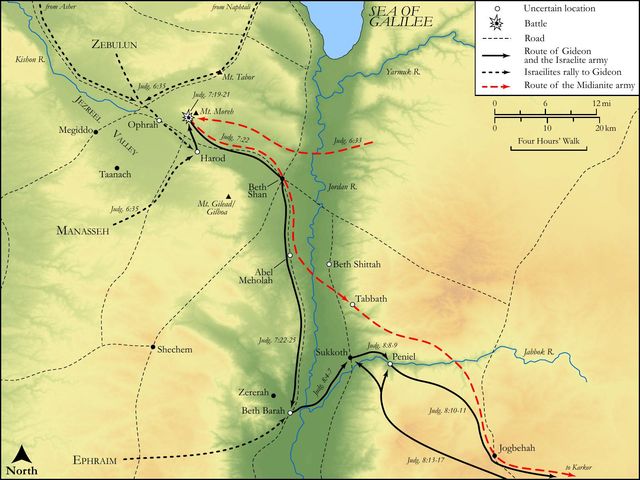
2.Being so, he orders him the sight of something that was discouraging. It was enough to frighten him to discern, perhaps by moon-light, the vast numbers of the enemy (Jdg 7:12), the men like grasshoppers for multitude, and they proved no better than grasshoppers for strength and courage; the camels one could not count, any more than the sand. But,
3.He causes him to hear that which was to him a very good omen; and when he had heard it he went back again immediately, supposing he now had what he was sent thither for. He overheard two soldiers of the enemy, that were comrades, talking; probably they were in bed together, waking in the night.
(1.)One of them tells his dream, and as our dreams generally are, and therefore not worth telling again, it is a very foolish one. He dreamed that he saw a barley-cake come rolling down the hill into the camp of the Midianites, and "methought," says he (for so we speak in telling our dreams), "this rolling cake struck one of our tents" (perhaps one of the chief of their tents) "and with such violence that" (would you think it?) "it overturned the tent, forced down the stakes, and broke the cords at one blow, so that the tent lay along and buried its inhabitants," Jdg 7:13. In multitudes of dreams there are divers vanities, says Solomon, Ecc 5:7. One would wonder what odd incoherent things are often put together by a ludicrous fancy in our dreams.
(2.)The other, it may be between sleeping and waking, undertakes to interpret this dream, and the interpretation is very far-fetched: This is nothing else save the sword of Gideon, Jdg 7:14. Our expositors now can tell us how apt the resemblance was, that Gideon, who had threshed corn for his family, and made cakes for his friend (Jdg 6:11-19), was fitly represented by a cake, - that he and his army were as inconsiderable as a cake made of a little flour, as contemptible as a barley-cake, hastily got together as a cake suddenly baked upon the coals, and as unlikely to conquer this great army as a cake to overthrow a tent. But, after all, do not interpretations belong to God? He put it into the head of the one to dream and into the mouth of the other to give the sense of it; if Gideon had heard the dream only, and he and his servant had been left to interpret it themselves, it had so little significancy in it that it would have done him little service; but, having the interpretation from the mouth of an enemy, it not only appeared to come from God, who has all men's hearts and tongues in his hand, but it was likewise an evidence that the enemy was quite dispirited, and that the name of Gideon had become so formidable to them that it disturbed their sleep. The victory would easily be won which was already so tamely yielded: Into his hand hath God delivered Midian. Those were not likely to fight who saw God fighting against them.
Lastly, Gideon, observing the finger of God pointing him to this very place, at this very time, to hear this dream and the interpretation of it, was exceedingly encouraged by it against the melancholy apprehensions he had upon the reducing of his army. He was very well pleased to hear himself compared to a barley-cake, when it proved to effect such great things. Being hereby animated, we are told (Jdg 7:15), 1. How he gave God the glory of it; he worshipped immediately, bowed his head, or, it may be, lifted up his eyes and hands, and in a short ejaculation thanked God for the victory he was now sure of, and for this encouragement to expect it. Wherever we are, we may speak to God, and worship him, and find a way open heavenward. God must have the praise of that which is encouraging to our faith, and his providence must be acknowledged in those events which, though minute and seemingly accidental, prove serviceable to us. 2. How he gave his friends a share in the encouragements he had received: Arise, prepare to march presently; the Lord has delivered Midian into your hand.
Continue studying Judges 7:12 across the web’s major study libraries — every link below opens this exact verse, chapter, or book on the destination site.
Read & Compare
 BibleGatewayThis verse in more than 200 translations and 70 languages.
 Bible.comThe YouVersion reader — hundreds of translations, reading plans, and highlights.
 ESV.orgCrossway's official English Standard Version reader.
 NET BibleThe NET translation with 60,000+ translators' notes on every rendering decision.
 STEP BibleTyndale House's free study tool — original text, vocabulary, and scholarly resources.
 BibliaLogos Bible Software's free web reader.
 USCCBThe New American Bible (Revised Edition) with the U.S. bishops' study notes.
Commentaries
 BibleHub CommentariesDozens of classic commentaries on this verse, gathered on one page.
 StudyLightMore than 100 commentary sets — the largest collection on the web.
 BibleRefPlain-English commentary on what this verse means, verse by verse.
 Enduring WordDavid Guzik's free commentary on this chapter, widely used by Bible teachers.
 Bible Study ToolsVerse commentary alongside Greek and Hebrew study aids.
Original Language & Research
- BibleHub InterlinearThe verse word by word — original language, transliteration, and English.
- BibleHub LexiconEvery word's original-language definition and Strong's entry.
 Blue Letter BibleDeep-study tools — Strong's numbers, concordance, and word studies.
 SefariaThe Hebrew text with Rashi and centuries of Jewish commentary.
Sermons, Hymns & Audio


TrulyRandomVerse is not affiliated with these sites and doesn’t control their content. They’re linked because they’re genuinely useful.
Summary
Judges 7:12 provides a stark, hyperbolic depiction of the overwhelming numerical superiority of Israel's enemies—the Midianites, Amalekites, and various "children of the east." This vivid imagery, likening their multitude to "grasshoppers" and their camels to "sand by the sea side," serves to underscore the seemingly impossible odds faced by Gideon's drastically reduced army. This dramatic contrast sets the stage for a miraculous divine intervention, ensuring that the ensuing victory would be undeniably attributed to God's omnipotence rather than human strength or strategic prowess, thereby magnifying His glory.
Context
ShowHideLiterary Context
Judges 7:12 is strategically positioned within the narrative to heighten the tension and magnify the impending miracle. It immediately follows God's deliberate and drastic reduction of Gideon's army, first from 32,000 to 10,000 by sending home the fearful (Judges 7:3), and then to a mere 300 men through a unique test at the water (Judges 7:4-7). This verse, by vividly portraying the enemy's immense scale, creates a profound contrast with Israel's minuscule force. It underscores the divine purpose behind the army's reduction: to prevent Israel from boasting that "my own hand has saved me" (Judges 7:2). The overwhelming visual of the enemy's encampment in the valley thus serves as the ultimate backdrop against which God's power will be undeniably displayed, emphasizing that the victory belongs solely to Him.
Historical & Cultural Context
For seven years, Israel had endured devastating oppression from the Midianites, Amalekites, and other nomadic "children of the east," who were desert tribes primarily from Transjordan and the Arabian Peninsula. These groups were notorious for their swift, coordinated raids, particularly during harvest times, to plunder Israel's crops and livestock, leaving the land impoverished and its people demoralized (Judges 6:1-6). Their military strategy heavily relied on camels, which provided unparalleled mobility for rapid incursions and efficient retreats, making them a highly formidable and elusive foe. The description of their vast numbers and countless camels in Judges 7:12 is not merely poetic exaggeration but reflects the very real, pervasive threat these well-equipped and numerous raiders posed to Israel's economic and physical survival. This context highlights the dire human impossibility of overcoming such an enemy and the desperate need for divine intervention.
Key Themes
ShowHideThis verse powerfully contributes to several foundational themes woven throughout the book of Judges and the broader biblical narrative. Firstly, it emphatically highlights the theme of Divine Sovereignty and Deliverance, demonstrating that God's power is not constrained by human weakness or overwhelming odds; rather, His strength is magnified through them. The greater the enemy's apparent strength, the clearer God's hand in the victory becomes. Secondly, it underscores God's Enduring Faithfulness to His Covenant Promises, even when His people are unfaithful, by raising up deliverers like Gideon in response to their cries for help. Thirdly, and perhaps most prominently, it reinforces the crucial principle of Humility and Absolute Dependence on God. The dramatic reduction of Gideon's army, immediately followed by the terrifying sight of the enemy's "multitude," was meticulously orchestrated to prevent human pride and compel Israel to rely entirely on divine strength. This echoes the profound truth articulated later by the prophet Zechariah: "Not by might nor by power, but by my Spirit, says the Lord of hosts" (Zechariah 4:6). The sheer scale of the enemy forces serves as the ultimate test of faith, preparing the ground for God's miraculous and undeniable intervention.
Exposition and Analysis
ShowHideKey Word Analysis
ShowHideThis word (H7230), appearing twice in the verse, signifies an overwhelming quantity, abundance, or greatness in number. In Judges 7:12, its repetition emphasizes the sheer, uncountable number of both the enemy soldiers and their camels, creating an immediate sense of dread and human impossibility. The use of rôb here highlights a numerical advantage so vast that it can only be overcome by divine intervention, underscoring the immense disparity between human capacity and God's boundless power.
This term (H697) specifically refers to locusts, renowned for their swarming behavior and the devastating impact of their countless numbers as they consume crops and vegetation. The comparison of the enemy forces to "grasshoppers" (locusts) vividly conveys not only their immense numerical strength but also their destructive nature and how they blanket the land, making any resistance seem utterly futile. It is a powerful metaphor for an innumerable, consuming host, emphasizing the overwhelming and pervasive presence of the enemy across the valley.
This word (H2344) refers to sand, particularly as "round or whirling particles." In this verse, the comparison of the camels to "sand by the sea side" is a classic biblical idiom for an uncountable multitude. While often used in God's promises to Abraham regarding his innumerable descendants, here it is ironically applied to Israel's enemies. This imagery powerfully reinforces the theme of immeasurable quantity, specifically for the camels, further highlighting the seemingly insurmountable odds and the complete human inability to contend with such an overwhelming force.
Verse Breakdown
ShowHide"And the Midianites and the Amalekites and all the children of the east lay along in the valley"
This opening clause meticulously identifies the formidable coalition of enemies Israel faced, comprising the Midianites, Amalekites, and other nomadic tribes from the eastern deserts. The phrase "lay along in the valley" paints a vivid picture of their vast encampment, stretching across the landscape. This detail suggests their readiness for battle and their complete, overwhelming dominance of the terrain, emphasizing their physical presence and the immediate, pervasive threat they posed to Gideon's small force.
"like grasshoppers for multitude"
This potent simile immediately establishes the overwhelming numerical superiority of the enemy soldiers. The comparison to "grasshoppers" (locusts) evokes an image of an uncountable, swarming mass that covers the ground, conveying a sense of dread, inevitability, and the sheer impossibility of human resistance against such a force. It starkly highlights the vast disparity between the two armies, making Gideon's task seem utterly hopeless from a human perspective.
"and their camels [were] without number"
This clause further amplifies the scale of the enemy's presence by focusing on their logistical and military assets. Camels were indispensable for these nomadic tribes, enabling their rapid movements, carrying plunder, and providing a significant tactical advantage. The declaration that they were "without number" underscores the vastness of their resources and their preparedness for sustained, mobile warfare, making them an even more formidable opponent.
"as the sand by the sea side for multitude"
This second hyperbole reinforces the theme of immeasurable quantity, specifically applied to the camels. The imagery of "sand by the sea side" is a well-established biblical idiom for an uncountable multitude, often used to describe God's promises of innumerable descendants (e.g., Abraham's seed). Here, it is ironically applied to Israel's enemies, highlighting the seemingly insurmountable odds and the complete human inability to contend with such a force, thereby setting the stage for a divinely orchestrated victory.
Literary Devices
ShowHideJudges 7:12 is rich in Imagery and employs powerful Literary Devices to convey the overwhelming nature of the enemy. The most prominent devices are Simile and Hyperbole. The text uses two distinct similes: the enemy soldiers are described as "like grasshoppers for multitude," and their camels are "as the sand by the sea side for multitude." Both comparisons are classic examples of Hyperbole, an intentional exaggeration used for emphasis or dramatic effect, not meant to be taken literally. The purpose is to impress upon the reader the sheer, unimaginable scale of the Midianite-Amalekite coalition, making the upcoming victory by Gideon's minuscule band of 300 men all the more miraculous and clearly attributable to divine power. This vivid imagery creates a stark contrast between the enemy's vastness and Israel's meager numbers, thereby magnifying the divine power that is about to be displayed. The repetition of the phrase "for multitude" further emphasizes the uncountable nature of the forces, driving home the point of human impossibility and setting the stage for God's glory.
Theological and Thematic Connections
ShowHideThis verse serves as a profound theological statement on the nature of divine power and the dynamics of God's redemptive work. By vividly portraying an enemy so vast that it is humanly unconquerable, the text meticulously sets the stage for God to demonstrate His omnipotence not through human strength, but precisely in spite of human weakness and overwhelming odds. It is a powerful testament to the biblical principle that God often chooses the weak, the few, and the seemingly insignificant to accomplish His grand purposes, ensuring that all glory redounds solely to Him. The overwhelming numerical superiority of the enemy described here is not a deterrent to God's plan but rather a necessary backdrop against which His miraculous intervention will shine most brightly, unequivocally revealing that victory belongs to the Lord, regardless of the numerical advantage of the opposition. This truth resonates throughout Scripture, reminding believers that God delights in using seemingly insufficient means to achieve mighty ends, thereby building profound faith and discouraging any form of self-reliance or boasting in human might.
Reflection and Application
ShowHideJudges 7:12 challenges us to profoundly re-evaluate our perspective on seemingly insurmountable obstacles in our own lives. Just as Gideon and his men faced an enemy that was "without number" and "like grasshoppers for multitude," we too often encounter situations—whether personal struggles, professional challenges, spiritual battles, or societal pressures—that appear overwhelming, beyond our capacity, and impossible to overcome. This verse serves as a powerful reminder that the size or complexity of our problem is never a measure of God's ability to deliver. Instead, such "multitudes" often serve as an explicit invitation for God to display His power in ways that leave no doubt about His authorship of the victory. When we feel that the odds are stacked against us, we are called not to despair or rely on our limited strength, but to remember that God delights in working through weakness to manifest His perfect strength. Our role is to cultivate a deep trust, commit to obedient action, and step forward in faith, knowing that the God who defeated countless Midianites with 300 men is more than capable of handling the "multitudes" in our lives. This passage encourages a radical shift from human calculation and self-reliance to a robust, unwavering dependence on divine strategy and limitless power, fostering a faith that looks beyond present circumstances to the sovereign might of our God.
Questions for Reflection
ShowHideFAQ
ShowHideWho were the "children of the east" mentioned alongside the Midianites and Amalekites?
ShowHideThe "children of the east" (Hebrew: b'nei qedem) was a general, collective term used in the Old Testament to refer to various nomadic or semi-nomadic tribes inhabiting the desert regions to the east of Israel, primarily in Transjordan and the Arabian Peninsula. These groups, including Midianites and Amalekites, were known for their predatory raiding and plunder, especially during agricultural harvest seasons, making them a persistent and devastating threat to settled societies like Israel. In the context of Judges, their alliance with the Midianites and Amalekites formed a formidable coalition that oppressed Israel for seven years prior to Gideon's deliverance (Judges 6:1-6). Their inclusion in the description emphasizes the widespread nature of the threat and the vastness of the enemy forces, highlighting the comprehensive and overwhelming oppression Israel faced.
Why does the verse specifically mention the camels, describing them as "without number"?
ShowHideThe specific mention of countless camels is highly significant for several reasons, amplifying the enemy's threat. Firstly, it highlights the mobility and economic power of the Midianites and their allies. Camels were indispensable for these desert-dwelling, nomadic peoples, enabling them to travel vast distances, carry immense plunder, and conduct swift, devastating raids. Their "without number" presence signifies not just military strength but also the immense wealth and resources these raiding parties possessed, accumulated through their oppressive activities. Secondly, it underscores the tactical challenge they posed. An army with countless camels could move quickly, strike unexpectedly, and retreat efficiently, making them difficult to corner or defeat by conventional means. Finally, the sheer number of camels, like the soldiers likened to "grasshoppers," serves to amplify the hyperbolic description of the enemy's overwhelming scale, further emphasizing the human impossibility of overcoming such a force and magnifying the miraculous nature of God's impending victory. This detail reinforces the central theme that God's power is displayed precisely when human resources are utterly insufficient.
Christ-Centered Fulfillment
ShowHideJudges 7:12, with its vivid depiction of an overwhelmingly vast enemy arrayed against a tiny, seemingly insignificant force, powerfully foreshadows the ultimate victory of God's kingdom through seemingly weak and unlikely means—culminating in the person and work of Jesus Christ. Just as Gideon's small band faced an innumerable foe that human strength could not overcome, humanity faced an insurmountable enemy in sin, death, and the powers of darkness—a "multitude" that no human wisdom, might, or self-effort could ever defeat. The seemingly impossible odds presented in this verse find their ultimate fulfillment in the cross, where the Son of God, appearing in weakness and humility, confronted and decisively triumphed over the spiritual principalities and powers, making a public spectacle of them (Colossians 2:15). Christ's victory was not achieved through a mighty earthly army or overwhelming physical force, but through His sacrificial death and glorious resurrection, a profound demonstration of divine power perfected in profound weakness (2 Corinthians 12:9). He is the true Lamb of God, who takes away the sin of the world (John 1:29), conquering the "multitude" of human sin and its devastating consequences not by might or power, but by His Spirit and His perfect obedience unto death. Thus, Judges 7:12, while a historical account of a military triumph, points forward to the greater spiritual battle won by the "few" (the faithful remnant, the Church) through the power of the "one" (Christ), ensuring that all glory belongs to God alone, for He has highly exalted Him and given Him the name that is above every name (Philippians 2:9-11).