


Judges 7:3
Bible text: King James Version (1769 Blayney text) · Public domain
Bible text: King James Version with Strong's numbers · Public domain
Bible text: Berean Standard Bible · Public domain
Bible text: American Standard Version (1901) · Public domain
Bible text: World English Bible, Messianic edition · Public domain
Bible text: Geneva Bible (1599) · Public domain
Bible text: Young's Literal Translation · Public domain
- וְעַתָּהve·'a·Tahand thereforeH6258Conj-w ¦ AdvAdverbוְandעַתָּהtherefore
- קְרָאke·Ra'proclaimH7121V-Qal-Imp-2msVerb Qal Imperative 2nd Singular Masculine
- נָאna'pleaseH4994PrtParticle Interjection
- בְּאָזְנֵיbe·'a·ze·Neiin [the] ears ofH241Prep-b ¦ N-fdcNoun Dual Feminine Constructבְּinאָזְנֵי[the] ears of
- הָעָםha·'Amthe peopleH5971Art ¦ N-msNoun Singular Masculine Absoluteהָtheעָםpeople
- לֵאמֹרle·Mor<to> sayingH559Prep-l ¦ V-Qal-InfVerb Qal Infinitive Constructלֵ<to>אמֹרsaying
- מִיmiwho?H4310InterrogPronoun Interrogative
- יָרֵאya·Re'[is] fearfulH3373Adj-msAdjective Singular Masculine Absolute
- וְחָרֵדve·cha·Redand tremblingH2730Conj-w ¦ Adj-msAdjective Singular Masculine Absoluteוְandחָרֵדtrembling
- יָשֹׁבya·Sholet him go backH7725V-Qal-Imperf-3msVerb Qal Imperfect 3rd Singular Masculine
- וְיִצְפֹּרve·yitz·Porand he may goH6852Conj-w ¦ V-Qal-ConjImperf-3msVerb Qal Conjunction+Imperfect 3rd Singular Masculineוְandיִצְפֹּרhe may go
- מֵהַרme·Harfrom [the] mountain ofH2022Prep-m ¦ N-mscNoun Singular Masculine Constructמֵfromהַר[the] mountain of
- הַגִּלְעָדha·gil·'Ad<the> GileadH1568Art ¦ N-properNoun Proper Locationהַ<the>גִּלְעָדGilead
- וַיָּשָׁבvai·Ya·shovand it returnedH7725Conj-w ¦ V-Qal-ConsecImperf-3msVerb Qal Consecutive Imperfect 3rd Singular Masculineוַandיָּשָׁבit returned
- מִןminofH4480PrepPreposition
- הָעָםha·'Amthe peopleH5971Art ¦ N-msNoun Singular Masculine Absoluteהָtheעָםpeople
- עֶשְׂרִים'es·RimtwentyH6242N-mpNoun Plural Masculine Absolute
- וּשְׁנַיִםu·she·Na·yimand twoH8147Conj-w ¦ N-cdNoun Dual common gender Absoluteוּandשְׁנַיִםtwo
- אֶלֶף'E·lefthousandH505N-csNoun Singular common gender Absolute
- וַעֲשֶׂרֶתva·'a·Se·retand tenH6235Conj-w ¦ N-fscNoun Singular Feminine Constructוַandעֲשֶׂרֶתten
- אֲלָפִים'a·la·Fimthousand<s>H505N-cpNoun Plural common gender Absolute
- נִשְׁאָרוּnish·'A·ruthey remainedH7604V-Niphal-Perf-3cpVerb Niphal Perfect 3rd Plural common gender
English is a literal word-by-word gloss of the Hebrew, not the KJV's wording. Why?
This is the original text the KJV's translators worked from — each Hebrew word with its own literal English meaning in this verse, prepared by scholars at Tyndale House, Cambridge. The KJV translates whole sentences, not word by word, so its wording differs: one Hebrew word can become several English words, and the KJV may choose “the LORD” where the gloss reads “Yahweh”. Both are faithful — they answer different questions. For the KJV's own rendering, switch to the KJV text.
Details
See on the biblical-era maps
Study this verse
Public-domain commentary
Matthew Henry
From his Commentary on the Whole Bible. Henry comments on passages, not single verses — this entry covers Judges 7:1–8. His three-level outline is real structure in the source text, so it is rendered as structure.
Here, I. Gideon applies himself with all possible care and industry to do the part of a good general, in leading on the hosts of Israel against the Midianites (Jdg 7:1): He rose up early, as one whose heart was upon his business, and who was afraid of losing time. Now that he is sure God is with him he is impatient of delay. He pitched near a famous well, that his army might not be distressed for want of water, and gained the higher ground, which possibly might be some advantage to him, for the Midianites were beneath him in the valley. Note, Faith in God's promises must not slacken, but rather quicken, our endeavours. When we are sure God goes before us, then we must bestir ourselves, Sa2 5:24.
II.God provides that the praise of the intended victory may be reserved wholly to himself, by appointing 300 men only to be employed in this service.
1.The army consisted of 32,000 men, a small army in comparison with what the Midianites had now brought into the field; Gideon was ready to think them too few, but God comes to him, and tells him they are too many, Jdg 7:2. Not but that those did well who offered themselves willingly to this expedition, but God saw fit not to make use of all that came. We often find God bringing great things to pass by a few hands, but this was the only time that he purposely made them fewer. Had Deborah lately blamed those who came not to the help of the Lord, and yet in the next great action must those be turned off that do come? Yes;
(1.)God would hereby show that when he employed suitable instruments in his service he did not need them, but could do his work without them, so that he was not indebted to them for their service, but they to him for employing them.
(2.)He would hereby put those to shame for their cowardice who had tamely submitted to the Midianites, and durst not make head against them, because of the disproportion of their numbers. They now saw that, if they had but made sure of the favour of God, one of them might have chased a thousand.
(3.)He would hereby silence and exclude boasting. This is the reason here given by him who knows the pride that is in men's hearts: Lest Israel vaunt themselves against me. Justly were those denied the honour of the success. My own hand hath saved me is a word that must never come out of the mouth of such as shall be saved. He that glories must glory in the Lord, and all flesh must be silent before him.
2.Two ways God took to lessen their numbers: - (1.) He ordered all that would own themselves timorous and faint-hearted to be dismissed, Jdg 7:3. They were now encamped on a mountain close to the enemy, called Mount Gilead, from Gilead, the common ancestor of these families of Manasseh, which were seated on this side Jordan (Num 26:30), and thence they might see perhaps the vast numbers of the enemy; those therefore who were disheartened at the sight were left to their liberty, to go back if they pleased. There was a law for making such a proclamation as this, Deu 20:8. But Gideon perhaps thought that concerned only those wars which were undertaken for the enlarging of their coast, not, as this, for their necessary defence against an invader; therefore Gideon would not have proclaimed this if God, who knew how his forces would hereby be diminished, had not commanded him. Cowards would be as likely as any, after the victory, to take the honour of it from God, and therefore God would not do them the honour to employ them in it. One would have thought there would be scarcely one Israelite to be found that against such an enemy as the Midianites, and under such a leader as Gideon, would own himself fearful; yet above two parts of three took advantage of this proclamation, and filed off, when they saw the strength of the enemy and their own weakness, not considering the assurances of the divine presence which their general had received of the Lord, and, it is likely, delivered unto them. Some think the oppression they had been under so long had broken their spirits, others, more probably, that consciousness of their own guilt had deprived them of their courage. Sin stared them in the face, and therefore they durst not look death in the face. Note, Fearful faint-hearted people are not fit to be employed for God; and, among those that are enlisted under the banner of Christ, there are more such than we think there are. (2.) He directed the cashiering of all that remained except 300 men, and he did it by a sign: The people are yet too many for me to make use off, Jdg 7:4. See how much God's thoughts and ways are above ours. Gideon himself, it is likely, thought they were too few, though they were as many as Barak encountered Sisera with (Jdg 4:14); and, had he not forced his way through the discouragement by dint of faith, he himself would have started back from so hazardous an enterprise, and have made the best of his own way back. But God saith, they are too many, and, when diminished to a third part, they are yet too many, which may help us to understand those providences which sometimes seem to weaken the church and its interests: its friends are too many, too mighty, too wise, for God to work deliverance by; God is taking a course to lessen them, that he may be exalted in his own strength. Gideon is ordered to bring his soldiers to the watering, probably to the well of Harod (Jdg 7:1) and the stream that ran from it; he, or some appointed by him, must observe how they drank. We must suppose they were all thirsty, and were inclined to drink; it is likely he told them they must prepare to enter upon action immediately, and therefore must refresh themselves accordingly, not expecting, after this, to drink any thing else but the blood of their enemies. Now some, and no doubt the most, would kneel down on their knees to drink, and put their mouths to the water as horses do, and so they might get their full draught. Others, it may be, would not make such a formal business of it, but as a dog laps with his tongue, a lap and away, so they would hastily take up a little water in their hands, and cool their mouths with that, and be gone. Three hundred and no more there were of this latter sort, that drank in haste, and by those God tells Gideon he would rout the Midianites, Jdg 7:7. By the former distinction none were retained but hearty men, that were resolved to do their utmost for retrieving the liberties of Israel; but by this further distinction it was provided that none should be made use of but, [1.] Men that were hardy, that could endure long fatigue, without complaining of thirst or weariness, that had not in them any dregs either of sloth or luxury. [2.] Men that were hasty, that thought it long till they were engaged with the enemy, preferring the service of God and their country before their necessary refreshment; such as these God chooses to employ, that are not only well affected, but zealously affected in a good thing. And also because these were the smaller number, and therefore the least likely to effect what they were designed for, God would by them save Israel. It was a great trial to the faith and courage of Gideon, when God bade him let all the rest of the people but these 300 go every man to his place, that is, go where they pleased out of his call, and from under his command; yet we may suppose those that were hearty in the cause, though now set aside, did not go so far out of hearing but that they were ready to follow the blow, when the 300 had broken the ice, though this does not appear. Thus strangely was Gideon's army purged, and modelled, and reduced, instead of being recruited, as one would think in so great an action it both needed and deserved to be. Now,
3.Let us see how this little despicable regiment, on which the stress of the action must lie, was accoutred and fitted out. Had these 300 been double-manned with servants and attendants, and double-armed with swords and spears, we should have thought them the more likely to bring something to pass. But, instead of making them more serviceable by their equipment, they are made less so. For,
(1.)Every soldier turns butler: They took victuals in their hands (Jdg 7:8), left their bag and baggage behind, and every man burdened himself with his own provision, which was a trial of their faith, whether they could trust God when they had no more provisions with them than they could carry, and a trial of their diligence, whether they would carry as much as they had occasion for. This was indeed living from hand to mouth.
(2.)Every soldier turns trumpeter. The regiments that were cashiered left their trumpets behind them for the use of these 300 men, who were furnished with these instead of weapons of war, as if they had been going rather to a game than to a battle.
Historical interpretation
Historical reception
1 surviving comment on this verse from the historical church.
Does not the leader of our army, the Lord and Savior Jesus Christ, call out now to his soldiers and say, Whoever is “fearful and anxious of heart,” let him not come to war with me? For this is also what he says in the Gospels in other words but with the same meaning: “Whoever does not take his own cross and come after me is not worthy of me,” and again: “Whoever does not renounce all that he has cannot be my disciple.” Is not Christ thus culling out the fearful and anxious and sending them from his camp?… But don’t let such a life of warfare turn you away; there really is nothing difficult, nothing arduous or impossible in it.
Continue studying Judges 7:3 across the web’s major study libraries — every link below opens this exact verse, chapter, or book on the destination site.
Read & Compare
 BibleGatewayThis verse in more than 200 translations and 70 languages.
 Bible.comThe YouVersion reader — hundreds of translations, reading plans, and highlights.
 ESV.orgCrossway's official English Standard Version reader.
 NET BibleThe NET translation with 60,000+ translators' notes on every rendering decision.
 STEP BibleTyndale House's free study tool — original text, vocabulary, and scholarly resources.
 BibliaLogos Bible Software's free web reader.
 USCCBThe New American Bible (Revised Edition) with the U.S. bishops' study notes.
Commentaries
 BibleHub CommentariesDozens of classic commentaries on this verse, gathered on one page.
 StudyLightMore than 100 commentary sets — the largest collection on the web.
 BibleRefPlain-English commentary on what this verse means, verse by verse.
 Enduring WordDavid Guzik's free commentary on this chapter, widely used by Bible teachers.
 Bible Study ToolsVerse commentary alongside Greek and Hebrew study aids.
Original Language & Research
- BibleHub InterlinearThe verse word by word — original language, transliteration, and English.
- BibleHub LexiconEvery word's original-language definition and Strong's entry.
 Blue Letter BibleDeep-study tools — Strong's numbers, concordance, and word studies.
 SefariaThe Hebrew text with Rashi and centuries of Jewish commentary.
Sermons, Hymns & Audio


TrulyRandomVerse is not affiliated with these sites and doesn’t control their content. They’re linked because they’re genuinely useful.
Summary
Judges 7:3 marks the initial, divinely mandated reduction of Gideon's army, a pivotal moment in Israel's confrontation with the Midianite oppressors. After assembling 32,000 men, God declares the force too large, fearing Israel would attribute victory to their own strength rather than divine intervention. This verse details God's first strategic test, inviting all who were "fearful and afraid" to return home, resulting in a dramatic decrease from 32,000 to 10,000 soldiers. This act powerfully underscores God's sovereignty, His unconventional methods for delivering His people, and His unwavering commitment to ensuring that all glory for triumph belongs solely to Him.
Context
ShowHideLiterary Context
Judges 7:3 is situated within the broader narrative of Gideon's judgeship, specifically following his divine call and initial preparations for battle against the Midianite coalition. In Judges 6, God commissions Gideon, a humble man from Manasseh, to deliver Israel from seven years of Midianite oppression. After receiving miraculous signs of confirmation (the fleeces), Gideon musters an army of 32,000 men to face the formidable Midianite-Amalekite forces (as depicted in Judges 6:33-35). Immediately preceding this verse, Judges 7:1-2 sets the theological stage: Gideon and his men are encamped by the spring of Harod, and God declares the army "too many" for Him to grant victory, lest Israel boast in their own strength. Judges 7:3 then records the direct implementation of this first divine instruction, followed by the second phase of reduction through the water test in Judges 7:4-8. Thus, this verse is crucial, initiating the process by which God ensures His glory will be undeniably paramount in the upcoming battle.
Historical & Cultural Context
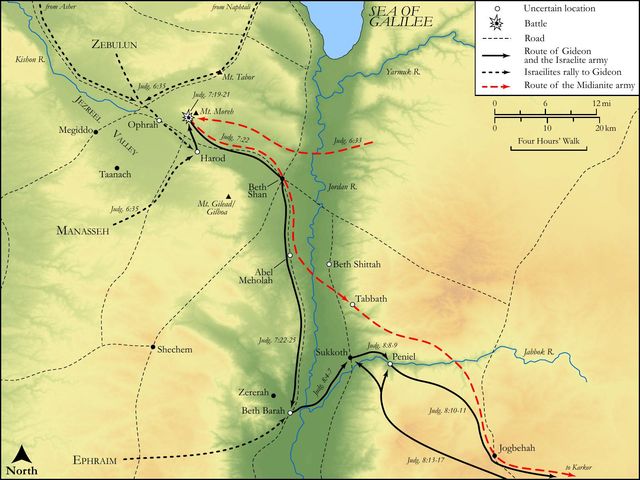
For seven years, the Midianites, Amalekites, and other "people of the East" had severely oppressed Israel, raiding their crops and livestock, leaving the land desolate and forcing the Israelites to hide in caves and strongholds (Judges 6:1-6). This prolonged period of subjugation had instilled deep fear and desperation among the Israelites, making Gideon's call to arms a daunting proposition. The instruction to dismiss the fearful was not entirely foreign to ancient Israelite warfare; it echoes the provisions found in Deuteronomy 20:8, which permitted those who were "fearful and fainthearted" to return home before battle, primarily to prevent the spread of discouragement. In Judges 7:3, however, God's application of this custom transcends mere morale; it serves a profound theological purpose—to drastically reduce the army to highlight divine intervention. The mention of "Mount Gilead" as a place of departure is geographically noteworthy; while Gideon's main encampment was at the spring of Harod (near Mount Gilboa), west of the Jordan, Gilead is a region east of the Jordan. This could imply that some of the mustered men were from that trans-Jordanian region and were returning home, or it might be a general directional reference for their dispersal from the encampment.
Key Themes
ShowHideThis verse powerfully contributes to several overarching themes within the book of Judges and the broader biblical narrative. Divine Sovereignty and Strategy is paramount, as God orchestrates the battle plan, demonstrating that victory is not dependent on human strength or numbers but on His omnipotence. The theme of Faith Over Fear is starkly presented, as the test immediately distinguishes between those who possessed genuine trust in God's ability to deliver and those who succumbed to natural human apprehension. Those who remained, though fewer, implicitly demonstrated a greater reliance on God's promise. This directly contributes to the theme of God's Glory, as the drastic reduction of the army prevents Israel from claiming victory by their own might, ensuring that God alone receives the praise. This principle is a recurring motif in Scripture, where God often chooses to work through the weak or the few to display His power, as seen in Paul's affirmation in 2 Corinthians 12:9 that God's "power is made perfect in weakness." Finally, Gideon's Obedience and Trust in executing such an unconventional and seemingly illogical command highlights his growing faith in God's plan, despite its defiance of conventional military wisdom.
Exposition and Analysis
ShowHideKey Word Analysis
ShowHideDerived from the root H3373, this word encompasses a broad semantic range, from reverential awe and respect to intense terror. In the context of Judges 7:3, it refers to a profound, paralyzing fear that would render a soldier ineffective in battle. It describes an internal state of dread and apprehension, a lack of courage that undermines military resolve and trust in God's deliverance.
This word specifically denotes trembling, quaking, or being deeply disturbed and agitated. It emphasizes the physical manifestation and debilitating effect of fear. While yârêʼ describes the internal state of being afraid, chârêd highlights the outward expression of that fear, suggesting a soldier so overcome by terror that they would be a liability rather than an asset. Together, "fearful and afraid" paints a vivid picture of individuals utterly incapacitated by terror, unfit for the rigors of battle and for participating in a divinely orchestrated victory.
Verse Breakdown
ShowHide"Now therefore go to, proclaim in the ears of the people, saying,"
This opening clause emphasizes the direct and immediate nature of God's command to Gideon. The phrase "go to" (Hebrew, nâʼ' H4994) is an imperative of incitement, urging immediate action. The proclamation is public, intended for all the mustered men to hear clearly, leaving no room for misunderstanding or ambiguity. This instruction is not a suggestion but a divine imperative, highlighting God's direct involvement in the military strategy.
"Whosoever [is] fearful and afraid, let him return and depart early from mount Gilead."
This is the core of God's first test and culling. It offers a voluntary exit for any soldier whose heart is not fully committed or who is overcome by fear. The phrase "fearful and afraid" (as analyzed above) targets those whose psychological and spiritual state would hinder the army's effectiveness and, more importantly, obscure God's glory in the impending victory. The instruction to "return and depart early" (Hebrew, shûwb' H7725 and tsâphar' H6852) signifies a complete and immediate dismissal from the military campaign, sending them away from the war zone, possibly back towards their homes in the region of Gilead.
"And there returned of the people twenty and two thousand;"
This clause records the astonishing and immediate result of God's proclamation. The vast majority of Gideon's initial army—22,000 out of 32,000—chose to depart. This dramatic reduction underscores the widespread fear among the Israelite forces and highlights the profound impact of God's test. It immediately brings the army to a manageable size for God's purposes, setting the stage for a victory that could not be attributed to human numbers.
"and there remained ten thousand."
This final clause states the precise number of soldiers remaining after the first reduction. This figure of 10,000 is still a significant force, but it represents less than a third of the original army. It sets the stage for the next phase of God's culling process, further emphasizing that human numbers are irrelevant to divine victory and that God's power will be magnified through a small, seemingly inadequate, force.
Literary Devices
ShowHideJudges 7:3 employs several powerful literary devices to convey its profound theological message. Irony is prominent, as conventional military strategy dictates increasing, not decreasing, troop numbers when facing a superior foe; yet, God commands the opposite, highlighting His unconventional methods and the paradoxical nature of divine power. This divine strategy subverts human wisdom. Contrast is also evident, primarily between human fear and divine courage, and between human strength (represented by numerical superiority) and God's omnipotence. The departure of 22,000 men starkly contrasts with the remaining 10,000, setting up the subsequent narrative where a much smaller force achieves a monumental victory. Furthermore, the verse functions as Foreshadowing, hinting at the extraordinary, divinely orchestrated victory that is to come. The drastic reduction of the army signals that the battle will not be won by conventional means but by a miraculous intervention, thereby foreshadowing the complete and undeniable triumph of God's might over human weakness.
Theological and Thematic Connections
ShowHideJudges 7:3 serves as a profound theological statement about the nature of divine warfare and the necessity of absolute reliance on God. It teaches that God is not limited by human resources or numbers; in fact, He often chooses to work through weakness and scarcity to magnify His glory. The dismissal of the fearful ensures that the ensuing victory cannot be attributed to Israel's military prowess but solely to God's intervention. This principle challenges believers to confront their own fears and anxieties, reminding them that true security and success come from trusting in God's power and plan, even when circumstances seem overwhelmingly against them. It underscores that God's primary concern is not merely victory, but that His people recognize and acknowledge His hand in their deliverance, fostering humility and deepening their worship.
Reflection and Application
ShowHideJudges 7:3 offers timeless lessons for believers navigating the challenges of life, compelling us to examine where we place our trust when facing overwhelming odds. Do we instinctively rely on our own strength, resources, or the perceived "numbers" on our side, or do we truly lean into God's sovereign power and unconventional methods? This passage challenges us to confront our fears head-on, recognizing that fear can be a debilitating force that prevents us from participating fully in God's greater purposes. Just as God dismissed the fearful from Gideon's army, we are called to dismiss the fear that hinders our faith, obedience, and willingness to step out in trust. When we choose to trust God despite our anxieties and the seemingly insurmountable nature of our circumstances, we create space for Him to demonstrate His miraculous power, ensuring that when victory comes, all glory is undeniably His. This cultivates a profound sense of humility, deepens our worship, and reminds us that true success is not measured by human achievement but by divine enablement.
Questions for Reflection
ShowHideFAQ
ShowHideWhy did God reduce Gideon's army so drastically?
ShowHideGod reduced Gideon's army primarily to ensure that the victory against the Midianites would be undeniably attributed to His divine power, not to Israel's military might or numerical superiority. As Judges 7:2 explicitly states, God said, "The people with you are too many for me to give the Midianites into their hand, lest Israel boast over me, saying, 'My own hand has saved me.'" This drastic reduction prevented human pride and guaranteed that God alone would receive the glory for the deliverance of His people. It also served to test Gideon's faith and the genuine commitment of the remaining soldiers.
What is the significance of the phrase "fearful and afraid"?
ShowHideThe phrase "fearful and afraid" (Hebrew: yârêʼ and chârêd) describes individuals who were overcome by debilitating terror, both internally and externally. While it aligns with the custom in Deuteronomy 20:8 to dismiss the fainthearted, in Judges 7:3, it also serves as a spiritual test. Soldiers who were truly "fearful and afraid" would not only be ineffective in battle but would also lack the faith necessary to participate in God's miraculous deliverance. Their departure ensured that only those with a measure of trust, however small, remained, making the subsequent victory an even clearer demonstration of God's power working through a dedicated, albeit small, remnant.
Does "Mount Gilead" refer to the actual region east of the Jordan, or something else?
ShowHideThe reference to "Mount Gilead" in Judges 7:3 has been a point of scholarly discussion because Gideon's encampment was at the spring of Harod, near Mount Gilboa, which is west of the Jordan River. While Gilead is indeed a region east of the Jordan, it's possible the phrase "depart early from mount Gilead" refers to the direction of return for some of the soldiers who had been mustered from that region. Alternatively, some interpretations suggest "Mount Gilead" might refer to a specific peak or landmark near the gathering point that served as a designated direction for their dispersal, or it could be a textual variant. Regardless of the precise geographical interpretation, the clear meaning is that the fearful soldiers were to leave the army's encampment and return to their homes, effectively removing themselves from the military campaign.
Christ-Centered Fulfillment
ShowHideJudges 7:3, with its profound emphasis on God working through weakness to achieve victory and receive all glory, powerfully foreshadows the person and redemptive work of Jesus Christ. Just as God deliberately reduced Gideon's army to prevent human boasting, Christ's ultimate victory over sin, death, and the powers of darkness was achieved not through worldly power, military might, or numerical superiority, but through an act that appeared to be profound weakness and defeat: His crucifixion. The cross, seemingly a sign of weakness and shame, became the very means by which God disarmed the principalities and powers, triumphing over them (Colossians 2:15) and securing salvation. Jesus, the Lamb of God (John 1:29), perfectly embodies the principle that God's strength is made perfect in weakness (2 Corinthians 12:9). His kingdom is not of this world, not built on human armies or political maneuvering (John 18:36), but on divine authority and humble servanthood. Furthermore, Christ's call to discipleship often involves overcoming fear and radical trust, echoing the faith required of Gideon's remaining 300. He assures His followers, "Do not fear those who kill the body but cannot kill the soul" (Matthew 10:28), inviting them to participate in His mission not by their own strength, but by His Spirit, ensuring that all glory belongs to God alone.